
True wilderness self-reliance isn’t about hacks; it’s about understanding the core principles of physics, biology, and safety that govern the outdoors.
- Effective fire-building in the wet relies on mastering airflow and thermodynamics, not just the shape of the fire lay.
- Tool safety and effectiveness are dictated by design principles, making a fixed-blade knife non-negotiable for tasks like processing damp wood.
Recommendation: Shift your focus from memorizing steps to understanding ‘why’ techniques work, turning unpredictable challenges into solvable problems.
The hiss of a dying ember, the stubborn refusal of damp twigs to catch—every camper knows the frustration of trying to build a fire in wet conditions. The internet is filled with quick tips: use a teepee structure, find dry tinder, shield it from the wind. While not wrong, this advice often misses the fundamental point. It teaches you to follow a recipe, but it doesn’t teach you how to cook. It gives you a fish, but offers no insight into how to catch your own, especially when the conditions are against you.
The journey from ‘glamping’ to genuine self-reliance isn’t about collecting a list of survival hacks. It’s about developing a deeper form of knowledge: a wilderness intelligence. This means understanding the underlying principles at play. Why does a teepee structure work? What forces are acting on your knife when you split wood? What invisible currents of cold air can turn a comfortable night into a shivering ordeal? This is principle-based bushcraft.
This guide moves beyond the “what” and dives deep into the “why.” We’ll deconstruct the essential skills—from fire and water to tools and shelter—by exploring the physics, biology, and environmental science that make them work. By mastering these principles, you stop simply surviving the elements and start entering into an intelligent dialogue with your environment. You learn to read the landscape, anticipate challenges, and adapt your strategy, transforming the wilderness from an adversary into a complex, readable system.
text
This article will guide you through the essential pillars of this wilderness intelligence. From the foundational skill of fire to the psychology of finding restoration in nature, each section builds on the last to provide a robust framework for true competence and connection outdoors.
Summary: Bushcraft Basics: How To Build A Fire In Wet Conditions Without Lighter Fluid?
- Why Does The ‘Teepee’ Structure Allow Airflow For Wet Wood?
- Fixed Blade Vs Folder: Which Knife Is Safer For Batoning Wood?
- How To Filter Stream Water To Remove Giardia Without Expensive Pumps
- The Biodegradable Soap Myth: Why You Shouldn’t Wash Dishes In The Lake
- Where To Pitch Your Tarp: Avoiding Cold Sinks And Wind Tunnels
- Pepper Spray Vs Bear Bells: Which Deterrent Actually Works On Predators?
- Canvas Vs Concrete: Which Luxury Experience Reconnects You To Nature?
- The Psychology Of Stays: Why Sleeping In A Treehouse Fixes Burnout?
Why Does The ‘Teepee’ Structure Allow Airflow For Wet Wood?
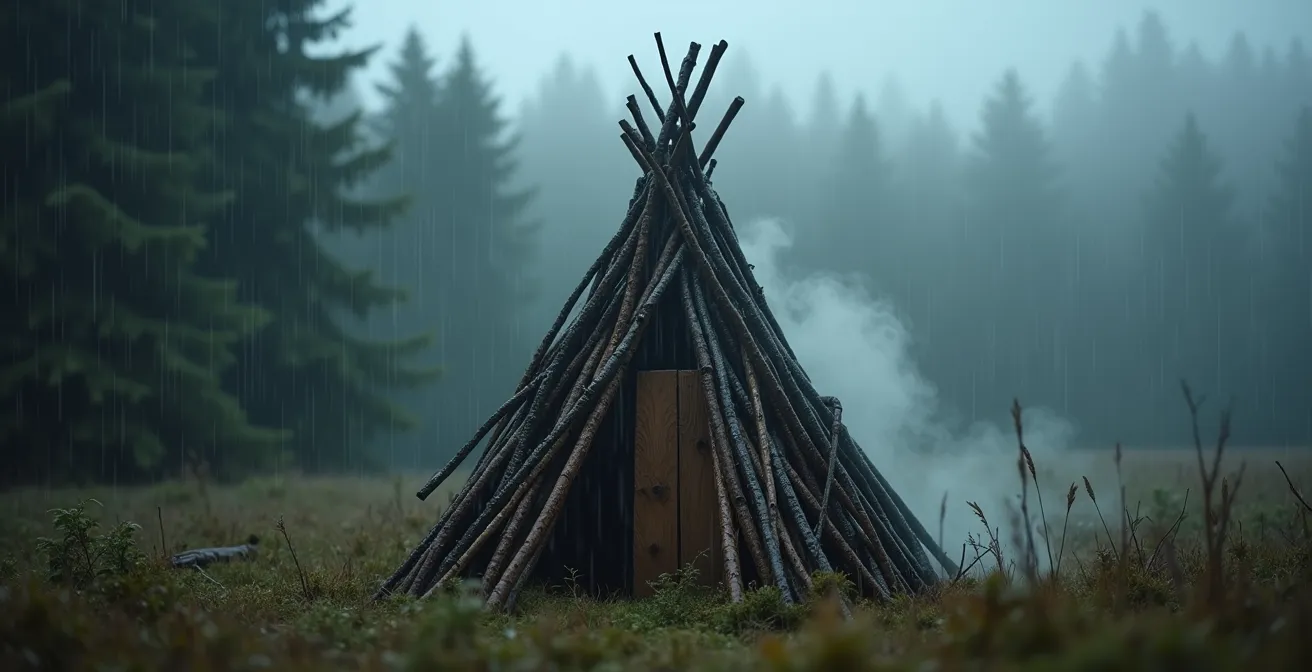
The classic teepee fire lay is recommended so often it has become a cliché. But its effectiveness, especially with damp wood, isn’t arbitrary; it’s a masterclass in applied thermodynamics. The challenge with wet wood is that the fire must first expend energy to boil off moisture before the wood itself can combust. This requires intense, concentrated heat and, most critically, a constant supply of oxygen. The teepee is an engine designed specifically to provide both.
The conical shape creates a natural chimney. As the tinder at the base ignites, it heats the air inside the cone. Hot air is less dense and rises, creating a vacuum at the base that pulls in fresh, oxygen-rich air from the outside. This continuous upward draft, known as the chimney effect, fans the flames, increasing their temperature. This intense heat is focused at the apex of the cone, pre-heating the upper layers of kindling and driving moisture out ahead of the flames.
Unlike a log cabin structure which can trap moisture and restrict airflow, the teepee’s gapped, vertical arrangement ensures that oxygen can reach the core of the fire. The structure is inherently designed to dry its own fuel as it burns from the bottom up. Mastering the teepee isn’t just about stacking sticks in a cone; it’s about understanding how to build a self-sustaining heat engine that can overcome the energy barrier of wet conditions. The structure does the work for you, provided you build it with the principles of airflow in mind.
Action Plan: Building an Effective Teepee Fire in Wet Conditions
- Create a dry platform using split logs with the bark-side down. This isolates your fire from the wet, heat-sapping ground.
- Form a small, dense tinder bundle at the center. Use dry inner bark, fine wood shavings, or reliable accelerants like petroleum jelly-soaked cotton balls.
- Arrange pencil-thin kindling in a cone shape around the tinder, leaving 1-inch gaps between pieces to guarantee airflow.
- Add progressively larger fuel sticks in layers, always maintaining the conical structure and crucial air gaps.
- Light the tinder bundle from the bottom on the windward side, allowing the natural chimney effect to draw the flames upward through the structure.
Fixed Blade Vs Folder: Which Knife Is Safer For Batoning Wood?
A reliable knife is arguably the most critical bushcraft tool, and its primary role often involves processing wood for fire and shelter. Batoning—the technique of splitting wood by striking the spine of a knife with a sturdy branch—is an essential skill, especially when all available wood is wet on the outside. This is where the debate between a fixed blade and a folding knife ends. For batoning, a full-tang fixed blade is not just a preference; it’s a fundamental safety requirement.
A folding knife’s greatest weakness is its pivot point and locking mechanism. These are inherent points of failure. When you baton with a folder, you subject this mechanism to immense percussive and torsional forces it was never designed to handle. Field reports and extensive testing confirm this; one analysis suggests that 92% of knife failures during batoning involve folding mechanisms. A lock failure during a forceful strike can cause the blade to snap shut on your fingers, leading to severe injury.
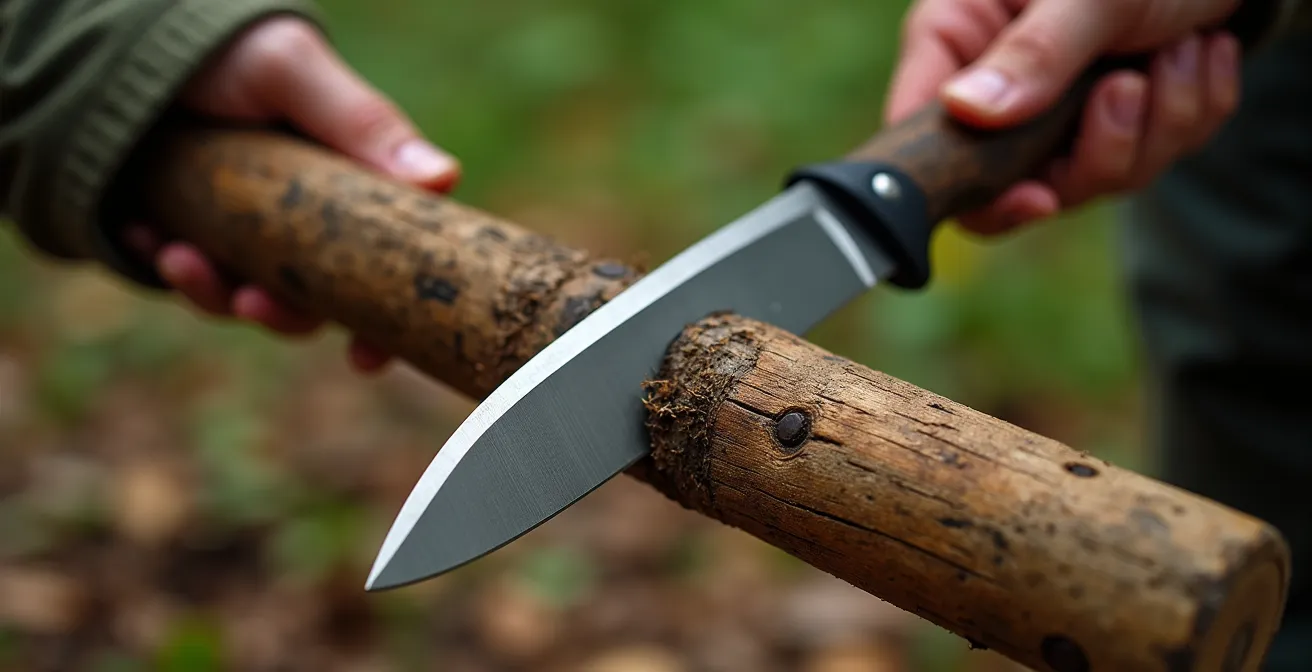
In contrast, a full-tang fixed blade is essentially a single, solid piece of steel that extends from the tip of the blade to the butt of the handle. This design has no moving parts to fail. It distributes the impact force of batoning evenly along the entire length of the steel, providing maximum structural integrity and durability. Choosing a fixed blade for bushcraft isn’t about being a traditionalist; it’s a decision based on the simple physics of force distribution and a commitment to operational safety.
The structural differences are not trivial; they have a direct and measurable impact on safety and performance in the field, as a recent comparative analysis shows.
| Feature | Fixed Blade | Folding Knife | Safety Impact |
|---|---|---|---|
| Structural Integrity | Full tang construction | Pivot point weakness | Fixed: No failure points under stress |
| Lock Mechanism | None needed | Can fail under torsional load | Folders: 56% injury rate when lock fails |
| Blade Thickness | 3.5-5mm typical | 2-3mm typical | Thicker blades reduce lateral stress fractures |
| Handle Stress | Distributed evenly | Concentrated at pivot | Fixed handles 4x more impact force |
| User Error Risk | Low – simple operation | High – improper lock engagement | Folders require precise technique to avoid failure |
How To Filter Stream Water To Remove Giardia Without Expensive Pumps
Clear, running mountain water looks pristine, but it can harbor microscopic dangers like Giardia and Cryptosporidium—cysts that cause severe gastrointestinal illness. While commercial filters are effective, they can be expensive, heavy, and prone to clogging or breaking. True self-reliance means knowing how to make water safe using natural materials and principles of purification. This involves a multi-barrier approach: mechanical filtration followed by mandatory chemical or thermal disinfection.
You can construct a surprisingly effective bio-filter using materials found in most forest environments. The principle is to pass the water through progressively finer layers to remove sediment and larger pathogens. This doesn’t make the water sterile, but it’s a critical first step to prepare it for final disinfection. A common method involves a container (like a cone of birch bark) layered with different media. Each layer serves a specific function in a gravity-fed system.
Here’s a breakdown of a classic multi-stage bio-filter:
- Coarse Filtration: A top layer of sphagnum moss or grass catches leaves, twigs, and large debris.
- Fine Particle Filtration: A thick layer of sand below the moss traps smaller suspended particles and some larger cysts.
- Adsorption: A layer of crushed charcoal from a completely extinguished fire is crucial. The porous nature of charcoal helps adsorb some chemical impurities and can improve taste and odor.
- Final Polish: Another layer of sand or fine gravel can be added at the bottom before the water drips out.
Crucially, this filtered water is NOT yet safe to drink. The final and non-negotiable step is to bring the collected water to a rolling boil for at least one minute (or three minutes at altitudes above 6,500 feet) to kill any remaining pathogens like Giardia. Alternatively, the Solar Water Disinfection (SODIS) method, approved by the WHO, has shown a 99.9% pathogen reduction in field tests by using UV-A radiation from the sun to inactivate cysts in clear plastic bottles.
The Biodegradable Soap Myth: Why You Shouldn’t Wash Dishes In The Lake
A common misconception among well-intentioned campers is that “biodegradable” or “eco-friendly” soap is safe to use directly in lakes and streams. This is a dangerous myth rooted in a misunderstanding of what “biodegradable” means. A substance is biodegradable if it can be broken down into natural elements by bacteria and other microorganisms. However, this process requires soil, time, and the right microbes. In an aquatic environment, these soaps do not break down quickly and can cause significant ecological damage.
The primary culprits are phosphates and surfactants, even in many “natural” soaps. Phosphates are a nutrient that can trigger explosive algal blooms in freshwater systems. This process, called eutrophication, depletes the water’s oxygen levels as the algae dies and decomposes, creating “dead zones” where fish and other aquatic life cannot survive. The scale of the impact is staggering; environmental research demonstrates that just one teaspoon of phosphate soap can trigger algae growth affecting 10,000 gallons of water. Surfactants, which help soap lather, can strip the natural waterproofing oils from the gills of fish and the feathers of waterfowl, leading to death from exposure or drowning.
The core principle of Leave No Trace ethics is to disperse impact. The correct protocol for washing dishes or yourself is to carry water at least 200 feet (about 70 adult paces) away from any water source. Use a minimal amount of biodegradable soap, and when finished, dig a small “cathole” 6-8 inches deep to dispose of the gray water. The soil acts as a natural filter, allowing microbes to break down the soap before the water slowly filters back into the groundwater system. This approach protects fragile aquatic ecosystems from direct chemical shock.
Where To Pitch Your Tarp: Avoiding Cold Sinks And Wind Tunnels
Choosing a campsite is one of the most consequential decisions you’ll make in the backcountry, yet many people simply look for a flat, clear spot. This ignores the invisible forces of micro-climate that can mean the difference between a restful night and a miserable, sleepless ordeal. Understanding how terrain shapes air temperature and wind flow is key to selecting a safe and comfortable site. Two of the most common mistakes are pitching in a valley bottom or directly on an exposed ridgeline.
Valley bottoms and depressions are notorious “cold sinks.” On a clear, calm night, the ground radiates heat and cools down. The air in contact with it also cools, becoming denser and heavier. This cold, heavy air then flows downhill like an invisible river, a phenomenon known as katabatic drainage. It pools in the lowest-lying areas, making them significantly colder than the surrounding slopes. Field studies in mountainous regions have revealed temperature differences of up to 15°F between valley bottoms and sites just 30 feet higher on the slopes. Pitching your shelter in this cold pool guarantees a colder, damper night.
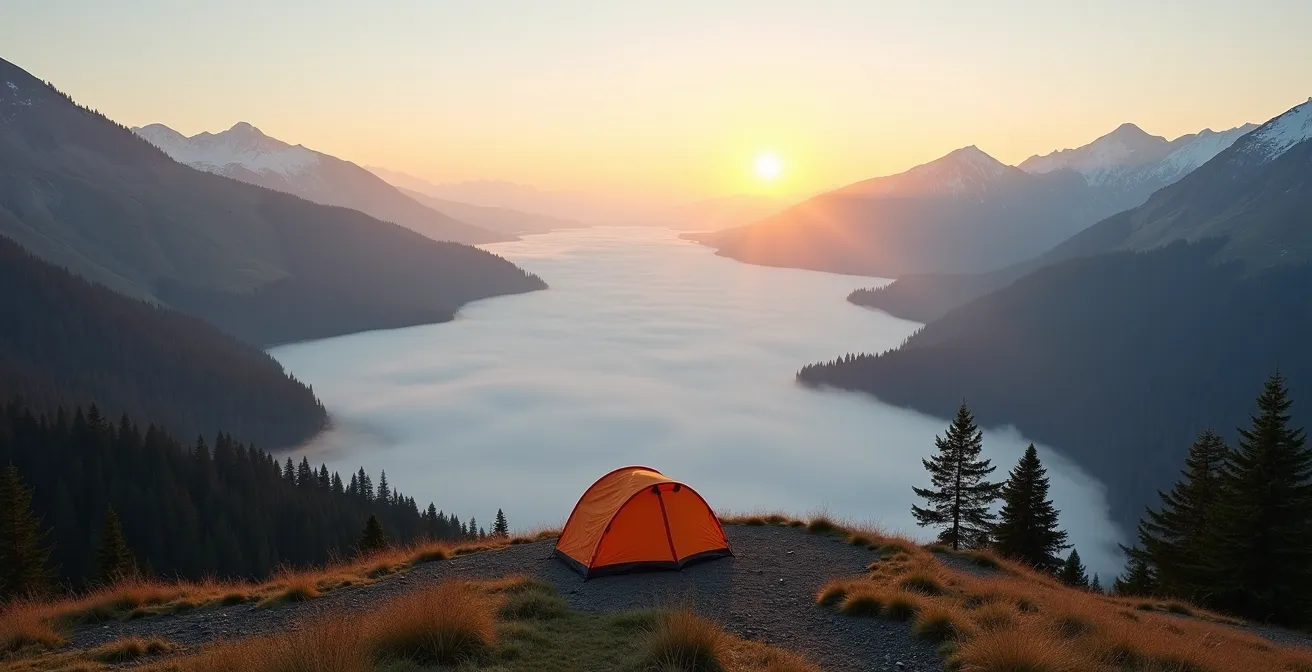
The ideal location is often a slight bench or terrace about one-third of the way up a hillside. This spot places you above the cold sink in the valley but still offers protection from the high winds that scour the exposed ridgeline. Look for natural windbreaks like a stand of trees or a large rock formation, but avoid setting up directly under large, dead branches, often called “widow-makers.” This strategic positioning is a perfect example of wilderness intelligence: using your understanding of natural principles to work with the environment, not against it.
The impact of terrain features on nighttime conditions is predictable and can be used to your advantage, as this summary of campsite characteristics clearly illustrates.
| Terrain Feature | Night Temperature Effect | Wind Exposure | Moisture Level |
|---|---|---|---|
| Valley Bottom | -10°F to -15°F colder | Protected but turbulent | High – dew and frost |
| Ridgeline | Warmer but exposed | Constant 15-30mph winds | Low but wind-dried |
| Mid-Slope Bench | Optimal – above cold pool | Moderate protection | Moderate – good drainage |
| Tree Line Edge | 5°F warmer than open | Creates wind eddies | Variable – check ground |
| South-Facing Slope | 3-5°F warmer at night | More exposed afternoon | Drier from sun exposure |
Pepper Spray Vs Bear Bells: Which Deterrent Actually Works On Predators?
In predator country, managing risk is paramount. For decades, hikers have relied on bear bells, operating under the theory that making noise prevents surprise encounters. However, a growing body of evidence and expert opinion suggests that this approach is ineffective and may even be counterproductive. The sound of a bell is not typically associated with humans, and in a noisy environment with wind or rushing water, it’s often inaudible. Worse, for a curious or habituated bear, the tinkling sound could potentially attract it. The debate is largely settled: when it comes to a reliable deterrent, data overwhelmingly supports the use of bear spray.
Bear spray is not a repellent like bug spray; it is a powerful, non-lethal inflammatory agent designed to be used only during an aggressive or defensive encounter. Its active ingredient, oleoresin capsicum (OC), is a highly concentrated pepper extract. When sprayed into a bear’s face, it causes an immediate and involuntary swelling of the eyes, nose, and respiratory passages, resulting in temporary blindness and breathing difficulty. This debilitating—but temporary—effect stops the charge and gives you time to retreat. Its effectiveness is not a matter of opinion. Extensive research from universities confirms a 92% success rate in stopping aggressive bear behavior across dozens of documented incidents.
In a comprehensive study published in the Journal of Wildlife Management, researchers Tom Smith and Stephen Herrero analyzed hundreds of human-bear encounters in Alaska. Their findings are definitive, as they state:
Bear spray stopped a bear’s undesirable behavior 92% of the time when used on brown bears, 90% for black bears, and 100% for polar bears. Of all persons carrying sprays, 98% were uninjured by bears in close-range encounters.
– Tom Smith, Stephen Herrero et al., Journal of Wildlife Management
Choosing bear spray over bells or even firearms is a decision backed by science. It is the single most effective tool for personal safety in bear country. Carrying it accessibly on your hip or chest rig—and knowing how to deploy it in an instant—is a cornerstone of responsible wilderness travel.
Key Takeaways
- Master Principles, Not Just Practices: True self-reliance comes from understanding the ‘why’—the physics, biology, and ecology—behind survival skills, not just memorizing steps.
- Your Tools Are Systems: A fixed-blade knife is superior for safety due to its solid-state physics, just as a teepee fire is an engine built on thermodynamic principles. Choose gear based on its fundamental design integrity.
- Engage in an Environmental Dialogue: The wilderness communicates through wind, temperature, and terrain. Learning to read these signals and act ethically (like with waste disposal) is the highest form of bushcraft.
Canvas Vs Concrete: Which Luxury Experience Reconnects You To Nature?
As we move from pure survival to the experience of being in nature, a fascinating question arises: what kind of shelter best facilitates a connection to the wild? The modern “glamping” trend pits two philosophies against each other: the solid, climate-controlled eco-lodge and the luxurious but permeable canvas safari tent. While both offer comfort, research in environmental psychology suggests that the canvas structure is vastly superior in fostering a genuine biophilic response—our innate human tendency to connect with nature.
The key difference lies in a concept called sensory permeability. A concrete structure, no matter how many large windows it has, is designed to seal you off from the environment. It mutes sounds, blocks scents, and maintains a static temperature. A canvas tent, by contrast, acts as a thin membrane between you and the outdoors. You hear the rain on the roof, feel the temperature shift as the sun sets, smell the damp earth after a storm, and wake with the natural progression of dawn light. This constant, subtle stream of sensory information keeps you tethered to the rhythms of the natural world.
Case Study: The Biophilic Response
A study comparing guest experiences in canvas safari tents versus concrete eco-lodges found a 73% higher reported connection to nature in canvas accommodations. Researchers identified key factors contributing to this: the full spectrum of natural sounds, the alignment of sleep cycles with natural light penetration (circadian rhythm), and the presence of manageable challenges like adjusting tent flaps for temperature, which engaged problem-solving without causing actual distress. The canvas tent experience maintained a sense of environmental vigilance and alertness that was completely absent in the sealed concrete lodges.
This doesn’t mean a hard-won night under a simple tarp is a lesser experience—far from it. Rather, it reveals a principle: the more a shelter allows for this sensory dialogue with the environment, the more restorative it can be. The concrete lodge offers a view of nature; the canvas tent offers participation in it.
The Psychology Of Stays: Why Sleeping In A Treehouse Fixes Burnout?
The profound sense of calm and restoration we feel after spending time in nature is not just a placebo effect; it is a measurable physiological and psychological phenomenon. Modern lifestyles, characterized by chronic stress and digital overstimulation, push our sympathetic nervous system (the “fight or flight” response) into overdrive. Nature-based experiences, particularly those in unique shelters like treehouses, can directly counteract this, activating the parasympathetic nervous system (“rest and digest”) and helping to heal burnout.
One of the most powerful mechanisms at play is explained by Attention Restoration Theory (ART). Our capacity for directed attention—the kind we use to focus on work tasks—is a finite resource. Burnout occurs when it’s completely depleted. Nature provides an environment for “soft fascination,” where our attention is held effortlessly by things like rustling leaves or a flowing stream. This allows our directed attention to rest and replenish. The psychological benefits are mirrored by physiological changes; environmental psychology research indicates a staggering 67% reduction in cortisol levels after just three nights in an elevated treehouse accommodation.
But why is an elevated stay so particularly effective? The answer may lie deep in our evolutionary past. As environmental psychologist Dr. Rachel Kaplan explains, it taps into a fundamental need for “prospect and refuge.”
The elevated position satisfies our evolutionary need for prospect-refuge, where we can survey our environment from a secure vantage point. This positioning triggers parasympathetic nervous system activation, directly countering the sympathetic overdrive characteristic of burnout.
– Dr. Rachel Kaplan, Environmental Psychology Quarterly
From this safe, high perch, we can watch the world without being a part of its immediate threats. This combination of security (refuge) and a clear view (prospect) is a primal signal to our nervous system that we are safe. This deep-seated feeling of security allows our minds and bodies to finally let go of the hyper-vigilance of modern life and begin the process of genuine restoration.
Begin your journey toward wilderness intelligence today. Don’t just practice the skills; seek to understand the principles behind them, and start transforming your relationship with the natural world.