
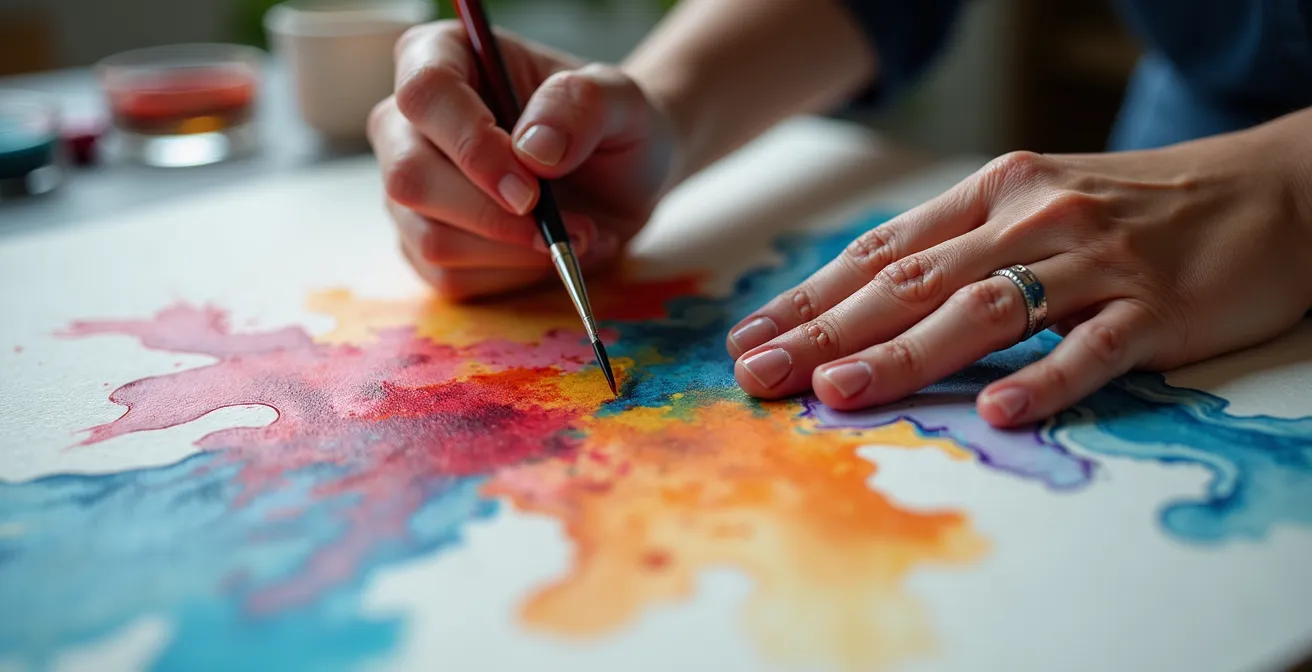
Contrary to the belief that healing requires talking, the most profound processing of grief often happens in silence, through non-verbal expression.
- Abstract art directly engages the brain’s emotional centers, bypassing the verbal logic that trauma can shut down.
- The goal is not to create a “masterpiece” but to externalize feelings, turning intangible pain into a tangible object you can see and understand.
Recommendation: Start not with a plan, but with a single color you are drawn to and a piece of paper. This simple act is the first step in a new kind of conversation with your grief.
When grief settles in, it often brings a profound silence. The right words feel impossible to find, and conversations can feel hollow, unable to touch the depth of the loss. We are often told that talking is the key to healing, that we must articulate our pain to move through it. But for many, especially when dealing with trauma, the part of the brain responsible for language simply seems to switch off, leaving a void where words used to be.
This is not a failure or a block; it’s a natural neurological response. The conventional path of talk therapy, while invaluable for many, can feel like an insurmountable hurdle when the very tool it requires—language—is inaccessible. But what if the solution wasn’t to force the words, but to find a different language altogether? What if the key was not in what we say, but in what we can express without speaking a single word?
This is the promise of abstract painting as a therapeutic tool. It offers a cognitive bypass, a way to communicate directly with our deepest emotions when our logical, verbal mind is overwhelmed. This guide explores how color, form, and the simple act of making marks can become a powerful, non-verbal dialogue for processing grief, not as an artist, but as a human seeking a path back to yourself. We will delve into the science behind this process, provide gentle starting points, and help you navigate the practical and emotional steps of this healing journey.
This article provides a structured path to understanding and using abstract art for emotional release. Below is a summary of the topics we will explore to help you begin this gentle and insightful practice.
Summary: Using Abstract Art to Navigate the Silence of Grief
- Why Does Color Bypass The Logical Brain To Access Deep Emotions?
- How To Start An Emotion Journal With Just Pastels And Paper
- Adult Coloring Books Vs Blank Canvas: Which Is Better For Trauma Release?
- The Perfectionist Trap: Why Judging Your Art Blocks The Healing Process
- When To Paint: Using Art During An Anxiety Spike Vs After The Storm
- How To Look In The Mirror For 2 Minutes Without Criticizing A Single Feature
- Why Does Acrylic Paint Dry Too Fast For Blending Techniques?
- Oil Or Acrylics: Which Medium Is Best For A Complete Beginner With No Studio?
Why Does Color Bypass The Logical Brain To Access Deep Emotions?
When you experience deep grief or trauma, the brain’s activity changes. The prefrontal cortex, responsible for logic and language, can become less active, while the amygdala, the emotional processing center, goes into overdrive. This is why it can feel impossible to “think” or “talk” your way through certain feelings. You’re trying to use a part of the brain that’s temporarily offline for that task. Color and abstract form, however, speak a more primal language that doesn’t need to be translated by logic.
Visual information travels on a superhighway directly to the brain’s emotional centers. In fact, neuroscience research shows that pathways from the thalamus to the amygdala allow for rapid emotional responses before the conscious, logical brain even has time to process what it’s seeing. This is the cognitive bypass in action. By choosing a color that feels like the tightness in your chest or the hollowness in your stomach, you are engaging in a direct, non-verbal dialogue with your emotions.
This process isn’t about knowing that “blue means sad.” It’s about a deeply personal connection. The act of choosing and applying color allows you to externalize an internal state, giving it a tangible form. To begin this exploration, you can try a simple exercise:
- Instead of thinking about traditional color associations, ask yourself specific, physical questions: “What color is the weight on my shoulders?” or “What color is the flicker of a happy memory?”
- Allow yourself to use the language of color when words feel inadequate. Your painting becomes a safe container for emotions, where only you need to know the meaning behind each mark.
- Focus on abstract expression. The power lies in creating something that represents a feeling, not a recognizable object.
By engaging with color in this way, you create a pathway for self-healing that doesn’t depend on verbal articulation. It’s a way of honoring the emotion by giving it space to exist outside of you, on paper or canvas, where it can be seen and acknowledged without judgment.
How To Start An Emotion Journal With Just Pastels And Paper
The idea of starting an “emotion journal” with art can feel intimidating. It may conjure images of complex sketchbooks and advanced techniques, but the reality can be much simpler and more accessible. The goal is not to create a beautiful diary, but to establish a consistent practice of tangible externalization—getting the feelings out of your head and onto the paper. Pastels and paper are perfect for this, as they are immediate, tactile, and require no setup.
To overcome the initial inertia, try the “First Five Minutes Framework.” This approach removes the pressure of creating a finished piece and focuses solely on the act of beginning. It’s a gentle way to build a habit of emotional check-ins. Here’s how to start:
- Choose One Color: Without overthinking, pick a single pastel color you’re drawn to in that moment. Don’t ask why, just trust your gut.
- Match Your Breath: For just five minutes, make marks on the paper that match the rhythm of your breath. If your breathing is short and shallow, the marks might be small and frantic. If it’s slow and deep, they might be long and flowing.
- Focus on Externalizing: The sole purpose of this exercise is to translate an internal feeling into an external, visible form. You are not drawing anything; you are simply moving your hand.
- Embrace the Process: During these five minutes, release any attachment to the outcome. The scribbles, lines, or smudges on the paper are not the point. The process of creating them is everything.
This practice can evolve. Some days it might be five minutes of angry scribbles. On other days, it might become a more elaborate “color timeline.” For instance, abstract artist Tremain Smith found that infinity symbols began appearing intuitively in her work as she processed grief. Her paintings became a form of emotional cartography, mapping a journey she couldn’t articulate in words. The symbols, she noted, “drip, and they’re on top of each other, and they’re all different colors,” each one representing a different layer of her experience. Your journal can become a similar map, a raw, honest record of your emotional landscape over time.
Adult Coloring Books Vs Blank Canvas: Which Is Better For Trauma Release?
When starting an art practice for grief, a common question arises: is it better to use a structured format like an adult coloring book or face the seemingly infinite possibility of a blank canvas? The answer depends entirely on your emotional state at that moment. Neither is inherently better; they are simply different tools for different needs. One offers a safe container, while the other offers radical freedom.
Adult coloring books provide a “contained” form of expression. The pre-drawn lines offer structure and predictability, which can be incredibly soothing during periods of high anxiety or overwhelm. When your inner world feels chaotic, the simple task of filling in a defined space can lower stress and provide a gentle, accessible outlet. You don’t have to make any major creative decisions, only choose the colors. This removes a layer of pressure and can make the act of creating feel safe.
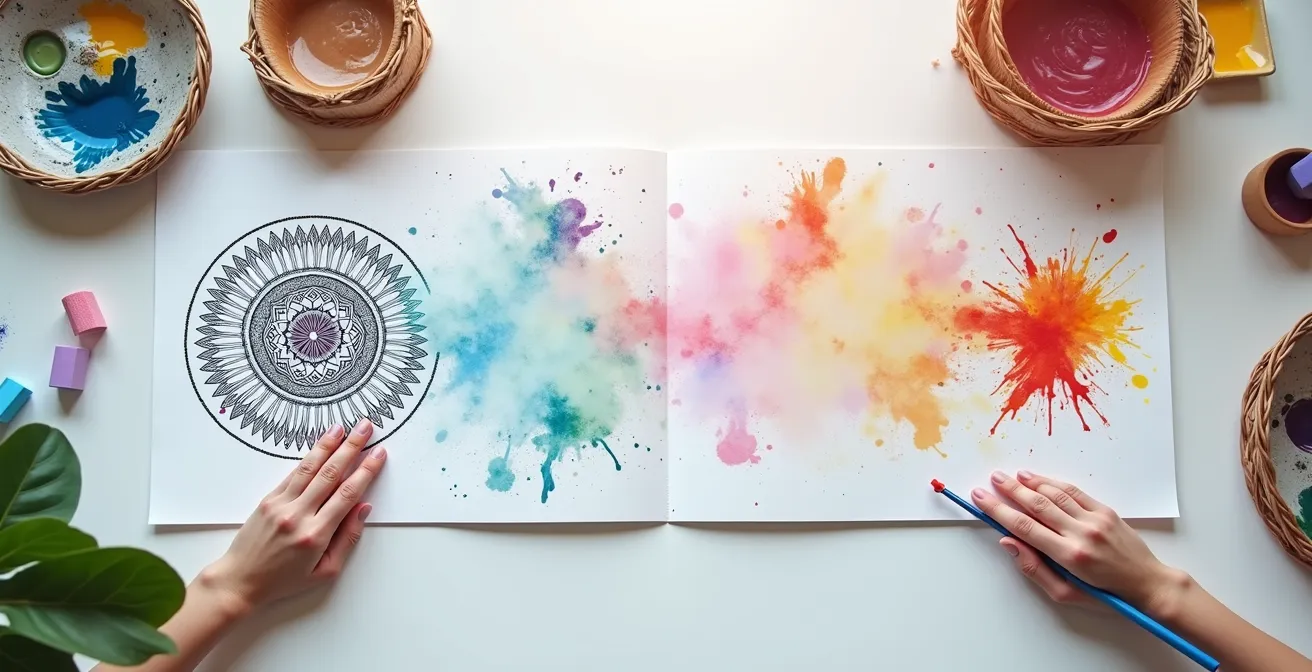
A blank canvas, on the other hand, offers an “uncontained” space for emotional release. For feelings that are too big or messy to fit within the lines—like rage, profound sadness, or explosive joy—a blank surface gives you the freedom to let them out. It allows you to process grief at your own pace, exploring both the painful aspects and the cherished memories without any rules or boundaries. This method requires a greater tolerance for uncertainty but can lead to more profound breakthroughs and a deeper sense of release.
As this comparative table shows, the ideal tool can change from day to day. There’s also a hybrid approach, where you might start with a coloring page and then move to a blank canvas as you feel more comfortable, or even paint over the lines of a coloring book to defy its structure.
| Method | Best For | Benefits |
|---|---|---|
| Coloring Books (Contained) | High anxiety periods, overwhelm | As a recent analysis from a guide on art therapy for grief highlights, they offer a safe and accessible outlet for deep feelings. |
| Blank Canvas (Uncontained) | Need for emotional release | Allows one to process grief at their own pace, exploring both pain and memories. |
| Hybrid Method | Transitional phases | Promotes self-reflection, emotional release, and healing. |
The Perfectionist Trap: Why Judging Your Art Blocks The Healing Process
One of the biggest obstacles to finding solace in art is the voice of the inner critic. “This doesn’t look right.” “I’m not a real artist.” “This is just a mess.” This judgment, this drive for perfection, is a trap that can completely shut down the healing process. When the focus shifts from authentic expression to creating a “good” piece of art, the non-verbal dialogue is silenced. You are no longer speaking the language of emotion; you are trying to meet an external standard that is irrelevant to your inner work.
Healing through art is about the process, not the product. It’s a foundational principle that bears repeating. As the experts at the Southern California Sunrise Recovery Center emphasize in their work on art therapy:
Healing through art is about the process, not creating masterpieces. There is no ‘right way’ to express grief through creativity.
– Southern California Sunrise Recovery Center, Art Therapy for Grief: Healing Through Creative Expression
The need for perfection often stems from a desire for control in a situation that feels utterly uncontrollable, like loss. But the therapeutic power of abstract art lies in letting go of that control. It’s about allowing the “mess” to happen because grief itself is messy. One of the most powerful examples of this is the project by artist Preston Zeller. Following his brother’s death, Zeller created one painting every day for a year, focusing only on daily expression rather than on the quality of each individual piece. He treated his art as raw data, a daily record of his grief. At the end of the year, he assembled the 365 paintings into a massive 10ft x 20ft mosaic, a stunning work of emotional cartography that represented a year of grieving. The power was in the accumulation of process, not the perfection of a single day.
Action Plan: Escaping The Perfectionist Trap
- Identify Triggers: Notice what makes your inner critic loudest. Is it a specific color? A perceived “mistake”? A comparison to others’ work? Simply name these points of contact with your judgment.
- Gather Evidence: Collect your “imperfect” creations without throwing them away. See them not as failures, but as an honest inventory of your emotional state on a given day.
- Check for Coherence: Ask yourself: Does my goal of creating a “perfect” image align with my goal of healing? Acknowledge that these two goals are often in direct conflict.
- Find Emotional Resonance: Look through your work and find one piece—even a simple scribble—that felt emotionally true when you made it. Its aesthetic quality is irrelevant. This is your new standard for “success.”
- Implement a Process-Only Plan: Set a timer for 10 minutes. Your only task is to make marks on paper until the timer goes off. The outcome is not the goal; completing the timed process is the victory.
When To Paint: Using Art During An Anxiety Spike Vs After The Storm
Integrating art into your grieving process isn’t about waiting for inspiration to strike. It’s about learning to use it as a responsive tool, adapting your technique to your emotional state in real-time. Just as you might reach for different coping mechanisms for different types of stress, you can use different artistic actions for different moments of your grief journey. The key is to distinguish between reactive art-making (in the middle of an emotional spike) and reflective art-making (in the calmer moments after).
During an acute anxiety spike or a wave of intense anger or sadness, your body is flooded with energy. The goal here is not to create a thoughtful composition but to discharge that overwhelming energy. This is a time for reactive art. The focus should be on fast, physical, repetitive motions that provide a somatic release. This isn’t about thinking; it’s about doing. Aggressive scribbling, jabbing at the paper with a pastel, or making rapid, sweeping strokes with a large brush can help externalize the intensity and ground you back in your body.
In the quieter moments “after the storm,” when the initial intensity has subsided but the emotion still lingers, the approach can shift to reflective art. This is a time for slower, more deliberate techniques that facilitate processing and understanding. Gentle watercolor blending, carefully layering colors, or slowly tracing shapes can help you sit with the feeling without being consumed by it. This is where you can begin to make sense of the emotional data you discharged during the reactive phase. It’s a moment for curiosity, not catharsis.
To make this a sustainable practice, consider incorporating art as a form of “emotional hygiene,” much like brushing your teeth. Scheduling just ten minutes a day, regardless of how you feel, can help lower your baseline stress levels and make the emotional peaks less overwhelming when they do occur. Here is a simple guide to timing your practice:
- During Anxiety Spikes (Reactive): Use fast, repetitive motions like aggressive scribbling or rapid brushstrokes to discharge intense energy.
- After the Storm (Reflective): Use slower techniques like watercolor blending or layering to process and understand the emotion.
- Daily Practice (Preventative): Schedule a brief, 10-minute session as “emotional hygiene” to maintain a lower stress baseline and build the habit.
How To Look In The Mirror For 2 Minutes Without Criticizing A Single Feature
The act of looking in the mirror can be fraught with difficulty, especially during grief. The reflection can feel alien, a stranger bearing the visible marks of loss. The exercise of looking at oneself without criticism is a powerful practice in self-acceptance, but it can be incredibly challenging. If the literal reflection is too painful, we can use abstract art to create a different kind of mirror—one that reflects our inner emotional state rather than our physical appearance.
Instead of standing in front of a glass mirror, stand in front of a blank piece of paper. This paper is your new mirror. Your task is not to replicate your features, but to create an abstract self-portrait of how you *feel* in this moment. This shifts the focus from external judgment to internal curiosity. You are no longer asking, “How do I look?” but rather, “What is present within me right now?”
This process of creating an emotional self-portrait is an act of looking at yourself with compassion. It’s a way to honor the truth of your experience without getting caught in the trap of physical self-criticism. The colors you choose represent your feelings, the marks you make represent your energy, and the final image represents your inner landscape. It is a reflection of your soul, not your skin.

To practice this form of self-reflection, you can use any materials you have on hand. The goal is to translate feeling into form:
- Use watercolors to represent your grief. Allow the colors to bleed and blend, creating soft edges or hard lines that mirror the nature of your sadness.
- Use charcoal to draw a particular emotion. The messiness and smudging quality of charcoal can be perfect for representing feelings that feel chaotic or undefined.
- Use any material to simply explore your emotions visually. The act of choosing a tool and making a mark is the beginning of looking at yourself with a new, more compassionate kind of honesty.
This abstract mirror becomes a space for acceptance. By looking at the finished piece, you are looking at yourself—your grief, your resilience, your memories—without a single feature to criticize. You are simply witnessing what is there.
Why Does Acrylic Paint Dry Too Fast For Blending Techniques?
For a beginner exploring emotional expression through paint, the technical properties of the medium can be unexpectedly frustrating. One of the most common challenges is the rapid drying time of acrylics. You lay down a beautiful, deep blue to represent a feeling, and when you go to blend a lighter color into it to show a glimmer of hope, the blue is already dry and unmoving. This happens because acrylic paint is essentially a plastic polymer emulsion. As the water in the paint evaporates, the polymer particles fuse together, locking the pigment in place. This process is irreversible and happens very quickly.
While this can be a technical hurdle, it can also be reframed as a powerful metaphor for the grieving process itself. The fast-drying nature of acrylics can represent the suddenness and permanence of loss. Some moments in life are fixed; they cannot be blended away, softened, or reworked. They simply are. Working with acrylics can be a practice in accepting this reality. You learn to work *with* the permanence, to layer new colors on top of the old ones, rather than trying to change what is already set.
This act of layering becomes symbolic. You are not erasing the dark color beneath; you are acknowledging it is there while adding a new experience, a new feeling, a new color on top of it. This creates depth and history in your painting, just as your life holds depth and history. Each layer is part of the story. As one artist, Merle Davison, noted while exploring her own trauma, her work became about processing “the anger, disappointments and joys that come with working through traumas to clearing on the other side of them.” Each of these is a distinct layer, not a seamless blend.
So, while the fast-drying quality of acrylics can seem like a limitation, it offers a unique lesson in acceptance. It teaches you to respond to what is, rather than trying to change what was. It encourages a non-verbal dialogue about moving forward, not by erasing the past, but by building upon it. The process becomes less about perfect technique and more about finding a method that feels authentic and therapeutic for your individual journey.
Key Takeaways
- Grief can silence the verbal parts of the brain; abstract art provides a direct, non-verbal language to communicate with your emotions.
- The goal is not artistic perfection but emotional process. Focus on externalizing feelings, not creating a masterpiece.
- Different tools and techniques serve different emotional needs, from the safety of coloring books during high anxiety to the freedom of a blank canvas for deep release.
Oil Or Acrylics: Which Medium Is Best For A Complete Beginner With No Studio?
Choosing the right materials is the final practical step to beginning your art-for-grief journey. For a complete beginner, especially one without a dedicated studio space, the choice often comes down to acrylics versus oils. While traditional oil paints are famous for their slow drying time and rich blending capabilities, they require toxic solvents for cleanup and good ventilation, making them impractical for most home environments. Acrylics, on the other hand, are water-based, low-odor, and clean up easily, making them the default choice for beginners.
However, the art world has evolved, offering a perfect middle ground: water-mixable oil paints. These paints offer the slow, reflective blending time of traditional oils but can be thinned and cleaned with just water, eliminating the need for solvents. This makes them a fantastic option for someone working in a small space who wants the freedom to slowly process emotions on the canvas.
Ultimately, the “best” medium is the one that aligns with both your emotional needs and your practical circumstances. There is no right or wrong choice. Some people find the immediacy of acrylics cathartic, while others need the slow, forgiving nature of oils to feel safe. Still others may find that mixing media—using pencils, pastels, and paint together—gives them the most flexibility to express shifting moods.
This table offers a simple comparison to help you decide which medium might be the best starting point for you, matching the emotional quality of the paint with its practical benefits for a beginner.
| Medium | Emotional Match | Practical Benefits |
|---|---|---|
| Acrylics | Fast, immediate emotional expression | Low-odor, water-based, easy cleanup |
| Water-Mixable Oils | Slow, reflective processing | As resources on art therapy suggest, they need no toxic solvents and are small-space friendly. |
| Mixed Media | Allows each person to express themselves in the way that’s best for them | Maximum flexibility for different moods |
The most important factor is finding a method that feels authentic and therapeutic for you. The tool is just a vehicle; the journey is what matters. The goal is to give your grief a voice, even if that voice is a splash of color on a page.
The first step is not to become an artist, but to allow yourself a new language to speak your grief. It begins with the simple, quiet act of choosing a color and making a mark. This is a conversation you can start today.