
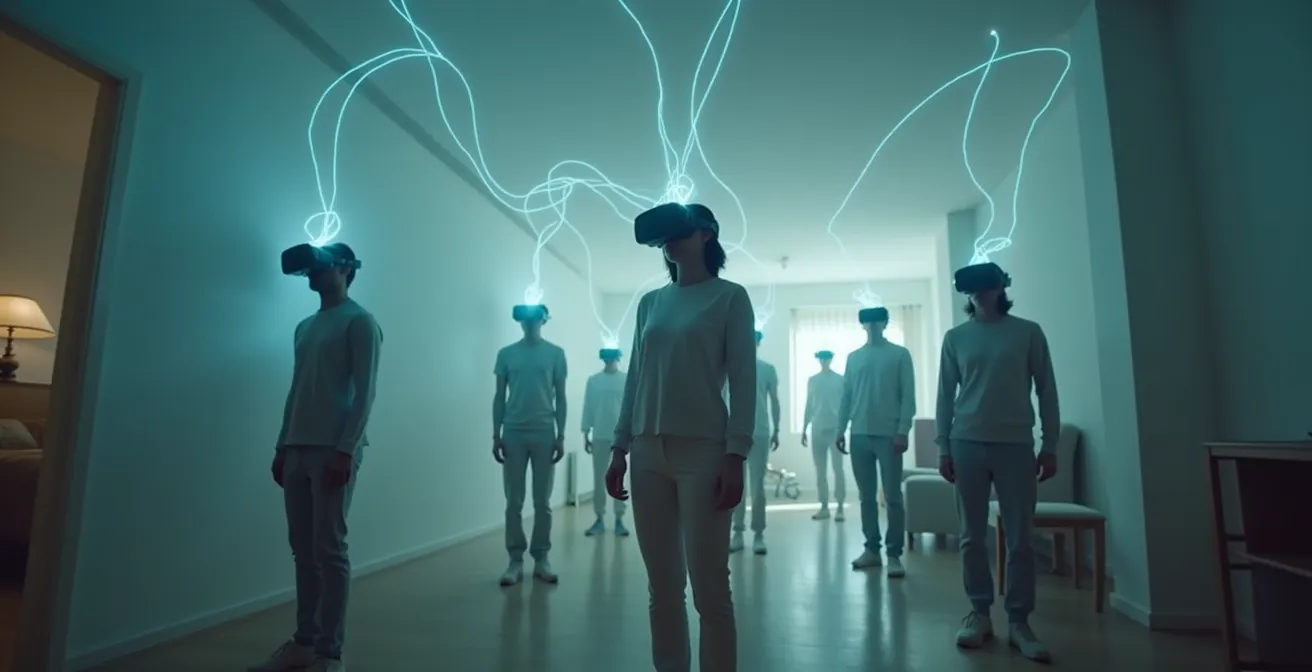
Virtual reality is more than a technological escape; it’s a powerful psychological tool for social support, but its benefits are not automatic.
- Embodying an avatar measurably reduces social anxiety by altering self-perception (the Proteus effect).
- True connection requires active “digital hygiene” to avoid toxic communities and algorithmic traps.
Recommendation: The key is to consciously leverage VR’s psychological benefits while setting firm boundaries to protect your privacy and mental well-being.
For millions grappling with mobility issues, chronic illness, or social anxiety, the world can feel like a room with shrinking walls. The longing for connection is a fundamental human need, yet the barriers to achieving it can seem insurmountable. In this landscape of isolation, a new digital frontier is emerging not just as an escape, but as a lifeline: virtual reality. We often hear promises of the metaverse, but the real revolution is happening now, in the quiet hum of VR communities where people are finding genuine social support.
The common advice is to “just get out there,” a phrase that rings hollow when “out there” is inaccessible or fraught with anxiety. Virtual reality platforms offer a different path. However, this world is not a simple utopia. It’s a complex ecosystem with its own rules, risks, and psychological dynamics. Simply logging on is not enough. The true potential of VR for social support lies not in the technology itself, but in understanding how to navigate it with intention and wisdom.
This guide moves beyond the hype. We will not just list apps; we will explore the psychological engine that makes VR so powerful for introverts—the phenomenon of avatar embodiment. We will then provide a practical framework for finding safe, welcoming spaces and building real trust. But we won’t shy away from the shadows: the algorithmic traps that breed toxicity and the very real danger of digital dependency. This is not about escaping reality, but about using a virtual world to build the strength and connections needed to thrive within it.
This article will serve as your compass, guiding you through the immense potential and a few of the necessary precautions of this nascent digital society. From the psychology of your avatar to the privacy of your data, you will gain the tools to forge real, supportive relationships in the virtual world.
Summary: Can Virtual Reality Communities Provide Real Social Support For Isolated People?
- Why Does Identifying With An Avatar Reduce Social Anxiety In Introverts?
- How To Find Non-Toxic Discord Communities For Niche Interests
- Text Vs Voice: Which Medium Builds Trust Faster In Digital Friendships?
- The Algorithm Trap: Why Your Online Group Is Radicalizing Your Opinions
- When To Log Off: Recognizing The Signs Of Digital Dependency
- How To Attend A Festival Alone Without Looking Or Feeling Awkward
- Cloud Vs Local Processing: Which Hub Protects Your Privacy Better?
- Video Games As Literature: How Playing RPGs Enhances Reading Comprehension?
Why Does Identifying With An Avatar Reduce Social Anxiety In Introverts?
For anyone who has felt their voice catch in their throat or their palms sweat in a social setting, the idea of a digital “mask” is instantly appealing. But an avatar in virtual reality is far more than a mask; it’s a vessel for embodiment. This is the core of the Proteus effect, a psychological phenomenon where an individual’s behavior conforms to the characteristics of their digital representation. It’s not about pretending; it’s about becoming.
When you choose a confident, idealized, or simply different avatar, your brain begins to adopt those traits. A meta-analysis of 56 studies confirmed that the Proteus effect has a significant impact, particularly in immersive VR environments. This digital shell provides a buffer, reducing the perceived risk of social judgment and freeing the user to interact more openly. The familiar knot of anxiety loosens because the “self” on display is one step removed, a curated identity that feels both safe and aspirational.

This effect can even extend to physical sensations. A 2024 study on pain perception found that participants who embodied muscular avatars in VR experienced a 15.98% reduction in perceived pain compared to those with “normal” avatars. If our minds can be convinced to feel less physical pain based on a digital body, it’s clear how they can be similarly persuaded to feel less social fear. The avatar becomes a practice ground for confidence, allowing introverted individuals to experiment with social behaviors in a low-stakes environment, building skills that can eventually translate to the physical world.
How To Find Non-Toxic Discord Communities For Niche Interests
Once you understand the power of avatar embodiment, the next crucial step is finding a safe space to deploy it. Platforms like Discord host millions of communities, but they are not all created equal. The very anonymity that lowers social barriers can also shield toxicity. The challenge is not just finding a server for your niche interest, whether it’s 18th-century pottery or vintage sci-fi, but auditing it for psychological safety. This is a non-negotiable step in what can be called “digital social hygiene.”
The scale of the problem is significant; in the first half of 2024 alone, Discord received approximately 5.59 million reports related to harassment and bullying. This data isn’t meant to scare you away, but to empower you to be selective. A truly supportive community is built on strong moderation and a culture of respect. Rushing into the first server you find is like walking into a random party; you have no idea what to expect. A more strategic approach is to “lurk” first—observe the flow of conversation, the enforcement of rules, and the way newcomers are treated.
Gentle entry is key. Look for servers with clear, prominently displayed rules and active, engaged moderators. The quality of a community is often revealed in how it handles conflict. Are disagreements shut down with insults, or are they guided toward respectful debate or private resolution? Pay attention to the “in-jokes.” Are they inclusive and based on shared enthusiasm, or do they “punch down” by targeting specific groups? A healthy community uplifts its members; a toxic one builds bonds by excluding others.
Action Plan: The Lurker’s Audit for Discord Communities
- Monitor for 48 Hours: Join the server but don’t post. Observe interaction patterns, peak activity times, and the general tone.
- Analyze Conflict Resolution: Find a past disagreement. Was it handled maturely in public, taken to private DMs, or did it devolve into public shaming?
- Evaluate Humor Profile: Assess the jokes. Are they based on shared interests (inclusive) or are they at the expense of others (exclusive, ‘punching down’)?
- Test New Member Integration: Watch how new members are greeted. Do actual, established members say hello, or is it just an automated bot message?
- Document Red Flags: Before engaging, take screenshots of any clear instances of harassment, hate speech, or unmoderated toxicity. It’s your evidence if you need to report and leave.
Text Vs Voice: Which Medium Builds Trust Faster In Digital Friendships?
Inside your chosen digital sanctuary, connection begins. But how does it deepen? The choice between text and voice chat is not just one of preference; it’s a strategic decision in “trust calibration.” For individuals with social anxiety, text often feels like the safer starting point. It’s asynchronous, editable, and devoid of the perceived judgment of tone and cadence. However, research suggests this comfort comes at the cost of connection speed.
The human voice is a rich carrier of emotional data. Tone, pitch, and pauses convey nuance that plain text struggles to replicate. This is why, as researcher Amit Kumar from the Journal of Experimental Psychology notes, the dynamic is often paradoxical:
People feel significantly more connected through voice-based media, but they have these fears about awkwardness that are pushing them towards text-based media.
– Amit Kumar, Journal of Experimental Psychology
This fear of awkwardness is a major hurdle. We worry about stumbles, silences, and mispronunciations—the very imperfections that make us human. Yet it is often in these unscripted moments that true bonding occurs. Voice chat, especially in the context of a shared activity in VR, accelerates intimacy by providing a richer stream of social cues.
Interestingly, the context of the relationship matters. A 2021 study on long-distance relationships found that frequent, responsive texting was a strong predictor of satisfaction for geographically distant couples. Conversely, voice calls were more beneficial for couples who were physically close. This suggests that text is excellent for maintaining connection and a sense of presence across distance, but for building deeper, more nuanced trust, the richness of voice is often superior. The ideal path may be a gradual one: starting with text to build a foundation of safety and shared interest, then transitioning to voice to build a more resilient, personal bond.
The Algorithm Trap: Why Your Online Group Is Radicalizing Your Opinions
A supportive community can be a sanctuary, but even the most well-meaning groups are susceptible to a hidden danger: the algorithmic trap. Platforms are designed to maximize engagement, and one of the most effective ways to do this is by showing users content that reinforces their existing beliefs. This creates an echo chamber, which can slowly and imperceptibly morph into a radicalizing “algorithmic funnel.” You join a group for a shared hobby, but the algorithm notices that divisive or emotionally charged content keeps you online longer. Gradually, you’re fed more extreme versions of the group’s initial ideas.
This isn’t a theoretical danger. An analysis of 30 million Discord messages on political servers found a measurable increase in toxic language, particularly sexism, in Republican-aligned servers after Kamala Harris’s nomination. This shows how real-world events can trigger algorithms to surface and amplify hateful content within a community, shifting its Overton window toward extremism. The group’s identity hardens, and dissenting or moderate opinions are pushed out, not necessarily by overt malice, but by the subtle, persistent pressure of the algorithm.
Furthermore, research in 2024 revealed how the very structure of platforms like Discord can be exploited. Because moderation is distributed and reliant on third-party tools like Disboard for server discovery, networks of hateful communities can proliferate. They create a web of interconnected servers that appear legitimate on the surface but are designed to funnel users toward more extreme content, deliberately evading platform-level controls. A user might join a “History Buffs” server, only to be subtly guided toward a linked server that promotes historical revisionism and hate speech.
The antidote to this is critical awareness and viewpoint diversity. Actively seek out information and opinions from outside your immediate digital circle. Be wary of groups where all members agree on everything, all the time. Healthy communities have disagreements. If your online group feels increasingly us-versus-the-world, it may be a sign that you’re in an algorithmic funnel.
When To Log Off: Recognizing The Signs Of Digital Dependency
The same immersion that makes VR a powerful tool for connection also makes it a potential catalyst for dependency. When a virtual world becomes more rewarding, predictable, and affirming than the real world, the temptation to stay logged in can be overwhelming. This isn’t a failure of willpower; it’s a predictable outcome of a system designed to hold your attention. Recognizing the signs of digital dependency फोन an unhealthy reliance—is a crucial act of self-care.
The line between healthy engagement and dependency is often blurry. For many moderators and highly engaged users, spending over 4 hours daily on Discord is common. The problem arises when this digital life begins to displace, rather than supplement, your physical one. Are you neglecting responsibilities, sleep, or real-world relationships in favor of your online community? Do you feel irritable, anxious, or empty when you’re not logged in? These are red flags that your digital connection is becoming a dependency.
Crucially, the impact of heavy VR use is not uniform. A 2021 study on social VR users highlighted a concerning trend: for individuals who were already socially isolated and had low self-esteem, heavy engagement could lead to negative effects on their overall well-being. The virtual world, instead of being a bridge, became a comfortable cage. It provided the feeling of social connection without the challenges and growth of real-world interaction, reinforcing a cycle of avoidance.
The solution is not to abandon VR, but to practice intentional disconnection. Set firm time limits for your sessions. Schedule real-world activities, even small ones, to ensure you remain grounded. Curate your digital experience to be a supplement to your life, not its centerpiece. If your mood and self-worth become entirely dependent on your status and interactions within a virtual community, it’s a clear sign that it’s time to log off and reconnect with yourself.
How To Attend A Festival Alone Without Looking Or Feeling Awkward
The skills and confidence forged in the digital realm can be a powerful toolkit for navigating a traditionally daunting real-world experience: attending a large event, like a music festival, alone. The feeling of being a single, disconnected node in a sea of established groups can trigger the very social anxiety that VR helps to soothe. However, by applying the principles of digital community-building to a physical space, you can transform the experience from one of awkwardness to one of empowered solitude and potential connection.
The strategy begins weeks before the event. Just as you would audit a Discord server, find the festival’s official online community—be it a subreddit, a Facebook group, or a Discord server. This is your digital entry point. Participate in discussions, ask questions about the lineup, and get a feel for the community’s vibe. This builds a sense of familiarity and turns strangers into, at the very least, familiar usernames. You’re no longer arriving cold; you’re arriving as a member of the community who just hasn’t met anyone in person yet.
Once there, reframe your objective. The goal is not to force friendships, but to have positive, low-stakes interactions. Create ‘social quests’ for yourself: ask three different people where the best food truck is, compliment five people on their outfits, or ask someone to take your picture in front of a landmark. These are small, purposeful interactions with a clear beginning and end, removing the pressure of open-ended conversation.
Finally, embrace the tools of comfortable solitude. Prepare a ‘Solo Kit’ with purposeful items like a book, a journal, or headphones. These objects signal contentment and self-sufficiency, not loneliness. They provide a graceful exit from social situations and a comfortable way to occupy yourself during downtime, turning what could be awkward waiting into a moment of peaceful reflection. You’re not just ‘the person who is alone’; you are ‘the person reading a book,’ a subtle but powerful shift in perception for both you and others.
Cloud Vs Local Processing: Which Hub Protects Your Privacy Better?
As you build trust and share more of yourself in virtual communities, the question of privacy becomes paramount. Your conversations, your avatar’s movements, and your connections are all data. Where this data is stored and processed—on a company’s cloud server or on your local device—has profound implications for your security and anonymity. This isn’t just a technical detail; it’s a fundamental choice about who you trust with your digital self.
Cloud-based processing is the standard for most major platforms like VRChat and Discord. It allows for massive, easily accessible worlds and seamless interaction. However, it means your data resides on company servers, where it can be subject to analysis, data breaches, or government requests. For sensitive discussions, such as those about mental health, grief, or personal identity, this presents a significant vulnerability. Your intimate conversations become a commodity.
Local processing, on the other hand, keeps the data on your own device. The environment might be smaller or require direct invitations, but control remains entirely in your hands. This is the equivalent of having a conversation in your own living room versus a public square. The risk is limited to the security of your own device, not the fortitude of a distant corporate server. As a point of personal security, regardless of the processing model, adopting two-factor authentication is crucial, a practice that has thankfully seen an 82% adoption rate among Discord moderators, setting a standard for all users.
The following table, based on the inherent trade-offs of each model, clarifies a comparison of these two approaches. It highlights that the best choice depends entirely on the context of the interaction.
| Aspect | Cloud Processing | Local Processing |
|---|---|---|
| Data Control | Platform-controlled, subject to analysis | User-controlled, remains on device |
| Vulnerability | Risk for mental health/grief discussions | Limited to device security |
| Accessibility | Easy public access, broad reach | Requires individual invitations |
| Best Use Case | Casual, low-stakes socializing | Sensitive, trusted friend discussions |
Key Takeaways
- Avatar embodiment is a real psychological tool (the Proteus effect) that can be consciously used to reduce social anxiety.
- Finding safe online spaces requires active “digital hygiene”—auditing communities before engaging to avoid toxicity and harassment.
- True social support in VR is a balancing act between leveraging its psychological benefits and actively managing the risks of algorithmic manipulation and digital dependency.
Video Games As Literature: How Playing RPGs Enhances Reading Comprehension?
When we reframe our understanding of virtual worlds, we see they are more than just social lounges; they are narrative engines. This is especially true of Role-Playing Games (RPGs), which are often dismissed as simple entertainment. In reality, they are complex, interactive literary systems that can provide a profound form of psychological support by giving players agency over their own story. This goes beyond simple reading comprehension; it’s about practicing life.
Research during the COVID-19 pandemic found that many users identified platforms like VRChat as a critical source of social support. Participants reported that the anonymity of avatars and a perceived sense of safety allowed them to practice social interactions, reduce negative thoughts, and form strong bonds that directly combated the pain of isolation. They weren’t just playing a game; they were co-authoring a narrative of survival and connection in a world that had suddenly become frighteningly lonely.
This shift from “game” to “social space” is a mainstream phenomenon. As of 2024, a significant portion of Discord’s user base is comprised of 54% non-gamers. People are flocking to these platforms not for the gameplay, but for the community and shared narrative. An RPG teaches systems thinking, cause-and-effect, and the consequences of choice. When you decide how your character responds to a crisis, you are, in a low-stakes environment, practicing how you might respond to your own. You learn to read not just text, but social systems.
The ultimate form of social support is not just being listened to, but feeling like the protagonist of your own life. For those who feel trapped by circumstance—be it physical disability or crippling anxiety—VR and RPGs can offer a space to reclaim that sense of agency. By making choices, shaping a story, and building alliances, you are not escaping reality. You are training the very muscles of resilience, creativity, and social navigation that are essential for a fulfilling life, both online and off.
Begin your journey into these communities not with naive optimism, but with informed intention. Use the tools of this new frontier to build the connections you deserve, safely and authentically.