
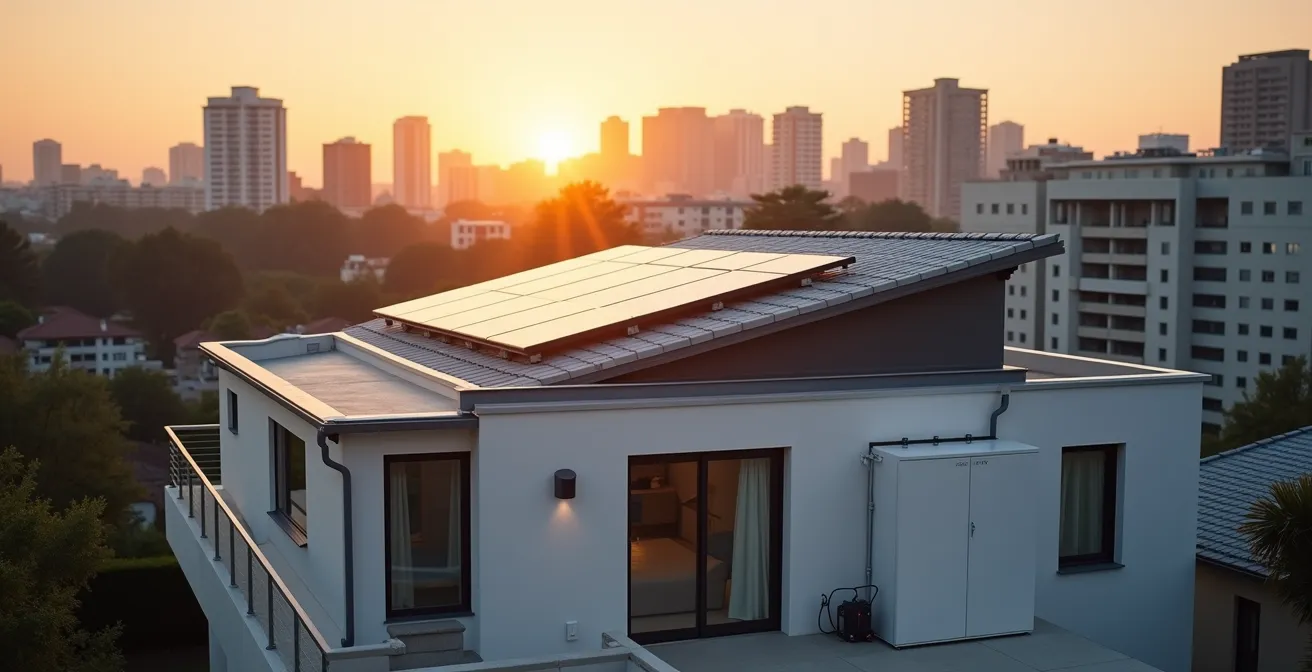
Achieving financial viability with home battery storage in an urban setting is conditional; it depends less on the hardware cost and more on a holistic engineering approach to your home’s entire energy system.
- True payback calculations must account for systemic factors like home insulation, phantom loads from IoT devices, and battery efficiency degradation.
- The choice of battery chemistry (e.g., LFP vs. traditional Li-ion) and the financing model (owning vs. leasing) have profound impacts on both safety and long-term asset value.
Recommendation: Prioritize a comprehensive energy audit and upgrade your home’s thermal integrity (insulation) before sizing and purchasing a solar and battery system.
For homeowners concerned about power outages and volatile energy prices, the dream of going off-grid, even in the heart of the city, is increasingly appealing. The promise of energy independence, powered by rooftop solar panels and a home battery, seems like the ultimate solution. Conventional wisdom often frames the decision as a simple financial calculation: will the monthly savings on my electricity bill eventually cover the steep upfront cost of a battery system? Many articles will present generic payback periods and lists of pros and cons.
However, this perspective misses the critical point. The financial viability of an urban off-grid system isn’t a simple plug-and-play equation. It’s a complex engineering challenge. The true key to a positive return on investment lies not in the battery itself, but in a disciplined, systemic optimization of the entire home ecosystem. This involves analyzing and mitigating energy waste, managing electrical loads with precision, and understanding the nuanced risks associated with different technologies and financing models.
This guide abandons the simplistic “is it worth it?” question. Instead, it provides a financial and engineering framework to answer *how* to make it viable. We will deconstruct the critical subsystems—from your home’s insulation to your smart-home’s network security—to reveal the levers that truly dictate whether your investment in energy independence will pay dividends or become a costly liability.
This article provides a detailed roadmap for evaluating and implementing a home energy storage system from an engineering and financial perspective. Explore the sections below to understand each critical component of a truly viable off-grid strategy.
Table of Contents: Home Battery Storage: Is It Financially Viable To Go Off-Grid In The City?
- Why Does Storing Solar Energy For Evening Use Slash Your Electricity Bill?
- How To Calculate The Payback Period For A $15,000 Solar System
- Lithium-Ion Vs Saltwater: Which Battery Is Safer For Home Storage?
- The Leasing Trap: Why You Should Never Lease Solar Panels If You Plan To Sell
- In Which Order To Upgrade: Insulation Before Solar For Maximum Efficiency
- How To Create A Guest Network Specifically For Your Smart Fridge And Bulbs
- How To Lower Your HVAC Bill By 20% With Geofencing Triggers
- Securing the smart home ecosystem against cyber threats and privacy breaches
Why Does Storing Solar Energy For Evening Use Slash Your Electricity Bill?
The fundamental economic principle behind home battery storage is energy arbitrage. Solar panels generate the most electricity during midday, a time when household consumption is often low and, in many regions, when electricity from the grid is cheapest. Conversely, energy demand peaks in the evening as residents return home, a period when solar production is zero and utility rates are often at their highest. A battery acts as a financial buffer, allowing you to capture the cheap, self-generated solar energy during the day and deploy it during these expensive peak hours, effectively avoiding high utility charges.
This time-shifting of energy directly translates into savings. Instead of selling excess solar power to the grid for a low credit and buying it back hours later at a premium, you are using your own stored energy at a net cost of zero. This strategy is the primary driver behind the financial return of a battery system. The overall profitability, however, is not guaranteed. It depends heavily on the “spread” between your utility’s peak and off-peak rates, as well as the round-trip efficiency of your battery—the percentage of energy you get out compared to what you put in, with losses typically around 10-15%.
While the concept is simple, achieving a favorable return on investment requires careful system design. The capacity of the battery (measured in kilowatt-hours, or kWh) must be sufficient to cover your evening energy needs without being oversized, which would unnecessarily inflate costs. As hobbyist “Glubux” demonstrated by running his home for 8 years on a system of recycled laptop batteries expanded to 56 kWh, long-term reliability is achievable. However, for most homeowners, achieving the typical solar payback period of 5 to 12 years requires a more precise and professionally engineered approach to system sizing.
Ultimately, storing solar energy is less about generating power and more about strategic financial management of your energy consumption.
How To Calculate The Payback Period For A $15,000 Solar System
Calculating the payback period for a solar and battery system goes far beyond a simple division of cost by annual savings. A true financial analysis must adopt the rigor of an engineering project, accounting for a wider range of variables that impact long-term value. The initial investment of $15,000 is your starting point, but the “return” side of the equation is multifaceted. It includes not only direct electricity bill savings but also the increased resale value of your home and potential government incentives.
The first step is to establish a precise baseline of your annual electricity costs, which your new system will offset. Next, you must factor in the appreciation of your property. An owned solar system is an asset, not a liability. For instance, according to a 2025 Zillow data analysis, a 6.9% premium is often seen on homes with owned solar panels. For a $400,000 home, this translates to a $27,600 increase in value, which can significantly shorten or even immediately justify the initial investment. Federal tax credits, state rebates, and local incentives must also be subtracted from the gross system cost to determine your true net investment.

Finally, you must project for degradation. Both solar panels and batteries lose efficiency over time. A realistic calculation models a slight decrease in annual savings over the system’s 25-year lifespan. By integrating these factors—direct savings, home value appreciation, net cost after incentives, and system degradation—you move from a simplistic estimate to a robust financial forecast. This comprehensive approach is the only way to determine if a $15,000 system is a sound financial decision for your specific situation.
Neglecting any of these components can lead to a misleading payback period and a poor investment decision.
Lithium-Ion Vs Saltwater: Which Battery Is Safer For Home Storage?
When selecting a home battery, safety is a non-negotiable parameter that directly influences the system’s long-term viability. The market is dominated by lithium-ion chemistries, but not all are created equal. The primary debate is between traditional Lithium-Ion (often Nickel Manganese Cobalt or NMC) and Lithium Iron Phosphate (LiFePO4 or LFP). While “saltwater” batteries exist, they remain a niche technology with lower energy density and are less common in residential applications.
LFP batteries are widely considered the safer choice for stationary home storage. Their chemical structure is more stable, making them far less prone to thermal runaway—a dangerous chain reaction where a cell overheats and can potentially catch fire. This inherent stability gives them a significant advantage over traditional Li-ion chemistries. However, it’s crucial to understand the nuances of this safety. As University of Sheffield researchers noted in the Journal of Energy Storage, a crucial distinction exists: while LFP cells are less likely to ignite in the first place, if they are forced into thermal runaway under extreme abuse conditions, their materials can still present a flammability hazard. This was highlighted in a study on the flammability of LFP batteries.
LFP presents a greater flammability hazard even though they show less occurrence of flames in cell thermal runaway tests
– University of Sheffield researchers, Journal of Energy Storage
This underscores that safety is a system-level property, relying on a high-quality Battery Management System (BMS) to prevent the conditions that lead to failure. The table below compares the key safety and performance metrics, clarifying why LFP is generally preferred despite this nuance.
| Safety Feature | LiFePO4 | Traditional Li-Ion |
|---|---|---|
| Thermal Runaway Risk | Extremely Low | Moderate to High |
| Operating Temperature | -20°C to 60°C | 0°C to 45°C |
| Fire Resistance | Incombustible | Flammable electrolyte |
| Cycle Life | 3,000-10,000 cycles | 1,000-2,300 cycles |
The superior cycle life and wider operating temperature range of LFP also contribute to its long-term financial viability. While saltwater batteries offer excellent safety profiles by being completely non-flammable, their lower energy density and market maturity currently make LFP the pragmatic choice for most urban homeowners balancing safety, performance, and cost.
In the end, a robust BMS combined with the inherent stability of LFP chemistry provides the most reliable safety framework for a residential energy storage system.
The Leasing Trap: Why You Should Never Lease Solar Panels If You Plan To Sell
While the high upfront cost of a solar and battery system can be daunting, falling for the allure of a “zero-down” solar lease or Power Purchase Agreement (PPA) can be a critical financial mistake, especially for homeowners who may sell their property within the lease term. Leasing transforms a valuable home asset into a long-term liability that can complicate or even derail a future home sale. The core issue is one of ownership: with a lease, you don’t own the system; a third-party company does.
This distinction has a massive impact on your home’s value. While owned solar systems demonstrably increase property value, extensive research shows that a 0% value increase for leased systems is the norm. Potential buyers are often wary of inheriting a 20-year lease agreement. They must not only qualify for the lease transfer with the solar company but also accept the terms and escalating payment schedules negotiated years prior. This adds a significant layer of complexity and perceived risk to the transaction, making your home less attractive compared to one with an owned system or no system at all.
If you have a leased system and plan to sell, you are often faced with two unattractive options: convince the buyer to assume the lease, or buy out the remaining lease contract yourself at a substantial cost. The buyout price is often inflated and may not reflect the current market value of the used equipment. This “leasing trap” effectively negates many of the financial benefits of going solar. To avoid these complications, owning the system outright—whether through cash purchase or a solar loan—is almost always the superior financial strategy.
Action Plan: Preparing to Sell a Home with Solar Panels
- Contract Review: Immediately verify whether your panels are owned or leased. Locate all original contracts and documentation.
- Obligation Calculation: If leased, contact the solar company to determine the exact buyout cost and the requirements for a lease transfer.
- Documentation Assembly: Compile a complete package for potential buyers, including all warranty information, system specifications, and a history of energy savings.
- Financial Modeling: Create a clear document for real estate agents and buyers that demonstrates the system’s annual energy savings and calculated return on investment.
- Strategic Decision: Based on the buyout cost and market conditions, decide whether it is more financially advantageous to buy out the lease before listing the home.
Ultimately, ownership is what converts a solar installation from an energy-saving appliance into a powerful financial asset that enhances your home’s long-term value.
In Which Order To Upgrade: Insulation Before Solar For Maximum Efficiency
One of the most common and costly mistakes in pursuing energy independence is focusing solely on energy generation (solar panels) without first minimizing energy consumption. From an engineering perspective, this is illogical. The most financially effective approach follows a strict order of operations: first, maximize your home’s thermal integrity, then size your solar and battery system to meet the *reduced* demand. Investing in insulation, air sealing, and high-performance windows is not an alternative to solar; it’s a prerequisite for a cost-effective solar installation.
A poorly insulated home is like a leaky bucket. Pouring more energy into it from a large, expensive solar array is inefficient and financially wasteful. By first improving your home’s building envelope, you drastically reduce the amount of energy needed to heat and cool it—typically the largest single load in any household. This reduction in demand has a cascading effect: it allows you to install a smaller, less expensive solar array and a smaller, less expensive battery system to achieve the same level of energy autonomy. The cost savings from downsizing the renewable energy hardware can often pay for the insulation upgrades entirely.

This “efficiency-first” principle is backed by hard data. An in-depth U.S. Department of Energy analysis shows that properly insulating a home can reduce the required solar system size by up to 30%. This not only slashes the upfront investment but also accelerates the payback period, making the entire project more financially attractive. A thermal imaging audit can quickly reveal where your home is losing the most heat, allowing you to target upgrades for maximum impact. Prioritizing thermal integrity is the single most powerful lever for improving the systemic efficiency of your home and the financial viability of your off-grid ambitions.
Reducing demand is always cheaper and more effective than increasing supply, forming the bedrock of a sound energy investment strategy.
How To Create A Guest Network Specifically For Your Smart Fridge And Bulbs
In an off-grid home, every watt counts. The proliferation of smart devices—from fridges and light bulbs to speakers and security cameras—introduces a significant source of “phantom loads.” These devices consume energy 24/7, even in standby mode, and their cumulative impact can be substantial. In fact, some studies indicate that phantom loads from IoT devices can account for 10-15% of total home energy. From a systemic efficiency standpoint, failing to manage this consumption is like leaving a tap dripping in a drought. It’s a slow drain on your precious battery reserves.
Beyond energy waste, connecting dozens of insecure IoT devices to your primary home network creates a major cybersecurity vulnerability. A compromised smart bulb could theoretically become an entry point for an attacker to access more critical systems, including your battery’s management system or inverter. The engineering solution is network segmentation. This involves creating a separate, isolated “guest” network (or more accurately, an IoT network) exclusively for your smart devices. This is typically achieved using VLANs (Virtual Local Area Networks), a feature available on many modern routers.
By segregating these devices, you achieve two critical goals. First, you can monitor the energy consumption of the IoT network as a whole, helping you identify particularly wasteful devices. Second, and more importantly, you create a digital firewall. If a device on the IoT network is compromised, the attacker is contained within that isolated segment, unable to see or access your laptops, personal files, or the critical control systems for your energy infrastructure. Implementing firewall rules that block any communication between the IoT network and your primary network is an essential step in this process. For devices that support it, using low-power protocols like Zigbee or Z-Wave instead of Wi-Fi can also dramatically reduce energy consumption.
Action Plan: Segmenting Your Off-Grid Home Network
- VLAN Configuration: Access your router’s settings and set up VLAN segregation to create a separate network for IoT devices, isolating it from your main network.
- SSID Creation: Configure a separate Wi-Fi name (SSID) specifically for your battery management system and another for all other smart appliances.
- Firewall Implementation: Establish strict firewall rules that block any and all network traffic between the IoT device network and your critical energy management systems.
- Load Monitoring: Use smart plugs or network monitoring tools to track the phantom loads from devices on the segregated network to identify energy hogs.
- Protocol Evaluation: For new device purchases, prioritize those that use low-power protocols like Zigbee or Z-Wave over power-hungry Wi-Fi.
This load segregation is not just a best practice; it’s a necessary measure for both the efficiency and security of your investment.
How To Lower Your HVAC Bill By 20% With Geofencing Triggers
The heating, ventilation, and air conditioning (HVAC) system is the single largest electrical load in most homes. In an off-grid scenario, managing this power-hungry beast is paramount to preventing a catastrophic drain on your battery. Relying on manual adjustments is inefficient and prone to human error. The solution lies in automated, predictive control using geofencing—a technology that uses your smartphone’s GPS to trigger actions based on your location.
Geofencing allows you to create a virtual perimeter around your home. When you leave this perimeter, a trigger is sent to your smart thermostat to automatically set the HVAC to an energy-saving “away” mode. When you re-enter the area, it automatically returns to your preferred comfort setting, ensuring the house is comfortable upon your arrival without wasting energy while you were gone. This simple automation can slash HVAC-related energy consumption by 20% or more, significantly extending your battery’s autonomy during cloudy days. It transforms your HVAC from a dumb, reactive load into an intelligent, proactive component of your energy ecosystem.
The concept can be extended even further for maximum efficiency. In the case study of DTG’s MPower battery systems, geofencing is used as part of a sophisticated automated load shedding strategy. The system can be programmed to not only adjust temperature but to also pre-cool or pre-heat the house during hours of peak solar production, effectively storing thermal energy in your home’s mass. This uses “free” solar energy to do the heavy lifting. Furthermore, you can set critical rules, such as automatically shutting off the HVAC entirely if the battery’s state of charge drops below a 30% threshold, preserving essential power for critical loads. This level of intelligent automation is what truly unlocks the financial and practical viability of an urban off-grid lifestyle.
By integrating location and weather data, you can create a truly predictive and resilient home energy management system.
Key takeaways
- Financial viability is conditional on a systemic approach, prioritizing efficiency (insulation) before generation (solar panels).
- Owned solar systems are financial assets that increase home value, whereas leased systems are liabilities that complicate sales and offer no value appreciation.
- Securing the off-grid smart home requires both physical safety (stable LFP battery chemistry) and cyber-physical security (network segmentation for IoT devices).
Securing the smart home ecosystem against cyber threats and privacy breaches
In a sophisticated off-grid home, the concept of security must be expanded beyond physical safety to encompass the entire cyber-physical ecosystem. Your energy system’s brain—the Battery Management System (BMS) and the inverter—is now a network-connected device. Protecting this critical infrastructure from digital threats is just as important as protecting your battery from thermal runaway. A failure in cybersecurity could lead to a physical failure or a complete loss of power.
The core principle of off-grid cybersecurity is isolation. As one off-grid security expert puts it, your core energy components must be treated as inviolable. This is a foundational rule for system architecture.
Your Battery Management System and inverter are ‘Tier 1’ infrastructure that must be isolated from potentially compromised IoT devices
– Off-Grid Security Expert, DIY Solar Power Forum
This reinforces the strategy of network segmentation discussed earlier. Your BMS and inverter should never share a network with your smart TV, security cameras, or other consumer-grade IoT gadgets. This requires a disciplined approach to network design, but it is the most effective defense against a cascading failure initiated by an insecure device. Furthermore, it’s critical to keep the firmware of your inverter and BMS constantly updated to patch any discovered vulnerabilities and to disable any remote access features that are not absolutely essential for your use case.
Physical security measures remain the ultimate failsafe. This includes installing physical DC disconnect switches that allow you to completely isolate the battery from the inverter in an emergency. It’s also vital to document a “black start” procedure—a step-by-step guide to safely restarting the entire system from a complete shutdown without grid power. Finally, regular inspections with a thermal camera can help you identify potential electrical faults or “hot spots” in connections or components before they escalate into a catastrophic failure. This combination of robust digital hygiene and physical failsafes is the hallmark of a professionally secured and truly resilient off-grid system.
By adopting an engineer’s mindset that treats the home as an integrated system, you can build a resilient and financially sound off-grid solution that provides true energy independence.