
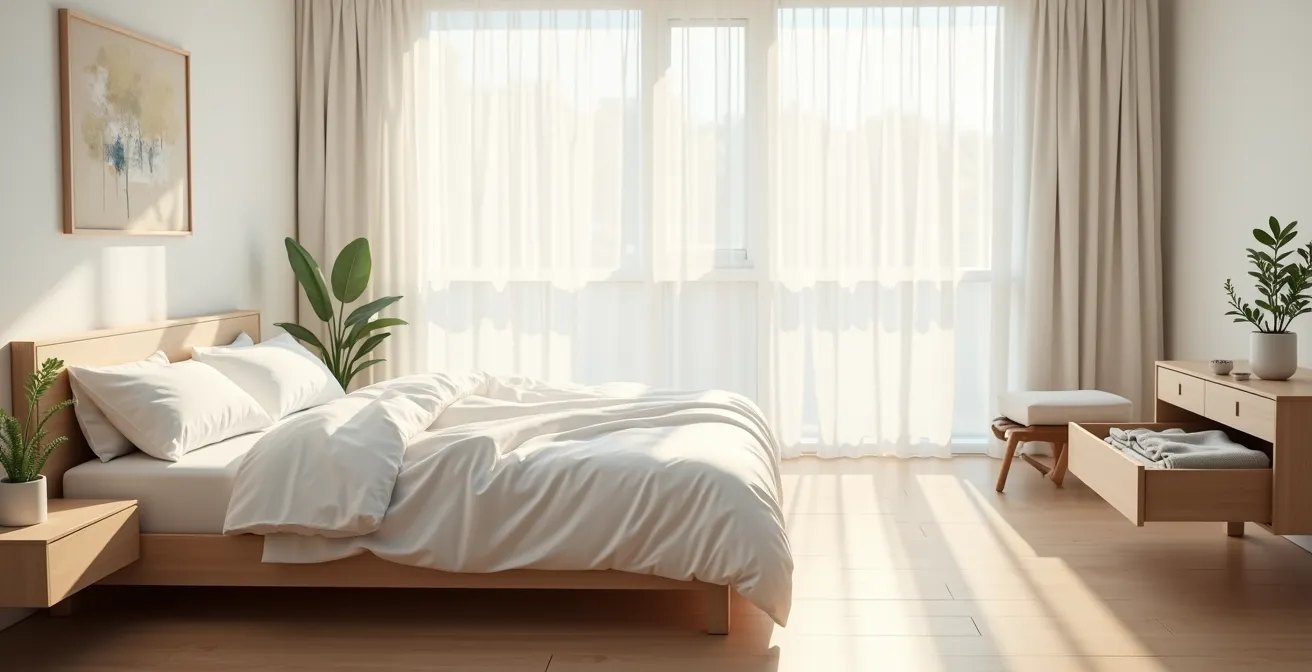
The constant feeling of being overwhelmed by your bedroom isn’t a personal failing; it’s a reaction to visual anxiety and decision fatigue.
- Clutter acts as “visual noise,” constantly demanding your brain’s attention and draining its resources.
- Effective decluttering focuses on reducing the number of decisions you have to make, not just on tidying up.
Recommendation: Instead of aiming for perfection, adopt compassionate strategies like the “Time Capsule” method for sentimental items to create emotional distance and make letting go easier.
If your bedroom feels less like a sanctuary and more like a source of stress, you’re not alone. That low-level hum of anxiety, the feeling of being perpetually unsettled, has a name: visual anxiety. It’s the brain’s natural response to an environment filled with “visual noise”—piles of clothes, stacks of books, and half-finished projects all competing for your attention. For a mind already prone to distraction or overwhelm, this constant sensory input is exhausting.
Most decluttering advice focuses on rigid rules: throw away anything you haven’t used in a year, buy more storage bins, or tackle the whole room at once. While well-intentioned, these approaches often fail because they don’t address the root cause: decision fatigue. The sheer volume of choices required to “get organized” can be paralyzing, leading to shutdown and a cycle of guilt. The problem isn’t your willpower; it’s the strategy.
But what if the solution wasn’t about forcing yourself to be tidier, but about redesigning your environment to be kinder to your brain? This guide offers a different path. We will explore practical, non-judgmental methods that reduce the cognitive load of clutter. By focusing on the psychology behind why we hold onto things and implementing systems that minimize daily choices, you can transform your bedroom from a space of chaos into a genuine haven of calm.
This article provides a complete roadmap, from mastering folding techniques that double your space to building a capsule wardrobe that eliminates daily outfit anxiety. Explore the sections below to find the strategies that resonate most with you.
Summary: A Non-Judgmental Guide to Curing Visual Anxiety
- How to Use the Vertical Folding Method to Double Drawer Capacity?
- Why You Can’t Throw Away Gifts You Hate and How to Let Go?
- The “One In, One Out” Rule That Prevents Clutter from Returning
- Sell or Donate: Is Listing Old Clothes on Vinted Worth Your Time?
- How to Delete 5,000 Emails in 10 Minutes Using Search Filters?
- How to Arrange Your Home Screen to Reduce Dopamine-Driven Clicks?
- When to Rotate Your Wardrobe: Storing Winter Wool Without Moth Damage
- How to Build a 30-Item Capsule Wardrobe That Works for All Seasons?
How to Use the Vertical Folding Method to Double Drawer Capacity?
Drawers often become black holes where clothes disappear, leading to that frantic morning search for a specific t-shirt. The problem isn’t the drawer; it’s the stacking. When clothes are stacked, you can only see the top item, forcing you to rummage and create a mess. The vertical folding method, popularized by Marie Kondo, solves this by turning your drawer into a filing cabinet. Each item stands upright, making every single piece visible at a glance. This simple shift dramatically reduces decision fatigue when getting dressed.
The goal is to fold each garment into a small, stable rectangle that can stand on its own. It might feel awkward at first, but with a little practice, it becomes a quick, meditative process. The payoff is immense: not only do you often double your storage capacity, but you also treat your clothes with more care and instantly know what you own. This visual clarity is a powerful antidote to the chaos of a conventional drawer.

As you can see, the technique focuses on creating smooth, rectangular shapes. This system transforms the act of putting away laundry from a chore into an act of organizing, setting you up for a calmer, more streamlined morning routine. It’s less about “tidying” and more about creating a sustainable system that works with your brain, not against it.
Your Action Plan: 5 Steps to Master Vertical Folding
- Clear the drawer completely and take a moment to wipe the empty space clean.
- Smooth your garment out on a flat surface and fold it into a neat, rectangular shape.
- Fold the rectangle in halves or thirds until the item is compact enough to stand up on its own.
- Leave a small gap at the folded edge to allow the fabric to settle without being crushed.
- File your items vertically from the front of the drawer to the back, arranging them from light to dark colors to enhance visual calm.
Why You Can’t Throw Away Gifts You Hate and How to Let Go?
That itchy sweater from an aunt, the bizarre vase from a well-meaning friend—these items take up more than just physical space. They carry the heavy weight of guilt and obligation. The reason it’s so hard to let go is that we confuse the object with the sentiment. We worry that discarding the gift is a rejection of the person who gave it. This emotional labor is a significant barrier to decluttering and a major source of underlying anxiety.
The purpose of a gift is to convey a sentiment at the moment it’s given. Once that sentiment is received, the object’s primary job is complete.
– Marie Kondo, The Life-Changing Magic of Tidying Up
Internalizing this idea is the first step. The gift fulfilled its purpose of expressing love or appreciation the moment you received it. Thank the item for the role it played, and then give yourself permission to release it. To make this process less daunting, a compassionate strategy is needed. The “Time Capsule Box” method, for example, provides a gentle off-ramp for items you’re not emotionally ready to part with just yet.
Case Study: The Time Capsule Box Method
Professional organizer Cas from Clutterbug often helps clients overcome what she calls “closet bullies”—items that induce guilt or make them feel bad. For one client, Krista, they created a “time capsule” box for sentimental clothing she couldn’t bear to discard. By placing the items in the box and setting a reminder to revisit them in one year, Krista was able to remove the daily guilt from her closet while creating healthy emotional distance. This strategy acknowledges the feeling without letting it control the space.
This approach is echoed by many who find boxing things up a crucial intermediate step. As one person shared after trying the method, “Usually after a week I realize I never use that stuff anyway so I decide to get rid of it sooner – like there was nothing to be anxious about in the first place!” It proves that sometimes, all you need is a little space to make the right decision without pressure.
The “One In, One Out” Rule That Prevents Clutter from Returning
After a major decluttering effort, the last thing you want is for the mess to creep back in. This is where the “One In, One Out” rule becomes your most powerful maintenance tool. The concept is simple: for every new item you bring into your home, a similar item must leave. Buy a new pair of jeans? An old pair goes into the donation bag. This creates a closed-loop system that forces you to be a conscious consumer and prevents the slow, steady accumulation that leads to chaos.
While this rule is excellent for maintenance, what if you’re still in the active decluttering phase? You can supercharge the process. As professional organizer Stacey Agin Murray advises, adopting a “One-In, TWO-Out” or even “One-In, THREE-Out” principle can rapidly reverse accumulation. This accelerated approach creates momentum and helps you reclaim your space much faster. It shifts the dynamic from simply maintaining equilibrium to actively reducing existing clutter.
Case Study: The Advanced One-In-Two-Out Strategy
Stacey Agin Murray of Organized Artistry LLC recommends evolving beyond the basic rule for those feeling truly overwhelmed. She explains, “The way to reduce clutter is to follow the One-in-TWO-Out or One-in-THREE-Out principle until the clutter is reduced enough to handle it and make decisions upon it easily.” This strategy is particularly effective for categories like books, clothes, or kitchen gadgets where duplicates and excess are common. It’s a focused attack on clutter hotspots.
The benefits of such a system extend beyond just a tidy room. A clutter-free environment is directly linked to better mental health and even improved rest. For instance, a study of 1,052 participants with insomnia showed that the simple act of tidying their space improved sleep quality as much as a regular bedtime self-care routine. By controlling the flow of items, you’re not just organizing your home; you’re engineering a more peaceful mind.
Sell or Donate: Is Listing Old Clothes on Vinted Worth Your Time?
Once you’ve decided to let go of clothing, a new dilemma arises: should you sell it or donate it? The allure of earning back some money by listing items on platforms like Vinted or Depop is strong. However, it’s crucial to perform a realistic cost-benefit analysis of your most valuable, non-renewable resource: your time and energy. Selling online requires significant executive function—taking photos, writing descriptions, negotiating with buyers, packaging, and shipping.
For individuals prone to overwhelm, this process can quickly become another source of stress, with bags of “to-be-listed” clothes creating more clutter and guilt. A pragmatic approach is to set a clear threshold. For high-value, branded, or designer items, the financial return might justify the effort. For everyday items, fast fashion, or anything with a potential resale value under a certain amount (say, £20 or $20), the immediate relief and mental freedom of donation are almost always more valuable.

The table below breaks down the trade-offs to help you make a decision that honors both your financial goals and your mental well-being. Sometimes, the most valuable return is the immediate peace of mind that comes from a clear space.
| Method | Time Required | Emotional Cost | Financial Return | Best For |
|---|---|---|---|---|
| Online Selling (Vinted/Depop) | 2-4 hours per 10 items | High (negotiations, shipping stress) | 30-60% of original price | Designer/branded items over £20 |
| Donation | 30 minutes total | Low (immediate relief) | Tax deduction possible | Items under £20 value |
| Consignment | 1 hour drop-off | Minimal | 40-50% of sale price | High-end items only |
| Textile Recycling | 15 minutes | None | None | Worn/damaged items |
How to Delete 5,000 Emails in 10 Minutes Using Search Filters?
The clutter in our bedrooms often mirrors the clutter in our digital lives. An inbox with thousands of unread emails creates the same kind of visual noise and background anxiety as a messy room. Each unread email represents a micro-decision waiting to be made, and the sheer volume can lead to debilitating choice paralysis. In fact, research shows that decision fatigue from making numerous choices in short periods can cause people to completely abandon a task, whether it’s cleaning their inbox or their closet.
The key to a digital declutter is not to read every email, but to use powerful search filters to make bulk decisions. Instead of tackling emails one by one, you can isolate and delete thousands at once. For example, searching for the word “unsubscribe” will instantly pull up years of promotional mailing lists. Searching for emails from a specific sender or with a certain subject line allows you to clear out entire categories in seconds. This isn’t about achieving “inbox zero” overnight; it’s about making a significant, visible dent in the clutter to reduce the cognitive load and reclaim a sense of control.
Follow this quick strategy to make immediate progress:
- Search for “unsubscribe”: This is the fastest way to find and delete hundreds or thousands of promotional emails and newsletters you no longer read.
- Filter by date: Use a search command like “before:2023/01/01” to isolate all emails older than a certain date. For most people, anything over a year old can be safely archived or deleted.
- Mass-select and delete: Once your search has isolated the target emails, use the “select all” function and hit delete or archive. It’s a single decision that clears thousands of items.
- Set up future filters: For recurring senders (like online stores), create a filter that automatically archives or deletes their messages so they never hit your main inbox again.
- Schedule maintenance: Dedicate just 15 minutes once a week to maintain your inbox. This prevents future buildup and keeps the digital clutter at bay.
How to Arrange Your Home Screen to Reduce Dopamine-Driven Clicks?
Your smartphone is a primary source of visual anxiety and distraction. The colorful icons and red notification badges are designed to trigger a dopamine response, compelling you to mindlessly click and scroll. Reclaiming your focus starts with transforming your phone from a temptation machine into a functional tool. The goal is to introduce “intentional friction”—small, deliberate obstacles that make it harder to access distracting apps, thus breaking the muscle memory of habitual checking.
A highly effective strategy is the Grayscale Method. By switching your phone’s display to black and white, you strip away the neurologically stimulating colors, making apps instantly less appealing. The second step is to ruthlessly organize your home screen. Only essential “tool” apps—like your calendar, maps, notes, and camera—should remain on the first page. All “temptation” apps, such as social media, news, and games, should be moved into a single folder on the very last page of your app screen. This forces you to consciously swipe and search for them, turning a mindless habit into a deliberate choice.
Case Study: The Grayscale and Folder Method
Tech experts and mental health advocates recommend combining the grayscale setting with a strategic app layout. Turning on grayscale mode makes the screen significantly less stimulating. At the same time, moving all distracting apps into a folder on the last home screen creates a crucial delay. This intentional friction interrupts the instant gratification loop. Accessing a social media app becomes a conscious, multi-step process rather than a mindless, dopamine-seeking reflex, which helps rewire ingrained digital habits over time.
Disabling notification badges is another critical step. Those little red circles are a form of “visual shouting,” creating a constant sense of urgency and pressure. By turning them off for all non-essential apps, you decide when to engage, rather than letting your phone dictate your attention. This digital decluttering directly lowers your daily cognitive load, leaving more mental energy for the things that truly matter.
When to Rotate Your Wardrobe: Storing Winter Wool Without Moth Damage
For those living in climates with distinct seasons, wardrobe rotation is a non-negotiable ritual for maintaining order. It prevents your closet from becoming an overwhelming mix of bulky sweaters and summer dresses. The best time to perform this switch is during the transitional weekends of spring and autumn—the first consistently warm weekend marks the time to store winter wear, and the first crisp, cold weekend is the signal to bring it back out. This ritual does more than just organize; it’s a chance to take inventory, clean your clothes, and prevent damage.
Proper storage is crucial, especially for natural fibers like wool and cashmere, which are susceptible to moths. Never store clothes in plastic dry-cleaning bags or airtight plastic bins, as this can trap moisture and cause yellowing or mildew. Instead, follow these essential steps:
- Wash everything first: Moths are attracted to dirt, body oils, and food particles, so always wash or dry-clean items before storing them.
- Use breathable containers: Opt for cotton garment bags, canvas bins, or acid-free cardboard boxes. This allows air to circulate while keeping dust and pests out.
- Ditch the mothballs: Traditional mothballs are toxic and leave a lingering, unpleasant smell. Use natural deterrents like cedar blocks, cedar hangers, or lavender sachets.
- Find a cool, dry place: Attics and basements can be prone to humidity and temperature fluctuations. The best storage spots are often high up on closet shelves or in under-bed storage containers in a climate-controlled room.
- Declutter as you go: The rotation process is the perfect opportunity to assess what you didn’t wear all season. Create a “donate/sell” box and be honest with yourself about what deserves to take up space.
This seasonal reset is also a good time to check on other items in your bedroom that have a limited lifespan. To maintain a healthy sleep environment, professional organizers recommend replacing inexpensive polyester pillows every year and memory-foam pillows every 18-36 months. Mattresses typically last 8-10 years. Integrating these checks into your seasonal rotation ensures your entire bedroom remains a healthy, restful sanctuary.
Key takeaways
- Visual anxiety is a real response to environmental overstimulation; your cluttered room is draining your mental energy.
- Focus on reducing “decision fatigue” with systems like vertical folding and capsule wardrobes, rather than just tidying.
- Use compassionate strategies like the “Time Capsule” box to handle sentimental items without guilt or pressure.
How to Build a 30-Item Capsule Wardrobe That Works for All Seasons?
The ultimate strategy for curing wardrobe-related decision fatigue is the capsule wardrobe. This is a minimalist collection of around 30 versatile, high-quality items that you love to wear and that can be mixed and matched to create numerous outfits. By drastically limiting your choices to only the best pieces, you eliminate the daily struggle of “what to wear.” The goal isn’t deprivation; it’s liberation from the overwhelming excess that characterizes most modern closets.
The thought of reducing your entire wardrobe to just 30 pieces can be terrifying. This is why the “Trial Separation” method is so effective. Instead of making irreversible decisions, you select your 30-item capsule and box up the rest of your clothes. Live with only your capsule for one month. This experiment proves the concept’s viability without the anxiety of permanent commitment. Many people are shocked to discover they don’t miss the boxed-up items at all, making the final decision to donate them feel easy and empowering.
Case Study: The Trial Separation Method for Capsule Wardrobes
Instead of immediately donating everything, this method suggests you box up all non-capsule clothes and live with just 30 items for one month. This “trial separation” demonstrates how little you actually need without the fear of making a mistake. It’s a low-risk experiment that proves the viability of a minimalist wardrobe. Most participants report never even opening the boxes, realizing the emotional attachment was far greater than the practical need for the items.
To build a successful capsule, start with a core color palette. Choose two base neutrals (like black, navy, gray, or denim) and one or two accent colors that complement them and that you feel great wearing. Every item you select should work with several others in the collection. The table below offers a few templates to get you started.
| Wardrobe Type | Base Neutrals (2) | Accent Colors (1-2) | Total Items | Season Adaptability |
|---|---|---|---|---|
| Classic Professional | Black, White | Navy, Camel | 30 | Add/remove 5 seasonal pieces |
| Casual Minimalist | Gray, Denim | White, Olive | 30 | Layer for temperature |
| Creative Modern | Black, Cream | Burgundy, Mustard | 30 | Swap accessories seasonally |
By implementing these strategies, you move from a reactive state of constantly tidying messes to a proactive state of designing an environment that supports your mental well-being. Start with the one technique that feels most achievable to you today, and build momentum from there.
Frequently Asked Questions about Digital Decluttering
Should I delete apps or just hide them?
Hide them first. Create a folder labeled “Time Wasters” on your very last app screen. If you haven’t felt the need to open that folder in 30 days, you can confidently delete the apps inside.
What apps should stay on my home screen?
Only “tool” apps that serve a specific, non-distracting purpose should stay. This includes utilities like Maps, Notes, Camera, and Calendar. All “temptation” apps—social media, news, games—should be moved off the main screen to create intentional friction.
How do notification badges affect anxiety?
Notification badges are a form of visual shouting that constantly pulls at your attention and triggers a low-level stress response. They create a false sense of urgency. Turning off all non-essential badges is a crucial step in reducing the constant pressure to engage with your device.