
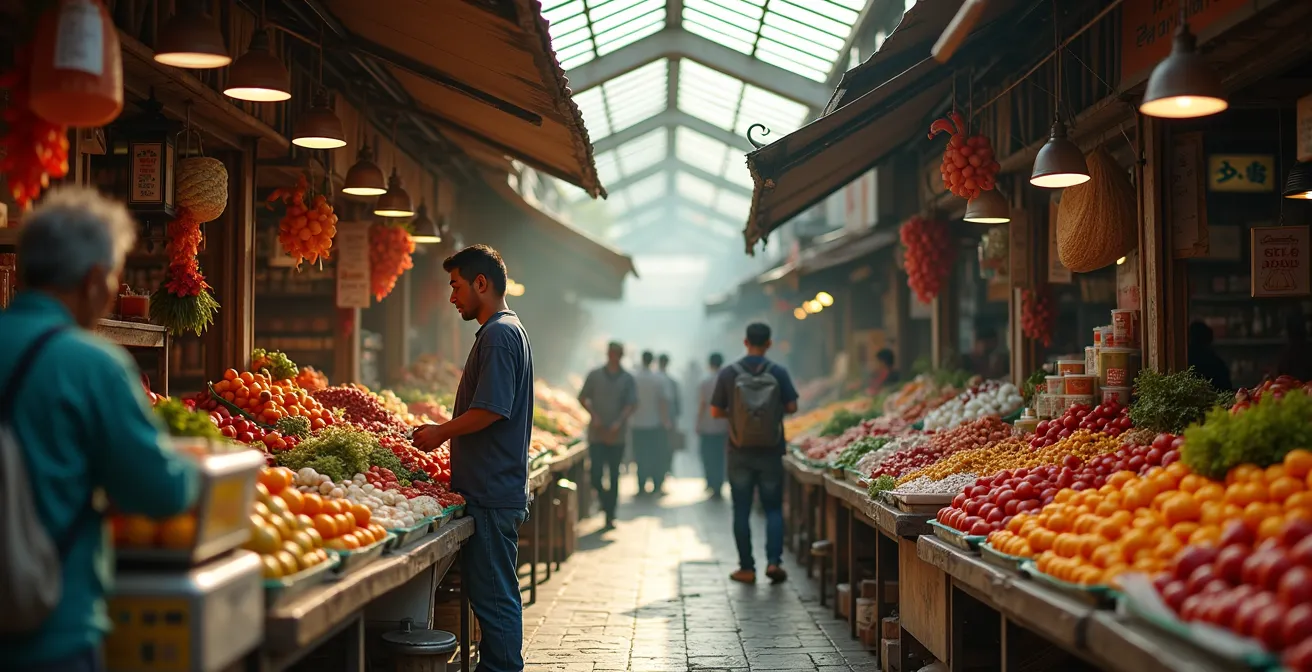
True local food isn’t found, it’s uncovered through a series of investigative techniques that go far beyond online reviews.
- Authenticity is a spectrum, from historical street food recipes to terroir-driven fine dining expressions.
- Environmental signals (clientele, menu design, vendor busyness) are far more reliable than curated online ratings.
Recommendation: Start by observing a local market during the “Chef’s Hour” (4-6 AM) to see where the real experts buy their ingredients.
There’s a universal moment of disappointment every traveler knows: you’ve journeyed thousands of miles, eager to taste the true soul of a city, only to find yourself seated before a glossy, laminated menu featuring pictures of the exact same five dishes you’ve seen at every other restaurant. This is the sanitized, shrink-wrapped version of a culture’s cuisine, designed for tourists, by people who assume they know what tourists want. The frustration is real. You want to eat like a local, to find those hidden gems where flavors are bold and unapologetic, but you’re trapped in an ecosystem of high ratings for mediocre food.
The common advice—”avoid the main square,” “look for crowds”—is a starting point, but it’s often insufficient. The modern tourist trail is sophisticated, creating facsimiles of authenticity that are increasingly hard to spot. The real solution isn’t about finding a better app than TripAdvisor. It’s about changing your entire approach. It requires you to stop being a consumer of reviews and start becoming a culinary investigator, a detective of taste who can read the subtle environmental cues and economic undercurrents of a city’s food scene.
This is not about luck; it’s a learnable skill. This guide will equip you with a forensic framework for finding genuine food experiences. We will move from identifying the clear warning signs of a tourist trap to decoding the complex language of street food, understanding the dual roles of markets, and even using digital tools against the grain to unearth the spots that locals cherish. It’s time to trade the illusion of curated perfection for the thrill of real discovery.
For those who prefer a visual introduction, the following video offers a fantastic immersion into the kind of vibrant street food culture in Athens that awaits when you know how to find it, perfectly complementing the investigative techniques in this guide.
To navigate this investigative journey, we’ve structured this guide to build your skills progressively. You will learn to spot the fakes, engage with confidence, and ultimately develop an instinct for authenticity.
Summary: A Culinary Detective’s Guide to Authentic Eating
- The Picture Menu Warning: 5 Signs A Restaurant Is Not For Locals
- How To Order Street Food In A Foreign Language Using Only Gestures
- Street Stalls Vs Michelin Stars: Which Offers A Truer Taste Of The Culture?
- The ‘Peel It or Cook It’ Rule: How To Eat Adventurously Without Getting Sick
- When To Visit Markets: Timing Your Arrival For The Freshest Local Delicacies
- How To Use Geotags Instead Of Hashtags To Find Untouched Spots
- The Intensity Error: Why Too Much Molecular Technique Ruins The Dish’s Soul
- Second City Tourism: Why Visiting Lyon Is Better Than Paris For Authenticity?
The Picture Menu Warning: 5 Signs A Restaurant Is Not For Locals
Before you can find the authentic, you must first learn to instantly recognize the fraudulent. Tourist-focused restaurants broadcast their identity through a series of predictable signals designed to attract unsuspecting travelers. Your first skill as a culinary investigator is to spot these red flags from a block away. These establishments operate on volume, not repeat business from discerning locals, and their entire model is built on convenience over quality. A recent study confirms this, identifying the top tourist trap criteria as above-average pricing and a lack of cultural authenticity.
The most infamous signal is the glossy, multi-language picture menu. While seemingly helpful, it’s a clear indicator that the restaurant caters to those who can’t read the local language or don’t know the local cuisine. It suggests a transactional, impersonal experience. But the clues don’t stop there. Observe the staff. An authentic, confident establishment doesn’t need a “hawker” on the street, brandishing a menu and pressuring passersby. The best places are often understated, relying on their reputation, not aggressive recruitment.
Pay close attention to the clientele and their timing. A restaurant bustling with tourists at 7 PM is a classic trap. The real evidence is a place filled with office workers on their lunch break around 1 PM or local families gathering for a late dinner. The food itself offers more clues: a menu with an overabundance of fried appetizers or suspiciously repetitive ingredients (e.g., the same sauce on chicken, beef, and fish) often points to a kitchen relying on frozen, mass-produced products rather than fresh, local sourcing. Finally, inspect the dessert menu. If it features international standards like cheesecake or molten lava cake, they are almost certainly not made in-house and serve as a final confirmation that the establishment’s soul is international, not local.
How To Order Street Food In A Foreign Language Using Only Gestures
The language barrier is often the biggest wall between a traveler and authentic street food. Yet, it’s a wall that can be dismantled without uttering a single word. Ordering from a bustling street stall where the vendor speaks no English is not an obstacle; it’s an opportunity to engage in the universal language of food. The key is a simple, confident system of gestures that conveys curiosity and intent clearly and respectfully. This non-verbal dance is a core part of the cultural experience itself.
The process can be broken down into a simple, three-step system. First, the “Curious Point”: approach the stall, make eye contact, smile, and point inquisitively at an ingredient or simmering pot while raising your eyebrows (‘What is that?’). This invites the vendor to show you what they’re making. Second, the “Single Finger Confirmation”: once you’ve identified what you want, hold up a single finger and then point directly at the item (‘One of those, please’). This is an unambiguous signal of purchase. Finally, the “Payment Query”: after you receive your food, rub your thumb and forefinger together (‘How much?’). For an even smoother transaction, use the ‘Show, Don’t Ask’ method: simply hold out a few assorted bills and let the vendor take the correct amount. Trust is a powerful currency.
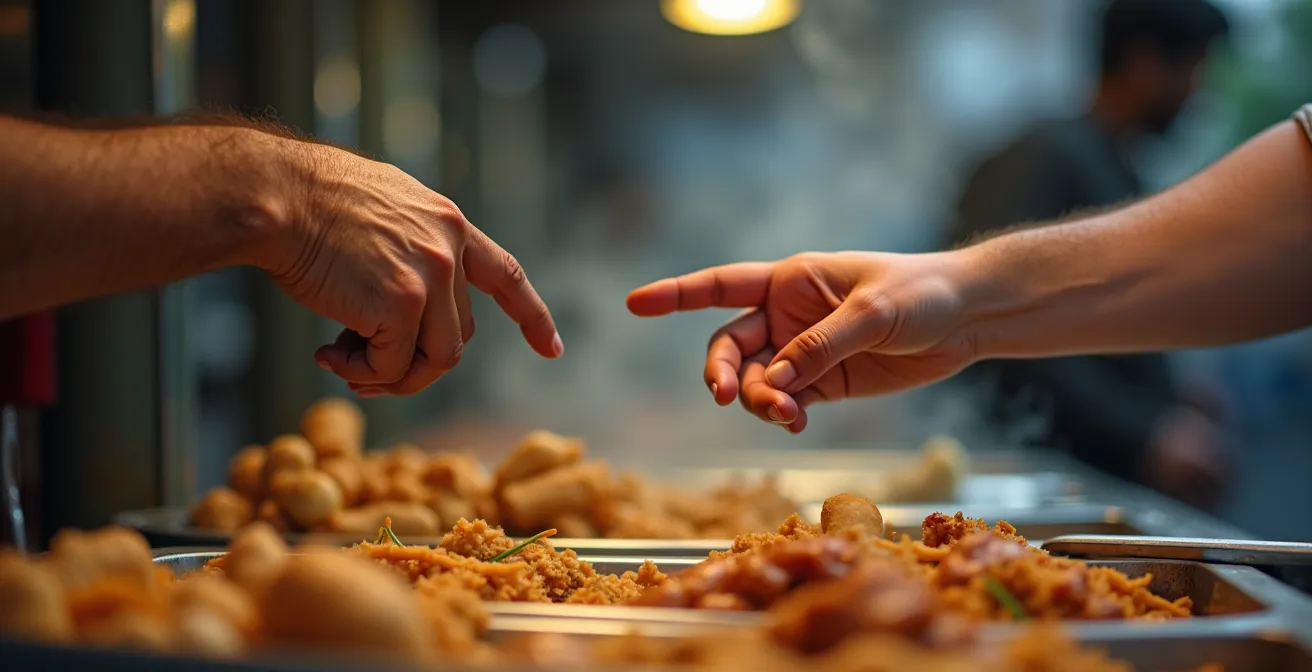
Advanced techniques can elevate the interaction. To sample a sauce, hesitate and give a questioning look while pointing at it; you’ll often be offered a small taste. A quick, dismissive hand wave can politely refuse an unwanted topping. The most effective strategy of all is the “Mimic the Master” technique: watch a local order ahead of you. Observe their exact sequence of points, nods, and gestures, and then replicate it. You’re not just ordering food; you’re showing respect for the local process, which is often appreciated far more than a fumbled attempt at the local language.
Street Stalls Vs Michelin Stars: Which Offers A Truer Taste Of The Culture?
The debate between street food and fine dining often presents a false choice, framing them as rivals for the title of “most authentic.” A true culinary investigator understands that they are not competitors but two complementary windows into a culture’s soul. They represent different facets of authenticity: the historical and the terroir. One tells the story of the people, the other the story of the land. To fully understand a place’s culinary identity, you must experience both.
Street food is the engine of a city’s daily life. It represents historical authenticity—recipes passed down through generations, perfected for speed, affordability, and flavor. These are the dishes that fuel the workforce, the meals shared in moments of haste and community. A bowl of pho on a plastic stool in Hanoi is a direct connection to a history of resourcefulness and a culture of communal eating. Its value is not in the rarity of its ingredients but in its time-tested perfection and its deep integration into the fabric of society.
Michelin-starred restaurants, on the other hand, often strive for terroir authenticity. A visionary chef in Lima might use avant-garde techniques to explore the biodiversity of the Amazon, presenting native ingredients in a way that tells a story about the land itself. This is a culture’s culinary embassy to the world, a showcase of its finest produce and highest technical skill. As one study on food tourism satisfaction notes, travelers value both the historical legacy of street food and the ingredient excellence of fine dining, suggesting that a full culinary spectrum is essential for a complete experience. Neither is “truer” than the other; they are simply different chapters of the same book.
This comparative table, based on an analysis of food’s cultural role, highlights the distinct but equally valid contributions of each.
| Aspect | Street Stalls | Michelin Restaurants |
|---|---|---|
| Authenticity Type | Historical – recipes of the people, passed down generations | Terroir – ultimate expression of native ingredients |
| Cultural Role | Engine of city’s daily life and workforce | Cultural embassy to the world |
| Price Range | $2-10 per meal | $50-300+ per meal |
| Innovation Level | Time-tested traditional recipes | Modern interpretations by visionary chefs |
| Local Integration | Deeply embedded in community | Often caters to international clientele |
The ‘Peel It or Cook It’ Rule: How To Eat Adventurously Without Getting Sick
The fear of getting sick is the single greatest barrier to adventurous eating. The old traveler’s adage—”peel it, cook it, or forget it”—is a decent starting point, but it’s overly simplistic and can cause you to miss out on incredible food. A more nuanced, investigative approach to food safety focuses not just on the food itself, but on the environment and processes of the vendor. The safest food comes from the busiest stalls, a principle savvy travelers call the “High-Volume Heuristic.”
As one travel food safety expert emphasizes in The Food We Know Travel Guide:
The safest street food isn’t just cooked; it’s cooked at a stall that is incredibly busy. High turnover means ingredients don’t sit around, ensuring maximum freshness and reducing risk.
– Travel food safety expert, The Food We Know Travel Guide
This is your most reliable clue. A long line of locals is the ultimate certification of quality and safety. It guarantees that ingredients are fresh and turned over quickly. Look for visible cooking surfaces that are roaringly hot and in constant use. Paradoxically, some of the riskiest items are those that seem “safe,” like pre-cut fruit platters or fresh salads. The danger here isn’t the food, but the potentially contaminated water used to wash it and the time it has spent sitting out. A deep-fried snack, cooked to order in boiling oil, is almost always a safer bet.
Building gut resilience is also part of the strategy. Starting your trip by consuming local probiotic-rich foods like yogurt, kefir, or other fermented drinks can help your system adapt to the local microbiome. Ultimately, the best tool is observation. Locals know which vendors maintain high standards. Following their lead is the most effective safety protocol you can adopt.
Your Action Plan for Safe Street Food
- Assess stall traffic: Prioritize vendors with a long, fast-moving line of locals. This is your primary safety signal.
- Verify cooking heat: Ensure you can see the food being cooked over a visibly hot surface (boiling oil, glowing coals).
- Analyze the queue: Observe the clientele. Locals queuing for a quick meal are a better sign than tourists lingering.
- Avoid pre-prepared “safe” foods: Be more wary of pre-cut fruit and salads than items cooked to order in front of you.
- Build gut resilience: Start your trip by consuming local yogurt or fermented drinks to prepare your digestive system.
When To Visit Markets: Timing Your Arrival For The Freshest Local Delicacies
Visiting a local market is standard tourist advice, but most travelers get it wrong. They arrive mid-day, wander aimlessly, and experience the market as a spectacle rather than a living organism. A culinary investigator knows that *when* you go to a market is more important than *that* you go. The market has distinct phases, each offering a different set of clues and opportunities. Timing your visit strategically transforms it from a photo-op into an intelligence-gathering mission.
The most crucial window is the “Chef’s Hour,” typically between 4 AM and 6 AM. In the pre-dawn darkness, the market belongs to the professionals. This is when the city’s top chefs and restaurant owners arrive to select the absolute best produce, fish, and meat for the day. By observing which stalls they patronize and the specific items they inspect, you are gaining invaluable insider information. This is the market at its most raw and functional. The second key window is the “Local’s Hour,” from roughly 8 AM to 11 AM, when the market is a bustling social hub for daily shoppers. This is the best time to experience the authentic atmosphere and see what regular people are buying for their home kitchens.
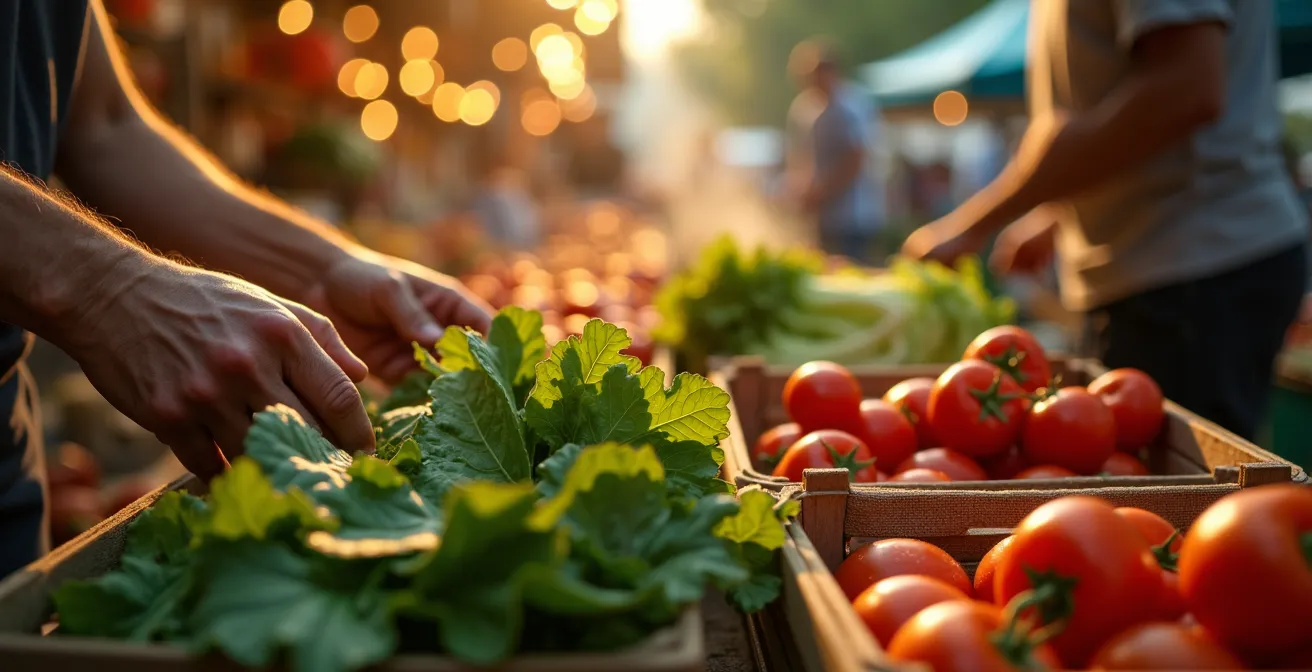
An advanced technique is to apply “Reverse Logistics.” Arrive before the market officially opens to watch the delivery trucks. You can instantly identify the vendors with the freshest ingredients by seeing who is receiving morning deliveries versus who is simply putting out yesterday’s stock. It’s also vital to distinguish between producers and resellers. Producers typically have a more rustic setup, selling a limited range of seasonal items they grew themselves. Resellers, by contrast, offer a suspiciously perfect and vast array of produce available year-round. For true local flavor, always favor the producer.
How To Use Geotags Instead Of Hashtags To Find Untouched Spots
In the age of social media, the search for authenticity has become a digital game of cat and mouse. Hashtags like #foodie or #[city]food are the new tourist traps—crowded digital spaces dominated by influencers and sponsored content. The savvy culinary investigator knows to ignore these broad signals and instead use a more precise digital tool: the geotag. Instagram posts with geotags are not only more engaging, but they also offer a map-based path to discovery.
The method is simple but powerful. Instead of searching for a hashtag, search for the geotag of a major, well-known landmark. Once the map appears, ignore the popular posts from that exact location. Instead, use your finger to physically drag the map one or two streets over into the surrounding residential or commercial neighborhoods. Now, tap “Search this area.” You have just left the digital tourist bubble and entered a visual feed of what real people are eating nearby. Differentiate between the ‘Top’ posts, which are still often influencer-driven, and the ‘Recent’ posts, which provide a raw, unfiltered stream of local life.
Your investigation continues by looking for specific patterns in this ‘Recent’ feed. Hunt for “photo dumps”—10-photo carousels that often start with a casual selfie but are followed by unpolished, unedited pictures of food. These are golden. They are signs of a genuine experience, not a curated performance. When you find a promising spot, your final step is cross-referencing. Verify the location on a locally-popular app (like Tabelog in Japan or Zomato in India) to see what the local consensus is, far from the skewed ratings of international platforms. This digital triangulation—from a broad geotag to a specific neighborhood to a local verification app—is the modern method for finding places that haven’t yet been spoiled by the tourist gaze.
Key Takeaways
- Adopt a “culinary forensics” mindset, treating the search for food as an investigation of signals and evidence.
- Prioritize direct observation—vendor busyness, clientele demographics, menu design—over unreliable online reviews.
- Understand that authenticity exists on a spectrum, from historical street food to terroir-focused fine dining; both are valid cultural expressions.
The Intensity Error: Why Too Much Molecular Technique Ruins The Dish’s Soul
As you move from street stalls to more ambitious restaurants, you encounter a different kind of potential trap: the “Intensity Error.” This occurs when a chef’s obsession with modern technique, particularly in molecular gastronomy, overshadows the ingredients themselves. Foams, gels, and spherifications can be used to amplify a dish’s core flavor, but too often they are used to showcase novelty for its own sake. The result is a plate that is technically impressive but emotionally hollow, disconnected from the ingredient’s soul and the culture’s culinary heritage.
The key to identifying this error is to ask one simple question: “Can I still name the primary ingredient by taste alone?” If a carrot has been transformed into a “soil” so deconstructed that its essential “carrot-ness” is lost, the technique has failed the ingredient. True mastery, or “Technical Humility,” is when immense skill is used invisibly to perfect a traditional element, making a sauce silkier or a piece of fish more succulent without screaming “look at my technique!”
James Beard semifinalist chef Hector Santiago perfectly articulates the opposite of this, the tourist-pleasing adaptation that loses its soul. He describes a tourist trap as a place that makes what they assume a traveler wants, “like pizza how they think an American would want it rather than making a delicious version of pizza that has their spin on it,” as he stated in a commentary on restaurant authenticity. This same principle applies to high-end cuisine. Innovation should serve the ingredient and the culture, not just a desire to appear novel or international. A dish must have an emotional connection, a resonance with a shared cultural experience or memory, to be truly authentic. A technically perfect dish that tastes of nothing but the chef’s ego is the fine-dining equivalent of a picture menu.
Second City Tourism: Why Visiting Lyon Is Better Than Paris For Authenticity?
The final and most strategic application of the culinary detective’s mindset is to apply it not just to a restaurant, but to your choice of destination itself. Capital cities—Paris, Rome, Tokyo—are often epicenters of tourism, and their food scenes, while vast, can be diluted by the sheer volume of visitors. The true heart of a country’s cuisine often beats strongest in its “second cities”: Lyon, not Paris; Bologna, not Rome; Osaka, not Tokyo.
These second cities offer a higher density of authenticity for several reasons. They typically have a lower tourist-to-local ratio, meaning restaurants are more dependent on repeat business from a discerning local clientele. This economic pressure preserves traditional culinary standards. Furthermore, these cities often possess a fiercely proud and distinct regional identity that is less diluted by international influences than the globalized melting pot of a capital. Lyon’s identity as the cradle of French gastronomy is more focused and protected than the sprawling, multifaceted scene in Paris. The result is a food culture that is often more conservative, more specialized, and more deeply rooted in local preferences.
This “Second City Strategy” also yields practical benefits, most notably in value. With a lower price premium, your budget stretches further, allowing for more experiences. The restaurant focus remains on serving the community, not adapting dishes for a transient tourist palate. This is not to say that capitals lack authentic food, but finding it requires significantly more investigative work to sift through the noise. In a second city, the baseline is simply higher.
Choosing a second city is a strategic move that places you directly in an environment where authentic food is the norm, not the exception. The following table breaks down the fundamental differences.
| Comparison Factor | Capital Cities | Second Cities |
|---|---|---|
| Examples | Paris, Rome, Tokyo, New York | Lyon, Bologna, Osaka, Chicago |
| Tourist Density | High – diluted food scene | Moderate – preserved authenticity |
| Local Identity | International, transient population | Strong regional identity |
| Price Premium | 30-50% higher on average | Local market prices |
| Restaurant Focus | Tourist-friendly adaptations | Traditional local preferences |
Now that you are equipped with this investigative framework, the next logical step is to consciously apply it on your next trip. Start by choosing a second city, practice identifying the red flags of tourist traps, and build your confidence by ordering at a busy market using only gestures. This is how you transform from a tourist into a true culinary explorer.