

The most effective networking in an adult sports league happens when you stop trying to “network” and instead use the game as a live demonstration of your professional character.
- Shared struggle on the field acts as a powerful “trust catalyst,” building bonds faster and more authentically than any corporate event.
- Your on-field behavior—how you handle pressure, support teammates, and manage competition—becomes your “character resume,” which is far more revealing than a business card.
Recommendation: Shift your goal from pitching your services to earning the next conversation. Use the post-game social hour to build on the trust you established during the game, with the sole objective of securing an off-site coffee meeting.
For many professionals, the thought of traditional networking—awkward conversations over lukewarm coffee at sterile corporate events—is enough to cause a shudder. The search for a more authentic way to build a professional circle has led many to an unexpected venue: the local adult sports league. It promises a “third space,” a unique environment that is neither the formal office nor the private home, where connections can blossom naturally. But simply showing up to play kickball isn’t a strategy.
The common advice to “just have fun” or “don’t be too intense” misses the point entirely. Without a strategic approach, the sports field can quickly become a place where professional reputations are damaged, not built. The real opportunity lies not in the post-game handshake, but in the game itself. It’s a live-action stage where your character, resilience, and leadership skills are on full display for everyone to see. This isn’t just about playing a game; it’s about managing the signals you send.
This guide moves beyond the platitudes and offers a playbook for transforming your athletic hobby into a powerful networking engine. We’ll explore the psychology of team bonding, the strategic selection of your sport, and the subtle art of transitioning a game-time connection into a real-world professional relationship. By understanding the underlying dynamics, you can leverage the shared experience of competition to build a network founded on genuine trust and mutual respect, not just a stack of business cards.
This article provides a comprehensive playbook for turning your time on the field into a strategic advantage. Explore the sections below to master each aspect of this unique networking environment.
Summary: A Professional’s Playbook to Sports League Networking
- Why Does Suffering Together On The Field Create Stronger Business Bonds?
- Golf Vs Kickball: Which Sport Attracts The Decision Makers You Need?
- How To Handle Winning Against Your Boss Without Damaging Your Career
- The Aggression Error: How Being Too Intense Ruin Your Social Reputation
- When To Pitch: Why The Locker Room Is The Wrong Place To Ask For A Job
- Festivals Vs Workshops: Which Event Type Yields Quality Connections?
- Crossed Arms Vs Open Palms: Which Gesture De-Escalates Office Conflict?
- The 3-Week ‘Dip’: How To Push Through When Motivation Vanishes?
Why Does Suffering Together On The Field Create Stronger Business Bonds?
The conference room and the soccer field are governed by vastly different social contracts, yet the latter is often more effective at forging strong professional ties. The reason lies in a potent psychological phenomenon: shared adversity is a powerful trust catalyst. When a team works together through physical exertion, facing setbacks and celebrating small victories, it creates a unique bonding experience that transactional office interactions can’t replicate. This process bypasses formal pleasantries and gets straight to character assessment.
The science behind this is compelling. A landmark 2005 study published in Nature revealed that oxytocin, often called the “bonding hormone,” significantly increases trust among humans. This hormone is released during shared physical activities and challenges—exactly the environment of a team sport. This biochemical boost makes us more willing to trust and cooperate with our teammates. Furthermore, research shows that groups focused on a shared task build trust at a remarkable rate. In fact, one study found that groups focused on shared tasks build trust 40% faster than those in casual social settings.
On the field, your actions become a living, breathing character resume. Are you the player who encourages a teammate after a mistake? Do you offer a strategic suggestion during a timeout? Do you keep your composure under pressure? These actions provide authentic signals about your reliability, leadership potential, and emotional intelligence—qualities that are highly valued in any professional setting. Your ability to be a dependable team player on Sunday directly translates to how others perceive your potential as a business partner on Monday.
Golf Vs Kickball: Which Sport Attracts The Decision Makers You Need?
Not all sports are created equal when it comes to networking. Your choice of league is the first strategic decision you’ll make, as it directly influences the demographic you’ll interact with and the nature of those interactions. Thinking of the sport as a filter can help you align your networking goals with the right environment. A high-barrier-to-entry sport like golf often attracts a different professional crowd than a low-cost, casual league like kickball.

The key is to match the sport’s culture with your target audience and desired interaction style. Golf provides hours of quiet, one-on-one conversation time, making it ideal for deep discussions with senior-level executives. Conversely, the informal, high-energy atmosphere of soccer or softball allows your personality to shine in a larger group setting, demonstrating your ability to collaborate and fit into a team dynamic. It’s about choosing the stage that best showcases your strengths to the audience you want to reach.
The following table breaks down the networking dynamics of common adult sports, providing a framework for making a strategic choice based on your professional objectives.
| Sport Type | Cost/Barrier | Social Formality | Typical Participants | Networking Dynamics |
|---|---|---|---|---|
| Golf | High ($500-2000/month) | Formal | C-suite executives, senior business owners | Long 1-on-1 conversations, guarded interactions |
| Kickball/Softball | Low ($50-150/season) | Informal | Junior to mid-level professionals | High authenticity, group bonding, casual atmosphere |
| Tennis/Squash | Medium ($100-400/month) | Semi-formal | Individual performers, strategic thinkers | Intense 1-on-1 interactions, private club access |
| Soccer/Basketball | Low ($75-200/season) | Informal | Collaborative team players, diverse industries | Broadcasting personality to large groups, team dynamics |
How To Handle Winning Against Your Boss Without Damaging Your Career
The scenario is both a dream and a nightmare: the game is on the line, and you’re up against your boss. Winning could bring glory, but could it also bring professional awkwardness? Navigating this delicate situation is a masterclass in social intelligence. The key is to separate the on-field competitor from the off-field professional. Your goal is to win the game without making your boss feel like they’ve lost.
Immediately after a winning play, your first move should be to deflect the spotlight. Frame the victory as a team success, not a personal triumph. Publicly praising a specific, positive contribution your boss made earlier in the game is an excellent strategy. It shows that you value their contribution and respect them, regardless of the final score. Self-deprecating humor can also be a powerful tool to diffuse any potential tension (“I think I used up all my luck for the year on that one play!”).
The post-game social setting is where you solidify the positive outcome. Offering to buy the first round of drinks for your boss or the team is a classic gesture of goodwill. This small act shifts the dynamic from competitors back to colleagues and friends. Ultimately, handling this situation gracefully demonstrates high emotional intelligence—a far more valuable career asset than a single win in a recreational sports league.
The Gracious Winner Protocol: Points to Follow
- Immediately deflect the spotlight after a winning play—frame it as a team success (“Great game everyone!”).
- Publicly praise a specific positive contribution your boss made earlier in the game.
- Use self-deprecating humor (“I think I broke my personal record for luck today”).
- Offer to buy the first round of drinks for your boss or the team.
- Assess your boss’s personality type beforehand—a ‘Competitor Boss’ respects skill, while an ‘Ego-Driven Boss’ needs to have a fun experience.
- Follow up the next day with a message focusing on their good plays, not your win.
The Aggression Error: How Being Too Intense Ruin Your Social Reputation
There’s a fine line between healthy competition and destructive aggression, and crossing it in an adult sports league can be career suicide. The “Aggression Error” occurs when a player channels their intensity in a negative way—yelling at referees, criticizing teammates, or displaying poor sportsmanship. This behavior doesn’t project “winner”; it projects “difficult to work with.” Your on-field persona is a powerful signal, and becoming “The Hothead” is the fastest way to repel the very connections you’re trying to make.
The goal is to reframe your competitive drive into positive leadership. Instead of arguing a call, you can channel that energy into encouraging teammates after a mistake. Instead of complaining about a bad play, you can focus on organizing strategy during the next timeout. This is active signal management: consciously transforming raw intensity into desirable professional traits like resilience, strategic thinking, and supportive leadership. People want to work with problem-solvers and motivators, not complainers.
Organizations that master this balance see incredible results, not just in networking but in team building. This approach turns a simple game into a valuable training ground for corporate culture.
Case Study: The Spark Social Sports Model
Spark Social Sports in Connecticut provides a powerful example. Growing from 200 participants to over 10,000 in seven years, its success is built on fostering a fun, inclusive atmosphere. The founder attributes this growth to an environment where competitive intensity is channeled into positive leadership. Participants consistently report that the leagues serve as “excellent networking and team-building activities,” where corporate teams strengthen their internal bonds while making valuable connections with professionals from other organizations. This demonstrates that a positive, well-managed competitive environment is a fertile ground for professional growth.
When To Pitch: Why The Locker Room Is The Wrong Place To Ask For A Job
The ultimate goal of networking is to create opportunities. With studies indicating that as many as 70% of job opportunities are never advertised publicly, informal networks are more critical than ever. However, there is a time and a place for everything, and the moments immediately following a game—in the locker room or on the sidelines—are definitively the wrong place to make a business pitch or ask for a job. This is a crucial boundary to respect in the “third space” of a sports league.
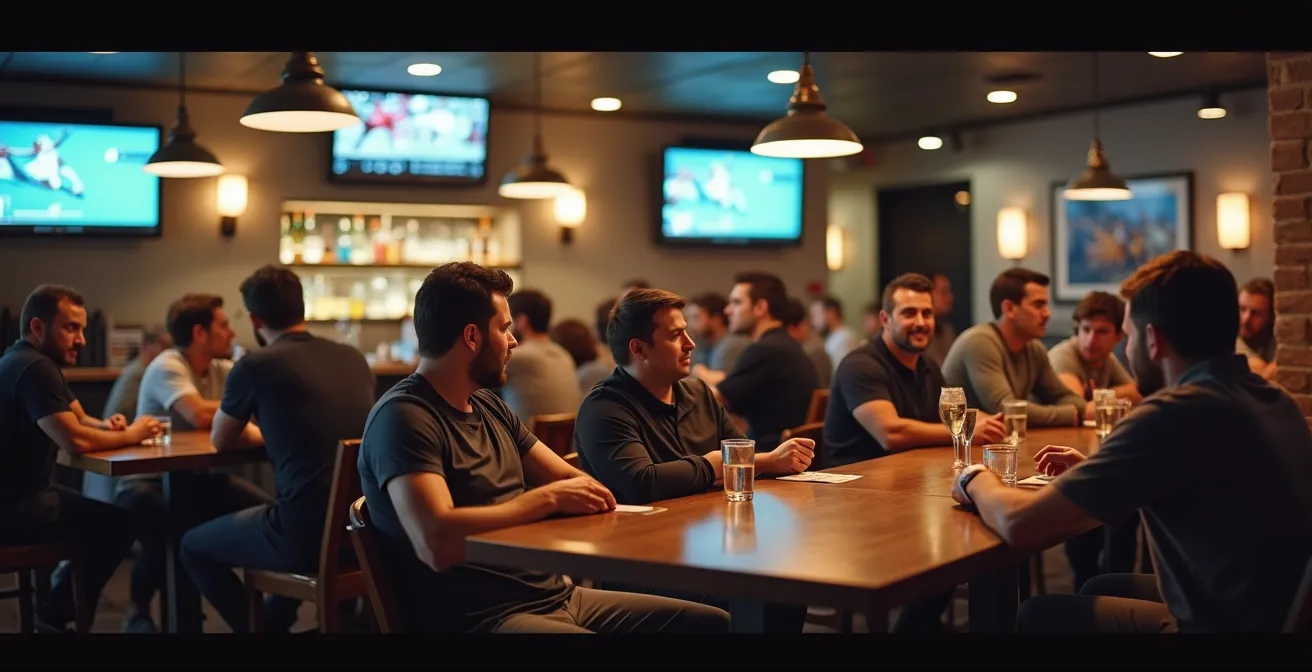
The transition from the game to a professional conversation must be gradual and earned. Think of it as a conversion funnel with distinct phases. The game itself is about building rapport and demonstrating your character. The immediate post-game cool-down is for discussing the game and sharing the collective experience. It’s only after this phase, typically at the post-game bar or social gathering, that a window for a gentle transition might open. A simple, open-ended question like, “So, what keeps you busy when you’re not a star pitcher?” can organically shift the conversation.
Even then, the goal is not to close a deal or secure an interview on the spot. The real objective is to earn the next conversation. Your aim should be to pique their interest enough to secure an off-site coffee meeting, where a proper business discussion can take place. Suggesting, “I’m fascinated by what your company does. Would you be open to a quick coffee next week so I could learn more?” is the perfect, low-pressure ask. It respects the social context of the league while creating a clear path toward a professional opportunity.
Action Plan: The Three-Phase Conversation Framework
- Phase 1 – Game & Field: Maintain zero business talk. Your entire focus should be on the sport, your team, and demonstrating your positive character traits. This is the rapport-building stage.
- Phase 2 – Post-Game Cool Down (First 30 minutes): The conversation should only be about the game that just finished. Re-live great plays, laugh about mistakes, and discuss team performance.
- Phase 3 – Social Opening (After game talk dies down): As the energy shifts, transition naturally with a question like, “So what keeps you busy when you’re not being a star shortstop?”
- The Real Goal: Your objective in this third phase is not to pitch, but to earn an off-site coffee meeting. Frame it as a desire to learn: “I’d love to hear more about your work. Would you be open to coffee next week?”
- The Digital Bridge: Connect on LinkedIn within 48 hours. Your connection request must include a personalized note referencing a specific, positive moment from the game to anchor the connection.
Festivals Vs Workshops: Which Event Type Yields Quality Connections?
Just as the sport you choose matters, so does the format of the athletic event. When your goal is to build deep, trust-based professional relationships, the structure of the league plays a pivotal role. We can think of the options in terms of “festivals” (one-day tournaments, charity events) versus “workshops” (a multi-week seasonal league). While festivals offer high-volume, brief interactions, they often lead to surface-level connections. They are great for lead generation or collecting a large number of contacts quickly.
In contrast, the “workshop” model of a 10-week season is designed for depth over breadth. Repeated interactions with the same group of people over several months allow your “character resume” to be seen consistently. It’s through this repetition that genuine friendships and trust are built. Teammates and opponents alike get to see you handle wins, losses, pressure, and fatigue over time, providing a much more accurate and reliable portrait of your personality and professionalism. This sustained exposure is what turns a casual acquaintance into a trusted professional ally.
Case Study: The Power of the Seasonal Model
The Chicago Sport and Social Club, the largest organizer of adult sports in the United States with over 100,000 annual participants, built its entire model on this principle. Their success demonstrates that weekly league participation is far more effective for building strong professional networks than one-off events. Members consistently report that the repeated interactions over the course of a season are what lead to genuine friendships and tangible business partnerships, with many participants signing up for multiple seasons specifically for these high-quality networking benefits.
The choice between these formats depends entirely on your networking goals, as outlined in the comparison below.
| Format | Duration | Interaction Type | Networking Goal | Relationship Depth |
|---|---|---|---|---|
| One-Day Tournament | 4-8 hours | High volume, brief interactions | Lead generation, contact collection | Surface-level connections |
| 10-Week Season | 2-3 months | Repeated interactions with same group | Trust building, character demonstration | Deep, trust-based relationships |
| Charity Events | Single day | Cause-oriented interactions | Values alignment, CSR connections | Purpose-driven connections |
Crossed Arms Vs Open Palms: Which Gesture De-Escalates Office Conflict?
The sports field is an emotionally charged environment. This heightened state makes non-verbal communication incredibly powerful, offering a live laboratory for understanding how body language affects perception. The lessons learned here are directly transferable to the more subdued, but often just as tense, environment of the office. As research highlights, our non-verbal cues can carry more weight than our words, especially under pressure.
In a heightened emotional and physical state, non-verbal cues are more powerful than in an office.
– Body Language Research, Sports Psychology Quarterly
On the field, approaching a referee with pointing fingers and tense shoulders signals aggression and closes them off to your argument. Approaching with open palms and a calm posture signals a desire for collaboration and de-escalates the situation. This exact principle applies when you’re approaching a colleague or manager to discuss a point of conflict. Crossed arms signal defensiveness and disagreement, while open palms and leaning in slightly signal receptiveness and a willingness to find a solution. Your posture can either build a wall or open a door before you’ve said a single word.
By consciously practicing positive body language in a low-stakes sports setting, you can train yourself to use it instinctively in high-stakes professional situations. Pay attention to how you and others react to these non-verbal signals. This form of signal management is a subtle but potent skill for conflict resolution and building a reputation as an approachable and collaborative professional.
- Open Palms vs. Pointing Fingers: Approaching a referee (or a colleague) with open palms models conflict resolution, while pointing fingers communicates blame.
- Pat on the Back: This simple gesture after a teammate’s error (or a colleague’s misstep in a project) builds immense social capital and signals a supportive nature.
- Hands on Hips: This stance projects frustration and impatience. Standing tall and nodding projects approachable authority instead.
- Helping an Opponent Up: This is the ultimate signal of a collaborative nature, showing you prioritize sportsmanship (and mutual respect) over pure competition.
Key Takeaways
- Shift your mindset from “talking business” to demonstrating character; your actions on the field are your most powerful resume.
- Be strategic in your choice of sport and league format; align the environment with your specific networking goals for relationship depth.
- Master the art of the transition; the goal of post-game socializing is not to make a pitch, but to earn a dedicated, off-site conversation.
The 3-Week ‘Dip’: How To Push Through When Motivation Vanishes?
Every professional who joins a sports league with networking in mind faces a critical moment: the 3-week ‘dip’. The initial excitement fades, muscle soreness sets in, and the commitment starts to feel like a chore. With recent surveys indicating that nearly one-third of adults are physically inactive, it’s no surprise that sticking with a new routine is difficult. This is the point where most fair-weather players drop out. For the strategic networker, however, this dip is not a crisis; it’s an opportunity.
Pushing through this period sends the most powerful signal of all: reliability and commitment. When you continue to show up consistently, you become part of the core group. The bonds formed among those who persevere through the dip are exponentially stronger. This is when superficial acquaintanceships transform into genuine relationships, because you have all passed a small, shared test of endurance. Your consistent presence proves you’re someone who follows through, a highly desirable trait in any professional context.
To overcome this dip, it’s helpful to gamify your own consistency. Reframe your objectives beyond just networking. Create small, personal goals that are entirely within your control. This shifts the focus from an external outcome (making a contact) to an internal one (personal improvement and consistency), which is a far more sustainable source of motivation. By making it through this phase, you not only build stronger bonds but also demonstrate a key professional strength.
- Create a personal points system: Award yourself 1 point for showing up, 2 for learning a teammate’s profession, and 3 for having a significant non-sports conversation.
- Set skill-based goals: Focus on improving your shot accuracy or playing a full game without needing a substitute. This detaches your motivation from networking success.
- Find an accountability buddy: Partner with a teammate and commit to showing up for each other, especially during weeks 3 and 4 when motivation is lowest.
- Reframe the dip as an opportunity: Recognize that this is when the most dedicated members of the group are revealed, and the strongest bonds are forged.
Now that you have the playbook, the next step is to choose your field and put these strategies into practice. Start by evaluating leagues not just for fun, but for their strategic fit with your professional goals.
Frequently Asked Questions About Networking in Sports
What if I get too heated during a game?
Immediately offer a quick, sincere apology on the field (‘Sorry, got too caught up in the game’). Follow up at the bar with another apology showing self-awareness. This can actually strengthen bonds by demonstrating humility.
How can I show leadership without being aggressive?
Channel competitive energy into encouraging teammates after mistakes, calling out smart plays by others, and organizing strategy during timeouts. This transforms intensity into desirable leadership qualities.
What personal brand should I cultivate on the field?
Choose between being ‘The Diplomat’ who calms tensions, ‘The Strategist’ who sees the whole field, or ‘The Encourager’ who boosts team morale. Avoid becoming ‘The Hothead’ at all costs.