

A high-quality leather bag is an asset whose value is determined by its structural integrity and material science, not its logo.
- True quality is found in tangible details like hand-sewn saddle stitching and vegetable-tanned leather that develops a rich patina over time.
- Calculating the “Cost-Per-Wear” reveals that a well-made, unbranded bag often provides superior long-term financial value compared to a logo-driven purchase.
Recommendation: To make a true “forever bag” investment, shift your focus from brand names and seasonal sales to a methodical assessment of materials, construction, and long-term durability.
For the discerning professional, the search for a “forever bag” can be a frustrating exercise. You appreciate fine craftsmanship and desire an accessory that will endure for decades, but the market is saturated with brand-driven price tags that often reflect marketing budgets more than material quality. You might see a beautifully designed bag, yet without a recognizable logo, a crucial question arises: is it a hidden gem or a well-disguised piece of fast fashion? The common advice—to “check the hardware” or “smell the leather”—is often too superficial to provide a confident answer.
The truth is, evaluating a luxury leather good is less an art and more a science. It requires moving past the surface and adopting the mindset of an appraiser who assesses an asset’s intrinsic worth. The key isn’t in recognizing a brand, but in understanding the indicators of structural integrity, patina potential, and long-term financial performance. The most valuable bags are not necessarily the most expensive at purchase, but those that deliver the lowest cost-per-wear over a lifetime of use.
This guide provides a systematic framework for that appraisal. We will deconstruct the anatomy of a superior leather bag, moving from the microscopic properties of the leather itself to the economic principles of a smart purchase. By learning to identify these non-obvious markers of quality, you can invest with confidence, knowing the value lies in the object itself, not in the name attached to it.
Contents: How to Appraise a Leather Bag for Lasting Value
- Quartz vs Automatic: Which Movement Holds Value Better Over 10 Years?
- The Stitching Detail on Designer Belts That Fakes Always Get Wrong
- Why Hanging Your Silk Scarves ruins Their Shape and Texture?
- When to Buy: Is the January Sale Actually Cheaper for Designer Shoes?
- The Leather Conditioner Mistake That Darkens Vintage Patina Irreversibly
- Trench Coat or Leather Jacket: Which Outerwear Offers Better Cost-Per-Wear?
- Treehouse vs Underwater Hotel: Which Experience Is Worth the $500/Night?
- How to Build a 30-Item Capsule Wardrobe That Works for All Seasons?
Quartz vs Automatic: Which Movement Holds Value Better Over 10 Years?
In the world of horology, this debate reveals a fundamental principle of value: do you prefer unwavering consistency or character that develops over time? A quartz movement is precise and low-maintenance, yet its value remains static. An automatic movement, with its intricate mechanics, requires care but gains a story and often appreciates in value. This same logic applies directly to leather. As esteemed 40-year leather craftsman Frank Clegg notes, the ultimate quality of leather is determined by two factors: “the hide selection and the tanning process.”
Chrome-tanned leather is the “quartz” of the industry. It’s produced quickly, is often water-resistant, and maintains its color uniformly for years. However, it lacks the ability to develop a rich, personal story. In contrast, vegetable-tanned leather is the “automatic movement.” This traditional, slower tanning method results in leather that breathes, evolves, and develops a unique patina—a warm glow and darkening in high-contact areas. This is the hallmark of an investment-grade piece, as it gains character and visual value with age, much like a well-maintained mechanical watch.
Your Audit Checklist: 5 Signs of Investment-Grade Leather
- Examine the Edges: High-quality, full-grain leather will have raw, fibrous edges, not perfectly smooth, painted, or plastic-coated ones. This indicates the hide’s natural structure is intact.
- Check Stress Points: Look for reinforcement with double stitching or metal rivets where handles and straps attach. This signals a design built for longevity and repairability.
- Identify the Tanning Method: Vegetable-tanned leather often has a richer, more earthy scent and will slightly change color when you bend it, demonstrating its ability to develop a patina.
- Test the Flexibility: Bend a corner. Quality leather should curve naturally and return to its shape. If it feels stiff, plastic-like, or creases harshly, it’s a lower-grade material.
- Verify Provenance Markers: Look for small, discreet stamps indicating origin (e.g., tanneries in Tuscany, Italy, or Horween in the USA). These are signals of superior raw materials.
The Stitching Detail on Designer Belts That Fakes Always Get Wrong
While this detail is a notorious giveaway on counterfeit belts, it is perhaps the single most revealing sign of structural integrity on any high-end leather good, especially a bag. The difference lies in a method that cannot be easily replicated by mass-production machinery: the hand-sewn saddle stitch. From a distance, all stitching might look the same, but an appraiser’s eye looks for the distinctive angle and robustness that signals hours of skilled labor.
A machine lockstitch uses two separate threads that “lock” together in the middle of the leather. If one of these threads breaks, the entire seam can quickly unravel, much like a snag in a sweater. In contrast, a hand-sewn saddle stitch uses a single, continuous thread passed back and forth through the same hole. This creates an incredibly durable, interlocking stitch; if one stitch breaks, the rest of the seam remains firmly intact. This is a non-negotiable feature of an investment-grade bag designed to last for generations, not just seasons.
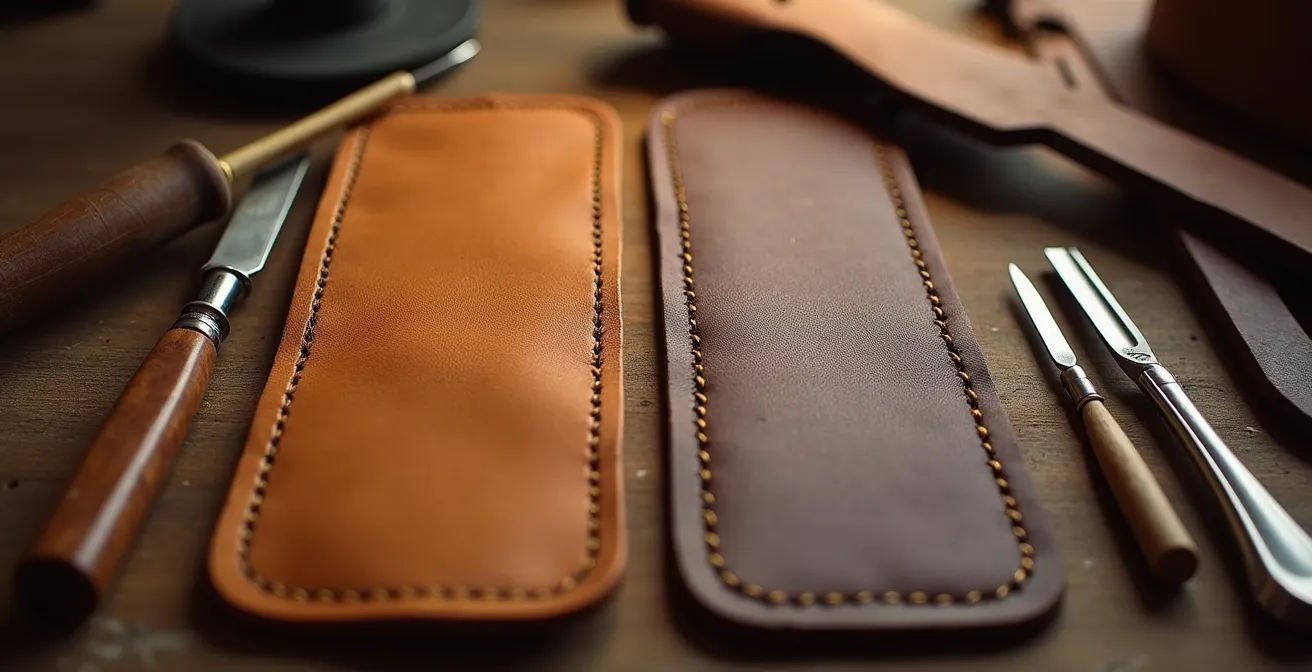
The visual tell is the angle. Machine stitching is almost always perfectly straight. A hand-sewn saddle stitch, due to the motion of the two needles, has a characteristic slant. The table below, based on an analysis from leather goods specialists Mission Mercantile, breaks down these crucial differences.
| Feature | Hand-Sewn Saddle Stitch | Machine Lockstitch |
|---|---|---|
| Thread Configuration | Single continuous thread | Two separate threads that interlock |
| Durability | Cannot unravel if thread breaks | Will unravel from break point |
| Angle | Distinctive slanted appearance | Perfectly straight stitches |
| Thread Type | Thick waxed linen or bonded synthetic | Thin cotton or basic nylon |
| Production Cost | High (skilled artisan labor) | Low (automated process) |
| Time Required | 30-60 minutes per item | 2-5 minutes per item |
Why Hanging Your Silk Scarves ruins Their Shape and Texture?
The principle behind why one should never hang a delicate silk scarf—gravity causing permanent stretching and distortion—applies with equal force to a quality leather bag. Storing a bag by its handles places constant, concentrated stress on the handle attachments and deforms the bag’s silhouette. This is a critical error that can sabotage the long-term value and structural integrity of your investment. Proper storage is not passive; it is an active part of preserving the asset.
The goal is to counteract gravity and maintain the bag’s intended shape. This means storing it upright on a shelf, never hanging. To prevent sagging and creasing, the interior should be lightly stuffed with acid-free tissue paper or specialized cotton pillows—never newspaper, as the ink can transfer and stain the lining. This maintains the bag’s architecture while the leather “rests.”
Case Study: The 5-Year Patina Development of a Properly Stored Duffle
An observation by Articles of Style documented a Frank Clegg vegetable-tanned leather duffle bag over five years of regular use. The bag was never hung by its handles; instead, it was stored upright and stuffed with acid-free paper when not in use. After five years, the bag had developed a magnificent, rich chestnut patina. Crucially, its core structure remained perfectly intact, with no sagging or stress marks at the handle attachments. This demonstrates that proper care allows investment-grade leather to gain aesthetic value (patina) without suffering structural degradation.
Furthermore, leather requires a stable environment. Storing it in a breathable dust bag within a closet with 40-50% humidity prevents the dual threats of mold (from too much moisture) and cracking (from excessive dryness). Avoid direct sunlight and heat sources at all costs, as they break down the natural oils in the leather, causing it to become brittle and frail.
When to Buy: Is the January Sale Actually Cheaper for Designer Shoes?
The allure of a January sale often creates a false sense of value. For an investor, the critical question isn’t “is it cheaper?” but “is it a good value?” When it comes to luxury goods, discounted items are not always the deal they appear to be. As industry analysis highlights, bags found in outlets are often from a separate, lower-quality manufacturing line made specifically for that channel. True investment-grade pieces are rarely subject to deep seasonal discounts.
A much smarter acquisition strategy is to understand the secondary market. According to leather market analysis, classic, well-maintained leather bags often retain 60-70% of their original retail value on the pre-loved market after one year. This demonstrates that high-quality leather is an asset that holds its worth, making the initial purchase price less of an expense and more of a capital allocation. A savvy buyer focuses on acquiring a piece with high value-retention potential rather than chasing a 20% discount on an item of inferior quality.
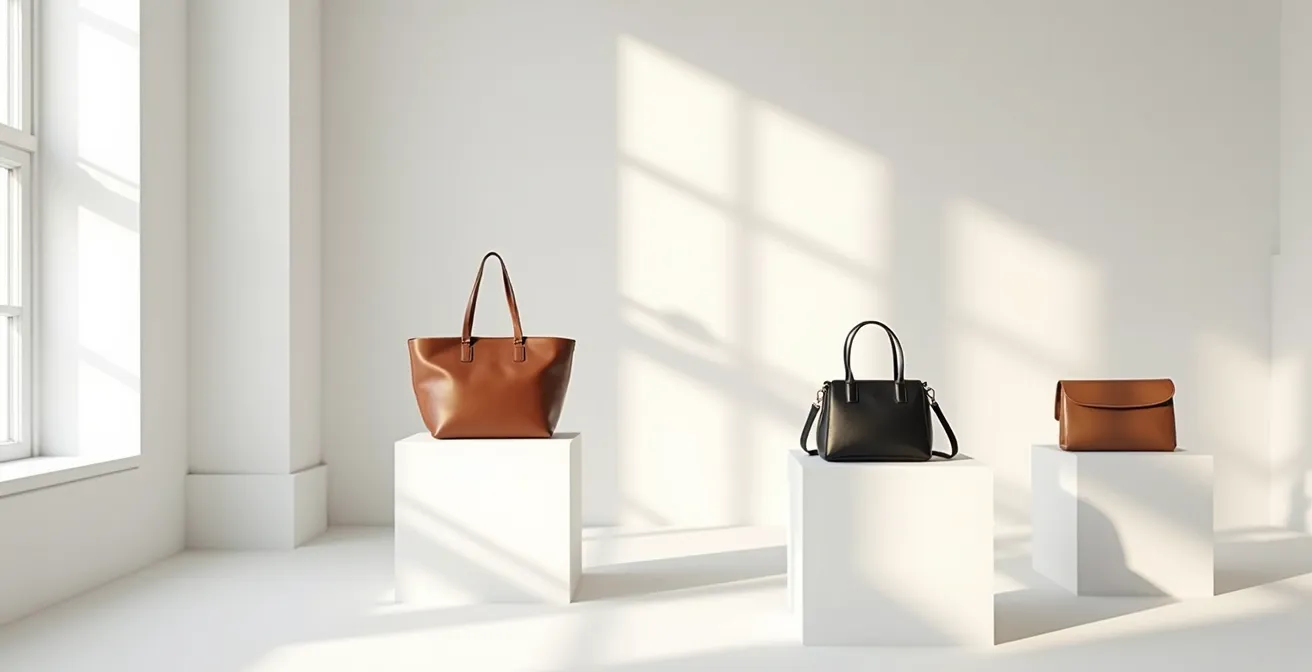
Therefore, the best “when to buy” is not tied to a specific month, but to when you have identified a piece with superior materials and construction. Paying full price for an artisan-made bag that will last 20 years is a far better financial decision than buying a discounted, mass-produced bag that will need replacing in three. The focus must shift from purchase price to lifetime value.
The Leather Conditioner Mistake That Darkens Vintage Patina Irreversibly
Applying the wrong conditioner to a quality leather bag is one of the most common and tragic mistakes an owner can make. It is the chemical equivalent of polishing a vintage silver coin, which instantly strips away its valuable patina and destroys its historical worth. Using a generic, petroleum-based conditioner on a piece of fine vegetable-tanned leather can cause immediate and irreversible darkening, ruining the very patina you hoped to nurture.
The science behind this is a matter of pH balance. As detailed in testing by leather specialists Nordform, vegetable-tanned leather has an acidic pH (typically 3.5-5.0). Many common conditioners are alkaline (pH 7.0+). When the alkaline product meets the acidic tannins in the leather, a chemical reaction occurs, causing a permanent and often splotchy darkening. You are not conditioning the leather; you are essentially re-dyeing it in an uncontrolled way.
Case Study: Nordform’s pH Testing and Irreversible Darkening
Nordform conducted tests on their Italian vegetable-tanned leather samples. When treated with standard petroleum-based conditioners, the samples showed significant, irreversible darkening within 24 hours. The alkaline chemicals reacted with the acidic tannins, destroying the leather’s natural color and its potential to develop a nuanced patina. In contrast, samples treated with a pH-matched, natural oil-based cream showed minimal color change and enhanced suppleness, preserving the leather’s investment-grade characteristics.
Choosing the right product is therefore essential. The type of leather dictates the type of conditioner, as different tanning processes create different chemical compositions. A light, pH-neutral cream is required for delicate vegetable-tanned leathers, while a more robust balm with beeswax might be suitable for durable chrome-tanned work bags.
| Leather Type | Recommended Product | Effect on Color | Application Frequency |
|---|---|---|---|
| Vegetable-Tanned (Patina) | Light leather cream (e.g., Bick 4) | Minimal change | Every 6-12 months |
| Chrome-Tanned (Smooth) | Leather balm with beeswax | Slight darkening | Every 3-6 months |
| Work/Rustic Leather | Neatsfoot oil | Significant darkening | As needed for conditioning |
| Delicate/Dress Leather | Specialized cream only | No change if correct product | Sparingly, 1-2 times yearly |
Trench Coat or Leather Jacket: Which Outerwear Offers Better Cost-Per-Wear?
This classic wardrobe question introduces the single most important metric for any savvy investor: Cost-Per-Wear (CPW). A $2000 bag used daily for a decade is a far better investment than a $500 bag that lasts only two years. The initial price tag is misleading; the true cost of an item is its total cost divided by the number of times you use it. Calculating CPW transforms your perspective from “how much does this cost?” to “how much value will this provide?”
A high-quality, full-grain leather bag is an undisputed champion in delivering a low CPW. Its durability means it can withstand years, even decades, of regular use. A durability analysis by leather goods brand WP Standard illustrates this powerfully: a $1500 full-grain leather bag, used 250 days a year for 15 years, achieves a remarkable $0.40 cost-per-wear. In contrast, a trendy, lower-quality bag might have a lower initial price but a much higher CPW due to its short lifespan.
To apply this framework to your own purchases, you must become a diligent accountant of your wardrobe. Track the purchase price, estimate the number of days you’ll realistically use the item per year, and be honest about the material’s expected lifespan. Full-grain leather can last over 15 years; “genuine” leather often fails within 2-5 years. This calculation provides an objective, data-driven way to justify investing in a higher-priced, higher-quality piece. It’s the ultimate tool for moving beyond emotional purchases and making sound financial decisions for your collection.
Key Takeaways
- Material Matters Most: The “automatic vs. quartz” analogy holds true. Vegetable-tanned leather develops valuable patina over time, while chrome-tanned leather remains static.
- Construction is Non-Negotiable: Hand-sewn saddle stitching is a hallmark of durability and craftsmanship that machines cannot replicate, ensuring the bag’s structural integrity for decades.
- Adopt an Investor’s Metric: Shift focus from the purchase price to the Cost-Per-Wear (CPW). A higher initial investment in a durable, well-made bag yields a significantly lower true cost over its lifespan.
Treehouse vs Underwater Hotel: Which Experience Is Worth the $500/Night?
When you buy a bag from a major luxury house, you are not just buying leather and thread. You are paying for the “Underwater Hotel”—the massive marketing campaigns, the prime retail real estate, the celebrity endorsements. This overhead is built into the price. In contrast, when you buy from an independent artisan, you are paying for the “Treehouse”—the raw materials and the skilled labor required to build it. The experience is more direct, more authentic, and often, a much better value.
With an independent artisan, the cost is almost entirely materials and labor—the ‘product’ itself, without the resort fees of big brand marketing.
– Leather craftsmanship analysis, comparing artisan vs. luxury brand pricing structures
This “artisan economics” model prioritizes substance over branding. By cutting out the middlemen and the marketing markup, these craftsmen can invest more into higher-quality materials and spend more time on meticulous construction, all while offering a more competitive price. The value is concentrated in the object, not diluted across a global corporate structure.
Case Study: The PEGAI Bespoke Experience
The brand PEGAI, founded by leather expert Tanner Leatherstein, exemplifies this model. Customers can engage in a bespoke process, selecting specific hides from Italian or Turkish tanneries and choosing their own hardware and thread. They receive progress photos over the 4-6 week crafting period, creating a personal connection to the bag’s creation. The final product, which is of comparable or superior quality to a luxury brand bag, is often priced at 30-40% of the cost, because the customer is paying for craftsmanship, not a logo.
Seeking out these artisans is the final secret of the savvy buyer. You are not only acquiring a superior product but also a unique experience and a story connected to its creation. This is the ultimate luxury: a product where 100% of the cost reflects 100% of the value.
How to Build a 30-Item Capsule Wardrobe That Works for All Seasons?
The philosophy of a capsule wardrobe is not about restriction; it’s about strategic investment in versatile, high-quality pieces that work seamlessly together. This principle applies with particular force to accessories. Rather than amassing a collection of trendy, disposable bags, the goal is to build a small, powerful portfolio of 2-3 “workhorse” bags that cover every occasion and are built to last a lifetime.
A truly strategic 3-bag capsule collection prioritizes function and material quality. It is built around a core of “chameleon neutrals” like cognac, taupe, olive, or navy, which are far more versatile than basic black. Each bag has a specific role, is made from a leather type suited to that role, and features quality markers that enhance its longevity and usefulness, such as metal feet on the bottom, robust internal organization, and adjustable or removable straps.
The ideal blueprint for a lifetime collection includes three key archetypes:
- The Workhorse Tote: A structured tote in a durable, scratch-resistant pebbled or full-grain leather. It should be large enough for a laptop and daily essentials, designed for 250+ days of use per year.
- The Crossbody Companion: A medium-sized bag in a soft but resilient leather, with an adjustable strap for maximum versatility. This is your go-to for weekends, travel, and errands.
- The Evening Transformer: A sleek, compact clutch or small shoulder bag with a removable chain or strap, allowing it to transition from formal events to elegant dinners. Quality hardware is paramount here.
This curated approach ensures that every piece in your collection is a hard-working asset. It’s the final step in moving away from a cluttered closet and towards a lean, high-performing portfolio of accessories that deliver exceptional value and timeless style.
Armed with this appraiser’s framework, your next step is to evaluate your own collection or your next potential purchase not by its brand, but by its intrinsic, lasting value. Begin by applying these principles to identify the true assets in your wardrobe.