
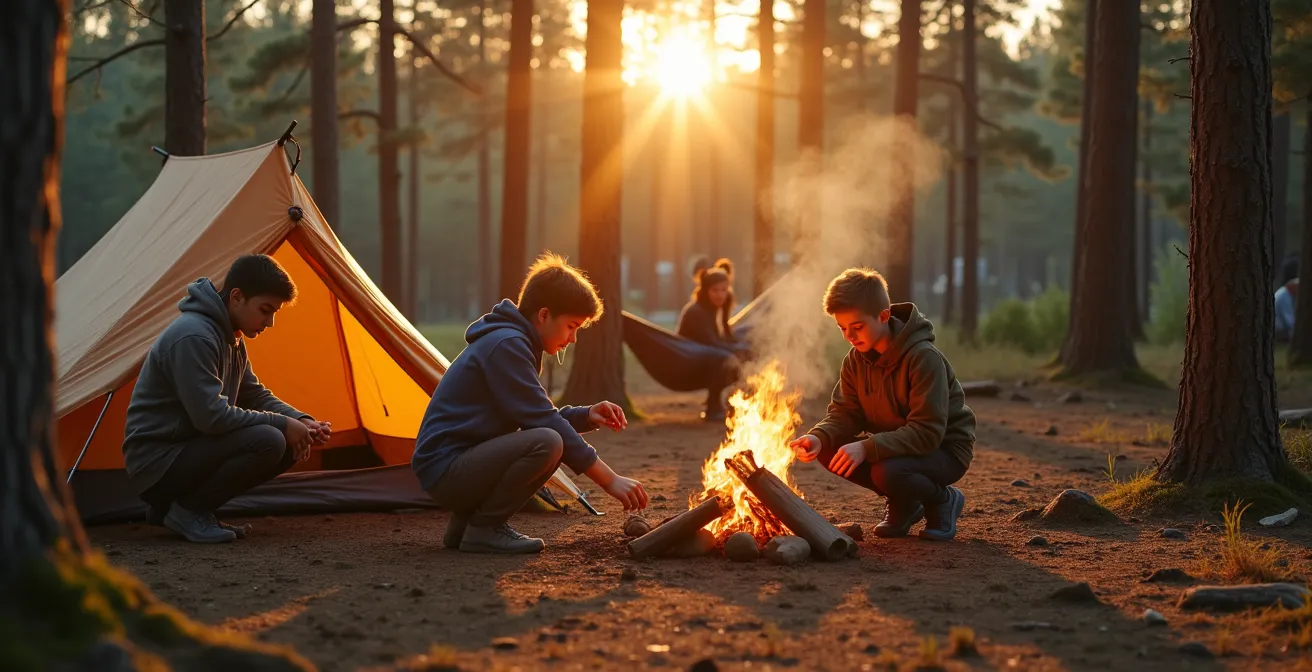
The key to a successful digital detox with teenagers isn’t banning phones; it’s making the real world more engaging by strategically reframing every camping challenge into a rewarding mission.
- Turn boredom from a complaint into a “creativity engine” by understanding the science behind it.
- Transform chores like cooking and setup into gamified team challenges that build skills and connection.
Recommendation: Stop fighting the tech addiction and start architecting an analog adventure that’s genuinely more compelling than their screens.
The scene is familiar: you’ve planned the perfect weekend getaway, a chance to escape the city, breathe fresh air, and reconnect as a family. Yet, from the backseat, the only glow comes from a phone screen, accompanied by a familiar eye-roll at the very mention of “no signal.” For parents of tech-addicted teenagers, a camping trip can feel less like a retreat and more like a battleground. The common advice—to just ban phones or pack a deck of cards—often misses the point entirely. It treats the symptom, not the cause, and sets up a dynamic of restriction versus rebellion.
The reality is that teenagers aren’t just addicted to screens; they’re addicted to the constant feedback, engagement, and sense of mastery that digital worlds provide. A passive vacation or a simple ban can’t compete with that. But what if the solution wasn’t to fight that impulse, but to redirect it? What if the very challenges of camping—the “boredom,” the cooking, the slightly uncomfortable sleeping arrangements—are not obstacles to overcome, but strategic opportunities to create a powerful, real-world engagement loop?
This guide moves beyond the platitudes. Instead of simply telling you to “let them be bored,” we’ll explore why boredom is a neurological superpower you can activate. Instead of just “making them help,” we’ll show you how to transform campsite chores into “expert mode” missions that appeal to their need for achievement. This is your playbook for turning a weekend of potential conflict into a transformative digital detox, not by force, but by design.
To navigate this journey successfully, we will explore every aspect of the trip, from managing expectations to choosing the right gear. The following sections break down how to turn each potential friction point into a moment of connection and growth.
Summary: A Strategic Guide to Camping with Tech-Addicted Teens
- Why “I’m Bored” Is the Gateway to Creative Play in Nature?
- Gas Stove vs Open Fire: Which Cooking Method Engages Kids More?
- Air Mattress vs Cot: Which Setup Prevents Back Pain for Parents?
- How to Handle the “Bathroom Situation” Without Freaking Out Urban Kids?
- When to Arrive: Why Setting Up Tent in the Dark Is a Recipe for Arguments?
- Why a “Digital Detox” Retreat Is More Effective Than a Beach Vacation?
- Composting Toilets: How to Deal with “Eco-Plumbing” Without Horror Stories?
- Yurt or Geodesic Dome: Which Glamping Structure Offers Better Insulation?
Why “I’m Bored” Is the Gateway to Creative Play in Nature?
The two most dreaded words on any family trip are, without a doubt, “I’m bored.” For parents, it’s a signal of failure, a cue to immediately find a distraction. But in the context of a digital detox, this complaint is actually the first sign of success. When a teen is bored, it means the constant, passive stimulation of their device has ceased. Their brain, accustomed to being fed content, is now asking, “What’s next?” This is the moment where true creativity begins. It’s not an empty state; it’s a preparatory one. In fact, research demonstrates that a small dose of boredom primes our brains for problem-solving and convergent thinking tasks.
Instead of rushing to “fix” boredom, the strategy is to reframe it. Explain to your teen, using analogies they understand, that this is their brain’s “default mode network” (DMN) activating—the same part responsible for daydreaming, self-reflection, and making new connections. It’s the mind’s equivalent of a system defrag. This “productive boredom” is a critical state that their hyper-connected lives rarely allow. Don’t immediately suggest an activity. Instead, normalize the feeling. A simple “That’s okay, let’s see what your brain comes up with” can be more powerful than any planned event.
This unstructured time is when they might finally notice the intricate pattern of a leaf, start a conversation without a prompt, or invent a game with nothing but a few rocks and a stick. It’s the space where internal curiosity replaces external validation. By allowing this quiet void, you’re not abandoning them to their misery; you’re guiding them back to their own imagination, a skill far more valuable and resilient than any app.
Gas Stove vs Open Fire: Which Cooking Method Engages Kids More?
Mealtime while camping can be a simple chore or a central event. The choice between a modern gas stove and a traditional open fire is about more than just efficiency; it’s a strategic decision that directly impacts teen engagement. A gas stove is fast, clean, and familiar—it’s the “easy mode.” It gets the job done but offers little in the way of a compelling experience. A teenager might help for a few minutes, but the process is too similar to home to hold their attention for long.
An open fire, however, is a different beast entirely. It’s primal, dynamic, and requires skill. This is the “analog expert mode” that can captivate a teen’s mind. Managing a fire involves learning about wood types, airflow, and patience—it’s a real-world physics puzzle. The process creates an “engagement loop“: the effort of building and maintaining the fire leads directly to the reward of a well-cooked meal and a warm gathering spot. According to a study by the American Camp Association, teens thrive in these group cooking environments, as the slower pace over an open fire naturally creates a social hub for conversation and connection, rather than just a task-oriented kitchen.
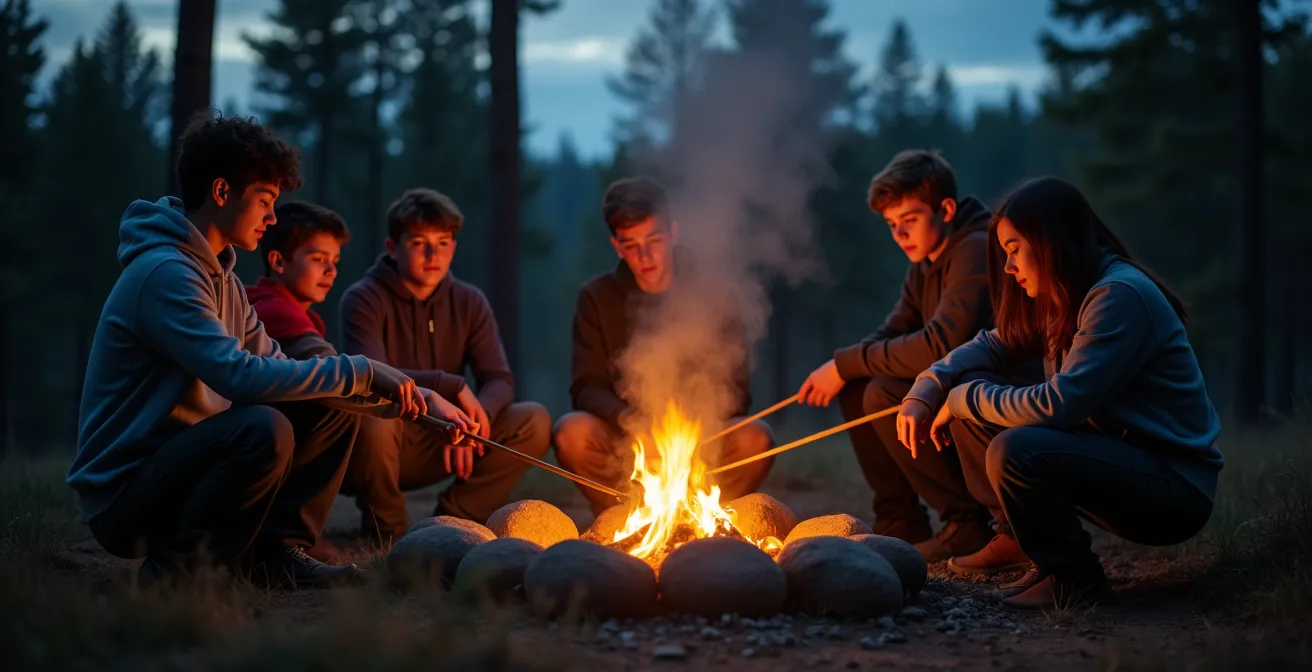
As the image above illustrates, the campfire becomes the heart of the campsite. It extends the activity far beyond just eating. It’s where stories are told, s’mores are made, and the day’s events are discussed. It taps into a fundamental human experience that a gas stove simply cannot replicate. By choosing the fire, you’re not just choosing a cooking method; you’re choosing to create a memorable, multi-sensory experience that makes the analog world feel rich and rewarding.
This table breaks down the key differences in how each method appeals to teenagers:
| Aspect | Gas Stove | Campfire |
|---|---|---|
| Engagement Level | Moderate – Quick and efficient | High – Interactive experience |
| Skill Building | Basic operation | Fire management, patience |
| Social Aspect | Limited to cooking time | Extended social hub opportunity |
| Teen Appeal | ‘Easy Mode’ – Less challenging | ‘Expert Mode’ – Achievement feeling |
| Post-meal Activities | None | Storytelling, s’mores, stargazing |
Air Mattress vs Cot: Which Setup Prevents Back Pain for Parents?
While much of the focus is on keeping teenagers happy, there’s a critical rule for parental survival on a camping trip: you cannot pour from an empty cup. Your own physical comfort, especially your sleep quality, is not a luxury—it’s a strategic necessity. A sleepless night on a deflating air mattress leads to a short temper and zero patience for the inevitable teenage gripes. Investing in your own rest is an investment in the trip’s success.
The great debate often comes down to the air mattress versus the cot. An air mattress offers a large, seemingly plush surface that mimics a traditional bed. However, it’s notoriously unreliable. They lose air in the cold, are easily punctured, and the “bounce” effect can disturb your partner. More importantly, they offer very little in terms of spinal support, often leading to morning back pain. A cot, on the other hand, provides a firm, elevated sleeping surface. It keeps you off the cold, uneven ground and offers consistent, stable support throughout the night. This elevation also makes getting in and out of the tent significantly easier—a small detail that your back will thank you for after a long day.
The choice is a direct trade-off between perceived comfort and actual orthopedic support. While a thick air mattress might seem more inviting, a sturdy cot is almost always the superior choice for preventing back pain and ensuring you wake up refreshed and ready to be the patient, engaging guide your family needs. As one expert wisely put it, your personal well-being is foundational to the group’s morale.
Your back pain threshold is directly proportional to your tolerance for teenage whining. Investing in your own sleep isn’t selfish; it’s a strategy for patience.
– Lou, Outdoor Equipment Expert, Advnture Guide to Camping with Teenagers
How to Handle the “Bathroom Situation” Without Freaking Out Urban Kids?
For a teenager raised in the city, the “bathroom situation” in the wild can be a source of genuine anxiety and disgust. The lack of flush toilets and porcelain sinks can feel like a major barrier to enjoying the outdoors. Forcing them to “just deal with it” is a recipe for resentment. The strategic approach is to reframe this challenge from a hygienic inconvenience into a lesson in environmental citizenship and advanced wilderness skills.
Instead of focusing on the “gross” factor, present the process as a mark of a responsible and skilled outdoorsperson. This is where you introduce the principles of Leave No Trace. Explain that digging a cathole isn’t just about hiding waste; it’s about protecting water sources and wildlife. Frame it as a skill that 99% of their peers don’t have. This shifts their perspective from feeling deprived of modern comforts to feeling empowered with exclusive knowledge. As demonstrated by programs like Bold Earth Adventures, teens respond positively when the process is tied to a greater sense of stewardship and responsibility.

To demystify the process, prepare a dedicated “wilderness hygiene kit” like the one shown. This kit should contain a small trowel, biodegradable toilet paper, and hand sanitizer. Present it not as a last resort, but as a professional piece of gear. When you demonstrate how to use it in a matter-of-fact, confident way, you model competence, not discomfort. By treating outdoor hygiene as a respectable skill, you turn a point of anxiety into an opportunity for them to feel capable, mature, and connected to the environment on a deeper level.
When to Arrive: Why Setting Up Tent in the Dark Is a Recipe for Arguments?
The first hour at the campsite sets the tone for the entire weekend. Arriving late and attempting to set up a tent in the dark with flashlights is a classic rookie mistake, and it’s a guaranteed recipe for frustration, frayed nerves, and family arguments. Under pressure, with dropping temperatures and rising stress, small mistakes cascade into major conflicts. The simple act of finding the right tent pole becomes a source of blame and irritation. This initial negative experience can poison the well for the whole trip.
The solution is both simple and non-negotiable: arrive with at least two hours of daylight to spare. This buffer time is not a luxury; it’s a strategic investment in family harmony. In fact, research shows that 75% fewer setup-related conflicts are reported by families who arrive at least two hours before sunset. This daylight window allows everyone to see what they’re doing, move at a reasonable pace, and troubleshoot any issues without the added pressure of impending darkness. It transforms a stressful ordeal into a collaborative team activity.
To take this a step further, you can gamify the process. Frame the setup as the “Golden Hour Challenge“—a mission to get the entire camp established before the sun dips below the horizon. This introduces a sense of fun and urgency, turning a chore into a shared goal. By assigning roles and treating it like a team sport, you replace potential conflict with a sense of collective achievement. A successful, stress-free setup is the first victory of the trip, creating positive momentum that will carry you through the weekend.
Action Plan: The “Golden Hour Challenge” Setup Strategy
- Pre-assign roles: In the car on the way, assign specific jobs like ‘Pole Specialist,’ ‘Stake Team,’ and ‘Lead Engineer’ to give everyone ownership.
- Equip the team: Provide everyone with their own headlamp before you even leave home. Treat them as primary tools, not just backups for emergencies.
- Create urgency: Announce the ‘Golden Hour Challenge’—the mission is a full camp setup (tent, sleeping bags, chairs) before the sun fully disappears.
- Gamify late arrivals: If arriving late is absolutely unavoidable, reframe it. Call it the ‘First Night Ops Mission’ to make the challenge feel intentional and exciting, not accidental and stressful.
- Practice at home: Do one full tent setup in your backyard in the daylight. This establishes the routine and works out the kinks before you’re in the field.
Why a “Digital Detox” Retreat Is More Effective Than a Beach Vacation?
When families seek to disconnect from technology, a beach vacation is often the first idea that comes to mind. It seems relaxing and simple. However, a passive environment like a beach is often ineffective for a true digital detox with teenagers. The ample downtime and lack of required engagement make it incredibly easy for a teen to retreat back into their phone to fill the void. The environment itself doesn’t offer a compelling alternative to the digital world.
A camping trip, by contrast, is an active retreat. It inherently demands engagement with the physical world. You have to build your shelter, make a fire, cook your food, and navigate your surroundings. These are not optional activities; they are essential for comfort and survival. This active engagement is precisely what makes camping a more powerful tool for digital detox. It doesn’t just remove the digital distraction; it replaces it with a rich, multi-sensory, and rewarding analog experience.
This process actively encourages the state of “productive boredom.” As National Geographic’s analysis of teen development highlights, unstructured outdoor time activates the brain’s default mode network (DMN), which is linked to creativity, self-reflection, and problem-solving. Unlike the passive boredom of a hotel room, the active context of camping forces the brain to engage with the environment to solve problems, fostering resilience and a sense of capability. The satisfaction of successfully starting a fire or setting up a tent provides a tangible sense of accomplishment that a high score in a video game can’t replicate.
Composting Toilets: How to Deal with “Eco-Plumbing” Without Horror Stories?
If you’re leveling up your camping experience to a site with eco-friendly facilities, you might encounter the composting toilet. For a teen (or even an adult) unfamiliar with the concept, it can be intimidating and a source of “horror stories.” The key, once again, is to proactively reframe the experience from a weird, primitive toilet into a piece of advanced, sustainable technology. It’s an opportunity to elevate their status to that of a true eco-citizen.
Start by explaining the “how” and “why” using relatable language. Don’t just post a list of rules. Use the “Tiny Factory” analogy: explain that the toilet isn’t a storage tank but a biological processing facility where millions of microbes are the workers, breaking everything down into harmless compost. Their role is to help the workers do their job. Compare adding sawdust or peat moss after each use to “clearing the system cache” in a computer—a familiar concept that makes the action feel technical and necessary, not just strange.
Demonstrate the process confidently and matter-of-factly, without apology or over-explanation. Your comfort will set the tone. Emphasize that using such a system is an advanced form of camping that most people never experience, putting them in an exclusive club of environmentally conscious travelers. This approach worked wonders for one teenager, who shared their perspective:
Initially, I was totally freaked out about the composting toilet situation. But when our guide explained it as basically running a mini ecosystem and that we were actually more eco-friendly than 99% of tourists, it became kind of cool. Now I actually brag to my friends about knowing how to camp with zero environmental impact.
– Teen Camper
Key Takeaways
- Parental comfort is not selfish; a well-rested parent is a more patient guide.
- Gamifying chores like setup and cooking turns potential conflict into collaborative fun.
- The goal isn’t just to survive without phones, but to make the real, analog world more compelling and rewarding than the digital one.
Yurt or Geodesic Dome: Which Glamping Structure Offers Better Insulation?
For families who want to dip their toes into the digital detox experience without committing to a full “roughing it” tent setup, glamping offers a fantastic middle ground. But even here, strategic choices can impact the family dynamic. When choosing between popular structures like a yurt or a geodesic dome, the decision goes beyond aesthetics and should consider factors like insulation, privacy, and the psychological space each creates for teenagers.
From a purely technical standpoint, both can offer good insulation, but their materials and design create different living experiences. A traditional yurt, with its thick felt or canvas walls and wooden lattice frame, offers excellent thermal and acoustic insulation. The soft, absorbent walls create a quiet, cozy atmosphere. This superior sound dampening can be a huge plus, as a glamping design analysis notes that privacy is a critical factor for teenagers. A geodesic dome, while visually stunning with its futuristic look, often uses materials that can amplify sound, making the space feel less private.
The “teen appeal” also differs. A dome might have a higher “Instagram factor” with its unique architectural lines, appealing to a teen’s visual social currency. However, a yurt’s round, communal shape can foster a more connected, ’round table’ dynamic. Ultimately, the choice depends on your family’s priorities. Do you need maximum privacy and a cozy vibe, or a visually exciting space that’s easier to divide into personal zones? The following table compares these two popular glamping options on factors relevant to a family trip with teens.
| Factor | Yurt | Geodesic Dome |
|---|---|---|
| Thermal Insulation | Excellent – thick walls, traditional design | Good – depends on covering material |
| Acoustic Privacy | Superior – soft walls absorb sound | Limited – hard surfaces amplify noise |
| Teen Appeal | Traditional, cozy, ‘authentic’ | Futuristic, ‘Mars base’ aesthetic |
| Instagram Factor | Moderate – bohemian vibes | High – unique architectural photos |
| Space Psychology | Communal, ’round table’ dynamic | Easier to create personal zones |
Ultimately, a successful camping trip with tech-addicted teens is an exercise in strategic thinking. It’s about being an architect of experience, not just a supervisor of rules. By reframing boredom, gamifying chores, and prioritizing connection over convenience, you can create a powerful analog adventure that doesn’t just survive the absence of screens—it thrives because of it.