
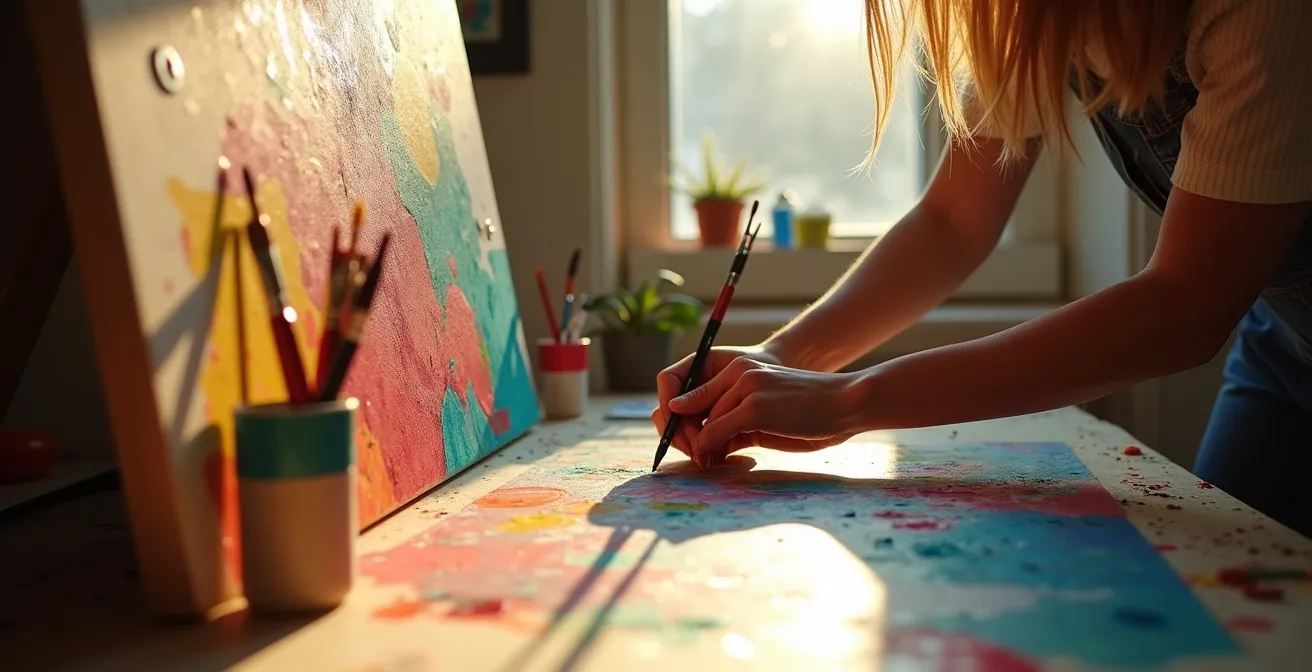
When you’re overwhelmed by anxiety or trauma, words often fall short. This guide moves beyond simple distraction to reveal how specific art therapy practices work as direct physiological tools. You’ll learn how activities like working with clay or intentional coloring can calm your nervous system and provide a safe, non-verbal language to process feelings that are otherwise inaccessible, even if you don’t consider yourself an artist.
There are moments when an emotion is so vast, so heavy, that trying to capture it with words feels like trying to catch the ocean in a teacup. For those navigating the complexities of anxiety or the deep echoes of trauma, this is a familiar struggle. Well-meaning advice often encourages us to “talk it out,” but what happens when the very part of your brain responsible for language shuts down in moments of stress? What happens when the feelings are lodged in your body, not your vocabulary?
This is where the conventional approach to emotional expression can fail us. We’re told to journal, to confide in a friend, or to see a therapist, all of which are valuable tools. Yet they all rely on a verbal bridge that can crumble under the weight of intense emotion. You might have found yourself staring at a blank page, the pressure to find the “right” words only adding to your anxiety. This is a common experience, and it’s not a personal failing; it’s a sign that you may need a different language.
But what if the key wasn’t to try harder with words, but to bypass them entirely? What if you could communicate directly with your nervous system, using your hands, color, and texture as your new vocabulary? This is the core promise of using art for emotional expression. It’s not about creating a masterpiece; it’s about engaging in a process that offers a direct, physiological route to regulation and release. It’s less about the final product and more about the somatic experience of creation.
This guide will walk you through specific, gentle techniques that are grounded in the science of how our brains and bodies process stress. We will explore why certain materials are so effective, how to overcome the fear of the blank page, and how to create a safe space for your own creative exploration. You don’t need to be an artist; you only need to be willing to try a different kind of conversation with yourself.
To help you navigate these powerful techniques, this article explores the specific “why” behind each practice. The following sections will guide you through the most effective methods for channeling your emotions into a tangible, healing form.
Table of Contents: A Guide to Expressing Emotions Beyond Words
- Why Mandala Coloring Lowers Heart Rate and Anxiety Levels?
- Clay vs Paint: Why Working With Your Hands Grounds You in the Moment?
- The “Ugly Drawing” Exercise That Silences Your Perfectionism
- How to Create a “Studio Corner” in a Small Apartment?
- When to Create: Why Morning Pages Unlock Subconscious Thoughts?
- How Analyzing Abstract Art Forces Your Brain to Build New Connections?
- Why Working With Clay Reduces Cortisol Levels in 45 Minutes?
- Pottery or Woodworking: Which Workshop Cures Digital Burnout Faster?
Why Mandala Coloring Lowers Heart Rate and Anxiety Levels?
The rise of adult coloring books isn’t just a trend; it’s rooted in a deep psychological need for order and focus in a chaotic world. Mandalas, with their concentric patterns and predictable symmetry, are particularly powerful. When you engage in coloring a mandala, you are giving your brain a very specific and contained task. This focused attention on repeating patterns and staying within the lines acts as a form of mindfulness, gently pulling your awareness away from anxious, looping thoughts and into the present moment.
The therapeutic power lies in its structure. The circular shape of the mandala is a universal symbol of wholeness and integration. As you fill it with color, you are symbolically “pulling things together.” This process engages both hemispheres of the brain: the left brain enjoys the logic and structure of the pattern, while the right brain is free to play with color and intuition. This whole-brain engagement helps to soothe the amygdala, the brain’s fear center, and shift your nervous system from a state of “fight-or-flight” to “rest-and-digest.”
The repetitive motion of coloring is also key. It creates a gentle rhythm that can slow your breathing and lower your heart rate, mimicking the effects of meditation. It’s a low-stakes activity; there is no pressure to create something from scratch. You are simply invited to fill a pre-existing structure, which removes the paralysis of the blank page and allows for a state of relaxed focus, making it an incredibly accessible first step for anyone feeling overwhelmed.
Your Action Plan: Creating an Emotional Map with Color
- Points of contact: Identify the core emotions you are feeling right now or wish to express (e.g., anxiety, joy, anger, sadness).
- Collecte: Assign a specific color from your art supplies to each of these emotions. This creates your personal, intuitive color palette.
- Cohérence: As you begin coloring your mandala, try to match the colors you use to the feelings you’re experiencing in the moment. Don’t overthink it; let your intuition guide your hand.
- Mémorabilité/émotion: When you finish, step back and look at the mandala as a whole. Which colors (emotions) dominate? What does this visual map tell you that words could not?
- Plan d’intégration: Use this finished piece as a starting point for reflection. It can be a tool to share your feelings with a therapist or a trusted person, using the visual as a guide to explain your inner world.
This simple act transforms coloring from a mere distraction into a profound tool for self-discovery and emotional communication.
Clay vs Paint: Why Working With Your Hands Grounds You in the Moment?
While any art form can be therapeutic, mediums that involve direct contact with your hands, like clay, have a unique and powerful ability to ground you. When your mind is racing with anxious thoughts or caught in a trauma loop, the physical sensation of cool, malleable clay provides immediate sensory feedback. This is a concept known as tactile grounding. Your brain’s attention is drawn to the feeling of the material in your hands—its texture, temperature, and weight—pulling you out of your head and anchoring you firmly in the present moment.
Unlike painting, which uses a tool as an intermediary, working with clay is a direct, primal connection. You push, pull, pinch, and smooth the material with your own strength. This physical engagement is crucial. Using both hands to work the clay provides bilateral stimulation, engaging both the left and right hemispheres of the brain simultaneously. This process helps the brain integrate thoughts and emotions, promoting a state of regulation and calm. It’s a mechanism similar to that used in trauma therapies like EMDR.
The very nature of clay is forgiving. If you make a “mistake,” you can simply ball it up and start again. This removes the pressure of perfectionism that can be so paralyzing with other mediums like paint or ink. It’s a physical metaphor for resilience and the possibility of a fresh start. This tangible interaction offers a sense of control and agency that can be incredibly empowering when you feel like your inner world is out of control.
Case Study: Bilateral Stimulation Through Clay Work
A 2016 study from the Journal of the American Art Therapy Association demonstrated that just 45 minutes of clay work significantly reduced cortisol levels in participants. The researchers noted that the bilateral stimulation from using both hands helps integrate left and right brain functions, promoting emotional regulation in a way that is similar to established therapeutic techniques for trauma.
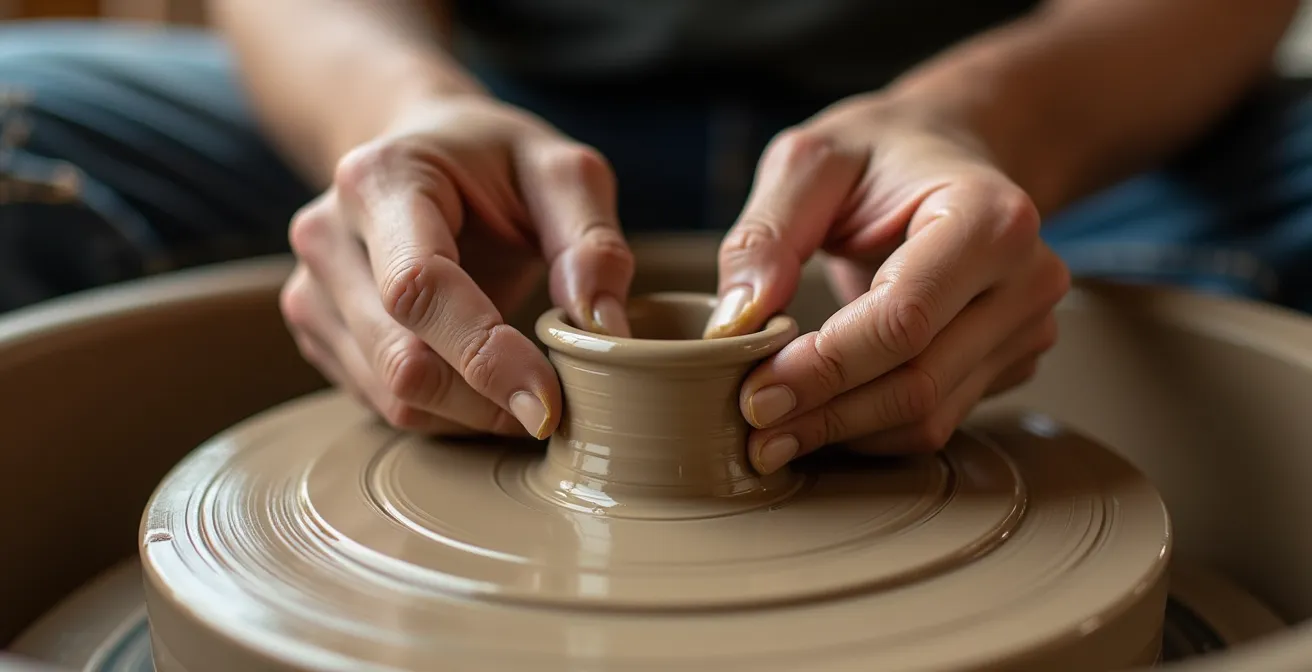
As you can see, the engagement is total. Every part of your hand is involved, sending constant sensory information to your brain that says, “You are here. You are safe. You are creating.” This direct physical feedback is something that painting, for all its expressive potential, cannot replicate in the same way. It’s the difference between describing a feeling and holding it in your hands.
Ultimately, the choice between clay and paint depends on your needs. If you need to ground yourself and calm an activated nervous system, clay is an unparalleled tool. If you need to express a wide range of emotions through color, paint might be your medium. But for immediate, in-the-moment relief, getting your hands dirty is often the most direct path back to yourself.
The “Ugly Drawing” Exercise That Silences Your Perfectionism
Art therapy offers a way for someone to express aspects of themselves without relying on words. It transcends verbal language, and for some people that can be very non-threatening and safe.
– Gretchen Miller, Art therapist and AATA board member
One of the biggest barriers to creative expression is the voice of the inner critic. It’s that nagging thought that says, “I’m not good at this,” “This looks childish,” or “I don’t know what to draw.” This fear of not being “good enough” can be so powerful that it stops us before we even begin. The “Ugly Drawing” exercise is a direct and playful antidote to this perfectionism. The goal is simple: to intentionally create something you consider “ugly” or nonsensical.
The instructions are liberatingly straightforward. Take a piece of paper and a pen or marker. Now, try to draw your anger, your anxiety, or your frustration. Don’t draw a picture *of* something that makes you angry; draw the anger itself. Let it be a chaotic scribble, a series of jagged lines, or a heavy, dark shape. The key is to give yourself permission for it to be messy, uncontrolled, and absolutely not beautiful. By making “ugly” the goal, you instantly silence the inner critic because you are succeeding by its own measure of failure. There is no way to fail the exercise.
This process does two things. First, it bypasses the analytical, critical part of your brain and allows for a more direct, subconscious expression of emotion to emerge. As one therapist noted, the “scribble warmup helps bypass the critical mind and allows authentic emotional expression to emerge naturally.” Second, it externalizes the feeling. That overwhelming anxiety is no longer just a storm inside you; it is a tangible object on the page. You can look at it, acknowledge it, and even physically alter it. You can tear it up, scribble over it, or transform it into something else. This act of externalization gives you a sense of agency over the emotion.
The “Ugly Drawing” is not about the product; it is a powerful process of letting go. It teaches you that your expression has value, regardless of its aesthetic quality, and that there is profound relief in simply allowing what’s inside to come out, no matter what it looks like.
How to Create a “Studio Corner” in a Small Apartment?
The idea of a dedicated art “studio” can feel intimidating, especially if you live in a small space. It conjures images of large, light-filled rooms, which is an unrealistic standard for most people. However, creating a therapeutic art space isn’t about size; it’s about intention. A “studio corner” can be as simple as a small table, a comfortable cushion on the floor, or even a portable box of supplies that you bring to your kitchen table. The key is to create a psychological boundary that signals to your brain: “This is a space for creative expression, not for work or chores.”
The most important element is consistency. Choose a spot, no matter how small, and dedicate it to your art practice. If possible, choose a corner with some natural light, as this can have a positive impact on your mood. The real transformation, however, comes from building a ritual around the space. This ritual acts as a trigger for your creative mind. It could be lighting a specific candle, playing a particular instrumental playlist, or making a cup of herbal tea. When your brain associates these sensory cues with the act of creating, it becomes easier to drop into a therapeutic state.
Keep your materials simple and accessible. Having everything stored neatly in a designated box or on a small shelf removes the friction of having to search for supplies. An overwhelming amount of choice can lead to paralysis, so start with the basics: a sketchbook, some pencils, a small set of watercolors or markers. The goal is to make it as easy as possible to begin. This space is not for performance or for creating masterpieces to hang on the wall. It is a personal sanctuary, a safe container for your emotions to unfold without judgment.
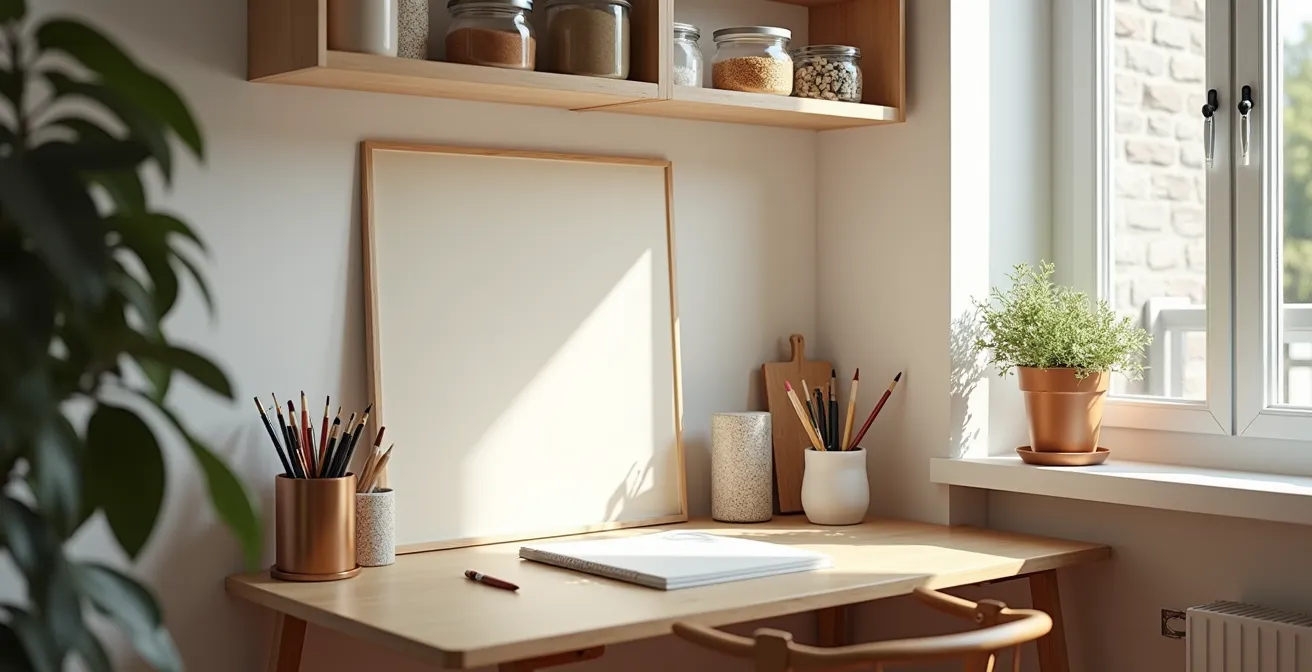
Think of this corner as a charging station for your emotional well-being. It should feel inviting and calming. You can add elements that appeal to multiple senses, such as a soft blanket for texture or a small diffuser with a calming scent like lavender. These sensory anchors help ground you in the space and deepen the therapeutic experience. Even spending just 15 minutes a day in your corner can establish a powerful and healing practice.
By creating this small but mighty sanctuary, you are sending a clear message to yourself: your emotional health is a priority, and you are carving out the time and space it deserves.
When to Create: Why Morning Pages Unlock Subconscious Thoughts?
The timing of your creative practice can be just as important as the practice itself. While any time you make art is beneficial, there is a unique therapeutic power to creating in the morning, immediately after waking. This concept, popularized by Julia Cameron as “Morning Pages,” can be adapted into a visual practice. The goal is to create before your mind is fully “online”—before the inner critic has had its coffee and the day’s to-do list has taken over.
In this early morning, pre-conscious state, the barrier between your conscious and subconscious mind is at its most permeable. Your defenses are down, and the analytical part of your brain that censors your thoughts and impulses is still groggy. This creates a precious window of opportunity to access feelings and images that are stored deep within your body and subconscious. As you draw, paint, or scribble during this time, you are not thinking about what to create; you are simply allowing whatever is present to flow onto the page.
This practice is particularly effective for processing complex emotions or trauma, which are often stored as non-verbal, sensory memories. It’s about speaking the language of the subconscious, which is a language of images, symbols, and sensations, not words. The art you create in this state may not “make sense” logically, but it will often hold a profound emotional truth.
Case Study: Morning Art Practice for Emotional Processing
Art therapist Youhjung demonstrates how morning art sessions tap into the pre-conscious state before the inner critic awakens. Participants in her workshops report that creating art immediately upon waking allows them to access emotions stored as images in the body. This enables them to speak the language of the subconscious through visual expression, often revealing insights that were inaccessible through talk therapy alone.
Interestingly, research from Drexel University has shown that art-making has a measurable effect on stress hormones, and this effect can be particularly pronounced in younger people. The study revealed that younger participants showed consistently lower cortisol levels after a session of art creation, suggesting that establishing this practice early can build powerful coping mechanisms for life. This physiological benefit, combined with the psychological access of the morning state, makes for a potent therapeutic ritual.
You don’t need to spend hours on this. Even five minutes of scribbling in a notebook by your bed before your feet hit the floor can be a powerful way to check in with your inner world and start your day with a sense of release and clarity.
How Analyzing Abstract Art Forces Your Brain to Build New Connections?
Engaging with art isn’t limited to creating it; there is also a profound therapeutic benefit in simply observing it, especially abstract art. When you look at a realistic painting of a landscape, your brain quickly identifies and categorizes what it sees: “tree,” “sky,” “river.” The mental work is minimal. But when you stand before an abstract piece—a canvas of swirling colors, ambiguous shapes, and complex textures—your brain is faced with a puzzle. It has no immediate category to file it under.
This ambiguity forces your brain to work differently. It has to abandon its automatic-pilot mode and actively engage in a process of meaning-making. It starts searching for patterns, making associations, and trying to build a narrative from the visual data. This process of trying to find meaning in ambiguity actively forges new neural connections. You are, in essence, giving your brain a workout in cognitive flexibility, teaching it to look at a situation from multiple angles and to be comfortable with not having an immediate answer.
For someone struggling with anxiety, which often involves rigid, black-and-white thinking patterns, this is an incredibly valuable exercise. Abstract art invites you to let go of the need for a single, “correct” interpretation. Your emotional response to the piece becomes the “meaning.” Does a splash of red feel like anger or passion? Does a dark, dense area feel overwhelming or comforting? There is no wrong answer. Your personal interpretation is the only one that matters.
This practice cultivates a tolerance for uncertainty, which is a core skill in managing anxiety. It teaches you that it’s okay for things to be unresolved and that you can find your own meaning and feeling within a complex situation. You can do this by visiting a museum, looking at art books, or simply browsing online collections. Spend a few minutes with a piece and ask yourself not “What is it?” but rather, “What does it make me feel?”
By engaging with abstraction, you are training your brain to become more resilient, more creative, and more comfortable with the beautiful, messy complexity of both art and life.
Why Working With Clay Reduces Cortisol Levels in 45 Minutes?
The calming effect of working with clay is not just a feeling; it’s a measurable physiological event. Scientific research has provided concrete evidence that this ancient practice has a direct impact on our body’s stress response. Specifically, it has been shown to significantly reduce levels of cortisol, the primary stress hormone that courses through our bodies when we are in a state of anxiety or “fight-or-flight.”
A landmark study confirmed this effect in a controlled setting. The research demonstrated that just 45 minutes of art-making with clay resulted in a statistically significant cortisol reduction across a group of participants. This provides a powerful validation for what potters have known for centuries: the process of centering clay on a wheel is also a process of centering the self. The combination of focused attention, rhythmic motion, and tactile sensory input creates a powerful trifecta for nervous system regulation.
To harness this benefit, you can create a simple, timed ritual. Start with about 5 minutes of intensive kneading. This warms up the clay and, more importantly, activates the tactile senses in your hands, grounding you in the physical act. For the next 20 minutes, focus on creating a physical representation of your current stressor. Give your anxiety a shape. Don’t worry about what it looks like; focus on imbuing the clay with that feeling. The act of externalizing the stressor is the first step toward gaining power over it.
Then, the crucial part: for the next 15 minutes, methodically deconstruct and transform that shape. You can crush it, smooth it out, or reshape it into something that feels neutral or even positive. This is a potent symbolic act of transformation and release. Finally, spend the last 5 minutes in quiet reflection, simply holding the new, transformed shape in your hands. Notice the shift in the material and, more importantly, the corresponding shift in your own internal state. This structured process turns a simple piece of clay into a powerful tool for hormonal and emotional regulation.
This isn’t just a way to pass the time; it is a predictable, reliable, and scientifically-backed method for actively lowering your body’s stress levels in under an hour.
Key Takeaways
- Art is not just a hobby; it’s a physiological tool that can directly regulate your nervous system and lower stress hormones like cortisol.
- Tactile activities like working with clay are exceptionally grounding, using the power of touch and bilateral stimulation to pull you out of anxious thoughts.
- Overcoming perfectionism is crucial. Exercises like the “Ugly Drawing” give you permission to be imperfect, unlocking authentic emotional expression.
Pottery or Woodworking: Which Workshop Cures Digital Burnout Faster?
In our digitally saturated lives, burnout is a common ailment. We suffer from a sense of disconnection, a lack of tangible accomplishment, and overwhelming mental fatigue. Craft workshops like pottery and woodworking offer a powerful antidote, but they cater to slightly different needs. Choosing the right one depends on the specific nature of your burnout. Both pull you away from screens and into the physical world, but they do so with different energies.
Pottery, with its focus on the potter’s wheel, is inherently cyclical and rhythmic. The process of centering the clay requires a calm, focused presence that soothes an anxious mind. It is a forgiving medium, making it ideal for those suffering from overwhelm burnout. The ability to restart easily reduces pressure, and the grounding, centering motion helps to regulate a scattered and overstimulated nervous system. As one PTSD survivor who turned to pottery shared, “I find it relaxing and it helps to reduce my anxiety.”
Four years ago a psychologist recommended I take up pottery again… I now have a fully functional pottery studio where I do pottery for therapy. It HAS transformed my life.
– A C-PTSD Survivor
Woodworking, on the other hand, is a more linear and structured process. It involves precise measurements, careful planning, and a step-by-step progression toward a finished object. This makes it particularly effective for those experiencing apathy burnout—a feeling of listlessness and lack of accomplishment. The tangible, constructive nature of woodworking provides a clear sense of purpose and a satisfying, visible result. It satisfies the need for order and control, which can be deeply restorative when work feels chaotic and endless.
To help clarify the choice, consider this breakdown. A comparative analysis of the two crafts highlights their differing therapeutic strengths.
| Burnout Type | Recommended Medium | Key Benefits |
|---|---|---|
| Overwhelm Burnout | Pottery | Grounding, forgiving material, centering focus |
| Apathy Burnout | Woodworking | Precise structure, tangible accomplishment, constructive process |
| Process Energy | Pottery: Cyclical/rhythmic | Soothes anxious mind through repetitive wheel motion |
| Process Energy | Woodworking: Linear/project-based | Satisfies need for order and control through planning |
Ultimately, both paths lead away from digital fatigue and back to the satisfaction of creating something real with your own two hands. The best workshop is the one that offers the energy you most need to restore your sense of balance and purpose.