
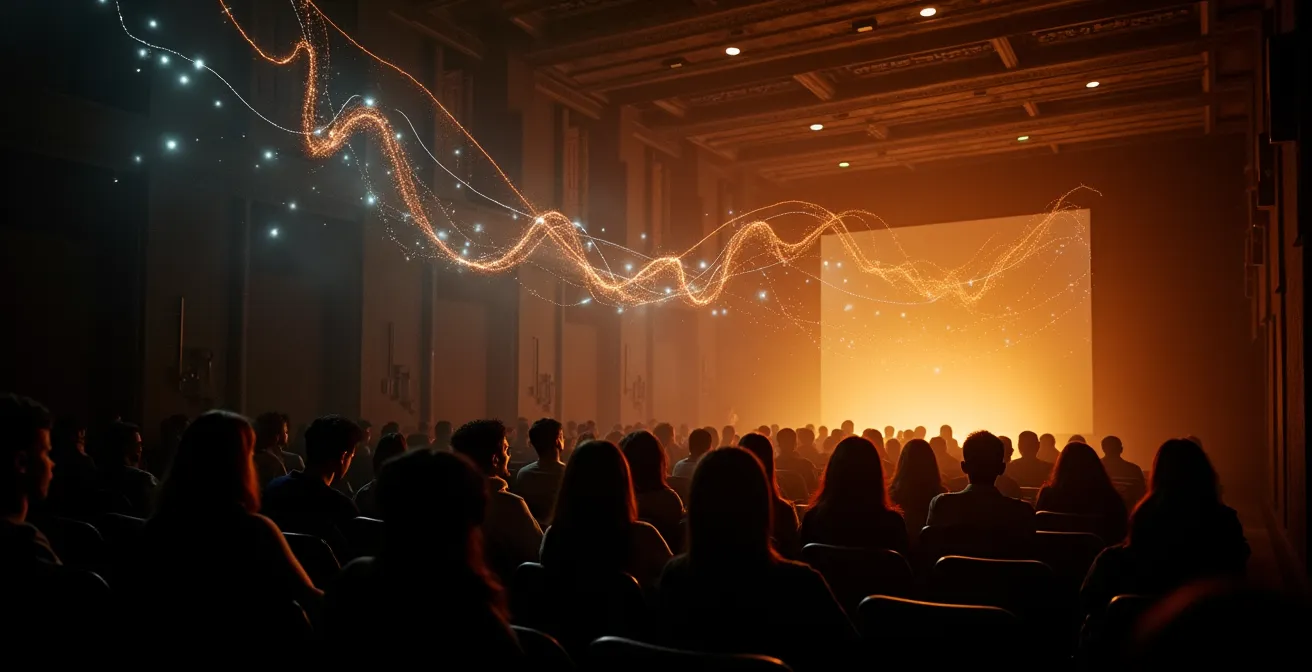
The unique “magic” of live theater isn’t just a feeling; it’s a measurable biological event of brain and heart synchronization that streamed content cannot replicate.
- Shared physical presence creates a neurological phenomenon called “collective effervescence” by coupling the brainwaves and heart rates of the audience.
- The narrative itself, independent of simple audio-visual cues, is powerful enough to drive this shared physiological response, creating a deep, communal experience.
Recommendation: Instead of viewing a theater ticket as just entertainment, consider it an investment in a unique form of cognitive and emotional enrichment that is biologically distinct from home viewing.
In an age dominated by the infinite scroll and the immediate gratification of streaming services, the choice between a night in with Netflix and a night out at the theater often feels like a simple economic and logistical calculation. One is convenient, affordable, and comfortable. The other requires planning, travel, and a significant financial outlay. For many digital natives, the question is stark: is the high cost of a theater ticket truly justified by the experience? The common answers—”it’s a social event,” “it feels more special”—are often emotionally valid but scientifically vague.
But what if the fundamental difference isn’t merely social, but deeply neurological? What if your brain and body are physically altered by the mere presence of live actors in a shared space, triggering a cascade of reactions that a screen, no matter how large or high-definition, can never hope to match? The perceived “liveness” of a performance is not a subjective feeling; it is the catalyst for a state of inter-brain synchronization, a powerful coupling of minds and bodies that is only now being fully understood by neuroscience.
This article will dissect the cognitive and physiological phenomena that make live performance a fundamentally different neural event. We will move beyond the platitudes to explore the measurable science of collective effervescence, examine why your focus is naturally captured in a theater, and reveal how different genres can trigger distinct chemical releases in your brain. This isn’t a defense of tradition; it’s a neurological comparison that explains why the value of live theater lies in an experience that is, by its very nature, inimitable.
text
To fully grasp the profound differences between these two experiences, this article explores the underlying neurological mechanisms at play. The following sections break down the science behind the unique power of live performance, providing a clear comparison to the more passive act of streaming content at home.
Summary: Live Theater vs Netflix: Why the Brain Reacts Differently to Real Presence?
- The “Collective Effervescence” Phenomenon in Live Audiences
- Why You Don’t Check Your Phone in a Theater (But Do at the Cinema)?
- Stalls or Circle: Where Is the Sound and Emotional Impact Strongest?
- Tragedy vs Comedy: Which Genre Releases More Endorphins?
- How to Get “Day Seats” for Sold Out Shows Without Camping Overnight?
- Why Trying a New Activity Boosts Neuroplasticity More Than Routine Exercise?
- How Analyzing Abstract Art Forces Your Brain to Build New Connections?
- How to Find Hidden Gems in Your Own City Using Satellite Maps?
The “Collective Effervescence” Phenomenon in Live Audiences
The feeling of being part of a crowd, laughing, gasping, or holding your breath in unison, is not a coincidence. It’s a well-documented phenomenon that sociologists like Émile Durkheim termed “collective effervescence.” Today, neuroscience is providing the biological basis for this sensation. When a group of people experiences a live event together, their brains begin to synchronize. MIT research demonstrates that it is possible to measure interpersonal synchrony across multiple modalities simultaneously, showing that audience members’ brainwaves can start to align with each other and with the performers.
This neural coupling is driven in part by what is known as the mirror neuron system. As one research team explains, these specialized neurons are fundamental to our ability to connect with others. According to a study featured in MinnPost on musician and audience brain activity, this system is key to empathy:
The postcentral cortices are hubs for the brain’s mirror neuron system, a group of specialized neurons that let us ‘mirror’ the actions and behaviors of others. Although somewhat controversial, it is believed that mirror neurons play a role in empathy, among other human processes. In the present study, the frontoparietal mirror neuron system allows audiences to experience or comprehend the mind of the performer as if they were to ‘walk in another’s shoes’
– Research team, MinnPost – Musicians and audiences sync brain activity study
Unlike watching a pre-recorded actor on Netflix, the physical presence of a performer creates a dynamic, real-time feedback loop. Your brain isn’t just passively processing pixels; it’s actively mirroring the micro-expressions, breathing patterns, and subtle intentions of a live human being. This creates a shared reality that is neurologically much richer than solo viewing.
Case Study: The University of Houston’s Mobile Brain-Body Imaging Dataset
To quantify these interactions, researchers at the University of Houston developed a groundbreaking dataset. They equipped actors, a director, and audience members with mobile EEG, eye-tracking, heart rate, and other sensors during emotionally intense theater scenes. This “hyperscanning” setup allows for the simultaneous tracking of neural and physiological patterns between individuals in a real-world setting. The dataset provides a rare resource for studying exactly how actors’ and audiences’ brains and bodies interact and synchronize during a live dramatic performance, turning the abstract concept of “connection” into hard data.
Why You Don’t Check Your Phone in a Theater (But Do at the Cinema)?
While social etiquette plays a role, the reason you’re less likely to be distracted during a live show goes deeper than politeness. The intense synchrony described earlier creates a state of “attentional lock-in.” Your brain, coupled with those around you and the performers, is engaged in a demanding, multi-sensory processing task. This shared cognitive load makes it more difficult for your attention to wander. The unpredictability of a live performance—the knowledge that anything could happen—keeps your prefrontal cortex on high alert in a way a perfectly edited film does not.
This isn’t just a mental state; it’s physiological. A fascinating 2024 study from the University of Bath showed for the first time that Heart-Rate Synchrony (HRS) occurs in audience members during a live theater performance. Your heartbeat literally starts to align with those of strangers around you, all responding in unison to the dramatic tension on stage. This shared biological rhythm creates a powerful sense of unity and focus that the isolated, predictable environment of watching Netflix on a sofa simply cannot generate. Your phone becomes an unwelcome intruder into this tightly woven biological and social fabric.

The sensory environment of a theater is designed to command attention. The focused lighting, the enveloping acoustics, and even the tactile sensation of the seat contribute to a state of heightened awareness. Your brain is receiving a coherent, immersive set of signals that all point to one thing: the stage. At home, your brain is bombarded with competing stimuli—the glow of your phone, the hum of the refrigerator, the comfort of your blanket—making distraction the path of least resistance.
Stalls or Circle: Where Is the Sound and Emotional Impact Strongest?
The experience of live theater is not uniform; where you sit can significantly alter your neurological and emotional response. Proximity matters. Sitting in the stalls, closer to the stage, enhances the activation of the mirror neuron system. You can perceive the performers’ micro-expressions, the subtle tensing of a muscle, or the slight tremble in a voice. Your brain receives a richer, more detailed stream of social and emotional data to process, leading to a more intense feeling of connection and empathy. Furthermore, the low-frequency sound vibrations from the stage and orchestra are more physically palpable in the stalls, which can have a direct, grounding effect on the nervous system.
However, a seat in the circle offers a different advantage: perspective. From a higher vantage point, you can better appreciate the overall choreography, stage design, and the collective reaction of the audience itself, enhancing the sense of collective effervescence. The most impactful experience is a complex interplay of audio-visual input and social presence. In fact, research published in the Annals of the New York Academy of Sciences reveals that performances combining both audio and visual elements evoke a higher inter-subject correlation of heart rate (ISC-HR) than audio-only experiences, confirming that a full sensory performance is key to driving physiological synchrony.
The crucial factor remains the “liveness” of the event. A study from the NEUROLIVE project at Goldsmiths, University of London, directly compared brain activity across different viewing conditions, with startling results.
| Viewing Condition | Brain Synchrony Level | Key Finding |
|---|---|---|
| Live Performance | High Delta band synchrony | Strongest when performers made eye contact |
| Cinema with Others | Moderate synchrony | Social presence maintains some synchronization |
| Alone in Lab | Weakened synchrony | Individual viewing reduces collective brain response |
This data clearly shows that while watching with others in a cinema is better than watching alone, nothing matches the high-synchrony state induced by the presence of live performers. The shared space and time are irreplaceable ingredients.
Tragedy vs Comedy: Which Genre Releases More Endorphins?
The emotional journey of a play is also a biochemical one. Different genres leverage our neural architecture in distinct ways to produce their effects. Comedies, with their barrages of laughter, are potent endorphin triggers. Laughter is a social bonding mechanism that involves deep, repeated exhalations, which can stimulate the vagus nerve and lead to a release of endorphins—the body’s natural opioids. This creates a feeling of euphoria and social connection, reinforcing the collective effervescence of the audience.
Tragedies, on the other hand, operate through a different but equally powerful mechanism: empathy. By presenting characters in distress, tragedies activate our mirror neuron system and associated empathy circuits on a profound level. Experiencing this “simulated” suffering alongside hundreds of others can lead to a cathartic release. The shared emotional arc, from tension to resolution, can produce a powerful sense of communal relief and bonding. Moreover, neuroscience research confirms that mirror neurons are strongly associated with human empathy, enabling us to put ourselves in another’s place and feel a version of their pain or joy.
This link between empathy and the mirror system is not just theoretical; it’s measurable. As neuroscientist Christian Keysers, a leading figure in the field, has noted in his research:
People who are more empathic according to self-report questionnaires have stronger activations both in the mirror system for hand actions and the mirror system for emotions, providing more direct support for the idea that the mirror system is linked to empathy
– Christian Keysers, Social Brain Lab research
Therefore, while a comedy might offer a more immediate and explosive release of “feel-good” chemicals, a tragedy can induce a deeper, more sustained state of empathetic connection, resulting in a different kind of emotional and neurochemical payoff. The choice isn’t between good and bad, but between two different flavors of profound neural engagement.
How to Get “Day Seats” for Sold Out Shows Without Camping Overnight?
For the digital native accustomed to instant access, the concept of “day seats” or a last-minute ticket lottery for a sold-out show can seem archaic. However, understanding the neuroscience of attention and reward can provide a strategic edge. Traditional advice focuses on timing and luck, but a neurologically-informed approach involves hacking the systems that govern both ticket releases and audience behavior.
Box offices and ticketing apps are designed to manage high demand, but they are also influenced by predictable patterns of human behavior. For example, release times are often aligned with periods of high physiological arousal and social media engagement. By understanding these rhythms, you can anticipate when digital queues might open or when returned tickets are most likely to be processed. The key is to shift from a mindset of passive waiting to one of active, strategic monitoring, leveraging the very dopamine-driven reward systems that social media apps use to keep users engaged.
Instead of relying on brute force (like camping out), you can use technology and an understanding of cognitive biases to your advantage. This involves treating the ticket hunt not as a chore, but as a game with rules that can be learned and exploited.
Your Action Plan for Snagging Last-Minute Seats
- Monitor Social Media APIs: Track official theater social media feeds during high-engagement periods (e.g., post-matinee on a weekend), when dopamine-driven sharing of extra tickets or last-minute releases peaks.
- Track Box Office Patterns: Note the specific times of day when the box office releases returned tickets. These are often aligned with cognitive lulls, like mid-afternoon, when fewer people are actively checking.
- Use Gamified Apps: Engage with official lottery apps like TodayTix. These systems are designed to trigger reward anticipation, but consistent daily entry significantly increases your statistical probability over time.
- Time Your Arrival: For in-person returns, arrive when others’ attention is divided. The 30-45 minutes before curtain-up is a period of high cognitive load for both staff and other hopefuls, creating opportunities.
- Leverage Effort Justification: Actively participating in digital queues or lotteries, even if unsuccessful initially, engages the “effort justification” bias. This cognitive principle suggests that the more effort you invest, the more you will value the eventual reward, enhancing your appreciation of the show if you succeed.
Why Trying a New Activity Boosts Neuroplasticity More Than Routine Exercise?
Your brain thrives on novelty. While routine activities like watching your favorite Netflix series are comfortable, they follow predictable neural pathways. The brain operates on autopilot, conserving energy. A new and complex activity, like attending a live theater performance, forces the brain to build new connections—a process known as neuroplasticity. The combination of a novel physical environment, live social cues, complex narrative, and multi-sensory input creates a rich, stimulating experience that is the neurological equivalent of a full-body workout for your brain.

This effect is amplified by the live component. As Western Psychology research demonstrates, when you are in the presence of live performers, you get greater brainwave synchrony between audience members than you do when listening to a recording. This shared neural state during a novel experience acts as a powerful catalyst for learning and memory formation. Each performance is unique; the actors’ choices, the audience’s reactions, and the subtle variations in timing create a one-of-a-kind event. Your brain cannot rely on pre-existing scripts and is forced to actively engage, process, and adapt in real-time.
In contrast, the predictable structure of a streamed episode, designed for easy consumption, offers little in the way of neurological challenge. It’s the difference between walking a familiar path and navigating a new, uncharted trail. Both can be enjoyable, but only the latter forces your brain to create a new map, strengthening its cognitive flexibility and resilience.
How Analyzing Abstract Art Forces Your Brain to Build New Connections?
Just as abstract art challenges you to find meaning in non-literal forms, live theater forces your brain to construct a narrative from a complex web of cues: dialogue, body language, lighting, sound, and the collective energy of the room. A streamed show on Netflix presents a finished, perfectly edited product. The camera directs your focus, the sound mix clarifies every word, and the narrative is delivered in a neat, digestible package. There is little room for ambiguity.
Live performance, however, is inherently “abstract” in its presentation. You choose where to look. You might focus on the lead actor, another character’s subtle reaction, or the set design. Your brain must actively work to integrate these disparate elements into a coherent whole. This act of interpretation—of filling in the gaps—is a powerful cognitive exercise. It compels your brain to form new connections between its visual, auditory, and emotional processing centers.
Most profoundly, it appears our physiology is driven not just by what we see or hear, but by the story we are constructing in our minds. This separates the high-level narrative from low-level sensory features as the primary driver of our shared experience.
Case Study: Narrative-Driven Heart Rate Synchrony
A landmark study published in Nature’s Scientific Reports sought to separate the effect of a story from its sensory delivery. Researchers presented participants with the same narrative but in different modalities (e.g., one group watched a video, another listened to an audio description). Despite the complete lack of shared low-level features (no identical sights or sounds), the participants’ heart rates still synchronized. The analysis found that the shared narrative was approximately 10 times more predictive of heart rate synchrony than perceptual features like visual saliency. This strongly suggests that our bodies are responding to the shared story itself—a cognitive construct—making live theater a potent vehicle for this narrative-driven physiological coupling.
Key takeaways
- The brains and even heartbeats of a live audience synchronize with each other and the performers, creating a measurable biological state of “collective effervescence.”
- This physiological synchrony creates an “attentional lock-in,” making a theater audience less prone to distraction than someone watching a screen at home.
- The shared narrative itself, more than just the sights and sounds, is powerful enough to drive this synchrony, proving the deep cognitive impact of storytelling in a group.
How to Find Hidden Gems in Your Own City Using Satellite Maps?
In the context of this discussion, the “hidden gems” are not physical locations on a map, but the profound neurological experiences that are often overlooked in our digitally saturated world. While Netflix offers a universe of content at your fingertips, it delivers it through a single, neurologically limited channel. The true “hidden gem” is the discovery of a different mode of brain function—one that is more connected, more focused, and more plastic.
The shared, ephemeral nature of a live show creates a unique memory encoded with rich sensory and emotional detail. Research continues to reinforce this distinction. For instance, a recent study from the Max Planck Institute showed how they simultaneously examined the brain activity of a quartet of guitarists and four audience members during a live concert using EEG, further confirming that this inter-brain synchronization is a robust and measurable phenomenon across different types of live performance.
Choosing theater is an act of exploring the hidden potential of your own mind. It’s a deliberate decision to trade the passive comfort of the familiar for an active, challenging, and neurologically enriching experience. The value isn’t just in the story on stage, but in the story being written in your own neural pathways. This experience is a “gem” hidden in plain sight, available in your own city, offering a depth of engagement that no algorithm or streaming platform can currently replicate.
The next time you weigh the cost of a ticket against another night on the sofa, consider the transaction differently. It is not merely an expense for two hours of entertainment; it is an investment in a unique neurological state—an opportunity to participate in a collective human experience that is as old as our species and as vital to our brains as ever.
Frequently Asked Questions About Live Theater vs Netflix: Why the Brain Reacts Differently to Real Presence?
How does live theater affect brain synchronization differently than film?
Live performances create stronger inter-brain synchronization due to the physical presence of performers, real-time unpredictability, and shared spatial experience that engages multiple sensory systems simultaneously.
Can brain synchronization predict audience enjoyment?
Research shows that higher brain synchronization correlates with audience engagement, particularly during structurally important moments in performances, though self-reported enjoyment doesn’t always match synchrony levels.
Does seating position affect neurological response to performance?
Yes, proximity to the stage affects mirror neuron activation intensity, with closer seats enabling better perception of micro-expressions and receiving more low-frequency vibrations that stimulate the vagus nerve.