

The key to managing Zoom fatigue isn’t finding more time to meditate, but using micro-moments to physiologically regulate your nervous system for peak performance.
- Controlled breathing patterns directly lower stress hormones like cortisol, calming your fight-or-flight response in seconds.
- Simple physical triggers and environmental cues can create psychological boundaries, helping you compartmentalize work stress.
Recommendation: Stop trying to empty your mind and start building a pragmatic toolkit of techniques to manage your body’s stress response during the workday.
The back-to-back schedule of video calls has become a defining feature of corporate life, bringing with it a unique form of exhaustion. For busy executives, the pressure to be constantly “on”—articulate, strategic, and composed—can be relentless. This isn’t just mental fatigue; it’s a state of sustained nervous system activation. The common advice to “be more mindful” or schedule a 30-minute meditation session often feels impractical, another task on an already overflowing to-do list. We’re told to turn off notifications or simply “be present,” but these platitudes fail to address the root physiological and cognitive load of constant digital interaction.
But what if the solution wasn’t about adding another lengthy practice, but about integrating small, potent techniques directly into the workflow? The true power of mindfulness for a results-driven professional lies not in finding serenity, but in mastering real-time nervous system regulation. This approach reframes mindfulness from a vague spiritual goal to a pragmatic, physiological toolkit. It’s about understanding the “why” behind the “what”—how specific, discrete actions can immediately shift your body’s response to stress, enhance focus, and build resilience from one call to the next.
This article moves beyond generic advice to provide a set of eight tactical, science-backed “micro-mindfulness” practices. Each technique is designed to be executed discreetly during or between high-pressure Zoom calls, providing you with the tools to manage your cognitive and emotional state, improve decision-making, and reclaim control over your workday.
For those who prefer a visual format, the following video offers a simple, guided breathing exercise that can be a great starting point for practicing calm amidst the digital noise.
This guide is structured to provide you with a comprehensive toolkit. We will explore physiological resets, communication strategies, digital environment optimizations, and break mechanics, all through the lens of pragmatic application.
Summary: A Pragmatic Guide to Micro-Mindfulness in Meetings
- Why the “Box Breathing” Technique Lowers Heart Rate in 60 Seconds?
- Toxic Positivity vs Mindful Acceptance: Why “Good Vibes Only” Hurts Team Morale?
- Headspace or Calm: Which App Is Better for Anxiety-Driven Insomnia?
- The “Doorway Trigger” Habit That Separates Work Stress from Home Life
- When to Take a Mental Break: The Ultradian Rhythm Signal You Ignore
- How to Arrange Your Home Screen to Reduce Dopamine-Driven Clicks?
- How Humming Low Frequencies Stimulates the Vagus Nerve Instantly?
- How to Reset Your Nervous System Using Cold Water on Your Face?
Why the “Box Breathing” Technique Lowers Heart Rate in 60 Seconds?
In a high-stakes call, a sudden surge of anxiety or a racing heart can derail your focus. The impulse might be to ignore it, but a more effective strategy is to engage in a physiological reset. “Box breathing,” a technique used by Navy SEALs, is a powerful tool because it directly influences the autonomic nervous system. The structured four-part cycle—inhale, hold, exhale, hold—forces a slower, more deliberate breathing pace. This stimulates the vagus nerve, the main pathway of your parasympathetic (or “rest-and-digest”) nervous system, signaling your body that the perceived threat has passed.
The magic is in the hold and the slow exhale. Holding your breath allows CO2 to build up slightly in your blood, which, upon exhalation, enhances the cardio-inhibitory response of the vagus nerve, actively slowing your heart rate. The extended exhale further reinforces this calming signal. This isn’t just a mental trick; it’s a form of biofeedback. By controlling your breath, you are sending a direct, non-verbal command to your brain to exit the “fight-or-flight” mode. Research confirms this effect; one study demonstrated that participants showed significantly lower cortisol levels after deep breathing exercises, highlighting its power to chemically reduce stress.
To apply this discreetly during a call, you don’t need to close your eyes or make it obvious. You can sync the four-second counts with a visual cue on your screen, like the blinking recording indicator or the edge of a video window.
- Inhale: Slowly breathe in through your nose for 4 counts while looking at the speaker’s video frame.
- Hold: Hold your breath for 4 counts, ensuring your shoulders remain relaxed and your facial expression is neutral.
- Exhale: Breathe out slowly through your mouth for 4 counts.
- Hold: Hold your breath with empty lungs for 4 counts before starting the cycle again.
Toxic Positivity vs Mindful Acceptance: Why “Good Vibes Only” Hurts Team Morale?
Stress in a virtual meeting isn’t just an internal experience; it’s often a shared one. When a project hits a roadblock or a team member expresses frustration, the default corporate response is often “toxic positivity”—a relentless focus on optimism that invalidates genuine negative emotions. Phrases like “Let’s stay positive!” or “No bad news!” shut down crucial communication and erode psychological safety. Team members learn that only “acceptable” emotions can be shared, forcing them to suppress stress, which ultimately hinders problem-solving and breeds resentment.
Mindful acceptance offers a more effective and pragmatic alternative. It’s not about dwelling on the negative; it’s about acknowledging reality without judgment. A mindful leader doesn’t ignore stress; they validate it as a data point. This small shift in language can transform team dynamics. Instead of dismissing a concern, try a phrase that acknowledges the difficulty while maintaining a forward-looking stance. For instance, as suggested by research into virtual mindfulness, a simple statement like the following can be incredibly powerful.
I see this is a complex point we need to solve.
– Leadership communication example, Virtual Mindfulness Activities research

This approach communicates empathy and signals that challenges are meant to be confronted, not avoided. This builds trust and encourages open dialogue, which is the bedrock of a high-performing, resilient team. The impact is measurable and significant, demonstrating that how a leader responds to stress directly affects team performance.
Case Study: The Impact of Mindful Acknowledgment
In a study on virtual meetings, participants who practiced “panning”—acknowledging difficult emotions without judgment—reported improved team psychological safety. Crucially, leaders who used brief, 15-second mindful interventions to validate stress (e.g., “This sounds stressful, let’s break it down”) created 37% better engagement scores compared to leaders who used phrases associated with toxic positivity. This highlights a clear link between mindful communication and tangible business outcomes.
Headspace or Calm: Which App Is Better for Anxiety-Driven Insomnia?
The stress from a day of high-pressure calls often lingers, manifesting as anxiety-driven insomnia. Your mind races, replaying conversations and anticipating the next day’s challenges, making restorative sleep impossible. For executives needing a practical tool to break this cycle, mindfulness apps like Headspace and Calm have become the go-to solution. While both are effective, they cater to slightly different needs, especially when it comes to tackling pre-sleep anxiety and stress.
Calm is often favored for its “Sleep Stories” and ambient soundscapes, which are designed to distract a racing mind and ease the user into slumber. Its interface, particularly the “Daily Calm” feature, is built for quick access. Headspace, conversely, offers a more structured, pedagogical approach. Its “SOS” sessions and mini-meditations are excellent for building a foundational mindfulness practice and can be used as quick “warm-ups” before a stressful meeting. Research supports the efficacy of both; a 2019 randomized controlled trial found that an 8-week Calm intervention showed greater stress reduction and mindfulness improvements in college students compared to a control group, while other studies show Headspace’s benefits over a longer-term 40-day period.
For the executive whose primary issue is falling asleep due to anxiety, Calm’s direct path to sleep-inducing content might be more efficient. For someone looking to build a broader stress-management skillset to use throughout the day, Headspace’s structured courses might be a better long-term investment. The choice depends on your specific goal: immediate sleep aid versus a comprehensive stress management education.
| Feature | Headspace | Calm |
|---|---|---|
| SOS Sessions Length | 3-5 minutes | 1-10 minutes (Daily Calm) |
| Pre-meeting Options | Mini meditations, warmup exercises | 7 Days of Calm, emergency sessions |
| Interface Speed | 2-3 taps to start | 1-2 taps to Daily Calm |
| Stress Reduction (Study) | Significant at 40 days | Significant at 8 weeks |
The “Doorway Trigger” Habit That Separates Work Stress from Home Life
When your office is your living room, the psychological boundaries between work and personal life dissolve. After a tense meeting, the associated stress “bleeds” into your home environment, as there is no physical commute to act as a buffer. This is rooted in the psychological principle of context-dependent memory, where our brains link emotions and mental states to physical locations. The “doorway effect”—forgetting why you entered a room—is a mild version of this. We can weaponize this phenomenon for our benefit by creating artificial “doorways” or transition rituals.
A “doorway trigger” is a deliberate, simple physical action you perform to signal a mental shift. It acts as a psychological anchor, telling your brain that one context (the high-pressure call) has ended and another (home life, or the next task) is beginning. Without this, your nervous system remains in a state of high alert, carrying the cognitive load of the previous meeting into your next activity. Creating these rituals helps compartmentalize stress and prevent the cumulative effect of Zoom fatigue. Research from the University of Edinburgh on Zoom fatigue validates this, finding that workers who created physical ‘transition rituals’ reported 43% less emotional residue between calls.
These triggers don’t need to be elaborate. The key is consistency. By repeatedly linking a specific action to a mental state change, you train your brain to respond automatically. Here are some examples of virtual doorway rituals you can integrate into your day:
- Pre-call trigger: Before joining a meeting, consciously touch a specific ‘focus object’ on your desk, like a smooth stone or a particular pen.
- During-call anchor: Take a sip of water from a designated ‘meeting mug’ to reset your attention when you feel it wandering.
- Post-call release: After a call ends, close all related browser tabs and documents one by one, in reverse order, taking a deep breath with each click.
- End-of-day ritual: When you finish work, turn off your monitor, stand up, stretch, and say a concluding phrase aloud, such as “Work is complete.”
When to Take a Mental Break: The Ultradian Rhythm Signal You Ignore
The feeling of “hitting a wall” during a long session of back-to-back meetings isn’t a failure of willpower; it’s a predictable biological signal. Our bodies operate on ultradian rhythms, which are 90-to-120-minute cycles of energy peaks and troughs that occur throughout the day. During the peak of a cycle, we have high focus and productivity. But as we approach the trough, our cognitive function naturally declines. Pushing through this period is counterproductive, leading to diminished performance, decision fatigue, and increased stress.
Ignoring these signals is a primary contributor to burnout. Neuroscience research is clear: forcing continuous focus is inefficient. One study indicated that mental performance drops by 23% during the 90-minute ultradian cycle troughs. The key to sustained performance is not to eliminate these troughs but to work *with* them. This means learning to recognize the signals—such as finding yourself re-reading the same email, feeling restless, or suddenly hungry—and responding with a strategic micro-break, rather than another cup of coffee.
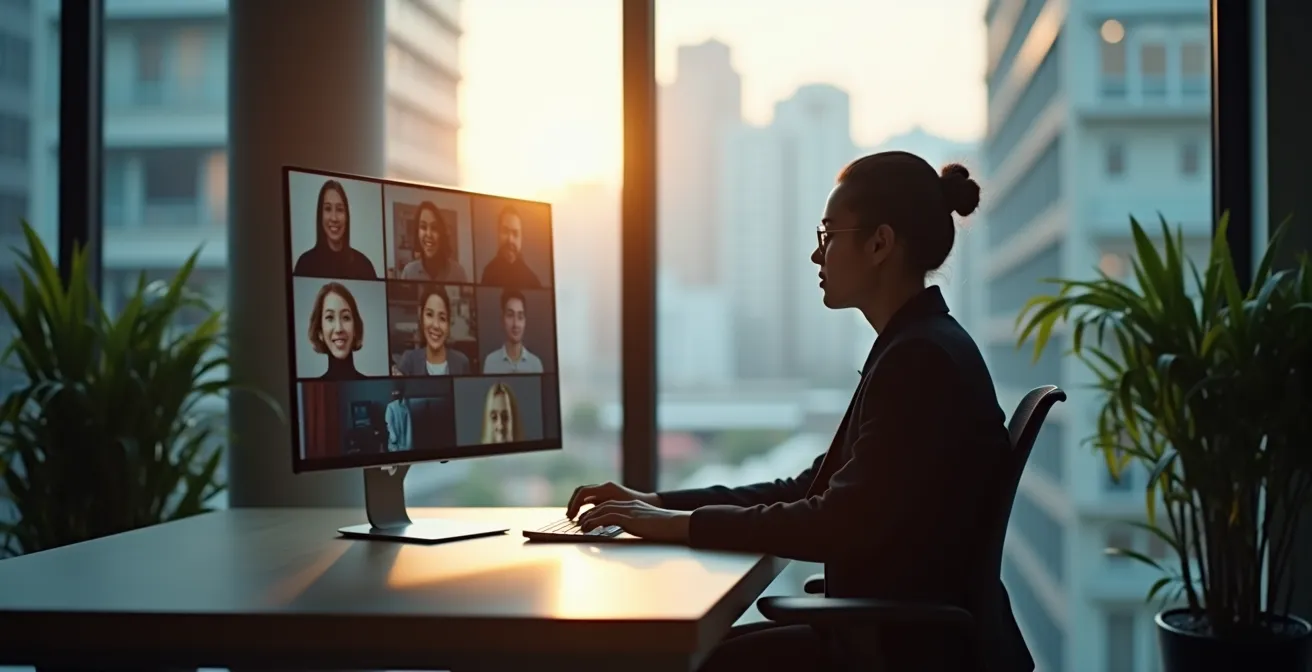
A micro-break doesn’t mean leaving your desk for 15 minutes. It can be a 30-to-90-second activity performed discreetly, even during a call. The goal is to briefly disengage the intense focus of the prefrontal cortex and allow your brain a moment of reset. These breaks, though short, are neurologically significant. They prevent cognitive overload and allow you to re-engage with renewed focus for the next energy cycle. Consider these Zoom-compatible micro-breaks:
- 20-20-20 Rule: Every 20 minutes, look at an object 20 feet away for 20 seconds to reduce digital eye strain.
- Below-Camera Hand Stretch: Out of the camera’s view, interlace your fingers, push your palms away, and extend your arms downward.
- Strategic Mute Moment: Turn off your camera and mute your mic for 30 seconds to do a few gentle neck rolls.
- Peripheral Vision Reset: Keeping your head still, let your eyes drift and simply notice objects in your peripheral vision without focusing on them.
How to Arrange Your Home Screen to Reduce Dopamine-Driven Clicks?
Your digital environment is as impactful as your physical one. A cluttered desktop or a dock filled with notification badges is a constant source of low-grade stress and distraction. Each icon is a potential “open loop”—a visual cue for an unfinished task or a potential dopamine hit from a new message or social media update. During a high-pressure Zoom call, these visual triggers compete for your limited cognitive resources, increasing your cognitive load and pulling you away from the present conversation.
Arranging your home screen for mindfulness is not about obsessive organization; it’s a strategic move to reduce unintentional, dopamine-driven clicks. The goal is to create a “digital cockpit” that is intentionally sparse and task-focused. This involves removing temptations and creating a clean slate before you enter a meeting. A study on virtual work environments found that professionals who created dedicated “Zoom-only” virtual desktops (a feature in both Windows and macOS) reported 65% fewer distractions during calls. This digital separation prevents the visual noise of your email inbox or team chat from derailing your focus.
By consciously curating what you see, you are preemptively managing your attention. This isn’t just about turning off notifications; it’s about eliminating the very *visual prompt* that triggers the desire to check them in the first place. You are designing an environment that supports focus rather than sabotaging it.
Your Pre-Flight Digital Cockpit Checklist
- Close Unnecessary Tabs: Shut down all browser tabs except for the meeting link and any documents essential for the call.
- Engage Do Not Disturb: Set your system to “Do Not Disturb” or “Focus” mode across all your devices.
- Isolate Your Workspace: Switch to a dedicated “Meeting” virtual desktop if your operating system supports it.
- Post a Visual Anchor: Place a digital sticky note with a single calming keyword (e.g., “Breathe,” “Focus”) in a corner of your screen.
- Hide the Dock/Taskbar: Minimize or auto-hide your taskbar or dock to eliminate distracting notification badges.
How Humming Low Frequencies Stimulates the Vagus Nerve Instantly?
In the moments before you present or enter a difficult negotiation on Zoom, you need a rapid method to ground yourself and calm your nervous system. One of the most effective and discreet tools is humming. This simple act is a powerful form of self-generated biofeedback. When you hum, the vibrations resonate through your skull, throat, and chest. This internal vibration physically stimulates the vagus nerve, which, as we’ve discussed, is the primary control center for your body’s “rest-and-digest” response.
The key is the frequency. Low-frequency humming (around 100-150 Hz) is particularly effective. This frequency range is similar to the vibrations used in some therapeutic devices designed for nervous system regulation. The stimulation of the vagus nerve triggers a cascade of calming effects: it can lower heart rate, reduce blood pressure, and switch your brain from a state of anxious hyper-vigilance to one of calm alertness. This is why humming, chanting, and singing are integral parts of many ancient contemplative traditions—they discovered this physiological hack centuries ago.
A secondary benefit, particularly relevant for Zoom calls, is the impact on your voice. Humming acts as a natural vocal warm-up. It relaxes the throat and vocal cords, leading to a deeper, more resonant, and more confident speaking voice when you do unmute yourself. You can practice a variation of the yogic “Bhramari” or “Bee Breath” silently with your microphone muted.
- Mute your microphone before you begin.
- Close your mouth and begin to hum at the lowest comfortable frequency you can produce.
- You can optionally place a hand on your sternum or throat to feel the internal vibration, which helps focus your attention.
- Continue for 30-60 seconds, focusing on the sensation of resonance in your skull and chest.
- Use this as a pre-call ritual to prime both your nervous system and your speaking voice.
Key Takeaways
- Micro-mindfulness is a toolkit for physiological regulation, not just a mental exercise.
- Brief, science-backed interventions like controlled breathing and cold exposure can instantly shift your nervous system from “stress” to “calm.”
- Managing your digital environment and creating transition rituals are as important as the techniques themselves for preventing burnout.
How to Reset Your Nervous System Using Cold Water on Your Face?
When you’re feeling completely overwhelmed between calls, and your nervous system is in overdrive, you need a hard reset. Splashing cold water on your face is one of the fastest and most potent ways to achieve this. The effect is not merely psychological; it triggers a powerful, primitive physiological response known as the mammalian dive reflex. This reflex evolved to help mammals conserve oxygen when submerged in cold water. When cold water hits your face (specifically the nostrils, cheeks, and forehead), it sends a powerful signal to your brain via the trigeminal nerve.
This signal instantly activates the parasympathetic nervous system, causing your heart rate to slow down and blood to be redirected from your extremities to your core organs. In a stressful office context, this means it rapidly brakes your “fight-or-flight” response, pulling you out of a state of anxiety or panic. The effect is immediate and profound. A 2024 study on stress resilience demonstrated that even a 30-second cold water exposure on the face or hands reduced cortisol levels by 28%, showcasing its potent biochemical impact.
Of course, splashing your face isn’t always practical in a professional setting. However, you can trigger a milder version of the same reflex with more discreet methods. The goal is to apply a cold stimulus to the highly sensitive areas of your face and neck. Corporate-friendly alternatives have proven highly effective, with one study showing office workers who used these techniques exhibited 35% faster stress hormone recovery between video calls. Consider these options for a quick reset:
- Cold Wrists: Run cold water over your wrists, where blood flows close to the surface of the skin.
- Facial Mist: Keep a facial mist spray in the fridge and spritz your face between calls.
- Cold Beverage: Gently press a cold can or water bottle against your neck or the sides of your face.
Begin integrating these pragmatic techniques into your daily routine. Start by picking one—box breathing, a doorway trigger, a digital cockpit reset—and practice it consistently. You have the power to transform high-pressure digital interactions from a source of burnout into an opportunity to build resilience.