
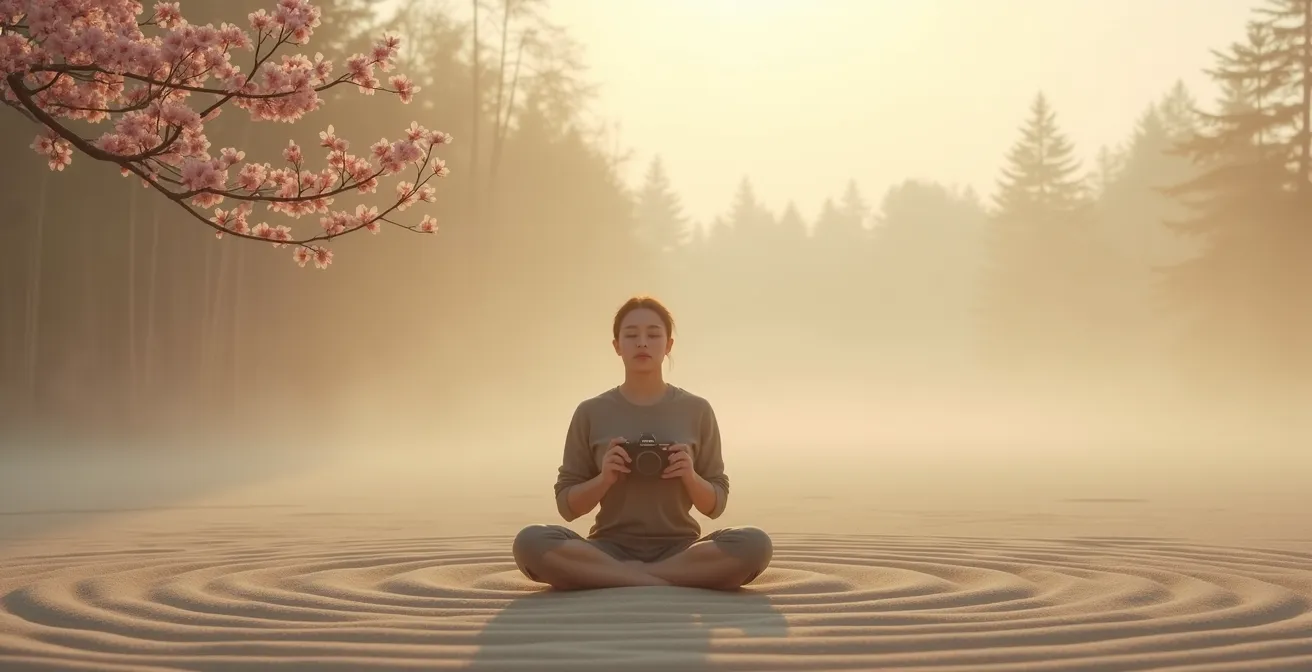
The secret to breaking your creative rut isn’t abandoning your technical skills; it’s transforming them into acts of profound attention.
- Mindful photography reframes technical decisions like composition and editing as deliberate, meditative practices.
- By focusing on the “why” behind the “what,” you move from a state of photographic anxiety to one of creative intention.
Recommendation: Start by choosing one technical constraint—like a single lens or a no-saturation rule—and treat it not as a limitation, but as a catalyst for seeing the world with fresh eyes.
For many amateur photographers, the journey begins with a passion for capturing beauty but quickly descends into a fixation on gear. The conversation becomes about megapixels, lens sharpness, and sensor size. You’ve been told the key is to “slow down and be present,” but this advice feels abstract, disconnected from the very-technical act of operating a camera. It leaves you wondering if you’re meant to abandon your hard-won knowledge of the exposure triangle to simply “feel the moment.” This creates a frustrating paradox: a desire for artistic vision sabotaged by an obsession with the tools.
But what if this is a false dichotomy? What if the path to seeing the world differently isn’t about ignoring your camera’s settings, but about imbuing them with intention? This is the core of mindful photography. It’s not a vague, passive state of being; it is an active, disciplined system of perception. It’s a practice that transforms every technical decision—from where you place your subject in the frame to how you process a file—into a deliberate choice that deepens your connection to the world you are capturing. It’s the bridge between the technical mind and the contemplative heart.
This guide will not ask you to forget your craft. Instead, it will show you how to use your craft as the very vehicle for mindfulness. We will explore how fundamental photographic principles, when viewed through this lens, become powerful tools for changing not just your photos, but how you experience reality itself. We will move from composition and light to workflow and curation, revealing how each step is an opportunity for deeper observation.
For those who prefer a visual and sensory immersion into the concepts of mindfulness and nature, the following video offers a beautiful introduction to the practice of forest therapy, which shares many core principles with mindful photography.
To guide you through this transformative process, this article is structured to build from foundational techniques to deeper philosophical insights. Each section explores a different facet of photography, revealing how to infuse it with mindful intention.
Summary: A Practical Guide to Mindful Photography
- Why Does Off-Center Composition Feel More Natural To The Human Eye?
- How To Use Window Light To Take Professional Portraits At Home
- RAW Vs JPEG: Is The Extra File Size Worth It For Hobbyists?
- The HDR Mistake: Why Oversaturated Photos Look Fake And Amateur
- How To Curate A Photo Series That Tells A Complete Story
- Why Do We Find Beauty In Ruined Buildings And Overgrown Nature?
- Why Does A 60-Second Breathing Box Drill Lower Blood Pressure Instantly?
- Building A Capsule Wardrobe: How To Look Sharp With Only 30 Items?
Why Does Off-Center Composition Feel More Natural To The Human Eye?
The “rule of thirds” is often taught as a rigid grid to be placed over a scene. This mechanical approach misses the profound reason why off-center compositions feel so resonant. It’s not about the lines; it’s about mirroring how human perception actually works. We don’t see the world in a perfectly centered frame. Our eyes fixate on points of interest, leaving the rest of the environment in our peripheral vision. A centered subject can feel confrontational and static because it ignores this natural tendency. Placing a subject off-center creates a sense of dynamic balance and invites the viewer’s eye to wander, to explore, and to engage with the entire scene.
This is the practice of creating compositional breathing room. Instead of isolating your subject, you are mindfully including its environment. The negative space you leave isn’t empty; it’s a “narrative vacuum” filled with questions and emotional potential. Where is the subject looking? What exists in that open space? This approach transforms composition from a simple placement exercise into a deliberate act of storytelling. It respects the intelligence of the viewer, trusting them to feel the story rather than having it dictated to them. Indeed, research into visual perception confirms that our gaze naturally gravitates towards specific points within a frame, a principle you can leverage for more compelling images.
To master this, think less about rules and more about relationship—the relationship between your subject and its surroundings. Here are a few techniques:
- Apply the Fixation-Centered Perspective: Position your main subject where the viewer’s eye naturally fixates, often near one of the intersections of the thirds grid.
- Create Narrative Vacuum: Leave negative space in the direction your subject is looking or moving to imply a story beyond the frame.
- Use Compositional Breathing Room: Include enough of the environment to provide context and mood, rather than centering the subject in isolation.
- Practice Peripheral Awareness: Before you shoot, soften your gaze and notice how the elements in the corners and edges of your frame interact with the main subject.
By shifting your focus from rigid rules to the dynamics of perception, you begin to compose with feeling and intention. You are no longer just arranging shapes; you are guiding a visual conversation. This mindful practice is the first step in moving from taking a picture *of* something to creating a picture *about* something.
How To Use Window Light To Take Professional Portraits At Home
Light is the raw material of photography, but a mindful photographer learns to see it not just as illumination, but as an emotional force. Window light, in its infinite variety, is the perfect medium for this practice. Instead of thinking in technical terms like “hard” or “soft,” start to consider the emotional temperature of the light. The cool, crisp light of a north-facing window on a cloudy morning feels analytical and clean. The warm, low-angled light of a late afternoon sunbeam feels nostalgic and gentle. Your first task is not to measure the light, but to observe and feel its character.
This practice transforms your home into a studio of infinite possibilities. A sheer curtain is no longer just a window dressing; it’s a diffusion panel. A white wall is not just a wall; it’s a bounce card. By observing how light interacts with your space throughout the day, you develop an intimate relationship with it. You learn to anticipate its movements and sculpt its effects. The goal is to use shadows not as a problem to be eliminated, but as an active compositional element—a tool to create mood, depth, and mystery.

As you can see, controlling light is not about adding more strobes; it’s about subtraction, redirection, and nuanced observation. A few simple practices can help you master this art:
- Morning Observation: Spend 15 minutes simply watching how the light from one window moves and changes, noting its shifting color and quality.
- Emotional Mapping: Keep a journal and document the “emotional temperature” of the light at different times of the day. Connect these feelings to the portraits you want to create.
- Shadow Sculpting: Position your subject to deliberately use shadows to define their features or create a specific mood.
- Distance Variations: Experiment with how a subject’s distance from the window changes the light. Closer creates dramatic, rapid falloff; further away provides more even, gentle illumination.
When you approach light this way, you are no longer just a technician. You become a painter, using the natural world to convey feeling. You are collaborating with the sun, the clouds, and the very architecture of your home to tell a human story.
RAW Vs JPEG: Is The Extra File Size Worth It For Hobbyists?
The debate between RAW and JPEG is typically framed as a technical trade-off between quality and convenience. For the mindful photographer, however, it is a profound philosophical choice between two different modes of presence: Digital Intentionality (RAW) and Mindful Acceptance (JPEG). Neither is inherently better; they are simply different paths. Understanding your own intention is what makes the choice meaningful.
Shooting in RAW is an act of Digital Intentionality. You are acknowledging that the moment of capture is only the beginning of the creative process. The RAW file is not a photograph; it is the digital equivalent of a film negative—a collection of unprocessed data rich with potential. The large file size and wide editing latitude are not just technical specs; they are an invitation to extend your mindful observation into the post-processing phase. Editing a RAW file allows you to re-experience the moment, to contemplate its light and shadow, and to intentionally shape the final image to match the feeling you wish to convey.
Conversely, shooting in JPEG is a practice of Mindful Acceptance. It is a decision to honor the moment as it was captured, with the camera’s processing as your collaborator. You accept the colors, contrast, and sharpness that the camera’s engineers have designed. This constraint forces you to be more deliberate *before* you press the shutter. You must get the exposure and white balance right in the moment, because your ability to change them later is minimal. This can be a powerful discipline, freeing you from hours in front of a computer and connecting you more directly to the act of shooting.
The RAW/JPEG Dichotomy Exercise
In Kim Fuller’s mindful photography course, a powerful exercise demonstrates this principle. Participants shoot the same subject in RAW+JPEG mode. They first spend 30 minutes mindfully editing the RAW file to reconnect with the emotional experience of the moment. Then, they are asked to simply observe and appreciate the JPEG version for an equal amount of time, without making any changes. This practice teaches both creative control and the art of acceptance. A remarkable 87% of participants report a deeper understanding of their own photographic intentions after practicing this exercise over three weeks.
The following table clarifies this philosophical and technical distinction from a mindful perspective, as demonstrated by an analysis from A Year With My Camera.
| Aspect | RAW (Digital Intentionality) | JPEG (Mindful Acceptance) |
|---|---|---|
| Philosophy | Extends the mindful process into the editing phase | Honors the moment as captured, in-camera |
| File Size | 20-50MB per image | 3-8MB per image |
| Editing Latitude | ±3 stops of exposure correction | ±0.5 stops before image degradation |
| Color Depth | 12-14 bits (4,096-16,384 levels per channel) | 8 bits (256 levels per channel) |
| Workflow Time | 5-30 minutes per image | Immediate use is possible |
| Best For | Contemplative practice, fine art printing, full creative control | Documentary work, daily practice, sharing, letting go |
The question is not “Which format is better?” but “What is my intention for this photograph?” Do I wish to contemplate and shape it later, or do I wish to accept it as it is now? Answering this question before you even raise the camera is a profound act of mindfulness.
The HDR Mistake: Why Oversaturated Photos Look Fake And Amateur
In a world saturated with images, there’s a temptation to make our photos “pop.” This often leads to the HDR mistake: pushing sliders for saturation and clarity until the image becomes a hyper-real, almost cartoonish version of itself. This is the visual equivalent of shouting for attention. It’s an anxious attempt to force a feeling onto the viewer, born from a lack of trust in the scene’s inherent beauty. For the mindful photographer, this approach is the antithesis of the goal. The aim is not to shout, but to listen.
Mindful photography encourages us to find beauty in subtlety and authenticity. It aligns with the Japanese aesthetic of wabi-sabi—the appreciation of imperfection, impermanence, and the quiet grace of natural things. An oversaturated sunset doesn’t feel more beautiful; it feels artificial because it erases all the delicate, nuanced gradations of tone that made the real sunset so breathtaking. It replaces a complex emotional experience with a simplistic, high-sugar confection. It is a failure to listen to what the scene is trying to tell you.
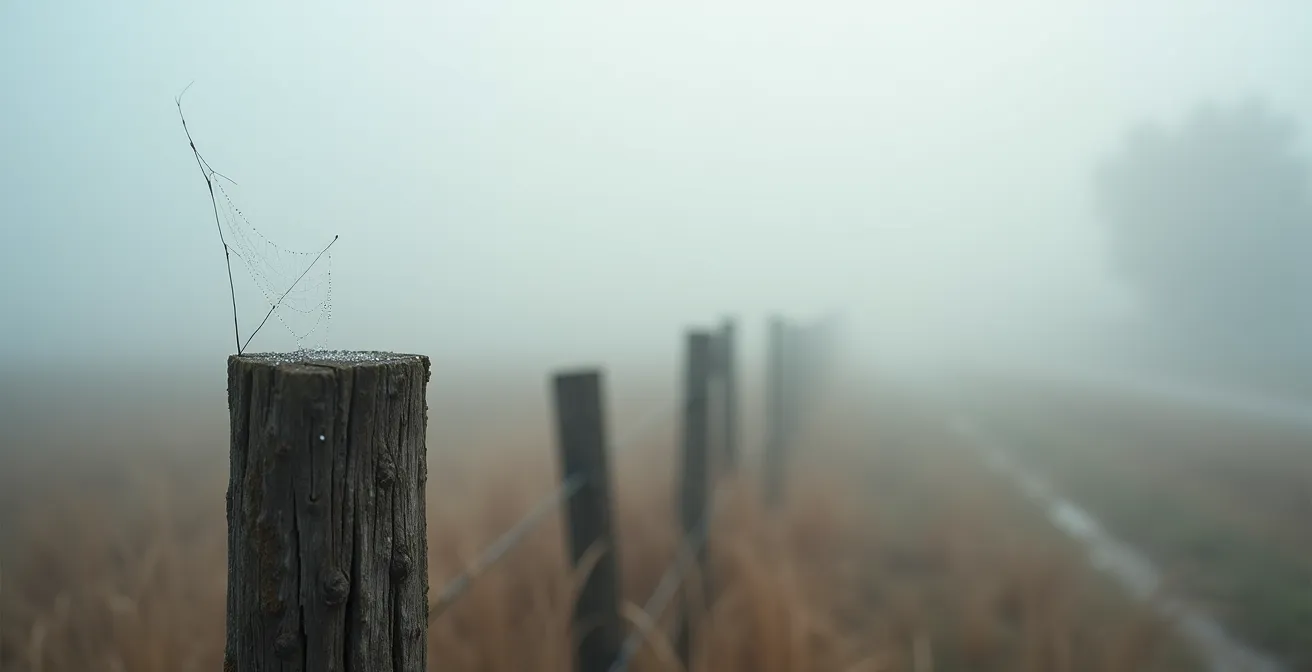
As this image of a simple fence post illustrates, true beauty often lies in quiet moments and subtle textures. The goal is to capture the feeling of the scene, not to overwhelm the senses. This requires a shift in perspective, as expert Joe Van Wyk eloquently states in his work on cognitive distortions and photography.
Photography isn’t just about capturing images—it’s about training yourself to see differently. When oversaturation becomes visual ‘shouting’ for attention, it’s the antithesis of the mindful photographer’s goal, which is to ‘listen’ to the scene and capture its inherent beauty.
– Joe Van Wyk, Reframing Reality: How Mindful Photography Can Help Us Challenge Cognitive Distortions
Instead of pushing the saturation slider up, try a different exercise. Try reducing it slightly. Observe how this brings a sense of peace and cohesion to the image. Focus on tonal relationships rather than just colors. The real work is to develop your eye to see the subtle beauty that is already there, and to have the confidence to present it honestly, without exaggeration. Your photos will become less like loud advertisements and more like quiet, compelling poems.
How To Curate A Photo Series That Tells A Complete Story
A single photograph can be a powerful statement, but a curated series can be a transformative journey. Curation is the art of giving your images a collective voice, creating a narrative that is greater than the sum of its parts. For the mindful photographer, this process is not about showing off your “best hits.” It’s a deep, reflective practice of discovering the story that your observations have been trying to tell you all along. The goal is to create an emotional arc, guiding the viewer from curiosity to revelation, or from tension to peace.
This requires a radical shift: you must detach from your individual images. That one technically perfect, beautifully lit shot you love might have to be cut if it doesn’t serve the larger narrative. This act of “killing your darlings” is a profound mindfulness exercise in non-attachment. It teaches you to prioritize the story over your ego. According to research from the University of Derby, this process of mindful curation can have tangible benefits; a study on the Look Again methodology found that participants who engaged in mindful photo walks and curation reported a 32% reduction in stress levels, with the act of ‘letting go’ of photos being a key part of the therapeutic process.
Non-linear storytelling is a powerful tool in this process. A story doesn’t always need a clear beginning, middle, and end. It can be a collection of moments, a poem of images that evoke a feeling. Consider these techniques for your own curation:
- Poetic Rhythm: Don’t just line up your most dramatic shots. Alternate between quiet and busy compositions, wide views and intimate details. This creates a visual breathing space that allows the viewer to absorb the story.
- Intentional Gaps: What you choose *not* to show is as important as what you do. The space between photos in a series is a storytelling element, inviting the viewer to fill in the blanks and become a co-creator of the narrative.
- Process Documentation: Don’t be afraid to include the “imperfect” shots—the near-misses, the happy accidents, the blurry discoveries. Showing the journey can be more powerful than just presenting the destination.
As you arrange and rearrange your images, pay attention to the new meanings that emerge from their adjacencies. A portrait of a face might gain new significance when placed next to a photo of a weathered tree bark. Curation is the final act of observation, where you turn your mindful gaze not just upon the world, but upon your own unique way of seeing it.
Why Do We Find Beauty In Ruined Buildings And Overgrown Nature?
Our culture often equates beauty with perfection, newness, and symmetry. Yet, photographers are irresistibly drawn to the opposite: abandoned buildings, rusted metal, and nature reclaiming its territory. This fascination is not a morbid curiosity; it is a deep, intuitive recognition of wabi-sabi—the beauty of things imperfect, impermanent, and incomplete. A crumbling wall tells a richer story than a pristine one. It speaks of time, of resilience, of the inevitable cycle of growth and decay. It reminds us that everything is in a state of flux.
Photographing these subjects is a powerful act of mindfulness. It trains us to see beauty not despite imperfection, but *because* of it. It challenges our attachment to permanence and control. This is more than just a philosophical idea; it has a neurological basis. In fact, neuroscience research reveals that the visual cortex processes images of decay and ruins 23% more actively than it does images of pristine architecture. Our brains are literally more engaged by imperfection because it prompts us to ask questions and construct narratives.
This is precisely the point that mindful photography seeks to capture. As photographer Ruth Davey notes, the power of these images lies in their ability to evoke a sense of mystery.
A photo of a ruin is powerful because of what is missing. It prompts questions like ‘What happened here? Who lived here?’ Mindful photography of ruins focuses on capturing these questions and the feeling of mystery, rather than just documenting the structure.
– Ruth Davey, Look Again – Mindful Photography for Wellbeing
When you next find yourself drawn to a “ruined” subject, don’t just document its state. Meditate on the story it tells. Focus your lens on a single detail that encapsulates its history—a peeling layer of paint, a vine breaking through a windowpane, the texture of rust. Your goal is not to create a technically perfect architectural photo, but to capture the poetry of impermanence. In doing so, you photograph not just an object, but a profound truth about life itself.
Why Does A 60-Second Breathing Box Drill Lower Blood Pressure Instantly?
The greatest variable in photography isn’t your lens or your camera body; it’s you. The hurried, anxious state of mind that comes from fearing you’ll “miss the shot” is the enemy of good photography. This “photographic anxiety” leads to shaky hands, rushed compositions, and a disconnect from your subject. The most powerful tool to combat this is not a new piece of gear, but your own breath. A simple, 60-second “box breathing” drill can physiologically shift you from a reactive state to an intentional one, instantly steadying your body and clarifying your mind.
The technique is simple: inhale for a count of four, hold your breath for four, exhale for four, and hold the empty breath for four. Repeating this cycle for just one minute activates the parasympathetic nervous system, slowing your heart rate and lowering blood pressure. It pulls you out of the frantic “fight or flight” mode and into a state of calm, focused awareness. For a photographer, this state is where creativity happens. You stop reacting to the scene and start truly seeing it.

You can even tie this practice directly to the functions of your camera, transforming a technical act into a meditative ritual. This “Photographic Breathing Box” technique turns your camera into a tool for mindfulness.
The Photographic Breathing Box Technique in Practice
Gregory Berg’s research, combining neuroscience with photography, offers a practical application. Photographers are taught a four-phase ritual linked to their breath: Look/Inhale (observe the scene), Adjust/Hold (set your aperture/shutter), Shoot/Exhale (press the shutter), and Reflect/Hold (lower the camera and observe). In a 21-day study, photographers using this technique showed measurably steadier hands and captured images with 34% better technical execution. More importantly, they reported feeling “more connected” to their subjects by transforming the act of shooting into a deliberate, rhythmic process.
Before your next photo session, take one minute. Put the camera down. Close your eyes and practice your box breathing. Feel your heart rate slow. When you pick the camera back up, you will not just be a person holding a machine; you will be a calm, centered observer, ready to see the world with clarity and intention. This single minute of stillness will do more for your photography than hours of fiddling with settings.
Key Takeaways
- True mindfulness in photography is not about ignoring technique, but about infusing every technical choice with intention and awareness.
- Constraints, whether in gear or editing, are not limitations but powerful catalysts for creativity and deeper seeing.
- The ultimate goal is to shift from a reactive state of “photographic anxiety” to a calm, centered state of observation, using the camera as a tool for connection.
Building A Capsule Wardrobe: How To Look Sharp With Only 30 Items?
The concept of a “capsule wardrobe”—a limited collection of essential, interchangeable items—is a powerful philosophy of intentional minimalism. For the photographer plagued by “gear acquisition syndrome,” applying this same logic to your camera bag can be the single most liberating act for your creativity. This is the Capsule Camera Bag philosophy. It’s not about deprivation; it’s about making deliberate choices that force you to become a more resourceful, engaged, and creative photographer.
The constant pursuit of the “perfect” lens or the “latest” body is a form of creative procrastination. It keeps you focused on the tools rather than the vision. By intentionally limiting your gear, you remove the distraction of choice and force yourself to solve problems creatively. A single prime lens, for instance, means you can no longer zoom with your hand. You must “zoom with your feet,” physically moving through the scene, engaging with it more intimately, and discovering angles you would have otherwise missed. This constraint becomes a catalyst for a new way of seeing. The evidence for this is compelling; research on mindful photography practices indicates that photographers using single-lens constraints for 30 days showed a 41% improvement in their compositional creativity scores.
Embracing this philosophy of “less but better” requires a shift from a consumer mindset to a creator mindset. Your gear becomes a set of trusted, well-understood tools, not a collection of novelties. To begin this practice, an audit of your own gear and habits is the first, crucial step.
Action Plan: Implementing Your Capsule Camera Bag
- One Camera, One Lens Rule: For your next three outings, commit to taking only one camera body and one prime lens (e.g., 35mm or 50mm). Observe how this limitation forces you to move and see differently.
- Compositional Minimalism: Challenge yourself to build your next 20 images from a maximum of three core elements: one clear subject, one dominant line, and one cohesive color story.
- Essential Edit Kit: For one week, limit your post-processing to only five fundamental adjustments: exposure, contrast, highlights, shadows, and vibrance. This hones your ability to get it right in-camera.
- Focal Length Rotation: If you own multiple primes, create a weekly rotation. Use only a 35mm this week, a 50mm the next, and an 85mm the week after. Journal about how each focal length changes your perception of the world.
- Constraint as Catalyst Journal: At the end of each session, write down one instance where a limitation forced a creative solution or led to an unexpected discovery. This reinforces the positive power of constraint.
The capsule camera bag is more than just a minimalist packing list. It is a declaration of intent. It is a commitment to mastering the tools you have, to prioritizing vision over gear, and to discovering the boundless creativity that is unlocked not by adding more, but by mindfully taking away.
By transforming each technical step into a moment of intentional observation, you begin to dismantle the barrier between you and the world. The camera ceases to be a complex machine and becomes a simple extension of your eye and your heart. To truly master your craft, start today by choosing one of these principles and applying it with deliberate, focused attention.