
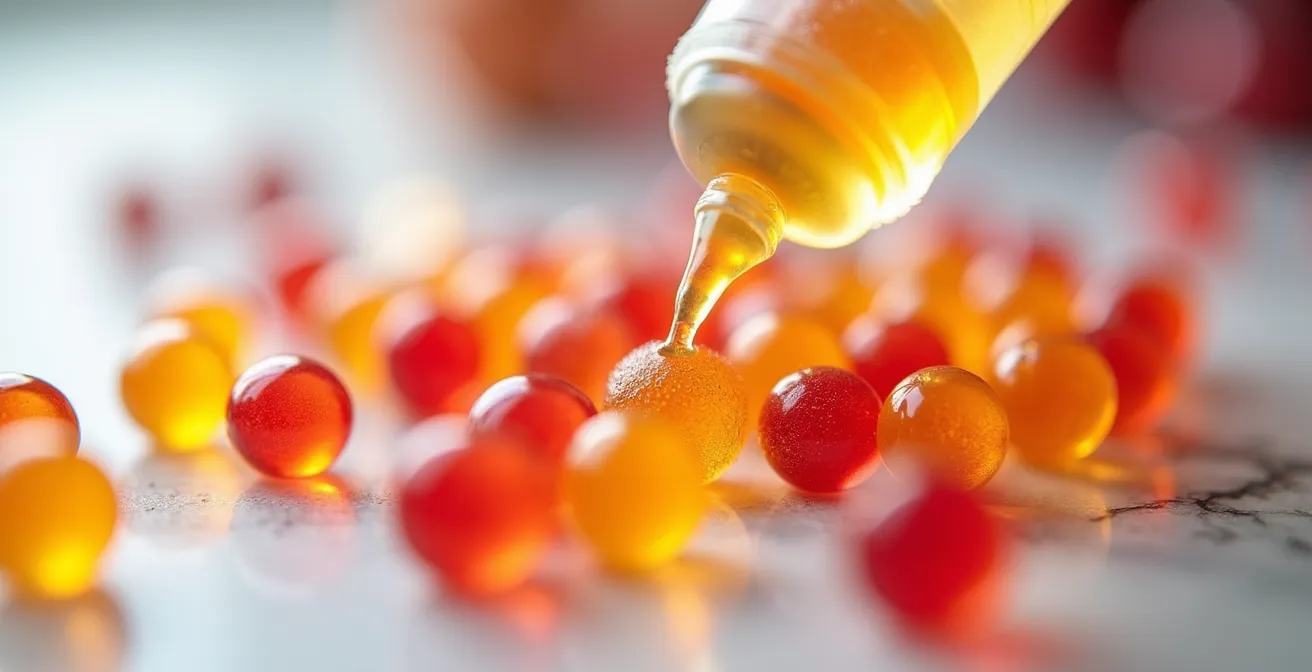
Creating perfect fruit caviar at home isn’t about having a lab; it’s about understanding the fundamental chemistry of gelling agents.
- Spherification is a controlled chemical reaction (ion exchange) where precision in measurement is non-negotiable for success.
- The choice of gelling agent (alginate vs. agar) and calcium source dictates the texture, taste, and stability of your final creation.
Recommendation: Master the principles of why ingredients interact before starting, and your results will shift from frustrating accidents to intentional artistry.
The allure of molecular gastronomy, with its whimsical foams, surprising textures, and jewel-like fruit caviar, can seem like a magical art form confined to the world’s most exclusive restaurant kitchens. Many home cooks, bored with standard recipes and eager for a challenge, attempt techniques like spherification only to be met with frustrating results: clumps of gel, misshapen blobs, or flavors that simply disappear. The common advice is often to just “follow the recipe” or marvel at the “magic” of it all, but this fails to empower the ambitious cook. We often hear about related techniques like sous-vide or emulsions, but the core of creating these delicate spheres remains elusive.
But what if the key wasn’t a better recipe or a mythical “chef’s touch”? What if the secret to moving beyond imitation and into true creation lies not in magic, but in science? The real breakthrough comes from understanding the ‘why’ behind the ‘how’. This guide takes a different approach. We will dismantle the core chemical principles that govern these transformations, from the polymer chains of sodium alginate to the thermal properties of agar-agar. By mastering the science, you gain the freedom to troubleshoot, adapt, and invent with confidence.
This article will guide you through the foundational science that makes spherification possible. We will explore the critical importance of precision, compare key ingredients, and even discuss the philosophical balance between technique and taste. By the end, you’ll have the knowledge to create perfect fruit caviar not by following a rigid recipe, but by commanding the principles of chemistry in your own kitchen.
Summary: The Science of Spherification: A Home Cook’s Guide to Mastering Fruit Caviar
- Why Does Sodium Alginate Turn Liquid Into Spheres When It Hits Calcium?
- How To Weigh Ingredients To 0.1g Accuracy For Perfect Results
- Agar Agar Vs Gelatin: Which Gelling Agent Is Best For Hot Foams?
- The Intensity Error: Why Too Much Molecular Technique Ruins The Dish’s Soul
- When To Plate: Why Foam Collapses If You Wait Too Long
- Street Stalls Vs Michelin Stars: Which Offers A Truer Taste Of The Culture?
- L-Ascorbic Acid Vs Sodium Ascorbyl Phosphate: Which Brightens Sensitive Skin?
- Lacto-Fermentation 101: How To Make Safe And Crunchy Pickles At Home?
Why Does Sodium Alginate Turn Liquid Into Spheres When It Hits Calcium?
The transformation of a liquid into a delicate sphere is not magic, but a beautiful demonstration of polymer chemistry. The key ingredient, sodium alginate, is a natural polysaccharide extracted from brown seaweed. In its initial state, it consists of long, unlinked polymer chains dissolved in your fruit juice or other liquid base, making it slightly viscous. The “magic” happens through a process called ion exchange when this alginate solution comes into contact with a solution containing calcium ions (like a calcium chloride bath).
The calcium ions act as microscopic bridges. Each calcium ion has a double positive charge (Ca2+), allowing it to connect two separate alginate polymer chains. As droplets of the alginate mixture fall into the calcium bath, the calcium ions on the surface immediately begin linking the alginate chains together, forming a flexible, cross-linked skin or gel membrane. This process creates a polymer matrix that encapsulates the still-liquid interior. The result is a perfect sphere with a delicate outer membrane that bursts in the mouth.

This process, known as basic spherification, continues as long as the sphere remains in the calcium bath; the gel wall will thicken inwards, eventually turning the entire sphere solid. This kinetic aspect is what makes timing so crucial in achieving the desired liquid-center texture. This technique was famously pioneered and popularized by the creative team at El Bulli, fundamentally changing the landscape of modern cuisine.
El Bulli’s pioneering spherification technique
Ferran Adrià’s team at El Bulli restaurant discovered spherification in 2003 after visiting Griffith España and learning about sodium alginate’s reaction with calcium. This discovery revolutionized molecular gastronomy, allowing chefs to create liquid-filled spheres that burst in the mouth, transforming the dining experience worldwide.
How To Weigh Ingredients To 0.1g Accuracy For Perfect Results
In conventional cooking, a “pinch” of salt or a “splash” of cream are acceptable measurements. In molecular gastronomy, such imprecision leads to guaranteed failure. Because you are initiating a chemical reaction, the ratios of your reactants are absolute. Spherification requires a specific concentration of sodium alginate to create a stable solution and a specific concentration of calcium to trigger gelling. Too little alginate and no gel forms; too much, and the base liquid becomes a thick, unpleasant sludge. This is why a digital scale accurate to 0.1 grams is the single most important tool for any aspiring home gastronome.
Think of it as a chemical equation: the number of alginate polymer chains must be appropriate for the number of available calcium ions to form a stable matrix. A standard starting ratio is typically around 0.5% sodium alginate to the weight of your flavored liquid and 1% calcium chloride to the weight of the water in your setting bath. Deviating even slightly can dramatically alter the gelling kinetics—the speed and strength of the gel formation. For instance, different types of calcium salts have different efficiencies and can impart distinct flavors, further highlighting the need for precision.
A recent comparative analysis of calcium sources shows just how much this choice matters, affecting not only taste but the time it takes for the gel to form.
| Calcium Source | Gel Formation Time | Taste Profile | Best Use Case |
|---|---|---|---|
| Calcium Chloride | ~100 seconds | Slightly bitter | Fast production, masked flavors |
| Calcium Lactate | ~500 seconds | Neutral | Better taste, moderate speed |
| Calcium Gluconate | ~2000 seconds | Very neutral | Premium taste, thickness control |
Action Plan: Essential Measurements for Direct Spherification
- Weigh your flavored liquid precisely to establish a baseline for all other ingredients.
- Calculate and weigh 0.5% of your liquid’s weight for sodium alginate (e.g., 5g of alginate for 1000g of juice).
- Measure the water volume for your calcium bath by weight (e.g., 1000g or 1L).
- Add and weigh 1% of the water’s weight in calcium chloride (e.g., 10g of calcium for 1000g of water).
- Use an immersion blender for 5-10 minutes to fully dissolve the alginate without clumps, ensuring a homogenous solution for consistent reactions.
Agar Agar Vs Gelatin: Which Gelling Agent Is Best For Hot Foams?
When creating stable foams, especially hot ones, the choice of gelling and stabilizing agent is crucial. While gelatin is a common choice in classic pastry, it has a major limitation: it’s a protein that melts at a low temperature, around 35°C (95°F). This makes it entirely unsuitable for creating stable hot foams, as they would simply collapse into liquid upon warming. This is where agar-agar, a seaweed-derived polysaccharide, becomes the superior choice. Agar’s key advantage is its high melting point (around 85°C / 185°F) and its significant thermal hysteresis—it gels at around 32-40°C but doesn’t melt again until it’s heated much higher. This property allows it to create gels and foams that remain perfectly stable even when served hot.
While this H2 focuses on foam, agar’s unique properties also open the door to a different, more accessible type of spherification that doesn’t require sodium alginate. Known as “cold oil spherification,” this technique uses agar’s thermal gelling properties. A hot agar-infused liquid is dropped into a column of very cold oil. The thermal shock causes the droplets to instantly gel into solid, jelly-like pearls as they fall. This method is simpler and avoids the potential bitterness of calcium chloride.
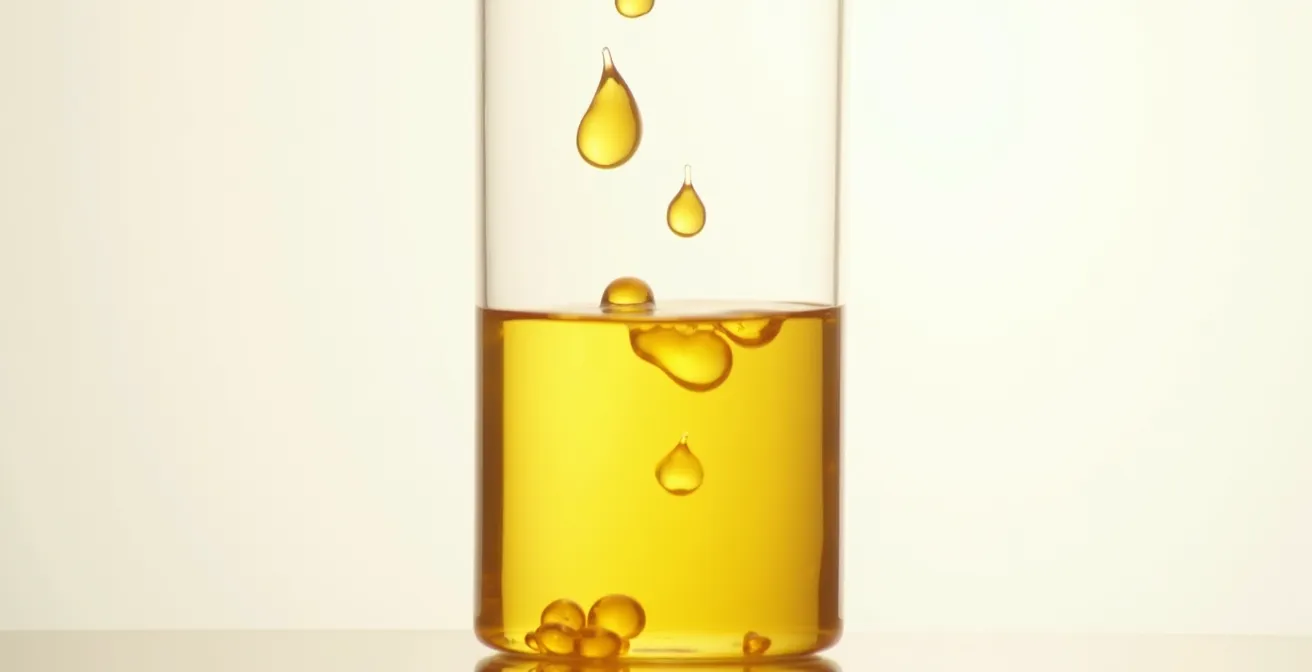
However, it’s important to understand the fundamental difference in the final product. As the experts at Modernist Pantry note, the result is texturally distinct.
Cold oil spherification is quite different than traditional spherification. You use the gelling agent, in this case agar. They differ from sodium alginate spheres because you will never have a liquid center.
– Modernist Pantry, Kitchen Alchemy Blog
This technique can be finicky, as one home cook discovered, but the key is mastering the temperature differential. Getting the oil ice-cold is a non-negotiable step for success.
The Intensity Error: Why Too Much Molecular Technique Ruins The Dish’s Soul
The power of molecular gastronomy techniques is seductive. The ability to transform a familiar liquid into a surprising new form can feel like the pinnacle of culinary artistry. However, this power comes with a significant risk: the “intensity error.” This occurs when the technique itself—the novelty of the texture, the pop of the sphere—becomes so dominant that it completely overshadows or even erases the soul of the original ingredient. A strawberry should still taste like a sun-ripened strawberry, not just a sweet, generic gel. The goal of a great chef is to use technique to enhance or reveal a new facet of an ingredient, not to obliterate its identity.
This isn’t just a philosophical debate; it’s a measurable chemical and sensory phenomenon. The process of spherification can alter the delicate volatile compounds that constitute an ingredient’s flavor and aroma. The gelling process and the introduction of other agents (like calcium salts) can mute some notes while amplifying others, sometimes in unpredictable ways. The more complex the original liquid, the more pronounced this transformation can be, pushing the flavor past its recognizable sensory threshold into something new and, potentially, less desirable.
An experiment documented on the Tiny Urban Kitchen blog perfectly illustrates this concept, showing how complex liquids are fundamentally changed by the process.
Flavor transformation in complex liquids during spherification
Testing with complex flavors revealed significant changes after spherification. A Chateau Le Tour Carnet red wine lost its deep tannins and became fruity and light, with Cabernet character disappearing while Merlot notes became pronounced. Similarly, spherified scotch whisky lost its sweet and floral notes but maintained its peaty characteristics, suggesting that simpler, more direct fruit flavors often work best with this technique.
When To Plate: Why Foam Collapses If You Wait Too Long
The ephemeral nature of certain culinary creations is part of their magic, but for a chef, it’s a logistical challenge that demands perfect timing. A delicate foam, which is essentially a liquid filled with tiny air bubbles, is inherently unstable. Gravity pulls the liquid down, and the surface tension holding the bubbles together weakens over time, causing it to collapse. This is why foams are always prepared and plated à la minute—at the last possible second.
This same principle of time-dependent stability applies directly to spherification, albeit for a different chemical reason. As we’ve seen, in basic spherification, the gelling process is continuous. The moment a sphere is removed from its calcium bath, the reaction doesn’t instantly stop. The calcium ions on the surface continue to work their way inward, thickening the gel wall. Wait too long to serve, and your delightful liquid-centered pearl becomes a firm, chewy gummy. The window to serve basic spherification caviar is therefore extremely short, ideally less than a minute after cooking.
To overcome this limitation for professional kitchens or home cooks wanting to prep ahead, reverse spherification was developed. In this method, the calcium is mixed into the flavored liquid, and the sphere is formed in an alginate bath. Once the sphere is removed and rinsed, the gelling process stops completely, as there is no more external alginate to continue the reaction. This crucial difference makes all the difference for preparation.
- Cook basic spherification spheres for less than 1 minute to maintain a liquid center.
- Serve basic spherification creations immediately, as the gelling continues after removal from the bath.
- Use reverse spherification for advance preparation, as the gelling stops once the sphere is rinsed.
- Store finished spheres in their original flavored liquid, not plain water, to prevent osmosis from diluting the flavor.
- Maintain a consistent temperature in the calcium bath for uniform and predictable sphere formation.
In fact, the reverse spherification technique is so stable that it completely changes the workflow, allowing for much more flexibility. The reverse spherification technique allows preparation up to 24 hours in advance, making it a game-changer for complex plating.
Street Stalls Vs Michelin Stars: Which Offers A Truer Taste Of The Culture?
The question of what constitutes an “authentic” taste of a culture is a complex and often passionate debate. On one side, we have the humble street stall: a vendor, often with decades of experience, perfecting a single dish passed down through generations. Here, authenticity is found in tradition, accessibility, and the unvarnished taste of a place. The food is intrinsically linked to its environment—the sounds, the smells, the community it serves. The terroir of the street provides a direct, unfiltered connection to the everyday culinary life of a culture.
On the other side stands the Michelin-starred restaurant. Here, a visionary chef often takes those same traditional flavors and deconstructs or reinterprets them using modern techniques and global influences. Authenticity is not found in replication, but in evolution and expression. A chef might use spherification to present a classic soup in a new way or use sous-vide to achieve a texture impossible with traditional methods. This is an exploration of a culture’s culinary potential, a taste of what its ingredients and flavor profiles can become.
To argue that one is “truer” than the other is to miss the point. They simply offer a taste of different facets of the same culture. The street stall offers a taste of a culture’s culinary memory and daily reality. It is the food of the people, honest and deeply rooted. The Michelin-starred restaurant offers a taste of a culture’s culinary ambition and artistic voice. It is a conversation with tradition, not a monologue. A truly comprehensive understanding of a food culture requires experiencing both: the comforting warmth of the established classic and the exhilarating spark of its creative future.
L-Ascorbic Acid Vs Sodium Ascorbyl Phosphate: Which Brightens Sensitive Skin?
In the world of skincare, Vitamin C is a celebrated powerhouse for its brightening and antioxidant properties. However, not all forms of Vitamin C are created equal, and choosing the right one is critical, especially for sensitive skin. The two most common contenders are L-Ascorbic Acid (L-AA) and Sodium Ascorbyl Phosphate (SAP).
L-Ascorbic Acid (L-AA) is the purest, most potent form of Vitamin C. It is highly effective and has the most research backing its efficacy in boosting collagen production and fading hyperpigmentation. However, its power is also its downfall for many. L-AA is notoriously unstable, oxidizing quickly when exposed to air and light, which renders it ineffective. More importantly, it is effective only at a very low, acidic pH (typically below 3.5), which can be extremely irritating for those with sensitive or compromised skin, causing redness and stinging.
Sodium Ascorbyl Phosphate (SAP), on the other hand, is a more stable, water-soluble derivative of Vitamin C. In the skin, it converts to ascorbic acid, making it active. While this conversion process makes it slightly less potent than direct L-AA, its advantages are significant. SAP is stable up to a pH of around 7, meaning it can be formulated in products that are much gentler and closer to the skin’s natural pH. This makes it far less likely to cause irritation. Furthermore, studies have shown that SAP also possesses antimicrobial properties, making it a beneficial ingredient for those with acne-prone skin.
For individuals with sensitive skin looking for the brightening benefits of Vitamin C without the associated irritation, the choice is clear. While L-AA offers maximum potency for resilient skin types, Sodium Ascorbyl Phosphate provides a much safer and more stable entry point into the world of topical Vitamin C, delivering effective results with a significantly lower risk of inflammation.
Key Takeaways
- Molecular gastronomy isn’t magic; it’s applied polymer chemistry, primarily driven by the ion exchange between alginate and calcium.
- Success is impossible without precision. The ratios of gelling agents and reactants are absolute, making a 0.1g scale an essential tool.
- Technique must always serve the ingredient. Over-manipulation can destroy the soul of a flavor, turning an artistic creation into a mere novelty.
Lacto-Fermentation 101: How To Make Safe And Crunchy Pickles At Home?
Lacto-fermentation is an ancient preservation technique that, much like molecular gastronomy, relies on controlling a natural process to transform ingredients. It’s the science behind sauerkraut, kimchi, and, of course, crunchy pickles. The process is elegantly simple: vegetables are submerged in a salt brine within an anaerobic (oxygen-free) environment. This salty, oxygen-free setting inhibits the growth of harmful bacteria while creating the perfect home for beneficial bacteria, primarily from the Lactobacillus family.
These good bacteria consume the natural sugars in the vegetables and convert them into lactic acid. This lactic acid is a natural preservative that further protects against spoilage and gives fermented foods their characteristic tangy flavor. To ensure your pickles are both safe and crunchy, two factors are critical. First, the salt concentration of your brine must be correct—typically between 2% and 5% by weight. Too little salt, and spoilage microbes can take hold; too much, and you’ll inhibit the beneficial Lactobacillus. Second, crunchiness comes from preserving the pectin in the vegetables’ cell walls. Using impeccably fresh, crisp vegetables is the best start. Additionally, adding tannins—found in grape leaves, oak leaves, or black tea—can help inhibit the enzymes that break down pectin, keeping your pickles satisfyingly crunchy.
Mastering this controlled process opens up a world of complex, gut-healthy flavors. It’s another example of how understanding the underlying science—in this case, microbiology—allows the home cook to create exceptional food with confidence. The principles of precision and controlling an environment are universal, whether you are creating a pickle or a perfect sphere of fruit juice.
Embrace the mindset of a scientist in your kitchen. Start with these foundational techniques, ask “why” at every step, and don’t be afraid to experiment. Your next culinary breakthrough is just one controlled reaction away.
Frequently Asked Questions on Molecular Gastronomy At Home: How To Make Fruit Caviar Without A Lab?
Can I make caviar pearls from fermented liquids like kombucha?
Yes, but you need to adjust for acidity. Add sodium citrate to neutralize pH if below 3.6, as basic spherification won’t occur in highly acidic liquids.
How does salt content from fermented brines affect spherification?
High salt content can interfere with gel formation. Dilute salty fermented liquids with distilled water to achieve proper alginate hydration and sphere formation.
What unique flavors work well for fermented spherification?
Kimchi brine pearls add umami bursts to savory dishes, while water kefir creates probiotic caviar perfect for health-conscious garnishes.