
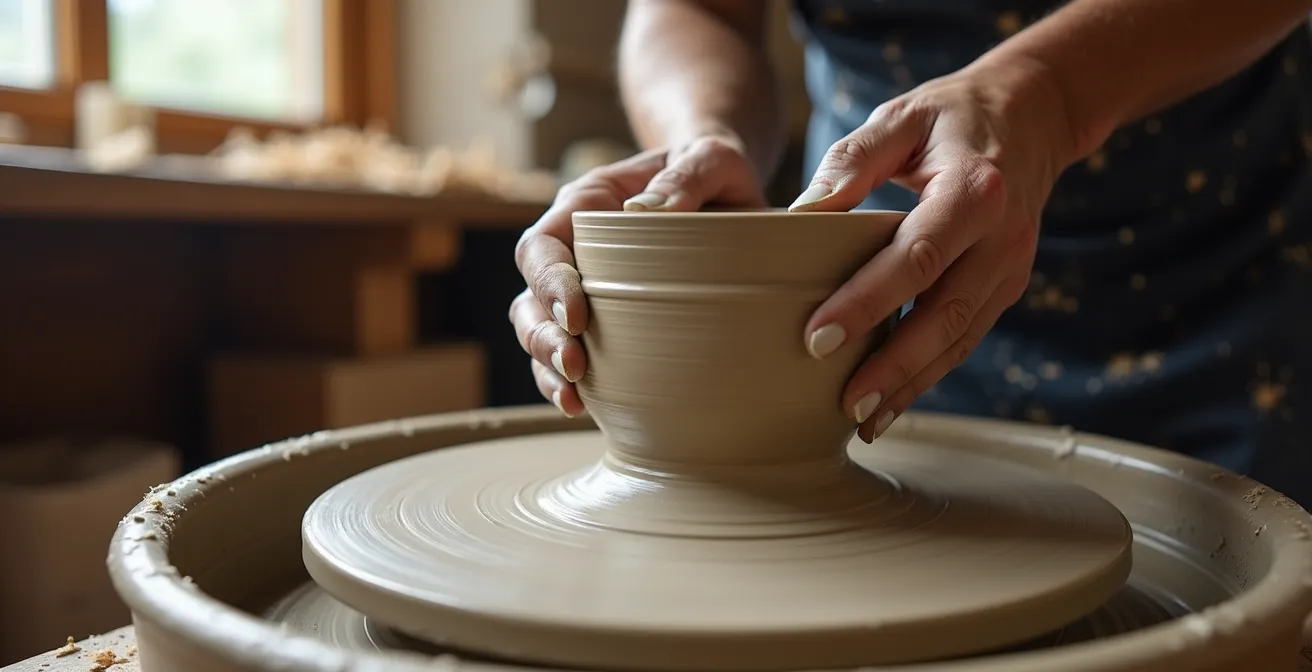
The most effective cure for digital burnout isn’t just “disconnecting”; it’s engaging in a tactile craft that provides a direct neurochemical reset.
- Working with materials like clay measurably lowers stress hormones like cortisol within minutes.
- The physical resistance and sensory feedback of manual crafts ground you in the present, rebuilding focus pathways degraded by screen time.
Recommendation: Choose a craft based on its physical demands and your tolerance for failure. Pottery offers an intense sensory experience, while leatherworking provides a lower-impact entry point.
If you’re a tech professional, the feeling is likely familiar: a constant hum of notifications, a backlog of abstract tasks, and a sense that your brain is a browser with too many tabs open. This is digital burnout, a state of cognitive and emotional exhaustion born from a world mediated by screens. The common advice—”just disconnect” or “practice mindfulness”—often feels like a flimsy patch on a deep-seated problem. You know you need a break from the digital, but the crucial question isn’t just *what* to do, but *why* it works.
The answer doesn’t lie in simple distraction. It lies in a targeted therapeutic intervention: engaging your hands with raw, physical materials. The battle between pottery and woodworking for the title of “best burnout cure” is less about the specific craft and more about the underlying mechanisms they trigger. This isn’t about finding a hobby; it’s about initiating a haptic feedback loop that counteracts the precise neurological strains of your work. It’s a process of using physical resistance, texture, and temperature to recalibrate a system overstimulated by light and information.
But what if the very idea of starting something new feels like another project? What about the cost, the physical strain, or the frustration of not being immediately good at it? This guide moves beyond the platitudes. We will deconstruct the science behind why clay can lower your stress hormones, analyze the true costs of setting up a home studio versus taking a class, and provide strategies for navigating the inevitable “ugly phase” of learning. By understanding the distinct therapeutic benefits and practical demands of different crafts, you can choose the one that will most effectively serve as your personal antidote to digital fatigue.
This article provides a complete framework for understanding how manual crafts combat digital burnout. From the neurochemical effects to the practical costs and psychological hurdles, each section is designed to help you make an informed, therapeutic choice for your well-being.
Summary: A Therapist’s Guide to Choosing a Manual Craft for Burnout Recovery
- Why Working With Clay Reduces Cortisol Levels in 45 Minutes?
- The Hidden Costs of DIY: Is It Cheaper to Take a Class or Buy the Tools?
- The “Ugly Phase” of Pottery: How to Persist When Your Bowls Collapse?
- Leather vs Glass: Which Material Requires Less Upper Body Strength?
- When to Craft: Why Evening Workshops Ruin Sleep for Some People?
- When to Take a “Micro-Break”: The 90-Minute Focus Limit
- Clay vs Paint: Why Working With Your Hands Grounds You in the Moment?
- How to Use Art to Express Emotions When Words Fail You?
Why Working With Clay Reduces Cortisol Levels in 45 Minutes?
The sensation of pushing your hands into cool, yielding clay is more than just pleasant; it’s a direct form of biochemical intervention. For a brain accustomed to the frictionless void of digital interfaces, the tactile resistance of clay provides a powerful sensory anchor. This process is not merely a distraction; it’s a neurochemical reset. The primary target of this reset is cortisol, the body’s main stress hormone, which is often chronically elevated in high-pressure, screen-based jobs. The act of shaping, pulling, and centering clay requires a level of focused, physical engagement that shifts the brain out of its analytical, threat-monitoring state.
The effect is remarkably fast. Compelling research from Drexel University reveals that 75% of participants experienced a measurable reduction in their cortisol levels after just 45 minutes of making art. A complementary study by the American Institute of Occupational Therapy quantified these benefits further, finding that participants in clay modeling saw an average cortisol drop of 27% and a simultaneous serotonin increase of 14%. This dual action—decreasing stress while boosting mood-stabilizing neurotransmitters—is the core reason why pottery feels so restorative.
This grounding effect comes from the sheer volume of sensory information the clay provides. Your nervous system is flooded with data on temperature, moisture, pressure, and texture. This proprioceptive grounding forces your attention into the present moment and into your own body, creating a natural meditative state that quiets the relentless internal monologue often fueled by digital work. It’s a direct, physical command to your brain: stop planning, stop worrying, and just feel.
The Hidden Costs of DIY: Is It Cheaper to Take a Class or Buy the Tools?
Once you’re convinced of the therapeutic benefits, the practical question arises: how do you start? The allure of a personal home studio is strong, promising creative freedom on your own schedule. However, the initial romance can quickly fade when confronted with the hidden costs and logistical hurdles. The alternative, joining a local studio or taking classes, offers a lower barrier to entry but comes with its own set of recurring expenses and constraints. Making the right financial and logistical choice is crucial to ensuring your new therapeutic outlet doesn’t become another source of stress.
A basic home pottery setup isn’t just about a wheel and some clay. The largest and most complex expense is often the kiln, a high-temperature oven necessary for firing your work. Beyond the purchase price, kilns often require professional installation of a dedicated 240V circuit and significant clear space for ventilation and safety. As a beginner, you must also factor in a higher rate of material waste from failed pieces, ongoing costs for clay and glazes, and maintenance like replacing kiln elements. The financial and spatial commitments are significant, as shown in this comparative breakdown.
The following table, based on data from pottery studio experts, outlines the real-world costs associated with both paths. It clarifies not just the initial investment but also the ongoing and often overlooked expenses that are critical for an accurate budget.
| Option | Initial Investment | Ongoing Costs | Hidden Expenses |
|---|---|---|---|
| DIY Home Studio | $1,000-$1,250 (basic wheel $500, kiln $500, tools $30-50) | Clay $20-40/month, Glazes $10-30/month, Electricity $20-50/month | 240V wiring ($350+), Kiln maintenance, Failed pieces material waste |
| Pottery Classes | $30-50 per class | $120-200/month (weekly classes) | Studio fees, Firing fees ($5-15/piece), Travel costs |
Your DIY Pottery Studio Cost Audit
- Electrical Upgrades: Have you factored in the cost of a 240V circuit installation for a kiln, which can range from $300 to $500 or more?
- Monthly Consumables: Calculate your estimated monthly budget for clay ($20-40), glazes ($10-30), and tool replacements ($10-20).
- Kiln Maintenance: Budget for essential upkeep, such as replacing heating elements after approximately 100 firings, which costs around $150.
- Space Costs: Acknowledge the spatial footprint; you’ll need to dedicate at least 100 square feet, which has an implicit cost based on local rent values.
- Failure Budget: As a beginner, realistically account for a 30-40% failure rate in your material costs for the first several months.
The “Ugly Phase” of Pottery: How to Persist When Your Bowls Collapse?
For tech workers accustomed to predictable logic and scalable success, the first encounter with clay can be humbling. You will have a clear vision in your mind, but your hands, untrained, will produce a lopsided, wobbly vessel. Then, inevitably, the walls will give way, and your creation will slump into a formless heap. This is the “ugly phase,” and it is the single greatest psychological hurdle for high achievers. It’s a moment where the desire for perfection clashes with the messy reality of a physical learning curve. Persisting through this phase is the first real therapeutic test.
The key is to reframe the experience. In the digital world, a crash is a critical error. In pottery, a collapse is failure as data. It’s the clay providing direct, non-judgmental feedback. Was the wall too thin? Was there too much water? Was your pressure uneven? This perspective is beautifully captured by one student’s experience:
I came to pottery from a startup job where everything moved at digital speed. My first week, I threw the same bowl forty times, each one collapsing because I was rushing. My teacher simply said, ‘The clay is teaching you something. Are you listening?’
– Maya, pottery student, Dharamkot Studio testimonial
Embracing this “ugly phase” means detaching your ego from the outcome. The goal is not to produce a perfect bowl on day one. The goal is to learn what the clay is teaching you. The image below shows a moment of recovery, not failure—the hands are not discarding the clay, but rather gathering it to begin again, armed with new information.
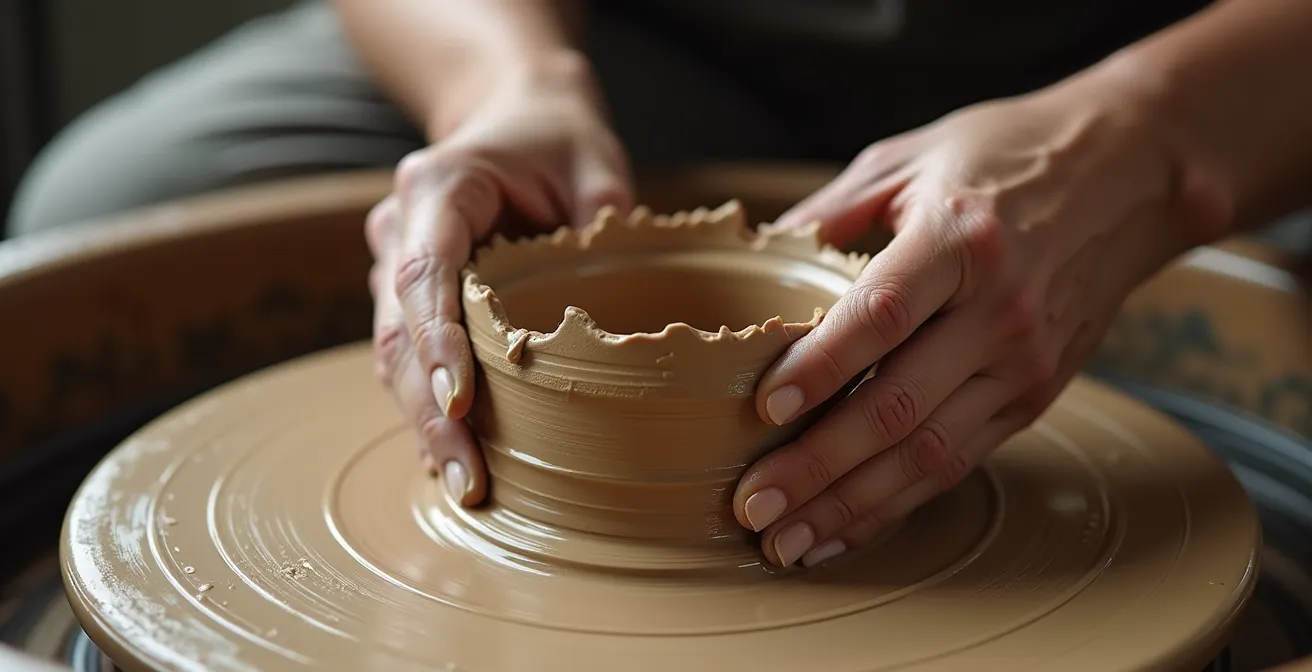
To turn this philosophy into practice, adopt an analytical approach. Instead of feeling frustrated, become a researcher of your own mistakes. Create an “Engineering Failure Log” for your practice sessions. By documenting the variables, you transform emotional setbacks into a structured learning process.
- Document each collapse: Note the height achieved, wall thickness, and amount of water used.
- Record wheel speed: Was it too fast, causing a wobble, or too slow, losing momentum?
- Analyze clay consistency: Too wet clay slumps easily, while too dry clay is prone to cracking.
- Track your centering time: Spending more than five minutes centering can overwork and weaken the clay’s structure.
Leather vs Glass: Which Material Requires Less Upper Body Strength?
While pottery is a powerful therapeutic tool, its physical demands, particularly the core and wrist strength required for “wedging” (kneading) clay and centering it on the wheel, aren’t suitable for everyone. For those with back issues, wrist strain, or limited upper body strength, forcing a craft that causes physical pain will only add to your stress, defeating the purpose. The world of manual crafts is vast, and choosing a material that aligns with your physical capabilities is paramount. This is where exploring alternatives like woodworking, leathercraft, or glasswork becomes essential.
Each material presents a unique physical profile. Woodworking, for instance, often requires significant upper body strength for sawing and sanding. Leatherworking, by contrast, relies heavily on fine motor control for cutting and stitching, with much lower demands on core or upper body strength. Cold-working glass (grinding and polishing) falls somewhere in between. Understanding these nuances allows you to select a craft that challenges you creatively without straining you physically.
The following scorecard, based on an analysis of workshop physical requirements, provides a clear comparison of the demands of four popular crafts. Use it to assess which practice best fits your body’s needs and limitations.
| Craft | Fine Motor Demand | Core Strength Need | Upper Body Requirement | Repetitive Strain Risk |
|---|---|---|---|---|
| Pottery | High (centering) | Very High | Medium (wedging) | Medium (wrists) |
| Woodworking | Medium | Low | High (sawing/sanding) | High (shoulders) |
| Leather | Very High | Low | Low (cutting/stitching) | High (hands) |
| Glass (cold work) | High | Low | Medium (grinding) | Medium (hands/eyes) |
Even within a physically demanding craft like pottery, modifications can make it accessible. It’s not always about avoiding a craft, but about adapting it to your body. Ergonomics are key to sustainability and enjoyment, proving that physical limitations don’t have to be a barrier to creative expression.
Case Study: Adaptive Ergonomics in Pottery
A professional potter suffering from chronic back pain successfully transitioned to a standing wheel throwing position. By raising the wheel to elbow height and learning to use body weight for leverage instead of pure arm strength, he reduced lumbar strain by an estimated 60%. This demonstrates that with proper ergonomic adjustments, even physically intensive crafts can be made accessible, allowing the therapeutic benefits to be enjoyed without pain.
When to Craft: Why Evening Workshops Ruin Sleep for Some People?
You’ve found the perfect craft, and you’ve booked an evening class to decompress after work. But instead of feeling relaxed and ready for bed, you find yourself lying awake, mind racing and body buzzing. This counterintuitive effect is not just in your head; it has a physiological basis. The intense focus and physical exertion of a craft like wheel throwing can be stimulating, directly interfering with the body’s natural process of winding down for sleep.
The primary culprit is body temperature. Sleep initiation is closely linked to a slight drop in our core body temperature. However, research indicates that an intensive activity like wheel throwing can raise core body temperature by 1-2°F. Your body then needs 60-90 minutes to cool back down to a baseline conducive to sleep. If your class ends at 9 PM and you’re in bed by 10:30 PM, your body may still be in an activated, elevated-temperature state, making it difficult to fall asleep. The bright, focused lighting of a workshop can also suppress the production of melatonin, your body’s key sleep hormone.

This doesn’t mean evening crafting is impossible. It simply means you need to build a conscious “cool-down” ritual to transition from creation mode to rest mode. Instead of rushing home, create a buffer that signals to your body and mind that the day’s work is done. This ritual should involve both physical and environmental cues to promote relaxation.
Consider implementing a craft-to-sleep transition routine tailored to your activity:
- After Pottery: A 10-minute warm water hand soak with Epsom salts helps release clay residue and relax tired muscles.
- After Woodworking: Perform progressive forearm and shoulder stretches, followed by a hand massage to release grip tension.
- General Cool-Down: If possible, lower the temperature in your workspace 30 minutes before you plan to finish.
- Lighting Transition: Dim the lights gradually in the final 15 minutes of your session to signal the approaching end.
- Mental Closure: The act of methodically cleaning and organizing your tools can serve as a powerful meditative transition from a state of creation to one of rest.
When to Take a “Micro-Break”: The 90-Minute Focus Limit
The battle against digital burnout isn’t just fought in evening workshops; it’s also waged during the workday itself. The human brain operates in natural cycles of focus and rest, known as ultradian rhythms, which last approximately 90-120 minutes. Pushing past this limit without a proper break is what leads to depleted focus, mental fatigue, and diminished productivity. For tech workers, the typical “break” involves switching from one screen (work) to another (phone), which fails to give the prefrontal cortex the genuine rest it needs.
The solution is a “haptic micro-break”—a short, 5-to-10-minute-long, screen-free interval dedicated to tactile engagement. This isn’t about idleness; it’s about actively engaging a different part of your brain to allow the analytical part to recover. The physical manipulation of an object provides a form of cognitive offloading, quieting the digital noise and allowing your focus to reset. Keeping a small, tangible project at your desk can be a powerful tool for managing your energy throughout the day.
This isn’t just a theoretical concept; its effectiveness has been observed in real-world work environments. The key is the shift from passive consumption (scrolling) to active, physical creation or manipulation.
Case Study: The Haptic Micro-Break
In a notable workplace study on cortisol and creativity, office workers who kept a small piece of clay at their desk for 5-minute tactile breaks demonstrated significantly improved focus scores compared to a control group who took phone-based breaks. The researchers concluded that the physical manipulation of the clay engaged different neural pathways related to sensory and motor skills. This allowed the prefrontal cortex, heavily used for digital tasks and executive function, to recover more effectively than it could during the passive digital consumption of a typical phone break.
Implementing this strategy is simple. Set a timer for 90 minutes. When it goes off, step away from your screen for 5 minutes. Don’t check your phone. Instead, pick up a piece of clay, a small leatherworking tool, or even a piece of wood for whittling. The goal is to engage your hands and your sense of touch. This brief but intentional shift is a potent strategy for maintaining high-quality focus and preventing the slow burn of digital exhaustion throughout your day.
Clay vs Paint: Why Working With Your Hands Grounds You in the Moment?
Why does molding a piece of clay feel so much more grounding than, for example, digital painting or even painting on a canvas? The answer lies in the richness of the sensory feedback. Working with your hands in three dimensions creates a powerful haptic feedback loop—a constant, two-way conversation between your hands and the material. The material pushes back, it has weight, temperature, and texture. This is fundamentally different from the 2D, frictionless world of a screen or even the low-resistance glide of a paintbrush.
This difference is quantifiable at a neurological level. Neuroscience research demonstrates that working with clay engages up to 5 times more sensory receptors than 2D painting. This is due to the combination of inputs: the temperature of the clay, its changing moisture content, its physical resistance against your palms, and its texture against your fingertips. This sensory flood demands your brain’s full attention, pulling your consciousness out of the abstract world of thoughts, plans, and worries, and anchoring it firmly in the physical reality of the here and now. It’s an involuntary form of mindfulness.
This active, responsive nature of three-dimensional materials is what gives them their unique therapeutic power. As one expert puts it, the material itself becomes a partner in the creative process.
Paint stays where you put it, but clay talks back. Working with clay integrates mental, emotional, and kinesthetic brain functions.
– Ashley Warner, Psychotherapist and ceramic artist
This “talking back” is crucial. It forces you to adapt, to listen, and to respond in a way that purely visual or digital media do not. For a mind trained to command and control information, the act of surrendering to the properties of a physical material is a profound exercise in letting go. It’s this dialogue between maker and material that makes working with your hands such a potent antidote to the disembodied nature of digital life.
Key Takeaways
- Tactile crafts are not just hobbies; they are targeted interventions that provide a measurable neurochemical reset by lowering cortisol.
- The “ugly phase” of learning is a critical part of the therapy, teaching resilience by reframing failure as valuable data.
- Choosing the right craft involves matching its physical demands (strength, motor skills) and logistical costs to your personal needs to avoid creating new stress.
How to Use Art to Express Emotions When Words Fail You?
For many professionals, especially in analytical fields, emotions can be difficult to process and articulate. The part of the brain that excels at logic and language is often overworked, while the part that processes feeling is neglected. When words fail, or when feelings are too complex to name, art provides an alternative language. This is the concept of cognitive offloading applied to emotion: instead of trying to think or talk your way through a feeling, you express it through physical action and form.
The repetitive, rhythmic motions of wedging clay, sanding wood, or stitching leather can be meditative, creating a mental space where subconscious feelings can surface. The physical object you create then becomes a container for that emotion. A pot thrown with angry, forceful energy will look and feel different from one thrown with calm, gentle hands. You don’t need to analyze it; the feeling is simply transferred into the object. This externalization can provide immense relief, making the emotion feel more manageable because it now exists outside of you.
This therapeutic application is not just for mild stress; it has been used effectively in clinical settings to help individuals process profound trauma, offering a non-verbal path to healing when verbal communication is too difficult or painful.
Case Study: Processing Trauma Through Clay
The therapeutic power of pottery has been profoundly demonstrated in PTSD recovery programs. Craig Mealing, a veteran, discovered pottery after being inspired by a TV show. He states, “I find it relaxing and it helps to reduce my anxiety – all food for helping with the symptoms of PTSD.” For some, the impact is life-altering. Another participant in a pottery therapy program reported that it “saved my life,” leading them to establish a home studio for daily therapeutic work on the recommendation of their psychologist. These stories highlight how the tactile, grounding nature of clay work can serve as a vital outlet for emotions that defy words.
You do not need to be an “artist” to benefit from this. The goal is expression, not exhibition. The next time you feel a complex emotion—frustration, grief, or even joy—that you can’t put into words, turn to your craft. Pour that feeling into the material. The process of giving a physical form to an internal state is one of the deepest and most healing aspects of manual creation.
Ultimately, the choice between pottery, woodworking, or any other craft is less about speed and more about fit. The right workshop is the one that meets your physical needs, respects your budget, and offers the specific kind of sensory feedback your burned-out nervous system craves. The first step is not to master a skill, but to simply begin the conversation between your hands and a material that talks back. Your journey away from digital burnout starts with that first, tangible touch. Book a taster class, buy a small starter kit, and give yourself permission to make something wonderfully, imperfectly real.