
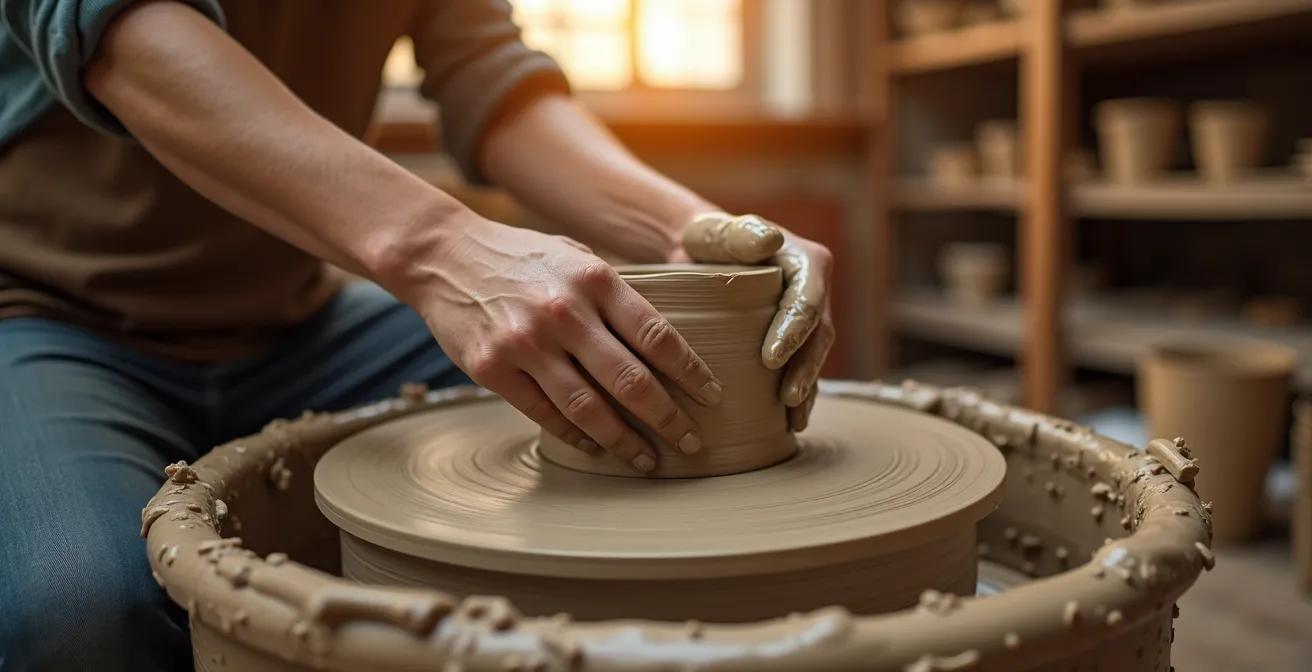
The constant abstraction of tech work leads to mental burnout; tactile hobbies offer a direct neurological reset by engaging the brain in a fundamentally different way.
- They quiet the brain’s ruminating “Default Mode Network” (DMN) and activate the present-focused “Task-Positive Network” (TPN).
- The key is choosing a craft that matches your personality (e.g., structured woodworking vs. iterative knitting) and focusing on the therapeutic process, not commercializing the result.
Recommendation: Start with one small, achievable project—like a leather cardholder or a simple acrylic painting—to experience the benefits without the pressure of perfection.
If you spend your days wrangling abstract logic, debugging invisible errors, and living inside a screen, you know the feeling. It’s a unique form of exhaustion that sleep doesn’t always fix—a sense of being mentally frayed and disconnected from the physical world. The common advice is to simply “get offline” or “find a hobby,” but this misses the crucial point. For a brain conditioned by the rigors of software engineering, the solution isn’t just any distraction; it’s a specific kind of engagement that works as a direct cognitive antidote.
The world of tech is one of pure control and abstract symbols. A misplaced semicolon can break an entire system, and success is measured in efficient logic and clean code. This environment hyper-develops certain mental muscles while leaving others atrophied. The usual suggestions often fail because they don’t address this specific imbalance. The real key isn’t just to stop thinking like a coder, but to start thinking with your hands. What if the most effective way to reset a brain overwhelmed by digital abstraction wasn’t another form of consumption, like watching a movie, but the tangible, imperfect, and grounding act of creation?
This article moves beyond the generic advice of “digital detox.” We will explore the specific neurological mechanisms that make tactile crafts like pottery, woodworking, and sewing so restorative for tech professionals. We’ll examine how to choose the right craft for your personality, how to start without getting overwhelmed, and why protecting your hobby from the pressures of monetization is critical for its therapeutic benefits. It’s time to understand how working with clay, wood, or fabric can recalibrate your mind in a way that simply logging off cannot.
To help you navigate this exploration, this guide breaks down the essential aspects of integrating tactile hobbies as a restorative practice. The following sections will guide you from the underlying neuroscience to practical advice for getting started in your own home.
Summary: A Practical Guide to Tactile Hobbies for Cognitive Balance
- Why Does Working With Clay Quiet The Default Mode Network Of The Brain?
- Woodworking Or Knitting: Which Craft Suits A High-Stress Type A Personality?
- How To Learn Leatherworking In A Weekend Workshop Without Overwhelming Yourself
- The ‘Etsy’ Trap: Why Trying To Sell Your First Creations Kills The Therapy
- How To Set Up A Sewing Corner In A Studio Apartment Under $100
- Why Does Building Furniture Quiet The Mind More Than Watching Netflix?
- Bioplastic Vs Petroleum: Which Actually Degrades In A Home Compost?
- Oil Or Acrylics: Which Medium Is Best For A Complete Beginner With No Studio?
Why Does Working With Clay Quiet The Default Mode Network Of The Brain?
For anyone whose mind keeps running code, replaying meetings, or architecting solutions long after logging off, you’re experiencing the Default Mode Network (DMN) in overdrive. This is the brain’s “idle” state, responsible for self-reflection, future planning, and rumination. While essential, in tech professionals it can become a source of persistent anxiety and an inability to switch off. Tactile hobbies like working with clay act as a powerful circuit breaker by forcefully engaging a different system: the Task-Positive Network (TPN), which is focused on the immediate, external world.
The therapeutic effect isn’t just a feeling; it’s a measurable neurological shift. Groundbreaking Oxford University research demonstrates that manual creative tasks suppress the DMN’s tendency toward internal chatter while increasing activity in the TPN. The process of shaping clay provides a constant stream of sensory information—a haptic feedback loop—that anchors your attention firmly in the present. Unlike the absolute control of coding, clay has its own properties. It requires a responsive adaptation, a kind of “controlled surrender” that is meditative in itself. This proprioceptive engagement grounds you in physical reality, overriding the brain’s default tendency to wander into abstract digital realms.
This shift from internal narrative to present-focused attention has profound mental health benefits. In fact, broader research published in 2024 shows that engaging in hobbies can reduce the odds of experiencing depression by a significant margin. By quieting the DMN, you’re not just distracting yourself; you are actively training your brain to exit cycles of rumination, providing a much-needed cognitive reset that passive entertainment simply cannot offer.
Woodworking Or Knitting: Which Craft Suits A High-Stress Type A Personality?
Choosing the right tactile hobby is like choosing the right programming language; the best one depends on the problem you’re trying to solve and your inherent working style. For a high-stress, Type A personality accustomed to rigid structures and clear outcomes, this choice is particularly critical. The goal is to find an activity that satisfies the craving for order and progress without replicating the high-stakes pressure of a day job. Woodworking and knitting represent two fundamentally different, yet equally valid, paths to achieving this balance.
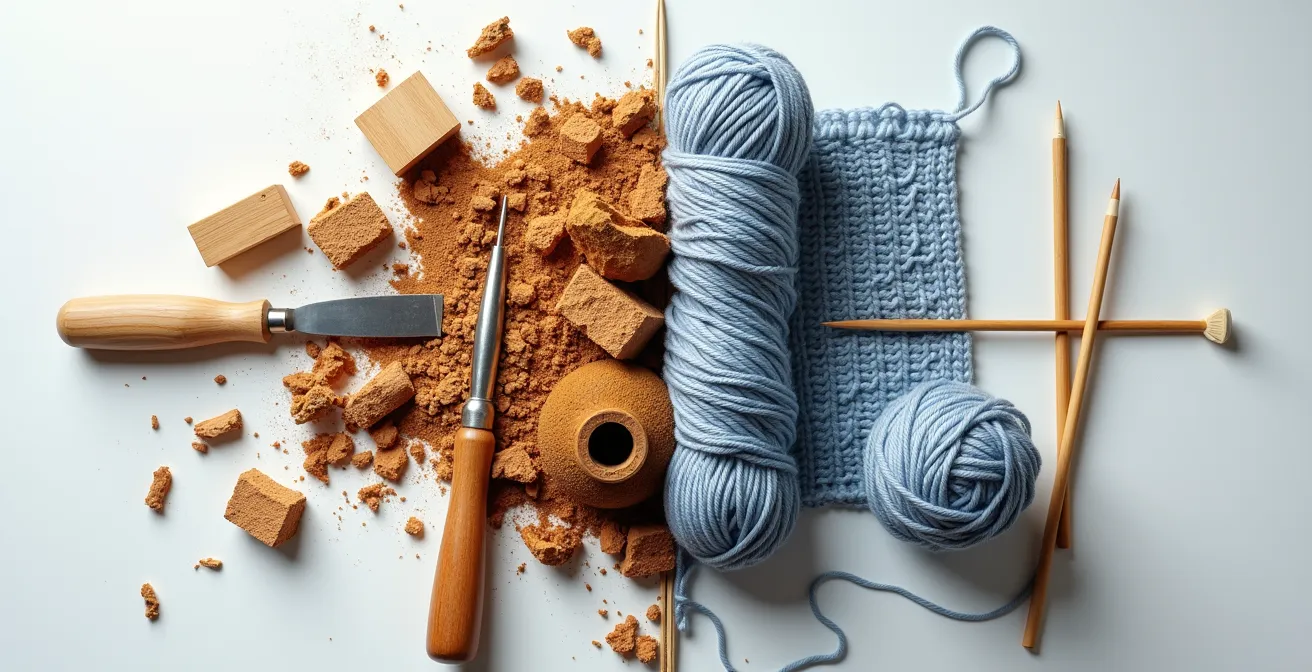
Woodworking often appeals to those who appreciate a ‘waterfall’ methodology. It demands meticulous upfront planning, precise measurements, and a commitment to a design. The satisfaction comes from executing a plan flawlessly. For a mind that thrives on logic and precision, the process of creating a perfect joint or a smooth finish can be deeply gratifying. However, the consequences of error are high—a wrong cut can be permanent, which can either be a thrilling challenge or a source of frustration.
Knitting, on the other hand, embodies a more ‘agile’ and iterative approach. While patterns provide a roadmap, the process is flexible. A mistake is not a disaster; it can be easily unraveled and corrected. The repetitive, rhythmic motion of the needles is inherently meditative and has been shown to reduce anxiety. It provides an immediate tactile feedback loop with every stitch, offering small, continuous rewards. The following table breaks down these differences to help you decide which craft might be a better fit for your cognitive style.
| Aspect | Woodworking | Knitting |
|---|---|---|
| Project Structure | ‘Waterfall’ approach – requires upfront planning | ‘Agile’ iterative – can adapt as you go |
| Error Recovery | High-consequence (wrong cut is permanent) | Low-consequence (can ‘tink’ or unravel mistakes) |
| Feedback Loop | Delayed structural feedback | Immediate tactile feedback with each stitch |
| Stress Response | Satisfying for precision-seekers | Meditative rhythm reduces anxiety |
| Mental Energy Required | High focus during critical cuts | Can be done while watching TV |
How To Learn Leatherworking In A Weekend Workshop Without Overwhelming Yourself
The ambition to master a new skill can quickly turn a therapeutic hobby into another source of pressure, especially for high-achievers. The thought of learning an entire craft like leatherworking can seem daunting. The solution, borrowed from the world of software development, is to adopt a Minimum Viable Product (MVP) approach. Instead of trying to learn everything at once, focus on internalizing a single technique to create one simple, finished object. This reframes the goal from “mastery” to “successful execution of a process.”
A weekend workshop is a perfect environment for this, but only if you go in with the right strategy. Your objective isn’t to leave as an expert, but to leave with a solidified understanding of a core workflow. This means resisting the urge to tackle a complex bag or belt and instead focusing on something elemental, like a cardholder. This small-scope project allows you to experience the full lifecycle—cutting, stitching, and finishing—in a manageable timeframe, building confidence rather than frustration.
As one Crafts Workshop Instructor from The Crucible wisely notes, the mindset is everything:
The goal is to internalize a technique, not to produce a flawless retail product. This reframes mistakes as data points, not failures.
– Crafts Workshop Instructor, The Crucible Ceramics Guide
This perspective is liberating. It allows you to focus on the ‘why’ behind each step, asking your instructor questions about material choices or technique variations. Your first piece is a learning artifact, not a portfolio item. To ensure your weekend is a success, follow a clear plan to stay present and avoid feeling overwhelmed.
Your Action Plan for a Stress-Free Workshop Weekend: Learning Leatherworking
- Set One Clear Goal: Choose to complete just ONE simple item, such as a cardholder or keychain, rather than attempting to learn every technique.
- Focus on One Skill Per Session: Dedicate the morning to mastering the cutting technique, the afternoon to saddle stitching, and the evening to edge finishing.
- Prepare Smart Questions: Instead of just asking ‘how,’ ask ‘why’ questions about technique choices to deepen your understanding of the craft’s principles.
- Accept B-Minus Quality: Your first piece is about learning the process. Embrace imperfections as part of the journey, not as failures.
- Mental Commenting: Consciously “comment out” thoughts about future steps to remain fully present and focused on the single technique you are practicing.
The ‘Etsy’ Trap: Why Trying To Sell Your First Creations Kills The Therapy
In a culture that glorifies the “side hustle,” the immediate impulse upon creating something beautiful is often, “I should sell this on Etsy.” For a tech professional seeking therapeutic release, this is arguably the most destructive path you can take. The moment a hobby is reframed as a commercial enterprise, it ceases to be a refuge from work and instead becomes a second, often more stressful, job. The entire neurological benefit is systematically dismantled.
The therapeutic power of a craft lies in its intrinsic motivation—the joy of the process itself. When you introduce extrinsic motivators like revenue, sales metrics, customer feedback, and production deadlines, the activity is hijacked. The gentle, focused state of the Task-Positive Network is replaced by the anxious, ruminating state of the Default Mode Network, worrying about marketability and efficiency. In fact, mental health research indicates up to a 50% reduction in the therapeutic benefits of hobbies when the primary focus shifts from personal enjoyment to commercial gain.
This shift isn’t just theoretical; it’s a well-documented phenomenon that transforms a mindful practice into a source of performance anxiety. The pressure to create a “sellable” product replaces the freedom to experiment and make mistakes, which are crucial parts of the learning process.
Case Study: From Kintsugi Philosophy to KPI Metrics
A study of craft hobbyists who attempted to monetize their work revealed a stark shift from intrinsic to extrinsic motivation. Participants who began selling their creations reported a dramatic increase in anxiety as they started tracking sales metrics, managing customer feedback, and worrying about production efficiency. The therapeutic ‘flow state’ they once enjoyed was replaced by performance pressure nearly identical to that of their day jobs, effectively neutralizing the hobby’s restorative purpose.
The lesson is clear: to protect the mental health benefits of your craft, you must fiercely guard it against the logic of the marketplace. See your creations as gifts, personal milestones, or learning artifacts—anything but inventory. The “Etsy trap” promises profit but often steals the very peace you were seeking to create.
How To Set Up A Sewing Corner In A Studio Apartment Under $100
One of the biggest perceived barriers to starting a tactile hobby is a lack of space, especially for those living in a studio or small apartment. The idea of housing a bulky sewing machine or messy art supplies seems impossible. However, the solution lies not in having more space, but in creating a smart, “deployable” system. With less than $100 and some clever organization, you can create a fully functional sewing corner that appears when you need it and vanishes when you don’t.
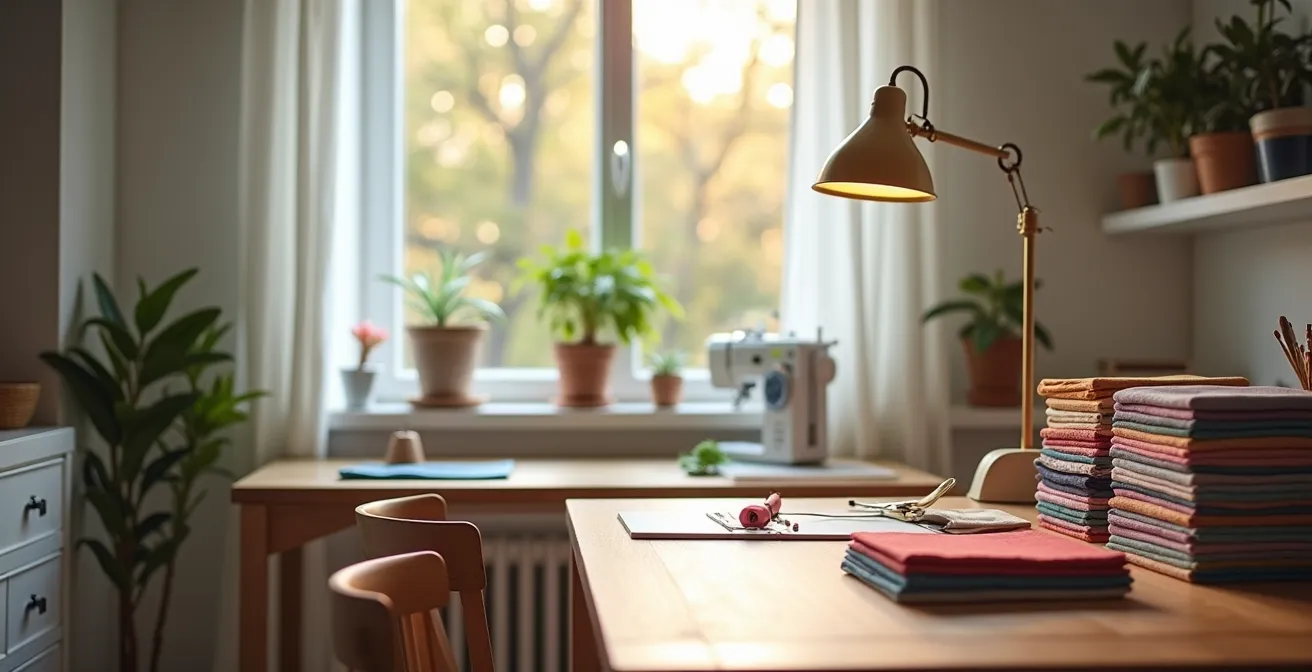
The core principle is mobility and containment. Instead of a dedicated, static desk, the system is built around a central, mobile unit. This approach transforms any flat surface—a kitchen table, a small desk, even a sturdy coffee table—into a temporary but effective workspace. The goal is to minimize setup and cleanup time, removing friction and making it easy to start a 30-minute session on a whim. If it takes 15 minutes to get your supplies out, you’re far less likely to start at all.
Here is a breakdown of a highly effective and budget-friendly system for creating a sewing corner in a minimal space:
- Rolling Cart Solution ($40): The foundation of the system is a 3-tier metal utility cart. The top tier holds the sewing machine, the middle holds fabric and projects-in-progress, and the bottom holds thread, scissors, and notions. It stores neatly in a closet or corner and rolls out instantly.
- Foldable Cutting Mat ($20): A self-healing cutting mat that can be folded in half is a game-changer. It provides a large, safe cutting surface when needed but stores flat against a wall or under a sofa.
- Task Lighting ($25): Good lighting is non-negotiable for sewing. A simple clip-on LED lamp with a flexible neck can be attached to your table or cart, creating an instant “sewing zone” and defining the psychological boundary of your workspace.
- Clear Storage Containers ($15): Use small, clear, stackable boxes for bobbins, needles, and buttons. Keeping supplies visible but contained prevents clutter and makes finding what you need effortless.
The ultimate goal is to optimize for a sub-90-second deployment time from storage to the first stitch. By designing your system for speed and efficiency, you eliminate the mental barrier to starting and make creativity an accessible part of your daily life, no matter how small your living space.
Why Does Building Furniture Quiet The Mind More Than Watching Netflix?
After a long day of mentally taxing work, the siren call of passive entertainment like Netflix is strong. It feels like the path of least resistance to “shutting off” the brain. However, this type of consumption offers only a fleeting distraction, not a true cognitive reset. Building a piece of furniture, while far more demanding, provides a deeper, more lasting form of mental restoration by engaging the brain’s reward system in a fundamentally different way.
Watching a show provides a steady stream of what can be described as ‘micro-dopamine hits’—novelty, story progression, and cliffhangers keep you engaged. But the satisfaction is shallow and evaporates the moment the screen goes dark. This is passive consumption. Furniture building, by contrast, is an act of active creation that cultivates what neuroscientists call “long-arc gratification.” The process is filled with challenges and problem-solving, but the reward is a tangible, functional object that continues delivering satisfaction for years.
This distinction is highlighted in a study of technology executives who took up furniture building. Brain scans revealed enhanced engagement of the prefrontal cortex during the planning and problem-solving phases of their projects. Unlike the passive state induced by television, the act of translating a 2D plan into a 3D object requires a powerful combination of spatial reasoning, sequential planning, and fine motor control. The final, completed piece of furniture serves as a persistent, physical reminder of one’s competence and ability to impact the real world—a powerful antidote to the ephemeral nature of digital work.
Every time you use the bookshelf you built or sit at the table you crafted, you receive a satisfying echo of that accomplishment. This long-arc reward system builds a more resilient sense of self-efficacy and provides a profound sense of peace that passive consumption can never match. It quiets the mind not by numbing it, but by giving it a meaningful, tangible problem to solve.
Key Takeaways
- Tactile hobbies are a neurological tool to shift your brain from a ruminating “Default Mode” to a present-focused “Task-Positive” state.
- The therapeutic benefit is maximized when you choose a craft that suits your personality (e.g., structured vs. iterative) and avoid the pressure of monetization.
- Even with limited space and budget, a functional craft corner is achievable with smart, “deployable” storage solutions.
Bioplastic Vs Petroleum: Which Actually Degrades In A Home Compost?
For the tech-minded hobbyist, crafts often intersect with technology, such as through 3D printing custom tools, parts, or even artistic models. As you create physical objects, the question of material impact inevitably arises. Many turn to “bioplastics” like PLA, assuming they are an eco-friendly alternative to traditional petroleum-based plastics. However, the reality of their biodegradability is far more complex, especially within the confines of a home compost bin.
The term “bioplastic” can be misleading. While derived from renewable resources like corn starch, not all bioplastics break down under the same conditions. The most common 3D printing filament, PLA (Polylactic Acid), is often labeled “compostable,” but this typically refers to industrial composting facilities. These facilities reach sustained temperatures of over 140°F (60°C), which are necessary to break down the polymer. In a typical home compost pile, which rarely exceeds that temperature for long, PLA will persist for years, much like a traditional plastic.
Truly home-compostable plastics do exist, but they are less common. Materials like PHA (Polyhydroxyalkanoate) or certain starch-based blends are designed to be broken down by the microorganisms found in a standard backyard compost environment. Understanding the distinction between industrial and home compostability is critical for any creator wanting to minimize their environmental footprint. The table below clarifies the degradation potential of common material types in a home setting.
| Material Type | Home Compost Degradation | Time Frame | Special Conditions |
|---|---|---|---|
| PLA Bioplastic | Limited (needs 140°F) | 6-12 months industrial only | Requires commercial facility |
| PHA Bioplastic | Yes | 3-6 months | Standard home compost OK |
| Petroleum Plastic | No | 450+ years | Never degrades naturally |
| Starch-Based | Yes | 2-4 months | Needs moisture and warmth |
For the conscientious maker, choosing the right material is as important as the design itself. While PLA is a step up from petroleum, if home compostability is the goal, seeking out PHA or certified starch-based materials is the only truly effective path.
Oil Or Acrylics: Which Medium Is Best For A Complete Beginner With No Studio?
For a tech professional intrigued by painting, the classic image of an artist’s studio—filled with the scent of turpentine and large canvases—can be intimidating and impractical. The choice between oil and acrylic paints is often the first hurdle, and for a beginner without a dedicated studio, the decision is straightforward: acrylics are the superior choice. They offer a much lower barrier to entry in terms of space, cost, and safety, making them ideal for apartment-friendly creative sessions.
The primary advantage of acrylics is that they are water-based. This eliminates the need for toxic solvents like turpentine for cleanup; soap and water are all that’s required. This also means there are no harsh fumes, making acrylics perfectly safe to use in a small, enclosed living space with standard ventilation. Furthermore, acrylics dry quickly, which is a significant logistical benefit. A painting can be dry to the touch in minutes, allowing it to be easily stored away after a session, a crucial feature when your dining table doubles as your creative space.
Getting started with acrylics is also incredibly budget-friendly. A basic setup to test the waters can be acquired for under $50. This accessibility removes the financial pressure and allows for pure experimentation. The focus can remain on the process of learning to see, mix colors, and apply paint to a surface. The quick-drying nature of the medium also lends itself to an iterative workflow familiar to any coder. An Art Instructor at Tiny Workshops offers a perfect analogy for this process:
Acrylics are ‘refactorable’: they dry fast, allowing for mistakes to be painted over and iterated upon quickly, like agile code.
– Art Instructor, Tiny Workshops Creative Guide
This “refactorable” quality is liberating for a beginner, as it removes the fear of making a permanent mistake. The following is a simple guide to setting up an apartment-friendly painting practice:
- Choose Acrylics for Small Spaces: They are the obvious choice due to water-based cleanup, no toxic fumes, and fast drying times that solve storage issues.
- Essential Supply List Under $50: A basic acrylic tube set, a pack of 3 varied brushes, a pad of canvas boards, disposable palette paper, and a water jar are all you need.
- Workspace Setup: Use a kitchen or dining table protected with an old tablecloth or plastic sheet. Keep all supplies contained in a single portable art box for quick setup and breakdown.
- Ventilation Not Required: Unlike traditional oils that require solvents, acrylics are safe to use in a standard living space without special ventilation.
- Quick Session Friendly: The fast-drying nature of acrylics makes 30-minute painting sessions entirely possible, fitting creativity into a busy schedule.
The journey from abstract code to tangible creation is a powerful act of cognitive recalibration. The key is to begin. The next logical step is to choose one small project from this guide and dedicate a single weekend to the process, not the product, to truly experience these restorative benefits for yourself.