
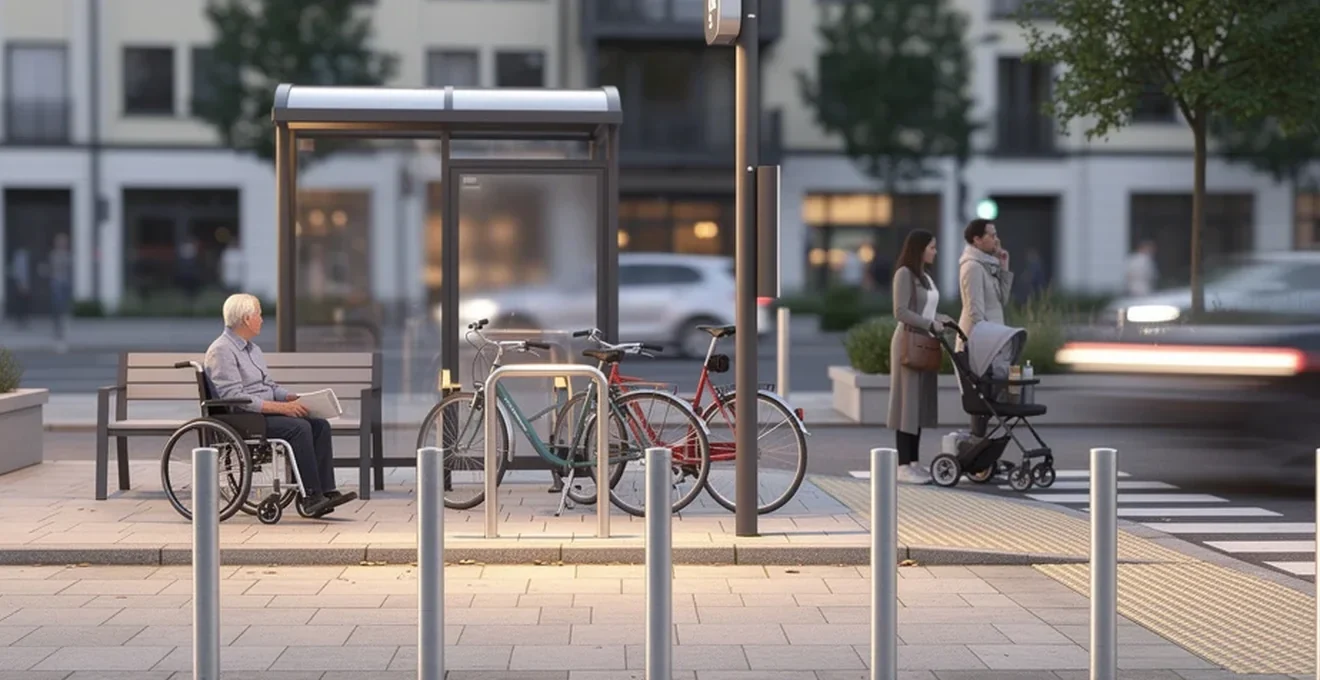
Street furniture rarely draws attention to itself, yet benches, bollards, bins and lighting columns do far more work than most passers-by realise. They shape how safely we cross a road, whether an older resident can rest long enough to complete a journey on foot, and how a public square deters or withstands a hostile vehicle attack. As local authorities face tighter budgets alongside growing pressure to meet accessibility, security and sustainability obligations, the specification of street furniture has moved from an afterthought to a strategic discipline. This article sets out how core categories of street furniture are defined, the materials and standards that govern them, and the practical role they play in vehicle mitigation, inclusive design, lighting-led crime prevention, sustainable drainage and smart city infrastructure.
Defining street furniture within urban design frameworks
Street furniture refers to the fixed and semi-fixed elements installed within public realm schemes to support safety, comfort, wayfinding and amenity. It sits at the intersection of engineering, landscape architecture and public policy: every bollard or bench must satisfy structural and regulatory requirements while also contributing to how a space looks and feels to the people using it. Far from being purely decorative, these elements increasingly form part of a coordinated strategy addressing security, accessibility, flood resilience and energy efficiency within a single, coherent public realm design.
Core categories: bollards, benches, bollard lighting, and bicycle racks
The core vocabulary of street furniture includes a relatively small number of recurring elements, each serving distinct but complementary functions:
- Bollards — used to demarcate pedestrian zones, control traffic flow and parking, and, in security-rated forms, provide certified protection against vehicle incursion.
- Benches and seating — provide rest points that support social interaction, encourage walking by guaranteeing a place to pause, and are essential for older people, parents with young children and those with mobility limitations.
- Bollard lighting — integrates illumination into low-level street furniture, allowing designers to place light precisely at gathering points without the groundwork required for conventional lampposts.
- Bicycle racks and shelters — support active travel by giving cyclists secure, convenient places to store bikes, encouraging a shift away from car dependency.
Placed thoughtfully, these elements do more than serve their individual function: they define zones within a space, support pedestrian rest areas in high-traffic environments, and help shape the overall identity of a street or square.
Materials engineering: galvanised steel, cast iron, and recycled composites
Material choice determines how street furniture performs over decades of exposure to weather, vandalism and heavy use. Galvanised steel remains a mainstay for structural elements such as bollards and bin housings because its zinc coating resists corrosion in exposed, high-footfall locations. Cast iron continues to be specified where durability and a traditional aesthetic are both required, particularly in heritage or conservation settings. Increasingly, recycled composites and recycled-content aluminium are being specified alongside certified hardwoods, reflecting a broader shift toward circularity in public realm procurement. The right material choice is not purely aesthetic; it must also withstand intense UV exposure, coastal conditions and temperature extremes without frequent replacement, keeping whole-life costs manageable for the public bodies that maintain these assets.
Regulatory standards: BS EN 1317 and BS 8300 compliance
Specification decisions are governed by recognised standards designed to ensure consistent safety and accessibility outcomes. BS EN 1317 relates to vehicle restraint systems and informs the structural performance expected of barriers and safety-critical street furniture. BS 8300 provides guidance on the design of buildings and their approaches to meet the needs of disabled people, directly informing decisions on seating height, clear circulation widths and tactile surface treatments. Compliance with these frameworks, alongside the Equality Act 2010 in respect of accessible design, is a baseline expectation for any public realm scheme rather than an optional enhancement.
Anti-terrorism and vehicle mitigation infrastructure
Vehicle-borne attacks on crowded public spaces have made hostile vehicle mitigation (HVM) a mainstream consideration in public realm design, rather than a specialist concern reserved for government buildings. The challenge for designers is achieving certified protection without turning a high street or plaza into something that looks and feels like a security checkpoint.
Hostile vehicle mitigation (HVM) bollards and PAS 68 certification
HVM bollards are engineered and tested to arrest a moving vehicle before it can reach pedestrians, and their performance is verified through recognised impact-testing regimes. Certification such as IWA 14-1 confirms that a product can withstand impact from a vehicle of a specified weight travelling at a defined speed — for example, products rated to withstand impact from a vehicle weighing up to 2.5 tonnes travelling at 30mph. Crucially, well-designed HVM products such as security-rated seats, bollards and bins can be specified so that, positioned correctly, they form an effective defensive perimeter around a high-footfall location that most users would never identify as anything other than ordinary, good-quality street furniture. Modular planter systems rated to the same standard extend this principle further, creating attractive, planted boundaries around entrances, event spaces and transport hubs that double as certified vehicle barriers. Because these products require no specialist installation beyond that of standard street furniture, they can be incorporated into new public realm schemes or retrofitted to existing locations with minimal disruption.
Impact-rated barriers for pedestrianised high streets
Pedestrianised high streets present a particular challenge: they must remain open, welcoming and commercially vibrant while still resisting vehicle incursion at their access points. Impact-rated barriers integrated into planters, seating and bollards allow local authorities to protect these spaces without erecting visibly hostile infrastructure. This is particularly important in town centres competing with online retail, where the physical environment needs to feel inviting rather than defensive in order to draw visitors who will linger and spend.
Case study: london bridge security retrofit scheme
Following vehicle-based attacks on UK public spaces in recent years, several high-profile locations have been retrofitted with certified hostile vehicle mitigation measures integrated into the surrounding streetscape. These schemes demonstrate the broader principle underpinning modern HVM design: protective infrastructure can be woven into the existing character of a place, using materials and forms consistent with the wider public realm, rather than imposed as a visibly separate security layer.
Universal design principles for inclusive streetscapes
Inclusive design ensures that streets and public spaces work for the full range of people who use them, not just the fittest or most mobile. With over ten million people in England now aged 65 or over — around one in five of the population — and the number of people aged 75 and over expected to nearly double to almost ten million by 2039, designing streetscapes around universal access is no longer a niche consideration.
Tactile paving and wayfinding for visually impaired pedestrians
Tactile paving provides underfoot cues that help visually impaired pedestrians identify changes in the street environment, such as approaching a kerb or crossing point. Combined with clear, legible wayfinding signage, it forms an essential part of a streetscape that can be navigated safely and independently by people with visual impairments.
Dropped kerbs and Level-Access thresholds for wheelchair users
Dropped kerbs and level-access thresholds remove one of the most basic barriers to independent movement for wheelchair users and anyone pushing a pram or using a mobility aid. These features work most effectively when specified consistently across a route, rather than in isolated locations, so that a wheelchair user can complete an entire journey without encountering an unexpected obstacle.
Colour contrast and signage legibility under the equality act 2010
Strong colour contrast between street furniture, surfaces and signage supports people with visual impairments and cognitive conditions in reading and navigating a space confidently. This is not simply good practice; it reflects the obligations set out under the Equality Act 2010, which requires public spaces and the services within them to be genuinely accessible to disabled people.
Seating ergonomics for elderly and Mobility-Impaired residents
Much of the UK’s existing street seating was not designed with an ageing population in mind. Benches lacking armrests are difficult to rise from for anyone with limited strength or joint problems, and seats set too low present the same difficulty. Gaps between seating opportunities that are trivial for a fit adult can make a straightforward trip to the shops exhausting, or simply impossible, for someone who needs to rest regularly. Inclusive seating ranges address this directly through:
- Armrests to support the physical effort of sitting down and standing up
- Backrests for people with spinal conditions or limited core strength
- Perch seating that allows a brief rest without a full sit-down and stand-up
- Consistent spacing along key routes so rest points are never too far apart
Specifying a coherent seating strategy across an entire town centre — rather than placing benches ad hoc — transforms accessibility for the whole community, and there is a commercial dimension too: making an environment comfortable for people who currently find it tiring to visit directly expands the number of people who choose to visit in person.
Lighting systems and crime prevention through environmental design (CPTED)
Lighting has a measurable, evidenced effect on both crime levels and how safe people feel in public space. Research from the College of Policing found that improved street lighting can reduce overall crime by around 21% in areas where it is introduced, with particular benefits for property crime and for perceptions of safety. This matters enormously for older residents, women and anyone navigating public spaces alone after dark.
LED column lighting and photometric uniformity ratios
Consistent, well-distributed light — rather than isolated bright spots separated by darker gaps — is central to how effectively lighting supports safety. LED column lighting offers efficient, controllable illumination, and achieving good photometric uniformity across a route or space reduces the pockets of shadow that can undermine a pedestrian’s sense of security even where average light levels appear adequate.
Natural surveillance principles in bus shelter placement
Crime Prevention Through Environmental Design (CPTED) is built around the principle that visibility and natural surveillance are among the most effective passive deterrents to antisocial behaviour, a position also advocated by the National Police Chiefs’ Council. Bus shelters and other street furniture positioned to maintain clear sightlines — rather than creating blind corners or concealed recesses — support this principle directly, allowing people using a space to see and be seen.
Smart sensors and adaptive lighting controls
Integrating lighting into street furniture itself, rather than relying solely on conventional lampposts, gives designers the ability to place illumination precisely at natural gathering points. Solar-powered LED lighting integrated into benches, bollards and other elements removes the need for mains connections, extensive groundwork or lengthy installation programmes, reducing both installation costs and ongoing energy expenditure. For councils simultaneously asked to cut costs and meet net zero commitments, this dual benefit is significant.
Sustainable materials and circular economy applications
Flooding has become one of the most pressing challenges facing the UK’s built environment. The Environment Agency’s 2024 National Flood Risk Assessment found that 6.3 million properties in England are now in areas at risk of flooding from rivers, the sea or surface water — a figure that could reach eight million, roughly one in four properties, by the middle of this century once climate change effects are factored in. Surface water flooding alone now affects 4.6 million properties, a 43% increase on the previous assessment, and a 2025 parliamentary committee review concluded that it remains the most common type of flooding in England while receiving insufficient strategic attention. Street furniture has a meaningful, and often underestimated, part to play in addressing this.
Recycled plastic bollards and carbon footprint reduction
Recycled plastic and recycled-content materials reduce the embodied carbon associated with manufacturing street furniture while still delivering the durability required for high-traffic public locations. Specifying recycled materials as standard, rather than as an exception, supports circularity across a public realm scheme without compromising on performance.
Permeable paving and sustainable drainage systems (SuDS)
Sustainable drainage systems (SuDS) work with natural water cycles to slow runoff, promote ground infiltration and temporarily store water where it falls, and street furniture contributes meaningfully to this strategy. Planters with appropriate drainage configurations ease pressure on drainage networks during storm events; tree pits with permeable surrounds allow water to infiltrate the soil rather than run directly into gutters; and permeable surface treatments around seating areas reduce the volume and speed of runoff entering the drainage system. Steel and concrete planter ranges, including those with integrated seating, can be specified with drainage and planting configurations that contribute directly to a wider SuDS strategy. Used thoughtfully as part of an overall public realm design, these installations have a collective impact on surface water resilience that should not be underestimated.
Timber sourcing standards: FSC-Certified street furniture
Certified, responsibly sourced timber ensures that wooden street furniture elements — from bench slats to planter cladding — do not contribute to deforestation or unsustainable forestry practices. Combined with UV-resistant stains and protective finishes, certified timber allows local authorities to specify natural materials that still perform reliably over a long service life.
Smart city integration and digital infrastructure
Digital technology is increasingly embedded within everyday street furniture, allowing local authorities to manage public assets more efficiently and respond to real conditions rather than fixed schedules.
Iot-enabled benches with solar charging ports
Benches integrated with solar panels and charging ports extend the basic function of a seat into a small piece of digital infrastructure, giving pedestrians a place to rest while also charging a phone or device. These installations typically rely on the same solar technology used in integrated lighting products, avoiding the need for mains power connections.
Sensor-equipped waste bins for Fill-Level monitoring
Traditional bin emptying follows fixed collection schedules regardless of actual fill levels — an approach that is often wasteful and ineffective, generating unnecessary vehicle movements on quiet days and overflowing bins on busy ones. Smart bin systems address this directly: solar-powered internal compaction can increase effective capacity by up to eight times compared with a conventional unit, while fill-level sensors transmit real-time data to collection teams, enabling emptying only when it is genuinely needed. The result is fewer vehicle collections, reduced emissions, fuel costs and congestion, and bins that rarely overflow even during the busiest periods. The higher initial investment in smart bin infrastructure is typically recovered through reduced collection frequency within a relatively short timeframe.
Digital wayfinding totems and Real-Time transport data displays
Digital totems providing maps, directions and live transport information extend traditional wayfinding signage into an interactive format. Positioned at transport hubs and key pedestrian junctions, they help guide people to landmarks or onward connections, contributing to the same goal as physical signage: a smoother, less stressful experience for anyone navigating an unfamiliar part of a city.