
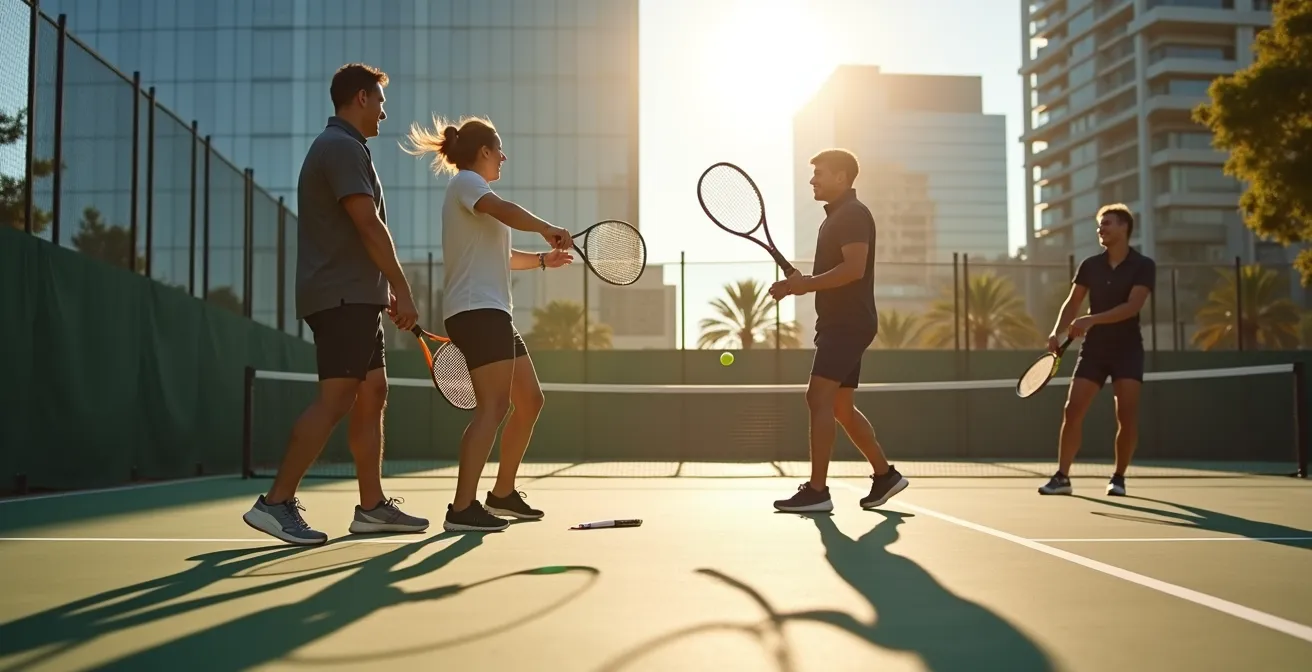
The most critical business connections are no longer forged on the golf course, but on the padel court, where strategic collaboration consistently outweighs individual dominance.
- Padel’s accessible nature and doubles format create a low-pressure environment ideal for building genuine rapport and observing teamwork skills in action.
- Every choice, from your racket to your warm-up routine, is a non-verbal signal that communicates your professionalism, strategy, and attention to detail.
Recommendation: Treat your next match not as a game of sport, but as a live-action case study of your professional character and collaborative abilities.
In the world of corporate relationship-building, the eighteen-hole golf marathon has long been the default arena. It’s a landscape of slow-paced conversations, handicap politics, and a significant time commitment. But a seismic shift is underway. Professionals are trading their clubs for rackets, seeking a faster, more dynamic, and strategically richer environment to build social capital. The question is no longer *if* you should play a sport for networking, but *which* sport offers the highest return on your investment of time and energy.
Many will compare tennis and padel on surface-level metrics: the court size, the learning curve, the speed of the game. While these are valid points, they miss the fundamental truth. The choice between these sports is a strategic decision about the professional persona you wish to project. This is not about fitness; it’s about framing. It’s about understanding that the court is a stage, and every serve, volley, and post-game handshake is a line in your professional script. This guide moves beyond the basics to reveal the underlying psychology and strategic maneuvers that turn a simple match into a powerful career-advancement tool.
This article will deconstruct the strategic nuances of racket sports for business networking. We will explore everything from the silent signals your equipment sends to the art of navigating post-match conversations, providing you with a complete playbook for success.
Summary: Tennis vs. Padel: A Strategic Guide to Networking on the Court
- Why Golf Remains the King of Deals Despite the Rise of Pickleball?
- The “Quiet Luxury” of Rackets: What Your Gear Says About Your Seniority?
- The Warm-Up Routine That Saves Your Knees on Hard Courts
- Locker Room Talk: How to Pivot Away from Uncomfortable Topics?
- When to Let the Boss Win: The Psychology of Competition in Business
- How to Use “Power Posing” Before Interviews to Hack Your Cortisol Levels?
- When to Arrive: The Golden Hour for Networking at Cultural Events
- How to Project Authority in Board Meetings When You Feel Like a Fraud?
Why Golf Remains the King of Deals Despite the Rise of Pickleball?
While golf has a legacy of being the backdrop for major business deals, its crown is beginning to slip, not to pickleball, but to the more strategically aligned sport of padel. The core reasons are accessibility and dynamics. Padel’s learning curve is significantly less steep, and its enclosed court and doubles format foster immediate interaction and teamwork. As the editorial team at Padel Tonic notes, “Unlike golf, which can take hours and requires a steep learning curve, padel lets players jump into a competitive match quickly, making it ideal for time-strapped executives.” This rapid entry into meaningful play is a game-changer for networking.
This explosive growth isn’t just anecdotal; the numbers confirm a major market shift. Projections show the padel industry is on track to achieve an impressive market value of USD 2.3 billion by 2025. This financial momentum reflects a deeper cultural shift where professionals are choosing efficiency and collaboration over tradition. Padel’s structure inherently favors communication and partnership, skills that are directly transferable to the business world. It provides a condensed, high-impact environment to assess a potential partner’s character, strategic thinking, and grace under pressure.
Padel Partners Networking Success Model
Padel Partners Networking has created a successful business network model combining monthly padel meetups with relaxed networking over coffee and croissants. Designed for all fitness levels including beginners, their events attract business owners, directors, and decision-makers who build meaningful connections through doubles matches and coaching sessions, proving padel’s effectiveness as an inclusive networking alternative to golf.
The transition from golf to padel is a move from a game of individual endurance to one of dynamic partnership. It’s a modern solution for building professional relationships that mirrors the pace and collaborative nature of today’s business landscape.
The “Quiet Luxury” of Rackets: What Your Gear Says About Your Seniority?
In the world of high-stakes networking, your equipment speaks before you do. The concept of “quiet luxury”—understated quality and craftsmanship over loud branding—is paramount on the court. A brand-new, top-of-the-line racket might scream “eager and trend-conscious,” while a slightly older, well-maintained model from a respected brand can signal experience and a quiet confidence that your skills, not your gear, do the talking. The details, from the type of grip to the subtle signs of wear, tell a story about your dedication and approach to the game, and by extension, to your profession.

The shape of your racket is another powerful, non-verbal cue. It’s a strategic choice that reflects your playing style and, metaphorically, your business persona. Choosing the right racket is not just about performance; it’s about aligning your equipment with the professional image you want to project. This is strategic signaling at its finest, demonstrating foresight and an understanding of nuanced communication.
- Diamond-shaped rackets signal an aggressive, power-focused leadership style—ideal for C-suite executives who make decisive moves.
- Round-hybrid shapes with a control focus indicate strategic thinking and precision—perfect for CFOs and risk managers.
- Teardrop balanced rackets suggest versatility and adaptability—favored by founders and entrepreneurs.
- Well-worn, older model rackets demonstrate supreme confidence, suggesting your skills speak louder than your gear.
- Latest high-tech carbon fiber models show innovation awareness and a keen eye for trends.
Action Plan: Auditing Your On-Court Signals
- Points of Contact: List all the “signals” you emit on court—racket, shoes, apparel, and even your water bottle.
- Collecte: Inventory your current gear. What does it say about you? Is it loud and new, or classic and understated?
- Coherence: Does your gear align with your professional role and the image you want to project (e.g., innovator, steady hand, aggressive leader)?
- Memorability: What is unique versus generic about your setup? A custom grip or a classic racket model can be a great conversation starter.
- Plan of Integration: Identify one or two elements to upgrade or change to better align your on-court persona with your career goals.
The Warm-Up Routine That Saves Your Knees on Hard Courts
Arriving on the court and immediately starting a high-intensity match is an amateur move. A structured, deliberate warm-up routine signals professionalism, discipline, and foresight—qualities highly valued in any business context. It shows you respect the process, take care of your assets (in this case, your body), and plan for sustained performance rather than short-term gains. This is particularly crucial in racket sports, where the risk of injury from explosive movements is high. In fact, studies show that up to two-thirds of tennis injuries are overuse-related, a risk significantly mitigated by proper preparation.
A comprehensive warm-up isn’t just about injury prevention; it’s a mental transition. It allows you to shift from your work mindset to a state of focused competition, calibrating your body and mind for the game ahead. An evidence-based routine like the “Tennis 10+” program provides a perfect framework that can be adapted for tennis or padel. It’s a sequence designed to activate key muscle groups, enhance mobility, and prime your reflexes. Following a proven system demonstrates that your approach is based on data and best practices, not guesswork.
Your on-court warm-up should include the following steps:
- Start with 3-5 minutes of light jogging or skipping to gradually increase heart rate.
- Perform dynamic stretches targeting hamstrings, shoulders, and hip flexors.
- Practice shadow swings focusing on forehand, backhand, and overhead motions.
- Execute lateral footwork drills along the baseline for agility preparation.
- Complete mini-rallies at a moderate pace to activate hand-eye coordination.
- Include resistance band exercises for rotator cuff and core activation.
This structured approach sends a clear message: you are a serious, prepared individual who leaves nothing to chance. It’s a powerful, non-verbal way to establish credibility before the first point is even played.
Locker Room Talk: How to Pivot Away from Uncomfortable Topics?
The game may end, but the networking continues. The post-match conversation, often happening in the lounge or “locker room,” is what I call the “Endorphin Window.” This is a critical period where positive feelings from the physical activity make individuals more open and receptive. However, it’s also a time when conversations can stray into risky territory like politics, office gossip, or other divisive subjects. Your ability to skillfully navigate these moments is as important as your backhand.
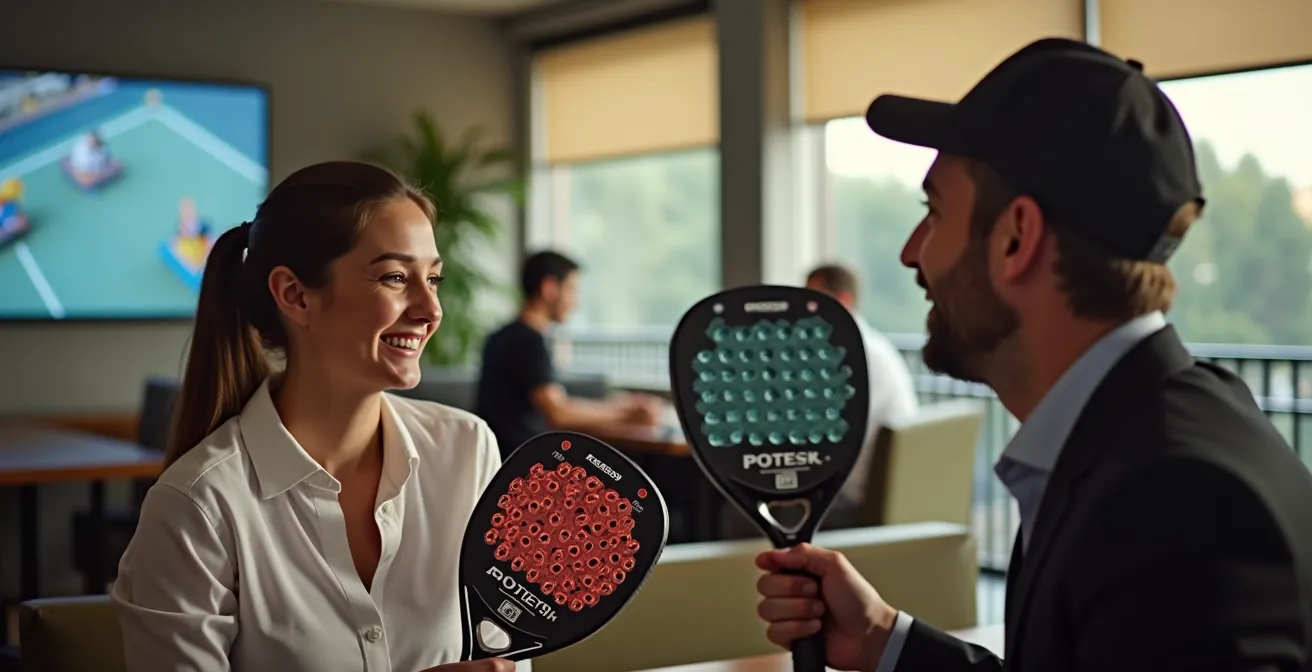
The key is not to shut down a conversation, but to master the “Acknowledge, Bridge, Pivot” technique. Acknowledge the comment briefly and neutrally (“That’s an interesting point…”), build a bridge back to a shared, safe context (“…and speaking of complex strategies…”), and then pivot to a positive, game-related topic (“…I was really impressed with your strategy on that last point.”). This technique allows you to control the conversational flow without creating awkwardness, demonstrating social intelligence and poise. To stay on safe ground, it’s useful to have a mental matrix of conversation topics, as shown in the analysis below.
This matrix, inspired by an analysis of safe topics in business networking, helps categorize potential conversations to maximize reward while minimizing risk.
| Topic Category | Risk Level | Reward Potential | Example Conversation Starters |
|---|---|---|---|
| The Game Itself | Low | Medium | ‘That backhand slice was incredible – how long have you been working on that?’ |
| Gear & Equipment | Low | Medium | ‘I noticed you’re using a diamond-shaped racket – how do you find the power?’ |
| Travel & Destinations | Low | High | ‘Have you played at any other clubs in the area?’ |
| Industry Trends (General) | Medium | High | ‘How is your sector adapting to remote work trends?’ |
| Politics/Religion | High | Low | Avoid – Use ABP technique to redirect if raised |
By preparing your conversational pivots and sticking to low-risk, high-reward topics, you transform the post-game chat from a potential minefield into a golden opportunity to solidify connections.
When to Let the Boss Win: The Psychology of Competition in Business
The old adage “let the boss win” is a relic of a bygone era of individualistic, hierarchical thinking, particularly in one-on-one sports like golf or tennis singles. In the collaborative arena of padel, the question becomes obsolete. The game is played in doubles, which fundamentally changes the dynamic from direct confrontation to partnership. Your goal is not to beat your boss, but to be an exceptional partner *to* them, whether you are on the same side of the net or playing as opponents in a friendly four-person match.
This collaborative structure is a direct parallel to a high-functioning business team. As a business networking expert noted in an analysis of doubles play dynamics, the objective is to be a supportive and communicative partner. This philosophy is perfectly encapsulated in the doubles format of padel.
Your objective is not to show individual dominance but to be an outstanding, supportive, and communicative partner. This demonstrates your value as a business collaborator far more effectively than winning.
– Business Networking Expert, Analysis of doubles play dynamics
Your value is demonstrated not by winning at all costs, but by your ability to communicate, strategize, and adapt with your partner. Do you offer encouragement after a missed shot? Do you communicate your intentions clearly? Do you adapt your play style to complement your partner’s strengths? These are the actions that a senior leader will notice and respect far more than a winning scoreline.
The Corporate Padel Cup’s Collaborative Approach
The Corporate Padel Cup by Property Padel demonstrates how padel’s doubles format naturally diffuses competitive pressure. Unlike one-on-one tennis creating direct win/loss dynamics, the four-person padel format allows junior executives to be on their boss’s team, actively helping them succeed. This collaborative structure has proven more effective for relationship building than traditional golf outings, as it emphasizes teamwork over individual performance.
How to Use “Power Posing” Before Interviews to Hack Your Cortisol Levels?
The concept of “power posing”—adopting open, expansive postures to influence your mindset—is not just for pre-interview prep; it’s a powerful tool for projecting confidence on the court. Your body language between points, during changeovers, and even while warming up sends constant signals about your mental state. Feeling like an underdog can trigger a rise in cortisol, the stress hormone, which tightens your muscles and clouds your judgment. By consciously adopting postures of confidence, you can “hack” this physiological response, reduce cortisol, and maintain a state of calm authority.
This isn’t about being arrogant; it’s about embodying resilience. Standing tall with your shoulders back after losing a point projects a completely different message than slumping over in frustration. This physical discipline is directly linked to performance. For instance, research demonstrates that dynamic stretching outperforms static stretching for tennis performance, underscoring the powerful connection between physical preparation and on-court results. Power posing is the psychological equivalent of a dynamic stretch—it prepares your mind for peak performance.
Integrate these techniques into your on-court routine to build and project unshakeable confidence:
- Hold the ready position with your chest out and racket firmly gripped for 30 seconds before serving.
- Practice shadow swings with full, expansive extension to embody confidence through movement.
- Stand with your shoulders back and head up between points to project resilience and control.
- Combine your physical power pose with visualization of a successful point or post-game conversation.
- Use controlled breathing (like the 4-7-8 pattern) while in a power stance to actively lower cortisol.
- Maintain open body language and steady eye contact during changeovers with opponents and partners.
By mastering your non-verbal cues, you take control of your own psychology and shape how others perceive you, turning feelings of doubt into a display of composed authority.
When to Arrive: The Golden Hour for Networking at Cultural Events
In sports-based networking, timing is everything. Your strategy shouldn’t begin with the first serve, but long before you step onto the court. Arriving at the club at the right time transforms the event from a simple match into a multi-stage networking opportunity. As Sphère Network co-founder Guillaume Allaux points out, padel’s format is perfectly suited for this. “Padel offers a format much more in line with today’s pace of life: short sessions, immediate dynamism, technical accessibility, and above all, a more collaborative atmosphere,” he says. This atmosphere is best leveraged by following a strategic timeline.
The most valuable networking doesn’t always happen during the game itself, but in the windows before and after. The period 20-30 minutes before your court time is the “Scouting and Rapport Building” phase. This is your chance to grab a coffee, observe who is present, and initiate light, low-pressure conversations. The 30 minutes immediately following the match is the “Endorphin Window,” the absolute golden hour for deepening connections. Endorphins are high, guards are down, and conversations can more easily transition from the game to genuine business potential. Missing these windows means missing half the opportunity.
The following timeline provides a strategic framework for maximizing your networking ROI on match day.
This detailed schedule outlines the key phases for effective relationship building around a match.
| Time Window | Activity | Networking Opportunity | Key Actions |
|---|---|---|---|
| 25 min before court time | Clubhouse arrival | Scout and light introductions | Order coffee, observe who’s present, make initial connections |
| During warm-up | Pre-game briefing | Build initial rapport | Ask about playing experience, share vulnerability, establish common ground |
| During play | Active game time | Demonstrate character | Show sportsmanship, communication skills, strategic thinking |
| 30 min post-match | Endorphin Window | Deepen connection | Share drinks, transition to business topics, exchange contact details |
| Next morning | Follow-up email | Solidify relationship | Reference specific game moments, propose concrete next steps |
Key Takeaways
- Shift your mindset: View racket sports not as a game, but as a strategic platform for demonstrating professional character and building social capital.
- Master non-verbal signals: Your choice of gear, your warm-up discipline, and your on-court posture communicate your professionalism more than words.
- Prioritize collaboration over dominance: In doubles-focused sports like padel, your value is shown by being a great partner, not just a great player.
How to Project Authority in Board Meetings When You Feel Like a Fraud?
The feeling of being a “fraud” or an imposter often stems from a perceived gap in skill or status. However, on the padel court, authority is not derived from raw power or expensive club memberships, but from strategic intelligence. Padel’s lower barrier to entry—with average gateway fees around €120 to €240 compared to golf’s €1,800-3,500—democratizes the networking landscape. It’s a space where your strategic acumen can outshine a competitor’s bigger budget or more powerful serve.
This is where you can truly project authority, even if you are technically the weakest player in the foursome. The key is to shift your role from “player” to “on-court strategist.” By understanding positioning, anticipating opponents’ moves, and communicating effectively with your partner, you can guide the flow of the game. This is a direct and powerful demonstration of leadership that is not lost on senior executives.
Even as the weakest player, you can become the ‘on-court strategist’ by mastering positioning and communication, guiding your more powerful partner. This is a direct parallel to leading a team of experts in business.
– Tennis Business Networking Analysis, Strategic positioning in doubles play
Your ability to make your partner look good, to call out plays, and to maintain a positive and strategic mindset under pressure is a far more compelling display of authority than simply hitting the ball hard. You are demonstrating that you can lead a team, maximize others’ strengths, and think several steps ahead—the very definition of a valuable business leader. This is how you transform feeling like a fraud into being the most valuable player on the court, without ever having the best shot.
Now that you have the playbook, the next step is to get on the court. Begin by analyzing your current on-court persona and identify one or two strategic elements from this guide to implement in your next networking match.