
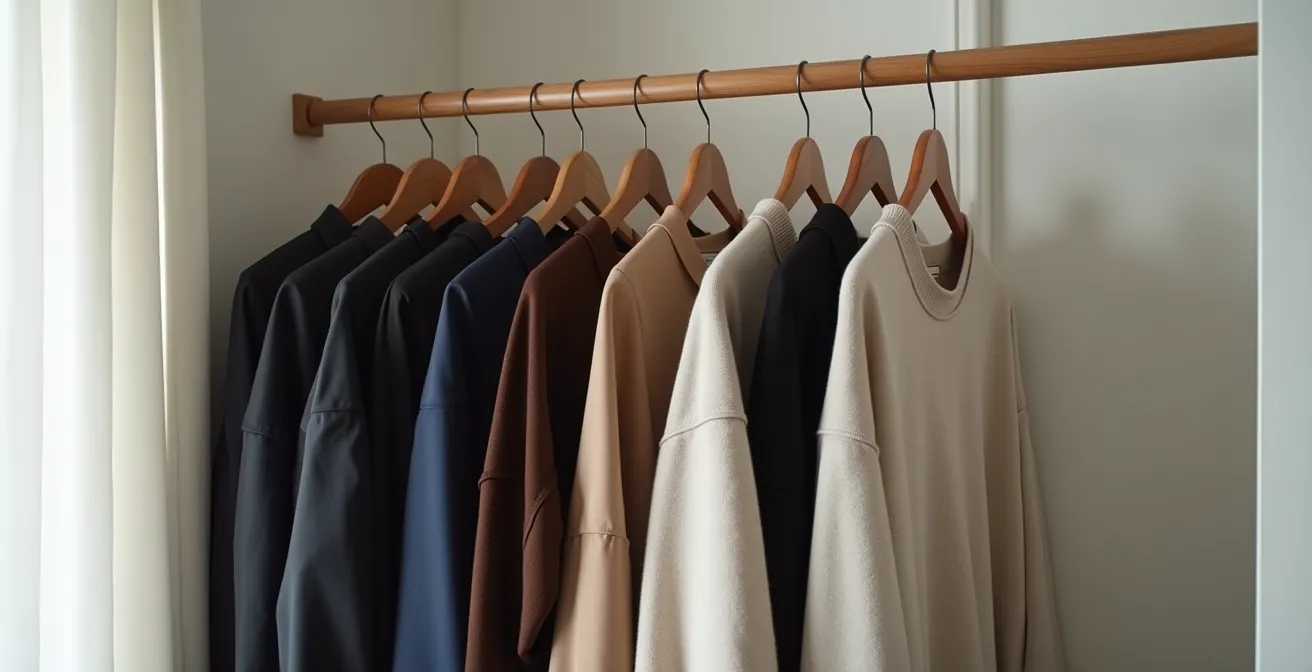
A capsule wardrobe’s true value isn’t minimalism; it’s the strategic management of your time, finances, and professional image.
- Investing in high-quality, versatile pieces drastically lowers your long-term cost-per-wear, saving you money.
- A curated system eliminates decision fatigue and uses key items to signal competence and attention to detail.
Recommendation: Stop viewing clothes as disposable expenses and start curating them as a portfolio of high-performing assets that work for you.
For many professionals, the morning begins with a familiar paradox: a closet overflowing with clothes, yet a frustrating sense that there is “nothing to wear.” This cycle of decision fatigue, trend-chasing, and wasted money is the silent cost of a disorganized wardrobe. The conventional advice often circles around generic decluttering tips or rigid lists of “must-have” items that ignore personal style and the nuances of a professional environment. The focus remains on the clothes themselves, not the system they should serve.
But what if the entire approach was reframed? What if a wardrobe wasn’t a collection of liabilities, but a portfolio of strategic assets? This is the core principle of a true capsule wardrobe. It’s not about restriction or owning fewer things for the sake of it. It’s an intentional, curated system designed to deliver a measurable return on investment—in saved time, in financial efficiency, and in the powerful, non-verbal communication of competence. As Racked.com’s former Shopping Director, Tiffany Yannetta, noted, the upper half of the body is what people see most, making a key piece like a blazer a critical tool for elevation.
A good blazer is important because it’s such an easy way to elevate an outfit. The upper half of your body is what people see the most — more than your pants or your shoes.
– Tiffany Yannetta, Racked.com Shopping Director
This guide moves beyond the basics. We will deconstruct the economics of quality, explore the science of materials, and provide a framework for building a wardrobe that functions as a powerful tool for professional success. It’s time to stop dressing for the day and start investing in a system that builds for the future.
For those who prefer a visual summary, the following video offers a great introduction to the core concepts of getting more value and versatility from your wardrobe.
This article breaks down the strategic pillars of building a high-performance capsule wardrobe, from understanding the true cost of quality to mastering the art of accessorizing for value. The following sections will guide you through each critical element.
Summary: The 30-Piece Capsule Wardrobe: A Professional’s Guide to Strategic Dressing
- Why Buying Cheap Blazers Costs You $400 More Over Three Years
- How To Identify High-Quality Wool Blends That Won’t Pill After One Season
- Navy Blue Vs Black: Which Base Color Offers More Versatility For Business?
- The ‘Sale Rack’ Trap That Fills Your Closet With Unwearable Clothes
- How To Arrange Your Closet To Create New Outfits In Under 2 Minutes
- Why Does A $5,000 Handbag Signal Competence In Certain Corporate Circles?
- Bioplastic Vs Petroleum: Which Actually Degrades In A Home Compost?
- Vintage Watches Or New Designers: Which Accessories Hold Their Value Best?
Why Buying Cheap Blazers Costs You $400 More Over Three Years
The allure of a $50 fast-fashion blazer is undeniable, offering an instant style update without a significant upfront cost. However, this is a financial illusion. The true cost of a garment is not its price tag but its cost-per-wear (CPW). When viewed through this lens, cheap clothing reveals itself as a recurring, expensive subscription service. A low-quality blazer may only last a year before it loses its shape, pills, or looks dated. Over three years, you may buy three such blazers, costing you $150.
In contrast, a high-quality, well-constructed blazer costing, for example, $550, is an investment. Built with superior fabric and tailoring, it can easily last five to ten years with proper care. While the initial outlay is higher, its durability makes it fundamentally cheaper over time. Fashion experts have calculated the CPW difference, noting that a quality piece can reach as low as $2.00 per wear for a $200 quality blazer worn frequently. The math is simple: the cheap option is a financial drain, while the quality piece is an asset that pays dividends in longevity and sustained appearance.
The visual difference in construction is a key indicator of this value. To understand this better, it helps to see the contrast in material integrity and tailoring techniques side-by-side.
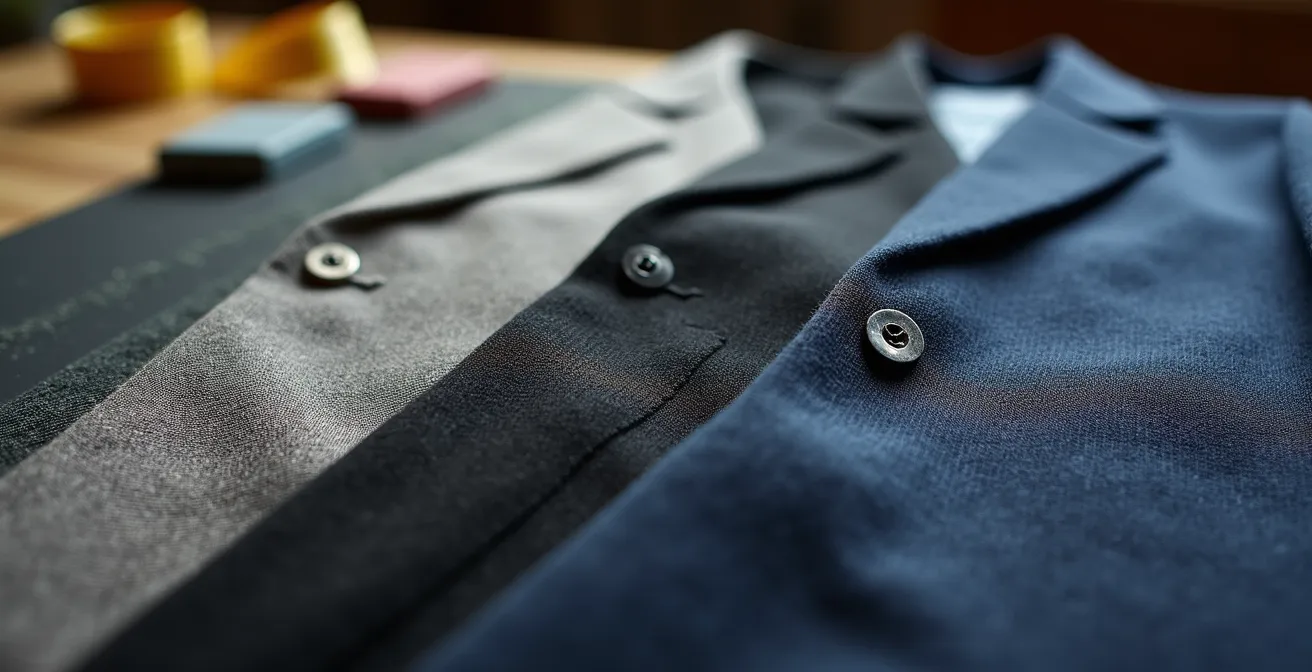
This image highlights the textural differences that determine an item’s lifespan. A cheap blazer often uses fused interlinings (glued) that bubble and warp, while a quality piece features stitched canvassing that molds to your body over time. This structural integrity is what you are truly paying for, ensuring the garment maintains its sharp silhouette year after year.
How To Identify High-Quality Wool Blends That Won’t Pill After One Season
One of the most visible signs of a low-quality garment is pilling—the formation of small, fuzzy balls on the surface of the fabric. This occurs when short, weak fibers break and get tangled. While many associate pilling with cheap synthetics, it can happen to natural fibers like wool if the quality is poor. The key to avoiding this lies in understanding material integrity and fiber length.
High-quality wool, particularly merino, is composed of long-staple fibers. These fibers are stronger and more tightly twisted into the yarn, making them far less likely to break and form pills. When you are shopping, you can perform a simple tactile test: a quality wool blend should feel smooth and dense, not light, overly soft, or “hairy.” A loose weave is another red flag, as it allows more room for fibers to rub against each other and pill.
Don’t be immediately discouraged by minor pilling on a new, high-quality wool garment. This is often just the shortest, residual fibers working their way out of the weave. After a few wears and a proper wash, these will disappear, leaving behind the strong, long-staple fibers that ensure long-term durability.
Case Study: The Durability of Merino Wool
Unbound Merino conducted a durability test on their garments to assess pilling. They found that after four initial wears and being washed with denim (a high-friction scenario), the merino wool items showed minimal pilling. The study confirmed that the initial shedding of short fibers is a natural process, which ultimately leaves a stronger, more pill-resistant surface composed of long-staple fibers. This demonstrates that initial pilling is not always an indicator of poor quality, but can be part of the “settling in” period for premium materials.
Investing in garments made from long-staple fibers like high-grade merino wool or tightly woven wool blends is a core tenet of the capsule wardrobe philosophy. It ensures your investment pieces maintain their clean, sharp appearance for seasons to come, safeguarding the aesthetic and financial value of your wardrobe.
Navy Blue Vs Black: Which Base Color Offers More Versatility For Business?
Once you’ve committed to investing in quality pieces, the next strategic decision is choosing a base color palette. This choice is the foundation of your capsule’s versatility. For professionals, the debate often narrows down to two classic anchors: black and navy blue. While black is often seen as the ultimate neutral, navy blue frequently offers superior versatility in a business context.
Black can be harsh against many skin tones and creates a stark, high-contrast look that can limit pairing options. For example, black pants paired with a lighter top can visually cut the body in half. Furthermore, matching different shades of black from different fabrics is notoriously difficult, often resulting in a disjointed look. It pairs excellently with white and grey but can clash or look flat with many other colors.
Navy, on the other hand, is a deep, saturated color that functions as a “rich neutral.” It harmonizes with a much wider array of colors, from earthy tones like olive and camel to vibrant shades like burgundy and even other blues. It provides a softer, more sophisticated contrast than black, making it a more forgiving and flexible foundation for building outfits. This enhanced compatibility means a single navy blazer or pair of trousers can anchor a significantly larger number of distinct, professional looks.
The following matrix illustrates how different base colors interact with common accent colors found in a professional wardrobe.
| Accent Color | Black Base | Navy Base | Charcoal Grey Base |
|---|---|---|---|
| Camel/Tan | Good | Excellent | Excellent |
| Burgundy | Good | Excellent | Good |
| Sky Blue | Fair | Good | Excellent |
| Olive | Fair | Excellent | Good |
| Cream/White | Excellent | Excellent | Excellent |
As the comparison shows, navy consistently rates as “Excellent” with a broader range of popular accent colors, confirming its status as a more versatile and strategic choice for a professional capsule wardrobe. While charcoal grey is also a strong contender, navy offers a depth of color that is both authoritative and approachable.
The ‘Sale Rack’ Trap That Fills Your Closet With Unwearable Clothes
The greatest threat to a well-curated capsule wardrobe isn’t wear and tear; it’s impulse buying. The “sale rack trap” is a powerful psychological phenomenon. A significant discount creates a sense of urgency and perceived value, leading us to purchase items we don’t need and that don’t fit our strategic wardrobe plan. The result is a “closet full of bargains” that are rarely, if ever, worn.
These purchases are the antithesis of the capsule philosophy. They are liabilities, not assets. They add clutter, increase decision fatigue, and possess an astronomically high cost-per-wear. Financial wellness experts confirm that trend-based wardrobes result in very high cost per wear due to low use frequency. That $30 “steal” of a trendy shirt worn only once is infinitely more expensive than a $150 classic shirt worn fifty times.
Avoiding this trap requires shifting from a reactive, opportunity-based shopping mindset to a proactive, mission-based one. You are not browsing; you are acquiring specific assets to fill identified gaps in your portfolio. This requires discipline and a clear set of rules to govern every potential purchase. The goal is to make conscious, strategic decisions that align with your long-term vision, rather than succumbing to the short-term thrill of a discount.
Action Plan: Your Strategic Shopping Mission Rules
- Create a Hit List: Before shopping, create a prioritized list of specific, missing capsule items. What function will this item serve?
- Stick to the List: Only purchase items that appear on your pre-made list. No exceptions. This prevents impulsive “finds.”
- Implement a 24-Hour Hold: For online purchases, leave items in your cart for 24 hours. This cooling-off period separates genuine need from fleeting want.
- Apply the Rule of Three: Before buying, ask yourself: “Can this item create at least three distinct outfits with pieces I already own?”
- Perform a Palette & Style Check: Does the item’s color and silhouette perfectly match your defined color palette and personal style? If it’s an outlier, it’s a “no.”
By internalizing these rules, you transform shopping from a passive activity into a strategic acquisition process. Every item that enters your closet does so by design, not by chance, ensuring it contributes directly to the efficiency and elegance of your system.
How To Arrange Your Closet To Create New Outfits In Under 2 Minutes
A capsule wardrobe’s benefits are only realized when the system is easy to use. A brilliantly curated collection of clothes is useless if it’s arranged chaotically. The goal of closet organization is to minimize cognitive load and streamline the process of getting dressed. A properly arranged closet should allow you to visualize and assemble complete, stylish outfits in moments.
One of the most effective techniques is the “Outfit Formula” method. Instead of grouping items by type (all shirts together, all pants together), you group them into ready-to-wear outfits. This could mean hanging a shirt, trouser, and blazer together on a single quality hanger. In the morning, you’re not making three decisions; you’re making one. This simple shift in organization has a dramatic impact on efficiency.
Case Study: The Outfit Formula Method
The style experts at Stridewise tested the outfit formula method with a core collection of just 15 items. By pre-grouping them into complete outfits, they were able to create over 30 distinct combinations. The most significant result was the reduction in morning decision time, which dropped from an average of 10-15 minutes to under 2 minutes. This quantifies the “decision ROI” of a systematic closet arrangement, saving over an hour each week.
To take this a step further, many professionals create a “digital twin” of their closet. By photographing each item and using a wardrobe app, you can build and save outfits digitally during downtime, like a Sunday evening or on a commute. This removes the decision-making process from the time-pressured morning rush entirely.
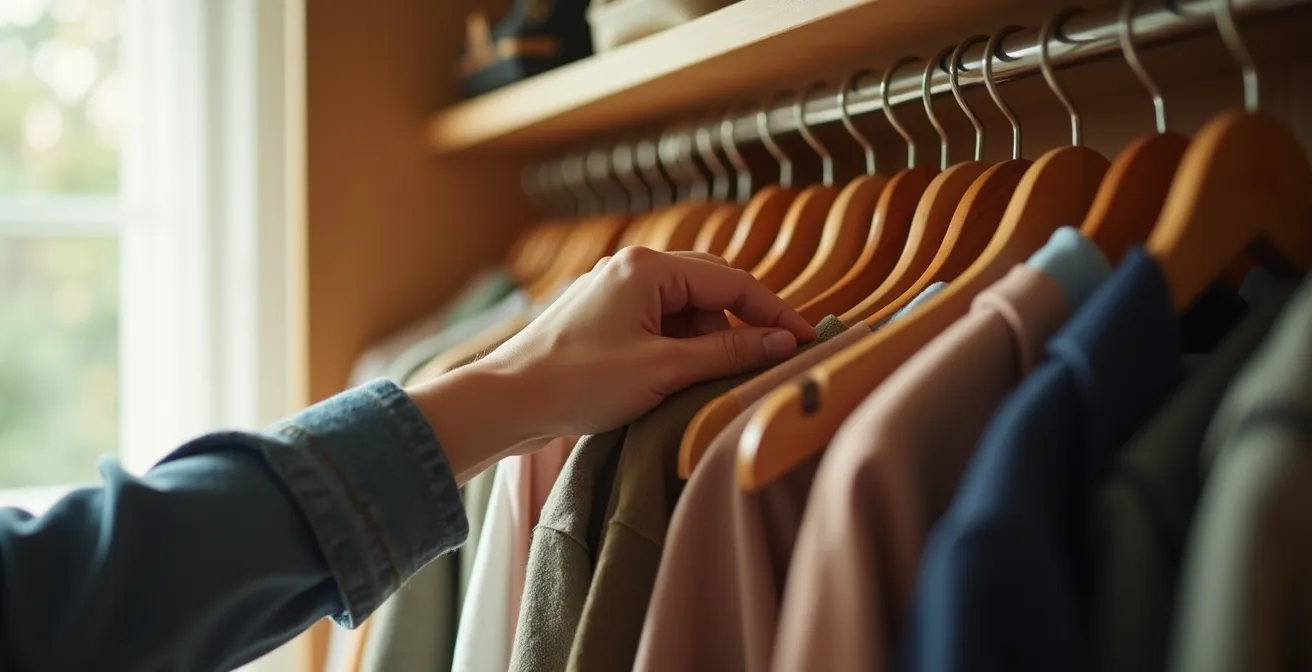
This organized approach, whether physical or digital, transforms your closet from a storage space into a high-efficiency tool. It allows you to leverage your investment pieces to their full potential, ensuring you always look polished and put-together without the daily stress.
Why Does A $5,000 Handbag Signal Competence In Certain Corporate Circles?
In many professional environments, clothing and accessories function as a non-verbal language, communicating status, attention to detail, and success. A luxury item, like a $5,000 handbag, acts as a powerful form of competence signaling. The logic, whether conscious or subconscious, is that an individual who can afford and properly maintain such an item likely possesses a high degree of professional success and diligence. It’s a shorthand for “I am successful, and I care about the details.”
However, this does not mean that expensive luxury items are a prerequisite for professional advancement. The signal being sent is not about the price tag itself, but about the *qualities* the item represents: quality, discernment, and meticulous care. The strategic professional understands that it’s possible to send the same signal using more subtle and financially astute methods. This is the concept of “signal substitution.”
Instead of a flashy logo, the signal of competence can be transmitted through an impeccably maintained pair of high-quality leather shoes, a classic and well-cared-for watch, or a premium leather portfolio. These items convey the same message of quality, attention to detail, and understated success, often at a fraction of the cost. They signal that you invest in lasting quality, not just in fleeting status symbols.
Case Study: The Signal Substitution Strategy
An analysis by Who What Wear on professional wardrobe investments explored this exact concept. Their research found that high-quality accessories in the $200-$500 range, such as classic leather portfolios or perfectly maintained shoes, could achieve a similar perception of competence as luxury items costing over $5,000. The key factor was not the brand, but the impeccable condition and classic design of the items, which signaled a deep-seated attention to detail—a highly valued trait in any professional.
The lesson for the capsule wardrobe strategist is clear: focus on the message, not just the medium. Invest in the highest quality you can afford in key signaling categories—shoes, a watch, a bag or portfolio—and maintain them fastidiously. This approach builds a professional image based on substance and discernment, which is a far more powerful signal than brand recognition alone.
Bioplastic Vs Petroleum: Which Actually Degrades In A Home Compost?
For the modern professional, a strategic wardrobe is not only about financial and aesthetic ROI but also about aligning with personal values. Sustainability is no longer a niche concern; it’s a core component of intelligent consumption. Market research reveals that over 60% of consumers indicate a preference for sustainable clothing options. In the context of a capsule wardrobe, where longevity is paramount, understanding a material’s full lifecycle—from production to end-of-life—is crucial.
The choice of materials has a profound impact. Petroleum-based synthetics like polyester and nylon are incredibly durable and often affordable, but their environmental cost is immense. They are energy-intensive to produce and can persist in landfills for hundreds of years. While they can be recycled, the process is complex and not yet widely available for blended fabrics.
On the other side are natural fibers and modern “bioplastics” or cellulosics like Tencel™ Lyocell. Natural fibers like wool and cotton are biodegradable. However, it’s important to understand the nuances. The term “bioplastic” can be misleading; many require specific industrial composting conditions (high heat and pressure) to break down and will not degrade in a home compost bin. In contrast, natural, untreated fibers like wool and cotton will biodegrade relatively quickly. Tencel, derived from wood pulp in a closed-loop system, is also celebrated for its biodegradability and low production impact.
This scorecard provides a simplified overview of the trade-offs between common wardrobe materials, focusing on durability, production impact, and end-of-life options.
| Material | Durability (1-5) | Production Impact (1-5) | End-of-Life Options |
|---|---|---|---|
| Merino Wool | 4 | 3 | Biodegradable (3-5 years) |
| Cotton | 3 | 2 | Biodegradable (6 months) |
| Tencel/Lyocell | 4 | 4 | Biodegradable (6 months) |
| Polyester | 5 | 1 | Recyclable (persists 200+ years) |
| Nylon | 5 | 1 | Recyclable (persists 40+ years) |
The strategic choice involves balancing durability with environmental impact. For a capsule wardrobe, prioritizing durable, biodegradable materials like high-quality wool or Tencel represents a holistic investment—one that serves both your professional image and your environmental principles.
Key Takeaways
- Invest for Low Cost-Per-Wear: The true cost of an item is its price divided by how many times you wear it. Quality pieces are cheaper in the long run.
- Build on a Versatile Base: Choose a strategic base neutral color, like navy or charcoal, that harmonizes with a wide range of accent colors to maximize outfit combinations.
- Master Your Accessories: Use high-quality, well-maintained accessories like a classic watch or leather portfolio to signal competence without relying on flashy logos.
Vintage Watches Or New Designers: Which Accessories Hold Their Value Best?
The final layer of a strategic capsule wardrobe is the accessory collection. Viewing accessories not as finishing touches but as long-term assets completes the portfolio management approach. Unlike clothing, which inevitably wears out, certain accessories can maintain or even appreciate in value over time. The key is to distinguish between items that are trendy consumables and those that are true, retainable assets.
New designer accessories, particularly “it” bags or seasonal items, often function like new cars; their value plummets the moment they are used. They are subject to the whims of fashion cycles, and their resale value is highly unpredictable. While they may provide a short-term style boost, they are poor financial investments.
In contrast, classic, high-quality pieces from established heritage brands tend to perform much better as assets. This is especially true in two categories: luxury mechanical watches and iconic handbags. These items are supported by decades of brand equity, craftsmanship, and a robust secondary market. A vintage watch from a respected brand or a classic handbag design can often be resold for a significant percentage of its original price, and in some cases, can even appreciate.
Case Study: Value Retention in Luxury Accessories
An analysis of resale platforms by Memorandum shows that iconic luxury items, such as classic Chanel handbags, can retain 60-80% of their original price when sold on the secondary market. Vintage watches from brands like Omega and Rolex have demonstrated an even greater ability to appreciate in value over time. The study highlighted a critical factor for value retention: meticulous maintenance and the preservation of original documentation, such as boxes and service papers, which can add 20-30% to the final resale value.
This data reinforces the core philosophy: invest in timeless design and proven quality. An accessory strategy built around a few core, high-retention pieces provides both daily style and a stable financial asset, making it the ultimate expression of a strategic wardrobe.
By adopting this asset management mindset, you transform your relationship with your clothes. Your wardrobe ceases to be a source of stress and becomes a streamlined, high-performance system that supports your professional goals, saves you money, and gives you back your most valuable resource: time.