

Moving to a new city often feels isolating, but local festivals are your most powerful, untapped tool for building a genuine community—if you treat them as a social laboratory, not just a spectator sport.
- Volunteering at events is the single fastest way to create shared experiences and form bonds with locals.
- Authentic, community-run festivals offer far more opportunities for connection than large, commercial tourist traps.
- Your timing and strategy at an event matter more than anything; arriving early is key to making meaningful connections.
Recommendation: Instead of just attending the next festival, pick one small, specific volunteer role. Your goal isn’t to see the event, but to become part of the team that creates it.
Moving to a new city is a paradox. You’re surrounded by millions of people, yet you can feel utterly alone. You scroll through event listings, see vibrant posters for street fairs and cultural festivals, and think, “I should go.” But the thought of navigating a bustling crowd by yourself can be more intimidating than inviting. The common advice—”just put yourself out there”—feels hollow when you don’t have a strategy. It leads to you wandering aimlessly, a tourist in your own town, and returning home feeling more isolated than when you left.
But what if we reframe the entire approach? What if a local festival isn’t a passive experience to be consumed, but an active social laboratory you can engineer for connection? This isn’t about forcing awkward conversations or pretending to be an extrovert. It’s about a strategic shift in mindset. The true key to integration isn’t just attending events; it’s understanding the social dynamics at play and using them to your advantage. It’s about learning to distinguish tradition from tourism and investing your time where the ‘Social Return on Investment’ is highest.
This guide provides a playbook for turning that feeling of isolation into a targeted plan for community building. We’ll deconstruct the process, from overcoming the initial fear of going alone to identifying the “golden hour” for networking. You’ll learn why volunteering is a social superpower, how to find the events that locals actually love, and even how to apply these principles to other social settings like solo dining or sports. It’s time to stop being a spectator and start building your place in the city.
To help you navigate this new approach, this article breaks down the essential strategies. The following summary outlines the key stages of your journey from newcomer to connected local.
Summary: Your Strategic Guide to Festival Integration
- Why Attending Street Fairs Alone Is the Best Exposure Therapy?
- How to Volunteer at Local Events to Make Friends Fast?
- Tourism vs Tradition: How to Find the Authentic Festivals Locals Love?
- The Cost of Culture: How to Enjoy City Festivals Without Spending a Fortune?
- When to Arrive: The Golden Hour for Networking at Cultural Events
- Loneliness vs Solitude: How to Enjoy Dining Alone in a Foreign City?
- Why Golf Remains the King of Deals Despite the Rise of Pickleball?
- Tennis or Padel: Which Sport Is Best for Business Networking?
Why Attending Street Fairs Alone Is the Best Exposure Therapy?
The biggest hurdle for many newcomers isn’t finding an event; it’s the thought of attending it alone. This fear can be paralyzing, but as a relocation consultant, I encourage you to reframe this. Going solo isn’t a sign of failure; it’s your single greatest strategic advantage. Think of it as a mild form of exposure therapy, a psychological tool where you gradually face a fear in a controlled way. By attending a street fair alone, you are not a “loner”; you are an observer, an anthropologist, a free agent with a mission.
When you’re with a friend, you exist in a comfortable bubble. Your attention is directed inward, and you’re less approachable. When you’re alone, your focus shifts outward. You notice more, you’re more open to your surroundings, and crucially, you’re more accessible to others. Your newcomer status becomes your best conversation starter. A simple, honest question like, “Hi, I’m new here, can you tell me what this dish is that everyone’s eating?” is a powerful connection point. It’s a non-threatening invitation for a local to share their knowledge and feel helpful.
The goal isn’t to make a best friend in two hours. It’s to accumulate small, positive social interactions that build your confidence. Start with a clear, low-pressure objective: have three brief, pleasant exchanges. Maybe one is asking a vendor about their craft, another is complimenting someone’s dog, and the third is asking for directions to the main stage. These micro-connections rewire your brain to associate being alone in a crowd with opportunity, not anxiety. Each successful interaction makes the next one easier, transforming fear into a feeling of capable independence.
Embrace the freedom. You can stay as long as you want, follow your own curiosity, and leave without negotiating. This is not loneliness; this is reconnaissance. You’re gathering data, learning the city’s rhythm, and building your social foundation, one street fair at a time.
How to Volunteer at Local Events to Make Friends Fast?
If attending alone is the first step, volunteering is the accelerator pedal for social integration. It is, without a doubt, the most effective strategy for fast-tracking friendships in a new city. Why? Because it instantly solves the biggest social challenge: creating a shared context. Instead of struggling to find a reason to talk to strangers, you are immediately part of a team with a common goal. Your identity shifts from “outsider looking in” to “insider making it happen.”
This isn’t just a feeling; it’s backed by data. Volunteering creates a structured environment for interaction, and research shows this has a significant impact on building social ties. A study found that volunteering increases the likelihood of joining community groups by 24.4 percentage points. You’re not just hoping for chance encounters; you’re engineering consistent, repeated interactions over several hours or days—the very bedrock of friendship formation. You’ll work side-by-side with locals, sharing tasks, solving small problems, and experiencing the event from behind the scenes.

This collaborative environment fosters a unique type of bonding, one built on shared effort rather than social pressure. As one volunteer who was new to a city described the process, the connections happened naturally through the work.
As we set up the tables and chairs, prepped snacks, scooped casseroles, and poured coffee for our guests, I slowly got to know my fellow volunteers. After a few weeks, a fellow volunteer who knew I was new to the city invited me to a clothing swap. Another invited me over for dinner. Over time those relationships grew and to this day, some of my closest friends are my Sups friends.
– Newcomer’s Experience, Venture2Impact
Choose your role strategically. A position at the information booth puts you in contact with hundreds of attendees. Working on the setup or teardown crew creates a strong team dynamic. Helping at the beer garden is a recipe for laid-back conversation. You’re not just trading your time for free entry; you’re making a direct investment in your social network.
The bonds forged through a shared, slightly chaotic festival experience are often more resilient and genuine than those made over a fleeting chat. It’s the difference between seeing a show and being part of the cast.
Tourism vs Tradition: How to Find the Authentic Festivals Locals Love?
Not all festivals are created equal. Many cities have large, heavily marketed events that are designed more for tourists than for residents. While they can be fun, they are often poor environments for making genuine local connections. The attendees are transient, the atmosphere is commercial, and the experience can feel generic. Your mission is to develop authenticity filters to find the smaller, tradition-rich festivals where community is the main event.
The most authentic events are often organized by neighborhood committees, cultural associations, or local historical societies, not by city-wide marketing agencies. Their goal is to celebrate a shared heritage, not to maximize ticket sales. Look for signs of this grassroots origin: a slightly clunky website, flyers on physical community bulletin boards in libraries and coffee shops, and a lack of major corporate sponsors. The harder an event is to find online, the more likely it is to be a cherished local tradition. Your best sources are often analog: ask the barber, the baker, or the bartender what they’re looking forward to in the neighborhood.
These community-centric events instill a powerful sense of local pride and are structured to foster interaction. A perfect example of this principle, even on a large scale, is the New Orleans Jazz & Heritage Festival, which masterfully blends international fame with deep local roots.
Case Study: The New Orleans Jazz & Heritage Festival
The New Orleans Jazz & Heritage Festival is a great example of an event that celebrates authentic local culture. It achieves this by featuring dozens of local food stalls—from crawfish bread to beignets—and spotlighting local jazz, blues, and gospel musicians alongside international stars. According to a community event analysis by TicketFairy, this deep integration makes the festival a true cultural showcase that instills pride in local attendees and gives newcomers a genuine taste of the city’s soul.
To find these gems, become a digital anthropologist. Monitor neighborhood-specific subreddits or local Facebook groups. These online forums are the modern-day town square where grassroots events are born. By seeking out these smaller, more intimate gatherings, you are not only having a more meaningful cultural experience, but you are also placing yourself in an environment where conversations start easily and shared identity is strong.
When you’re one of fifty people watching a neighborhood parade instead of one of fifty thousand at a city-wide spectacle, you’re no longer an anonymous face in the crowd. You’re a neighbor.
The Cost of Culture: How to Enjoy City Festivals Without Spending a Fortune?
The allure of a vibrant city’s cultural scene can quickly collide with the reality of its cost. Tickets, food, transportation—it all adds up, creating a financial barrier to the very experiences that can help you integrate. But the most valuable currency for building a social network isn’t money; it’s time. The most strategic way to enjoy festivals without breaking the bank is to shift your perspective from “consumer” to “contributor.”
Volunteering, as discussed, is the ultimate “hack.” It grants you free access, but more importantly, it provides a structured role and immediate community. But there are other low-cost strategies. Many larger festivals need temporary staff for a few hours in exchange for a full-access pass. Smaller community events often have free-entry portions or are entirely free, funded by local grants or associations. Prioritize these. Instead of paying for expensive festival food, pack a picnic and find a spot on the grass—an open and friendly posture that can invite conversation.
The key is to analyze the “Social Return on Investment” (Social ROI) of your choices. Paying $100 for a ticket to wander alone through a massive music festival might yield a Social ROI of zero. Investing four hours of your time to volunteer at a local street fair could yield several promising new friendships, an infinitely higher return. This reframing is essential for anyone trying to build a life in a new city on a budget.
Volunteering not just as a free way to attend, but as an investment of time that yields a much higher ‘Social Return on Investment’ than simply paying for a ticket.
– Festival Integration Strategy Guide, Community Festival Research
Furthermore, look for the “fringe” events. Often, around a major festival, smaller, unofficial, and free events will pop up in nearby parks, bars, and galleries. These can be fantastic for meeting locals who are also looking for a more relaxed, budget-friendly experience. Your goal is connection, not consumption. By focusing on low-cost, high-interaction opportunities, you make your social integration efforts both sustainable and more effective.
Ultimately, the most memorable and meaningful connections you make won’t come from the most expensive experiences, but from the most authentic ones.
When to Arrive: The Golden Hour for Networking at Cultural Events
Most people treat a festival like a movie, arriving just as the main act starts and leaving when the credits roll. This is a strategic mistake. For networking and social integration, the most valuable moments happen in the quiet margins of the event, not at its chaotic peak. There is a “golden hour” for connection, and it’s almost always at the very beginning.
Arriving in the first hour, as vendors are finishing their setup and organizers are taking a final breath, is your secret weapon. The atmosphere is relaxed, the crowds are thin, and people are more open to conversation. This is your chance to talk to the creators—the artists, the chefs, the organizers—and ask them about their work. They aren’t yet overwhelmed and are often happy to share their passion. This is also when you’ll meet other keen, early attendees, people who are often just as eager to connect as you are.
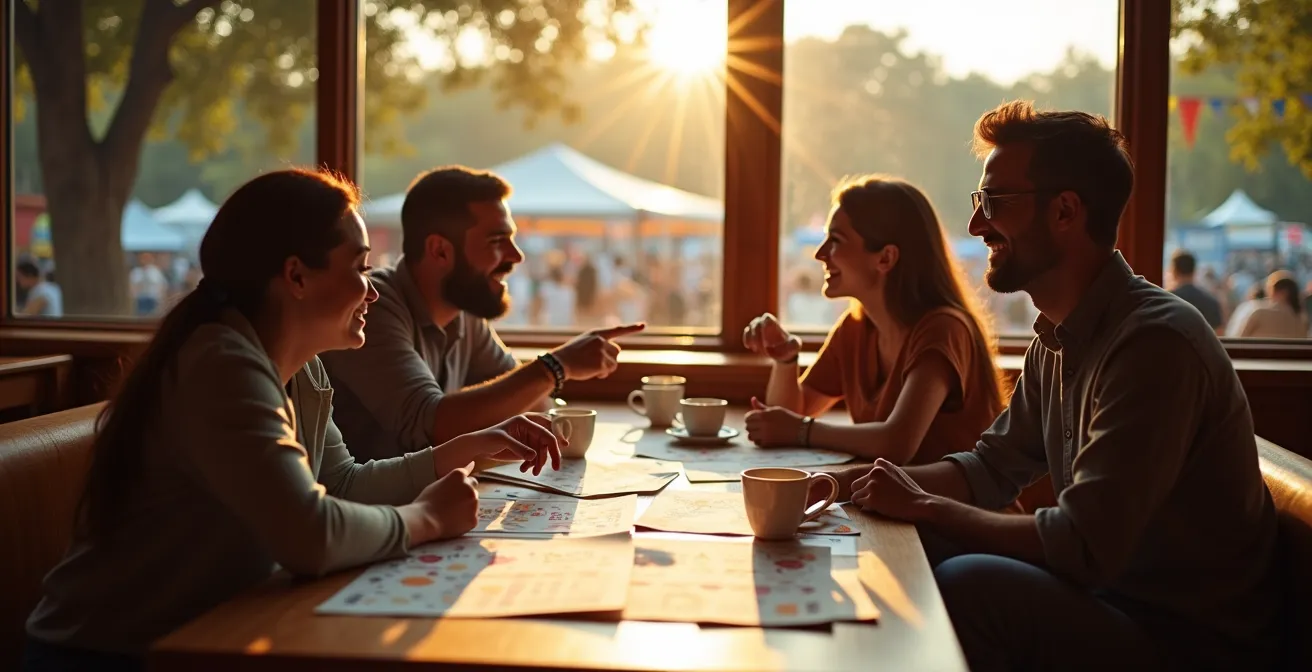
Think of the event’s timeline as a three-act play for networking. This framework helps you plan your energy and social goals for maximum effect.
- Act I (The Early Calm): The first 1-2 hours. Your goal here is quality conversations. Talk to vendors, organizers, and fellow early birds. This is where you plant the seeds for later connections.
- Act II (The Peak Buzz): The middle 3-4 hours. The energy is high, the crowds are dense. Shift your goal from deep conversation to shared experience. Join a dance, watch a performance in the crowd, and enjoy the collective energy. You might not talk much, but you’re building a shared memory with those around you.
- Act III (The Winding Down): The final 90 minutes. Many people have left, and a sense of relaxed camaraderie settles in. This is another prime time for connection. Revisit a vendor you spoke to earlier, or strike up a conversation with staff or other late-stayers. The pressure is off, and conversations can feel more genuine.
By strategically timing your arrival and departure, you transform the festival from a single, overwhelming block of time into a series of distinct opportunities, each with its own purpose in your integration playbook.
Loneliness vs Solitude: How to Enjoy Dining Alone in a Foreign City?
The strategy of using public spaces for social integration extends beyond festivals. One of the most common challenges for a newcomer is mealtime. An empty dining table can feel like a spotlight on your solitude. However, just like attending a festival alone, we can reframe dining solo from a lonely act into a powerful, strategic form of solitude. It’s a chance for “social reconnaissance” and a quiet assertion of your independence in your new home.
First, it’s important to recognize that you are far from alone in this practice. The stigma around solo dining is rapidly fading as more people embrace independent lifestyles. In fact, an analysis highlighted by Time magazine showed a significant shift, with one in four Americans eating all their meals alone on a given day in 2023. This normalization is your permission slip to claim your seat at the table, guilt-free. The key is to be intentional. Instead of hiding behind your phone, use the time to engage with your new environment.
Choosing the right spot is half the battle. Opt for a seat at the bar or a communal table, which are socially designed for interaction. Bring a prop that acts as a conversation starter—a book by a local author or a map of the city can invite questions from staff or fellow patrons. Becoming a “regular” at a neighborhood spot is a classic, effective strategy. Visiting the same café or diner at a consistent time each week makes you a familiar face, turning anonymity into belonging. The staff will learn your name, and other regulars will start to recognize you. This consistency is the slow-and-steady path to building a local network.
Your Action Plan: The Solo Diner’s Toolkit for Connection
- Choose your seat strategically: Opt for bar seating or communal tables over isolated two-tops to create natural opportunities for interaction.
- Bring a local anchor: Carry a book by a local author or a city map to serve as an organic conversation starter with staff or neighbors.
- Build familiarity: Visit the same neighborhood spot weekly at a consistent time to transform from a stranger into a familiar, welcome face.
- Conduct social reconnaissance: Use your meal time to observe neighborhood dynamics, listen to local chatter, and gather intel about your new environment.
- Reframe your mindset: Consciously view solo dining as an act of self-care, independence, and exploration, not as a sign of isolation.
This isn’t about forcing connections over every meal. It’s about turning a routine necessity into a periodic opportunity for observation, engagement, and quiet integration into the fabric of your new neighborhood.
Key Takeaways
- Integration is an active process of social engineering, not a passive hope for chance encounters.
- Volunteering offers the highest “Social ROI” by providing a shared context and purpose with locals.
- Authentic, community-run events are far more effective for connection than large, tourist-focused spectacles.
Why Golf Remains the King of Deals Despite the Rise of Pickleball?
While festivals and community events are superb for building a broad social network, sometimes the goal is more specific, such as professional networking. In the corporate world, certain environments are deliberately structured to facilitate relationship-building, and for decades, golf has been the undisputed champion. Despite the explosive popularity of faster-paced sports like pickleball, golf’s unique format gives it an unparalleled advantage for forging deep business connections.
The power of golf lies in its pace and structure. A single round offers more than four hours of uninterrupted time with a small group of people. This is a rare commodity in the modern business world. Unlike a 30-minute coffee meeting, a round of golf provides a relaxed, sustained period for conversation to evolve naturally from small talk to substantive discussion. The breaks between holes offer perfect, structured moments to delve deeper into a topic. Furthermore, the sport’s handicap system is a brilliant social equalizer, allowing a novice to compete on a level playing field with a seasoned player, removing skill-based intimidation and focusing the experience on camaraderie.
This environment is so effective that it has become an unofficial extension of the boardroom. The numbers are compelling; a study from Stanford’s Graduate School of Business found that an astonishing 90% of Fortune 500 CEOs play golf. This isn’t a coincidence. The game is a walking, talking personality test. How someone handles a bad shot, whether they’re honest about their score, and how they interact with their partners over several hours reveals more about their character than any formal interview. It’s this combination of sustained time, shared challenge, and character revelation that makes the golf course a premier arena for building trust and, ultimately, making deals.
While pickleball is great for a quick, energetic social outlet, golf is a strategic, long-form investment in high-value professional relationships. For an expat looking to build a professional network, understanding this dynamic is key.
Tennis or Padel: Which Sport Is Best for Business Networking?
Beyond golf, the racquet sports club is another classic venue for social and professional integration. But here too, the choice of sport matters. The recent explosion of padel alongside traditional tennis presents a strategic choice for the networking-minded expat. While both are excellent for fitness and meeting people, padel’s intrinsic design makes it a significantly more effective “friendship accelerator.”
Padel is almost always played in doubles on a smaller, glass-enclosed court. This structure is a social game-changer. The smaller court means players are physically closer, making conversation and banter between points not just possible, but constant and natural. The enclosed space keeps the ball in play longer, reducing downtime and maximizing interaction. Most importantly, the learning curve is remarkably gentle. An underhand serve and slower pace mean beginners can hold a rally within their first 30 minutes on the court, making it instantly accessible and inclusive.
Tennis, by contrast, requires a higher technical barrier to entry. The larger court creates more distance between players, and the focus is often more on the sport’s technical execution than on social interaction. While deep bonds can certainly be formed in a tennis club over time, padel is built for rapid, broad social engagement. The culture surrounding padel clubs often reflects this, with a greater emphasis on the post-game social at the club bar. The following table breaks down the key differences from a networking perspective.
| Factor | Padel | Tennis |
|---|---|---|
| Learning Curve | 30 minutes to start playing | Several lessons needed |
| Social Format | Always doubles (4 players) | Singles or doubles |
| Court Interaction | Smaller court = more banter | Larger court = less chat |
| Club Culture | Bar-centric, social focus | Sport-centric, varied social |
| Accessibility | Underhand serve, beginner-friendly | Technical barriers higher |
| Network Type | Wide (many connections quickly) | Deep (fewer, stronger bonds) |
This comparison, based on data and trends from sports industry research, shows a clear distinction. As highlighted by an analysis from the National Golf Foundation on sports trends, padel is designed for social mixing.
For expats looking to quickly build a wide social and professional network with minimal athletic prerequisites, padel is the clear strategic choice. It’s less a sport with a social component and more a social event with a sporting component.