
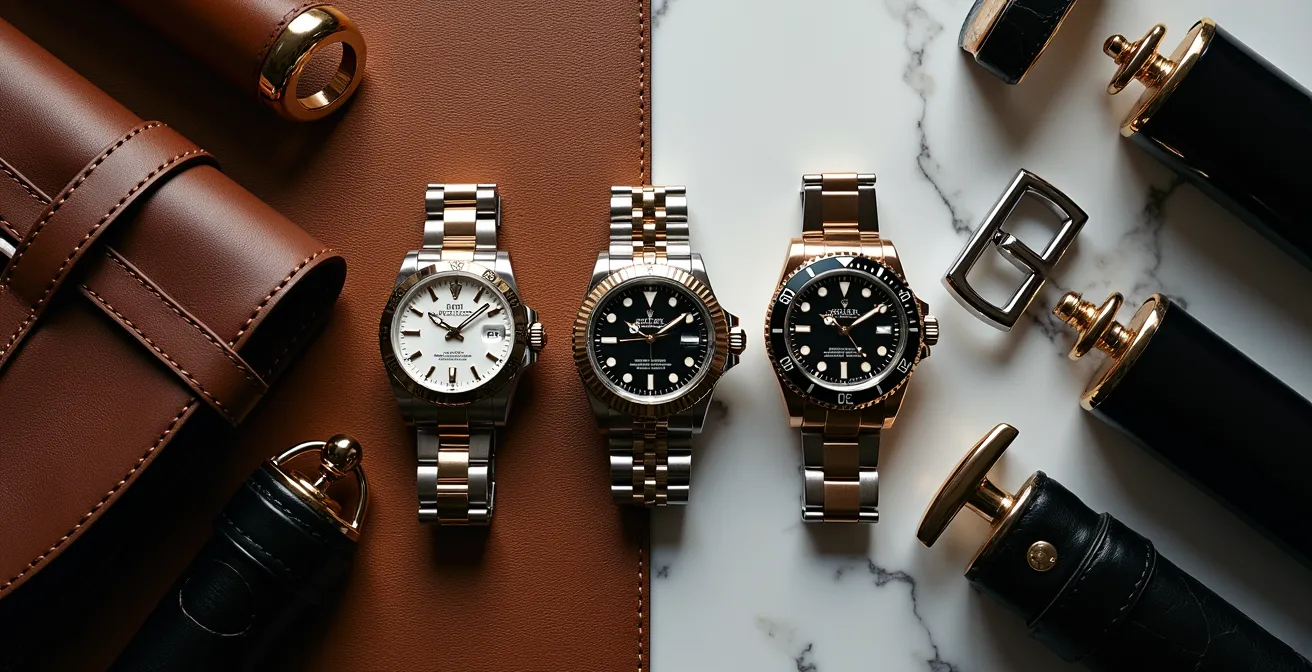
The true value of a luxury accessory is not its price tag, but its calculated return on investment, blending tangible utility with market performance.
- Classic, heritage designs consistently outperform fleeting, trend-driven items in long-term value retention.
- Material details, such as gold-plated hardware, can significantly increase an item’s resale value, sometimes retaining over 100% of the initial cost.
Recommendation: Treat your wardrobe as an “asset allocation” portfolio by analyzing each piece’s cost-per-wear and long-term value trajectory, rather than focusing solely on initial appeal.
For young investors and fashion enthusiasts, the line between personal style and asset management is increasingly blurred. The conversation often revolves around which iconic vintage watch or new designer handbag will appreciate over time. Common wisdom points towards established brands and limited editions as sure-fire investments. But this approach overlooks a more sophisticated financial framework. It treats these items as static collectibles rather than functional assets with their own performance metrics.
The real question isn’t just “what to buy,” but “how to calculate its true worth.” The conventional advice fails to account for the crucial concept of **cost-per-wear (CPW)**, the impact of market micro-trends, and the tangible utility derived from actually using the item. A bag that sits in a vault may appreciate, but a well-chosen piece worn frequently provides a different kind of return, blending aesthetic enjoyment with financial astuteness. This is the foundation of the “Asset Allocation Wardrobe”—a curated collection where every piece has a defined role and a measurable value.
This guide moves beyond the platitudes. Instead of simply listing “investment-grade” brands, we will dissect the financial mechanics that underpin an accessory’s value. We will explore how to analyze materials, spot the subtle markers of authenticity that protect your investment, and understand the value-decay curve that separates a fleeting trend from a timeless classic. It’s time to approach your accessories with the same analytical rigor you’d apply to any other asset class.
To navigate this complex landscape, this article breaks down the key financial and practical considerations. The following sections will equip you with the strategic mindset needed to build a collection that is both stylish and smart.
Summary: An Investor’s Guide to Accessory Value
- Why Does A $5,000 Handbag Signal Competence In Certain Corporate Circles?
- How To Spot A Super-Fake Hermes Scarf Without Being An Expert?
- Gold Vs Silver Hardware: Which Metal Ages Better On Leather Goods?
- The Trendy Bag Mistake That Loses 60% Of Its Value In 6 Months
- How To Store Your Luxury Bags To Prevent Structure Loss And Mold
- Why Buying Cheap Blazers Costs You $400 More Over Three Years
- How To Calculate The Payback Period For A $15,000 Solar System
- Building A Capsule Wardrobe: How To Look Sharp With Only 30 Items?
Why Does A $5,000 Handbag Signal Competence In Certain Corporate Circles?
In high-stakes professional environments, a luxury accessory operates as more than just a fashion statement; it functions as a non-verbal signal of financial acumen, attention to detail, and an understanding of long-term value. A $5,000 handbag is not merely an expense but a deliberate acquisition, suggesting the owner possesses the foresight and resources to invest in quality. This form of “peacocking” communicates an alignment with a culture where discerning choices are paramount, subtly influencing perceptions of competence and reliability among peers and clients.
This behavior is increasingly viewed through an investment lens, particularly among younger generations. They see these pieces not as frivolous spending, but as a component of a diversified portfolio. A study on luxury investment behavior revealed that 54% of Gen Z and younger millennials increased their spending on high-end timepieces and accessories between 2021 and 2023. This trend indicates a strategic shift where the public display of a high-value asset is also a display of savvy investment strategy, reinforcing one’s professional standing.
Therefore, the handbag becomes a piece of **social and financial collateral**. It signals that its owner is not just successful, but also understands how to allocate assets wisely. In circles where first impressions are critical and deals are made on trust, such a potent symbol can provide a distinct competitive edge, turning a fashion choice into a calculated career move. The accessory is a testament to an ability to navigate complex value systems, both aesthetic and economic.
Ultimately, this signaling power is directly tied to the item’s perceived and actual value, making the distinction between genuine and counterfeit not just a matter of ethics, but of preserving one’s investment and credibility.
How To Spot A Super-Fake Hermes Scarf Without Being An Expert?
Distinguishing a genuine luxury item from a “super-fake”—a counterfeit of such high quality that it mimics the original almost perfectly—requires moving beyond obvious tells. The key lies in a multi-sensory audit focusing on material integrity, hardware precision, and provenance. For an item like a Hermès scarf, the first indicator is the hand-feel of the silk twill. Genuine silk has a specific weight and a crisp yet soft texture; it drapes and reflects light in a way that cheaper polyester or lower-grade silks cannot replicate. The edges should feature hand-rolled and hand-stitched hems, with the stitching almost invisible and directed towards the “right” side of the fabric.
Another critical checkpoint is the print quality. Luxury houses invest in masterful artistry and printing techniques that produce incredibly sharp lines and a deep, even color saturation. On a counterfeit, you might notice slight color bleeding, pixelation upon close inspection, or a flatness in the colors that lacks the vibrancy of the original. Brand signatures, copyrights, and the artist’s signature should be flawlessly integrated into the design, not appearing as a crude stamp. These are subtle but decisive markers of authenticity.

The image above highlights the intricate weave and textural depth of genuine silk, details often overlooked in fakes. Protecting your investment means developing a discerning eye for these minute yet crucial differences. An authentication audit is not a one-step check but a holistic process.
Your 5-Step Authentication Audit: Verifying a Luxury Accessory
- Points of contact: List and verify all original inclusions that should be present, such as the dust cover, authenticity card, care booklet, and original purchase receipt.
- Collecte: Inventory the physical characteristics by examining the item’s material feel, weight, and the quality of its hardware, noting any inconsistencies.
- Cohérence: Confront the seller’s reputation and the item’s pricing by checking for consistency across multiple platforms and comparing against market standards.
- Mémorabilité/émotion: Spot unique versus generic details by inspecting the precision of stitching, the finishing on metals, and the overall craftsmanship that signals authentic quality.
- Plan d’intégration: Verify serial numbers or date codes where applicable, cross-referencing them with official brand databases or recognized authentication services to confirm legitimacy.
This disciplined verification process is the first line of defense in building an “Asset Allocation Wardrobe,” ensuring that each piece added is a genuine asset, not a liability.
Gold Vs Silver Hardware: Which Metal Ages Better On Leather Goods?
The choice between gold and silver-toned hardware on a luxury accessory is more than an aesthetic preference; it’s a financial decision with a direct impact on the item’s long-term value retention. Generally, **gold-plated hardware tends to hold its value better** and, in some cases, even appreciate on the resale market. This is particularly true for heritage brands where gold hardware is part of the iconic design language. The warmth of gold complements a wider range of leather colors and is often perceived as more classic and opulent, driving higher demand among collectors.
From a materials science perspective, high-quality gold plating (often 18k or 24k) is highly resistant to tarnishing and corrosion, requiring minimal maintenance to retain its luster. Palladium or other silver-toned hardware, while offering a sleek, modern look, often requires more frequent polishing to prevent oxidation, especially in humid climates. This higher maintenance can subtly affect its perceived condition over time. For instance, a report on luxury resale indicates that certain classic bags with gold hardware outperform their silver counterparts significantly, with one analysis showing a 131% retained value for a Chanel Kelly with gold hardware.
The following table, based on recent resale market analysis, breaks down the performance and characteristics of different hardware types, providing a clear framework for making an informed investment decision.
| Metal Type | Average Value Retention | Maintenance Requirements | Best Leather Pairings |
|---|---|---|---|
| 24k Gold Plating | 105-115% (heritage brands) | Minimal – resists tarnishing | Natural, warm-toned leathers |
| Palladium/Silver | 92-100% | Regular polishing needed | Cool-toned, structured leathers |
| PVD Coating | 88-95% | Very low maintenance | Modern, treated leathers |
Ultimately, while personal style should guide the final choice, understanding the financial implications of metal selection is a hallmark of a sophisticated accessory investor.
The Trendy Bag Mistake That Loses 60% Of Its Value In 6 Months
The most common and costly mistake an aspiring accessory investor can make is prioritizing fleeting, social media-driven trends over timeless design. While a viral “it” bag might offer a thrilling sense of relevance, its value is often tethered to a fragile, hyper-accelerated trend cycle. Once the cultural moment passes, demand plummets, and the bag’s resale value can crater by 60% or more within a single year. This phenomenon creates a steep **”value-decay curve”** for items that lack the foundational design principles of classic pieces.
Social media platforms like TikTok can create temporary value spikes, but these are often speculative bubbles. For example, analysis shows a temporary 20% value increase for ‘Brat’ green Bottega Veneta bags following a viral trend, but this demand is not sustainable. Savvy investors practice what can be called **”arbitrage fashion,”** identifying when to sell during these peaks, but they avoid buying into them. The smarter play is to focus on reissued classics or designs with a proven history of demand.
Case Study: Prada Re-Edition vs. Seasonal Trend Bags
A prime example of this principle is the performance of Prada’s Re-Edition line. While seasonal, trend-focused bags from various brands saw their values decline, the Prada Re-Edition 2000 Hobo and 2005 Hobo demonstrated remarkable resilience. According to a 2024 analysis, they boasted 94% and 89% average value retention respectively. This success stems from their connection to a proven, archival design, tapping into nostalgia while remaining stylistically versatile. They prove that a design rooted in a brand’s heritage is insulated from the dramatic value decay of purely trend-driven pieces.
The core lesson for an investor is to distinguish between cultural relevance and enduring value. A true asset holds its worth long after the social media buzz has faded.
How To Store Your Luxury Bags To Prevent Structure Loss And Mold
An accessory’s investment potential is directly tied to its physical condition. Improper storage can decimate value faster than any market fluctuation, leading to irreversible structural damage, color fading, and mold growth. The principles of archival preservation, used by museums, provide the best framework for protecting these assets. The primary objective is to maintain a stable environment, shielding the items from the three main culprits of degradation: **humidity, light, and pressure**.
Humidity is the most insidious enemy. Levels above 60% encourage mold and mildew, which can permanently stain leather and fabric. Conversely, levels below 40% can cause leather to dry out and crack. The ideal range is **between 45-55% humidity**, a level best monitored with a digital hygrometer. Storing bags in their original dust bags allows them to breathe while protecting them from dust and light. Never use plastic containers, which trap moisture. Stuffing bags with acid-free tissue paper (never newspaper, which can transfer ink) helps them retain their shape and prevents creasing.
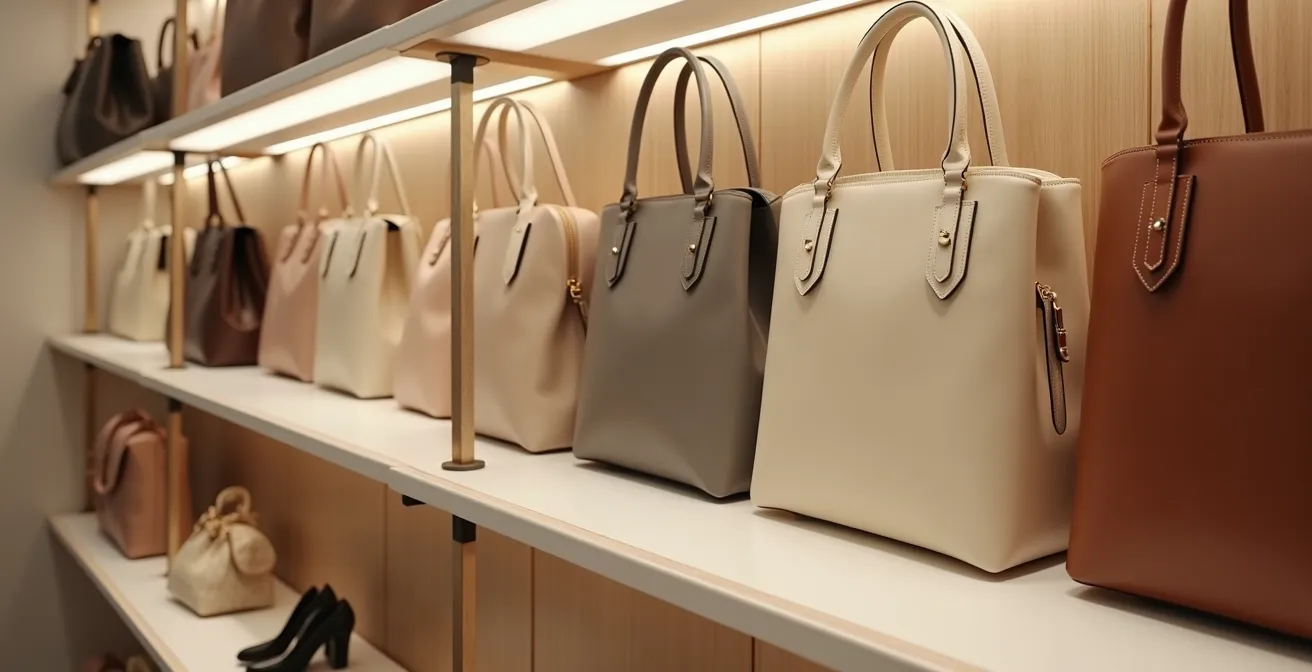
As shown in the organized system above, each item should be given its own space. Stacking bags or hanging them by their straps places undue stress on the structure and hardware, leading to distortion and damage over time. A climate-controlled closet with shelving is the gold standard for creating a personal “vault” that safeguards the condition and, therefore, the financial value of your collection.
For a truly professional approach, a museum-grade storage protocol is essential. This involves not just correct placement but active environmental management and documentation.
Museum-Grade Storage Protocol
- Maintain humidity levels between 45-55% using digital hygrometers and dehumidifiers if necessary.
- Use only acid-free tissue paper for stuffing to prevent material degradation and color transfer.
- Store bags upright in individual, breathable dust bags, never stacked or hung by their handles.
- Rotate the collection quarterly to air out materials and prevent permanent creasing in one position.
- Keep items in a temperature-controlled environment away from direct sunlight or harsh artificial light.
- Consider adding renewable silica gel packets inside bags stored in more humid environments.
- Document the condition of each high-value item with photos every six months for insurance and provenance records.
By treating storage with this level of seriousness, you are actively managing your assets and ensuring they remain in investment-grade condition for years to come.
Why Buying Cheap Blazers Costs You $400 More Over Three Years
The allure of a “fast fashion” blazer for $100 is undeniable, but it’s a financial illusion. A true investment analysis reveals a much higher total cost of ownership over time compared to a well-constructed $500 blazer. The key metric to apply here is **Cost-Per-Wear (CPW)**, which is calculated by dividing the total cost of an item (including purchase price, maintenance, and repairs) by the number of times it’s worn. A cheap blazer, made with inferior materials and poor construction, has a drastically shorter lifespan and higher maintenance needs.
A lower-quality garment often requires more frequent dry cleaning due to less resilient fabrics, and it’s more prone to issues like seam splitting or lost buttons, necessitating costly repairs. Within a year or two, it will likely need to be replaced entirely. In contrast, a high-quality blazer is crafted from durable wool or blends, is constructed for longevity, and requires less frequent cleaning. Its superior fit and material mean it gets worn more often, dramatically lowering its CPW. A simple three-year cost analysis demonstrates this disparity clearly.
The following table breaks down the expected expenses, revealing that the “cheaper” initial option is, in fact, the more expensive one in the long run.
| Cost Factor | $100 Blazer | $500 Blazer |
|---|---|---|
| Initial Purchase | $100 | $500 |
| Dry Cleaning (3 years) | $180 (monthly) | $72 (quarterly) |
| Tailoring/Repairs | $150 | $50 |
| Replacement Cost | $200 (2 replacements) | $0 |
| Total 3-Year Cost | $630 | $622 |
Proper fit dramatically increases the wearability and lifespan of garments, thus maximizing the value of the entire capsule
– Fashion Investment Analysis, MyArtBroker Guide to Entry-Level Luxury
This CPW analysis shifts the mindset from “how much does it cost now?” to “what is its value over time?” It’s the fundamental principle that separates a consumer from an investor.
How To Calculate The Payback Period For A $15,000 Solar System
Calculating the payback period for any significant asset—whether it’s a solar system for a home or a grail-level $15,000 vintage timepiece for a collection—requires a framework that goes beyond the initial purchase price. This H2 uses a solar system as a powerful metaphor for any high-value, long-term asset. The “payback” is not measured in saved energy costs, but in a combination of **value appreciation, tangible utility, and potential resale profit**. An investor must account for all inputs and outputs over the asset’s expected lifespan.
The first step is calculating the net cost. For a luxury asset, this means the purchase price minus any immediate “value” gained, such as a significant discount at auction. Next, you must factor in annual “degradation”—the cost of maintenance, insurance, and any minor wear that could affect its condition. This is analogous to a solar panel’s efficiency loss. Then, you must project the asset’s appreciation, similar to accounting for rising electricity costs. The luxury market has its own inflation; a classic Rolex or Patek Philippe has a well-documented history of appreciating far beyond standard inflation rates. A Zillow study found solar installations offer an average 35% ROI, serving as a solid benchmark for what a well-chosen tangible asset can achieve.
Finally, a comprehensive calculation must include “inverter replacement”—a major, foreseeable maintenance cost. For a watch, this could be a full movement overhaul every 10-15 years. The framework below, adapted from solar ROI analysis, provides a robust model for calculating the true payback period of any major luxury investment.
Luxury Asset ROI Calculation Framework
- Calculate net cost: Item price minus any initial acquisition discount or immediate market value increase.
- Factor annual degradation: Account for 0.5-1% of value for insurance and potential maintenance/servicing costs.
- Include major service costs: Budget for a significant overhaul at the 10-15 year mark (e.g., watch movement service).
- Add value appreciation: Project a conservative 4-6% annual increase based on historical data for the specific asset class.
- Account for market inflation: Factor in the general appreciation trend for luxury goods (2-3% annually).
- Calculate true payback: The point at which market value minus total maintenance costs exceeds the initial net cost.
- Project 25-year returns: Estimate the total potential profit upon resale, factoring in all costs and appreciation.
By applying this financial discipline, an investor can accurately assess whether a high-value accessory is simply a beautiful object or a genuine wealth-building instrument.
Key Takeaways
- True accessory value is determined by a Cost-Per-Wear (CPW) analysis, not just the initial purchase price.
- Classic, heritage designs offer superior long-term value retention compared to volatile, trend-driven “it” items.
- Meticulous storage and maintenance are non-negotiable for preserving an accessory’s physical condition and financial worth.
Building A Capsule Wardrobe: How To Look Sharp With Only 30 Items?
The ultimate expression of accessory and fashion investment is the capsule wardrobe: a curated collection of 30 or fewer high-quality, versatile items that work harmoniously. This is the pinnacle of the **”Asset Allocation Wardrobe”** philosophy. Rather than a closet overflowing with disposable trends, the capsule is a lean, high-performing portfolio where every piece delivers maximum return, both in style and in value. Looking sharp with a limited number of items is not about minimalism for its own sake; it’s about strategic selection.
The 80/20 principle is paramount here: invest 80% of your budget in timeless, foundational pieces (a great blazer, a classic watch, a versatile handbag) and allocate only 20% to more trend-aware or seasonal items. This strategy, as highlighted in investment analyses, ensures the core of your wardrobe is comprised of pieces that retain or increase their value over time. The foundation must be solid. A simple but transformative element is tailoring. Expert analysis suggests that a small investment in tailoring can make mid-range garments appear far more luxurious, dramatically increasing their “perceived value” and your confidence when wearing them.
Building this wardrobe requires discipline. It means resisting impulse buys and instead analyzing every potential addition based on its CPW, its versatility, and its long-term material quality. Does it complement at least three other items in your existing collection? Is it built to last more than a single season? This rigorous approach ensures that each of the 30 items is a workhorse, delivering exceptional utility and reinforcing a cohesive personal style. It’s the embodiment of “less is more,” where “more” signifies greater value, style, and financial intelligence.
Start today by auditing a single section of your current wardrobe. Analyze each piece not for what you paid, but for the true value it delivers. This is the first step toward transforming your closet from a mere collection of clothes into a high-performing portfolio of personal assets.