
The belief that you must “clear your mind” to meditate is the main reason beginners fail; the real key is choosing a technique that matches your brain’s natural state.
- Transcendental Meditation (TM) uses an “effortless” mantra to bypass the analytical brain, making it ideal for overthinkers.
- Mindfulness trains focused attention and non-judgmental observation, a skill that requires active practice.
Recommendation: Instead of forcing your mind to be quiet, start with a technique that gives it a simple job to do, allowing it to settle on its own.
If you’ve ever sat down, closed your eyes, and been told to simply “clear your mind,” you’ve likely encountered a wall of resistance. The harder you try to stop thinking, the louder the mental chatter becomes. This experience leads many skeptics and beginners to conclude, “Meditation isn’t for me. My mind is just too busy.” This frustration is common, but it’s not a personal failure. It’s often a fundamental technique mismatch.
Most popular advice revolves around observational mindfulness—noticing your breath, scanning your body, or watching thoughts go by like clouds. These are powerful practices, but for a mind conditioned to analyze, plan, and problem-solve, the instruction to “just observe” can feel like an impossible task. The analytical mind needs a job to do; asking it to do nothing often provokes it to do everything at once.
But what if the goal wasn’t to fight your thinking mind, but to give it something so simple and uninteresting that it naturally settles down? This is where the comparison between Transcendental Meditation and Mindfulness becomes crucial. The solution isn’t about trying harder, but about understanding the different mechanisms at play. This guide moves beyond surface-level definitions to explore which technique is neurologically better suited for a mind that refuses to be quiet, helping you find a path to stillness that feels less like a battle and more like a gentle return home.
This article provides a structured comparison to help you understand the core differences in mechanism, application, and results between these two popular meditation techniques. By exploring the specific scenarios where each excels, you can make an informed choice for your own mental wellness journey.
Summary: Finding the Right Meditation Path for a Restless Mind
- Why Repeating a Nonsense Sound Quiets the Monkey Mind Faster?
- How to Meditate on a Chair Without Hurting Your Lower Back?
- The Grey Matter Increase in the Prefrontal Cortex After 8 Weeks
- The Risk of “Meditation Sickness” When Trauma Resurfaces in Silence
- When to Meditate: Is 20 Minutes Once Better Than 10 Minutes Twice?
- Headspace or Calm: Which App Is Better for Anxiety-Driven Insomnia?
- The “Dichotomy of Control” Exercise That Stops Anger in Traffic
- How to Practice “Micro-Mindfulness” During High-Pressure Zoom Calls?
Why Repeating a Nonsense Sound Quiets the Monkey Mind Faster?
The “monkey mind” is the restless, analytical part of our brain that jumps from thought to thought. Trying to silence it with sheer will is often counterproductive. Transcendental Meditation (TM) employs a strategy of cognitive bypass rather than direct confrontation. It uses a mantra—a meaningless sound—as a tool. Because the sound has no semantic value, the analytical mind cannot latch onto it, analyze it, or spin stories around it. It’s a gentle, effortless repetition.
This process occupies the brain’s auditory processing channels, leaving fewer cognitive resources for the constant stream of thoughts. It doesn’t suppress thoughts; it simply allows the mind’s focus to drift to something simpler and less engaging. Neurologically, this is linked to quieting the Default Mode Network (DMN), the brain system active during mind-wandering. In fact, meta-analyses show consistent Default Mode Network deactivation across various mantra-based practices. In contrast, mindfulness asks you to actively observe thoughts, which for a beginner, can sometimes lead to more engagement with them. The mantra acts as a subtle anchor, allowing the mind to settle naturally without the strain of forced observation.
To understand this cognitive bypass in practice, consider these steps:
- Select a nonsensical mantra: The sound should carry no semantic weight to prevent the brain from starting an analytical process.
- Repeat it silently and effortlessly: The key is allowing it to occupy your awareness without force, letting it naturally fill the space usually taken by chatter.
- Return gently when thoughts arise: When you notice you’re thinking, you don’t fight the thought. You simply and gently return your awareness to the mantra, letting the sound naturally crowd out the mental noise.
This effortless method is why many people with busy minds find TM more accessible initially. It works with the mind’s nature instead of fighting against it.
How to Meditate on a Chair Without Hurting Your Lower Back?
The image of a meditator sitting perfectly cross-legged on the floor is a powerful but often impractical ideal. For many, especially beginners or those with physical limitations, a chair is a far more accessible tool. However, incorrect posture on a chair can lead to its own problems, namely lower back pain and discomfort that distract from the practice. The goal is to create a stable, aligned, and effortlessly upright posture.
The key is to support the natural curve of your lumbar spine. Most office chairs encourage slouching, which flattens this curve and puts strain on the lower back. To correct this, you need to ensure your hips are slightly higher than your knees, which tilts the pelvis forward and helps the spine stack naturally. Your feet must be flat on the floor to create a grounded, stable base.
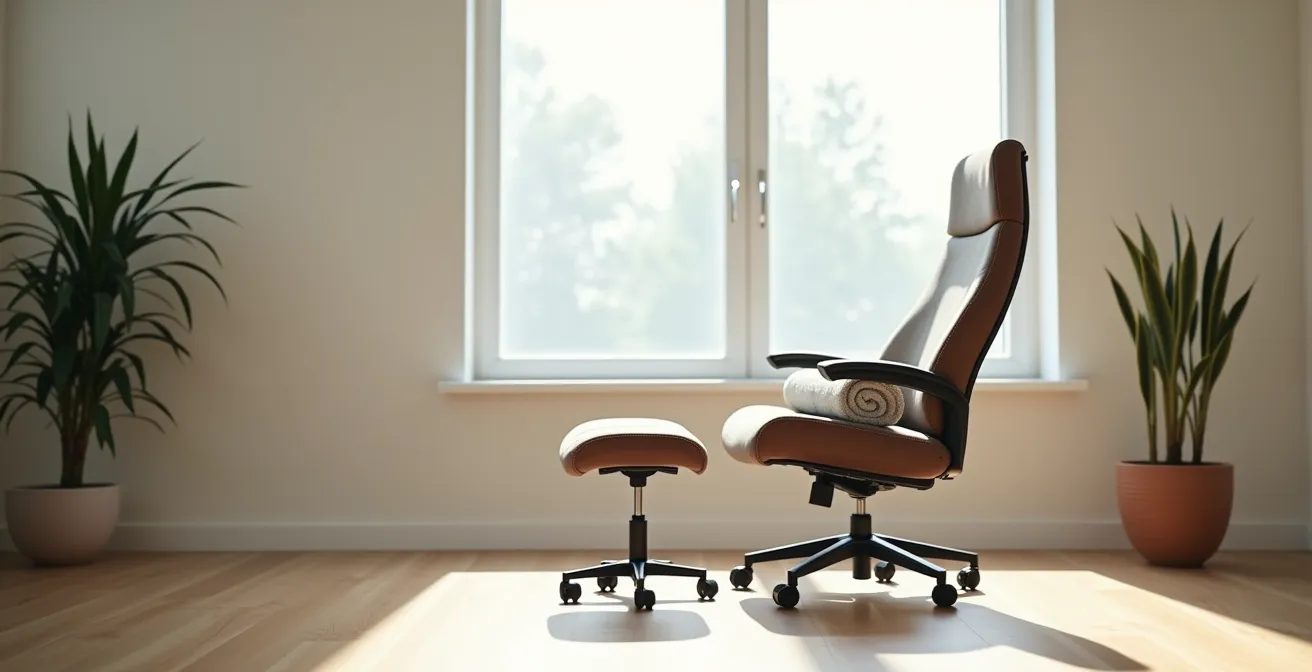
This illustration shows the ideal setup. Notice the feet are flat on the floor (using a footstool if necessary), the back is straight but not rigid, and there is support for the lower back. The arms rest comfortably, preventing tension in the shoulders. This setup isn’t about rigid formality; it’s about creating a physical state of dignified ease that allows you to forget about your body and let your mind settle. Without proper physical support, your meditation will be a constant battle against discomfort.
By making these small ergonomic adjustments, you transform a simple chair into a powerful tool for meditation, ensuring that physical pain doesn’t become another distraction for your already busy mind.
The Grey Matter Increase in the Prefrontal Cortex After 8 Weeks
While the immediate feeling of calm is a primary motivator for many, meditation also creates tangible, long-term changes in the brain’s structure and function. This concept, known as neuroplasticity, is where the brain physically remodels itself in response to experience. Both Mindfulness and TM have been shown to induce these changes, particularly in the prefrontal cortex (PFC)—the brain’s executive control center responsible for decision-making, emotional regulation, and attention.
Mindfulness practice, with its focus on sustained attention and awareness, acts like a workout for the PFC. Studies have shown that consistent practice can lead to an increase in grey matter density in this region. For example, a 2022 study in Scientific Reports found that an 8-week mindfulness training increases functional connectivity between the DMN and the Salience Network, which helps us toggle between internal thought and external tasks. This strengthens our ability to intentionally direct our focus and not get lost in rumination.

This enhanced brain coherence is a physical manifestation of a more organized, less chaotic mind. TM practice, by inducing a state of “restful alertness,” also strengthens the PFC and its connections to other brain regions. The effortless nature of the practice helps reduce the production of the stress hormone cortisol, creating an internal environment conducive to brain health and growth. Over time, this leads to a more resilient brain, one that is less reactive to stress and more capable of maintaining emotional balance.
These structural changes demonstrate that meditation is not just a temporary state of relaxation; it’s a cumulative training process that builds a stronger, more regulated brain over time.
The Risk of “Meditation Sickness” When Trauma Resurfaces in Silence
While meditation is overwhelmingly beneficial, it’s not without potential difficulties. For some individuals, particularly those with a history of trauma, the quiet space of meditation can become a container where deeply buried memories, emotions, or physical sensations resurface. This phenomenon, sometimes called “meditation sickness,” can manifest as anxiety, dissociation, or overwhelming emotional states. It’s crucial to approach this possibility with awareness and understand how different techniques manage it.
Mindfulness encourages practitioners to observe these difficult feelings with non-judgmental awareness. For some, this can be empowering, but for others, it can feel like being asked to sit and watch a fire burn without any tools to manage it. Transcendental Meditation offers a different approach. The technique is designed to let the nervous system release stress spontaneously and naturally. As Dr. Gemma Beckley of The Meditation Trust explains, the distinction is key:
TM is designed to let stress release spontaneously without engagement, while Mindfulness encourages observing the feeling without judgment.
– Dr. Gemma Beckley, The Meditation Trust
In TM, when a difficult sensation arises, the instruction is to gently and effortlessly return to the mantra, not to engage with the sensation. This “cognitive bypass” prevents the practitioner from becoming overwhelmed. However, if strong feelings do persist, having a trauma-informed toolkit is essential for any meditation practice.
Action Plan: Trauma-Informed First Aid for Meditation
- Titration: Instead of focusing on the overwhelming feeling, shift your attention to a small, manageable sensation. Notice just the temperature of your hands or the feeling of your feet on the floor.
- Sensory Anchoring: Ground yourself in the present moment with the 5-4-3-2-1 technique. Consciously identify 5 things you can see, 4 things you can hear, 3 things you can touch, 2 you can smell, and 1 you can taste.
- Pendulation: Gently shift your attention back and forth between an area of tension in your body and an area that feels calm or neutral. This allows your nervous system to self-regulate naturally.
- External Focus: Open your eyes and focus on an object in the room. Describe its color, texture, and shape to yourself. This pulls your attention out of the internal state.
- Seek Support: If these experiences are frequent or highly distressing, it is vital to stop the practice and consult with a qualified meditation teacher and a mental health professional.
Ultimately, a safe practice is a sustainable practice. Knowing how to navigate these challenges ensures that the path to healing does not inadvertently lead to re-traumatization.
When to Meditate: Is 20 Minutes Once Better Than 10 Minutes Twice?
Once you’ve chosen a technique, the next practical question is one of scheduling and dosage. Is it more effective to do a single, longer session or to split the time into two shorter periods? The answer depends on the underlying mechanism of the technique and your goal. TM and Mindfulness-based approaches offer different models for consistency and impact.
The standard TM recommendation is twenty minutes, twice a day. This isn’t arbitrary; it’s based on a “deep reset” model for the nervous system. The morning session helps dissolve the accumulated fatigue and stress from sleep, clearing the slate and regulating the morning cortisol spike. The second session, typically in the late afternoon or early evening, clears the stress accumulated during the day, preventing it from embedding in the nervous system overnight. This creates a virtuous cycle of progressively lower baseline stress. In contrast, many mindfulness apps encourage shorter, more frequent sessions, such as ten minutes twice a day. This “continuous training” model is excellent for building a consistent habit and practicing the skill of bringing your attention back to the present moment throughout the day.
The following table breaks down the two approaches and their intended effects.
| Approach | Schedule | Mechanism | Best For |
|---|---|---|---|
| Deep Reset (TM Model) | 20 min once or twice daily | Deep nervous system reset, cortisol regulation | High-stress professionals, morning cortisol spike management |
| Continuous Training (Mindfulness) | 10 min twice daily | Maintained awareness state, regular attention training | Building consistent mindfulness habit, multiple daily transitions |
The effectiveness of the twice-daily TM model is illustrated by the experiences of its practitioners, who often report a compounding benefit over time.
Case Study: TM’s Twice-Daily Virtuous Cycle
Practitioners following Transcendental Meditation’s recommended twice-daily 20-minute sessions report a compounding effect. The morning meditation dissolves accumulated stress from sleep and prepares the mind for the day, while the evening practice clears the day’s stress accumulation. This process creates progressively lower baseline stress levels over time, with many practitioners reporting significantly deeper rest and improved morning energy after just 8 weeks of consistent practice.
Ultimately, the best schedule is the one you can stick with consistently. However, understanding the theory behind the “dosage” can help you choose a routine that maximizes the unique benefits of your chosen technique.
Headspace or Calm: Which App Is Better for Anxiety-Driven Insomnia?
For many, the first entry point into meditation is through an app, with Headspace and Calm dominating the market. When it comes to tackling anxiety-driven insomnia—that frustrating state where a racing mind prevents sleep—these apps offer distinct approaches. Choosing the right one depends on the specific nature of your sleeplessness. Is your mind filled with racing thoughts, or is your body tense and unable to relax?
Calm’s primary tool for sleep is cognitive distraction. Its famous “Sleep Stories” are designed to gently redirect your attention away from anxious thought loops and onto a soothing, low-stakes narrative. This is highly effective for those whose insomnia is driven by rumination and worry. Headspace, on the other hand, often focuses more on interoceptive mindfulness. Its sleep-focused meditations frequently involve body scans and breathing exercises, which train you to notice and release physical tension. This is ideal for those whose anxiety manifests as bodily stress, like a tight jaw or a rapid heartbeat. In general, users report 30-40% improvement in sleep quality with consistent use of meditation apps over 30 days, indicating their general effectiveness.
It’s also useful to compare these app-based methods to the TM technique, which isn’t about distraction or observation but about inducing a state of deep rest that allows the nervous system to reset. This can be particularly powerful for chronic insomnia where decision fatigue at bedtime is a factor—the simplicity of a single practice can be a relief.
This table compares the core mechanisms of each approach for tackling insomnia.
As highlighted in a comparative analysis by Calm’s own blog, different tools serve different needs when it comes to sleep.
| App | Core Sleep Mechanism | Content Type | Best For |
|---|---|---|---|
| Calm | Cognitive Distraction | Sleep Stories, ambient sounds | Racing thoughts, need for mental redirection |
| Headspace | Interoceptive Mindfulness | Body scans, breathing exercises | Physical tension, body awareness training |
| TM Technique | Deep Rest Induction | Single mantra practice | Chronic insomnia, decision fatigue at bedtime |
Therefore, the “better” app is the one whose mechanism directly counters your specific pattern of anxiety at night. It may even be that a combination—a TM session in the evening to reduce baseline stress, followed by a Sleep Story at bedtime—is the most effective solution.
The “Dichotomy of Control” Exercise That Stops Anger in Traffic
A moment of intense frustration, like being cut off in traffic, is a real-world test for any mental practice. How do different techniques help us manage a sudden surge of anger? This is where we see a fascinating intersection between modern meditation and ancient Stoic philosophy. The Stoic exercise known as the Dichotomy of Control is a top-down cognitive tool. It involves actively asking yourself: “Is this event within my control, or outside of my control?” The traffic is outside your control; your reaction is within it. This mental sorting engages the prefrontal cortex to consciously override an emotional impulse from the amygdala.
This is a powerful mindfulness-in-action technique. However, a brain conditioned by regular TM practice may experience a different, more automatic process. The deep rest provided by TM helps to lower baseline levels of stress and anxiety, making the nervous system less hyper-reactive to begin with. The anger response may simply not trigger as intensely. Dr. Norman Rosenthal, a renowned psychiatrist and researcher, frames this difference as a distinction between active reframing and automatic regulation.
The Dichotomy of Control is an active, top-down cognitive reframing engaging the PFC. A TM-conditioned brain exhibits automatic, bottom-up downregulation of the amygdala’s fear/anger response.
– Dr. Norman Rosenthal, Transcendence – healing and transformation through Transcendental Meditation
This doesn’t mean the techniques are mutually exclusive. In fact, they can be powerfully combined to create a comprehensive resilience strategy. TM builds a calmer baseline state, while the Dichotomy of Control provides an active tool for moments when that calm is challenged.
- Morning: Start with a 20-minute TM session to build your baseline resilience and lower resting stress levels.
- During Trigger Moments: When anger arises (in traffic, in a meeting), immediately apply the Dichotomy of Control. Quickly categorize the situation as either ‘within my control’ or ‘outside my control.’
- Focus on Controllables: Consciously shift all your mental energy to what you can control: your breathing, your grip on the steering wheel, your choice of response.
- Evening: Use a second TM session to dissolve the accumulated stress from the day, reinforcing your calm baseline.
By stacking these practices, you’re not just managing anger in the moment; you’re fundamentally re-training your brain’s response to stress over the long term.
Key Takeaways
- The failure to “clear your mind” is not a personal flaw but often a mismatch between a busy mind and a meditation technique that requires active observation.
- Transcendental Meditation (TM) uses an effortless mantra to bypass the analytical brain, while Mindfulness trains the skill of focused, non-judgmental attention.
- The most effective approach may be a “mental toolkit,” using TM for deep nervous system reset and micro-mindfulness techniques for in-the-moment grounding.
How to Practice “Micro-Mindfulness” During High-Pressure Zoom Calls?
While TM provides a deep reset outside of daily activities, mindfulness excels at being integrated directly into them. High-pressure situations, like an important Zoom call, can trigger the body’s stress response—a racing heart, shallow breathing, and mental fog. This is where micro-mindfulness comes in. These are small, often invisible, grounding techniques that can be practiced in real-time to downregulate the nervous system without anyone knowing.
The goal is not to enter a deep meditative state but to use sensory anchors to pull your awareness out of the anxious narrative in your head and back into the physical reality of the present moment. This interrupts the feedback loop where anxious thoughts create physical tension, which in turn fuels more anxious thoughts. By focusing on a neutral physical sensation, you give your mind a simple, grounding task that breaks the cycle. It’s a practical application of the attentional control that mindfulness practice cultivates over time.
Here are several “invisible” anchoring techniques you can use during your next video call:
- Feet Grounding: Discreetly press the soles of your feet flat against the floor. Feel the texture of your socks or the solidity of the ground beneath you. This simple act creates a powerful sense of stability.
- Finger Press: Under the desk or out of the camera’s view, gently press your thumb and forefinger together. Focus on the sensation of the pressure as a calm anchor point.
- Chair Support: Become aware of the points of contact between your body and the chair. Feel your back against the backrest and your weight supported by the seat. Use this feeling of being held as a reminder to be present.
- Breath Awareness: You don’t need to close your eyes or breathe dramatically. Simply use a moment when you are muted to notice one full breath, focusing particularly on the sensation of the exhale.
These micro-practices demonstrate the true versatility of a “mental toolkit.” You can use TM for deep restoration and deploy these mindfulness techniques as in-the-moment tools to navigate the stressors of modern life with greater calm and presence.