
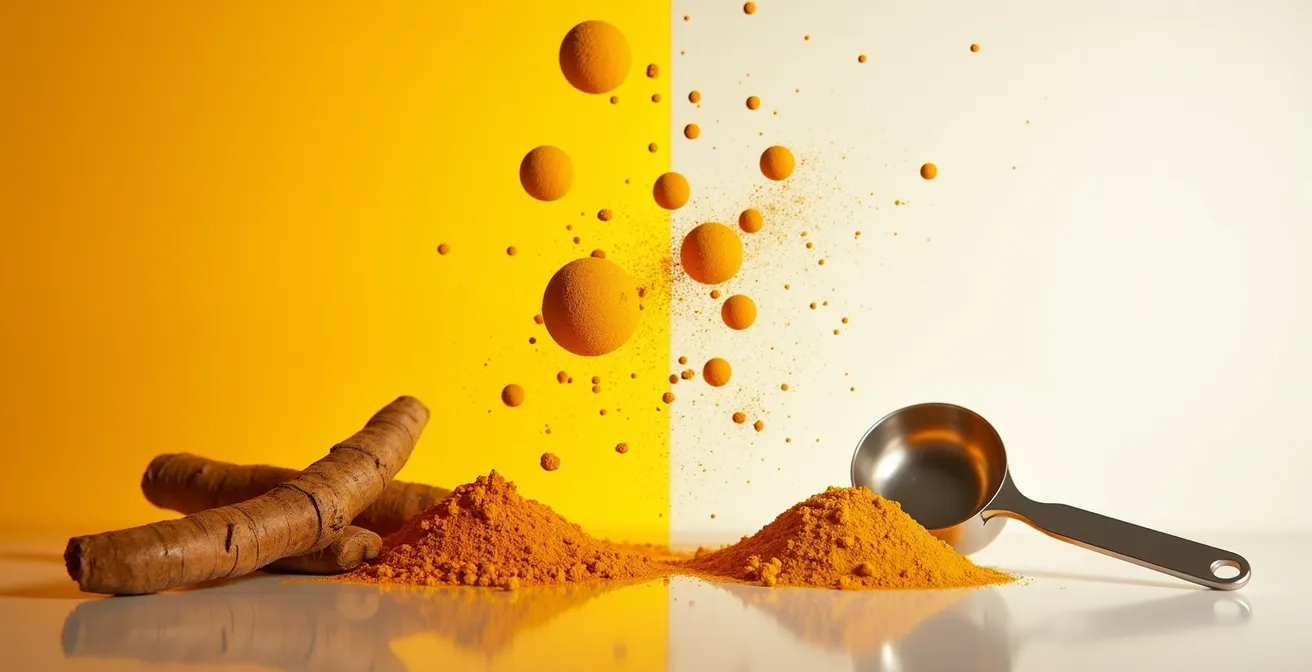
Despite its popularity, consuming raw turmeric powder for inflammation is almost entirely ineffective due to near-zero absorption of its active compound, curcumin.
- Clinical efficacy is only achieved with high-potency (95%) curcumin extracts, not the 2-6% found in the dietary spice.
- The scientific debate isn’t about *if* turmeric works, but about overcoming its profound bioavailability challenges through proper formulation and dosage.
Recommendation: Focus on standardized curcumin extracts and consult scientific evidence to understand the required therapeutic threshold, rather than relying on culinary amounts.
The wellness world is saturated with golden lattes and promises of turmeric’s potent anti-inflammatory power. It’s presented as a natural panacea for everything from sore joints to chronic disease, leading many health-conscious individuals to liberally sprinkle the bright yellow powder into their meals. Yet, for those who demand scientific proof, a significant disconnect exists between this popular advice and the hard data from clinical trials. The pervasive narrative often overlooks a critical scientific hurdle: the body can’t actually use what it can’t absorb.
The common recommendations—add it to your smoothie, take it with black pepper—are vast oversimplifications of a complex pharmacokinetic problem. While well-intentioned, this advice largely ignores the concept of a therapeutic threshold. The core issue isn’t whether curcumin, turmeric’s active compound, has anti-inflammatory properties; robust research confirms it does. The real question is whether the methods and dosages commonly promoted can ever deliver enough of this compound into the bloodstream to exert a meaningful clinical effect.
This article moves beyond the hype to address the science directly. We will deconstruct why relying on the raw spice is a flawed strategy, based on its molecular structure and metabolic fate in the body. Instead of repeating generic advice, we will explore what clinical studies reveal about effective formulations, dosage, and the critical importance of bioavailability. By examining the mechanisms of absorption and the evidence for different delivery systems, we will build a scientifically-grounded framework for understanding how to leverage curcumin’s potential safely and effectively.
To navigate this complex topic, we will break down the scientific evidence piece by piece. This structured approach will clarify the facts, address common myths, and provide a clear, evidence-based perspective on using turmeric for inflammation.
Table of Contents: A Scientific Look at Turmeric’s Efficacy
- Why Is Eating Raw Turmeric Powder Almost Useless For Joint Pain?
- How To Choose Between Tinctures And Capsules For Faster Absorption
- CBD Oil Vs Curcumin: Which Is Safer For Long-Term Pain Management?
- The Blood Thinning Danger: Combining Garlic Supplements With Aspirin
- When To Stop Taking Echinacea: Cycling Immune Boosters For Best Results
- L-Ascorbic Acid Vs Sodium Ascorbyl Phosphate: Which Brightens Sensitive Skin?
- The Resveratrol Myth: Why Red Wine Won’t Actually Save Your Heart
- Pharmacogenomics: Why Your DNA Determines Which Antidepressant Works For You?
Why Is Eating Raw Turmeric Powder Almost Useless For Joint Pain?
The fundamental reason dietary turmeric fails to impact joint pain lies in a single, critical concept: bioavailability. Curcumin, the primary bioactive compound in turmeric, is notoriously difficult for the human body to absorb. When you consume raw turmeric powder, which typically contains a mere 2-6% curcumin, it undergoes rapid metabolism in the liver and intestinal wall. The vast majority is converted into inactive substances and excreted before it can ever reach the systemic circulation where it would need to act on inflamed tissues. Its poor solubility in water and unstable nature at intestinal pH levels further compound this issue.
Clinical evidence paints a stark picture of this inefficiency. To achieve a therapeutic effect, a certain concentration of curcumin must be present in the bloodstream. However, studies consistently show that consuming even large amounts of raw turmeric results in negligible to undetectable levels of active curcumin in the blood. This means you could eat spoonfuls of turmeric powder daily without ever reaching the therapeutic threshold necessary to modulate inflammatory pathways effectively.
The contrast with standardized extracts is dramatic. These formulations contain 95% curcuminoids and are often paired with technologies designed to overcome the absorption barrier. A landmark 2023 systematic review and meta-analysis of 66 trials confirmed that supplementation with these high-potency extracts significantly reduces key inflammatory markers like C-reactive protein (CRP), TNF-α, and IL-6. These clinical results were achieved with daily doses of 300-4000 mg of curcuminoids—a concentration impossible to obtain from dietary turmeric. In essence, relying on the spice is like trying to fill a swimming pool with a leaky eyedropper; the tool is simply not suited for the task.
How To Choose Between Tinctures And Capsules For Faster Absorption
Once we accept that standardized extracts are necessary, the next question becomes which delivery system is superior: liquid tinctures or solid capsules? The answer depends on the formulation’s technology and the desired onset of action. Tinctures, which are typically alcohol- or glycerin-based liquid extracts, offer the theoretical advantage of faster absorption. When held under the tongue (sublingually), some of the curcuminoids can bypass the digestive system and enter the bloodstream directly through the rich network of capillaries in the oral mucosa. This can lead to a quicker onset of effects compared to capsules, which must first travel to the stomach and dissolve.
However, this advantage is not guaranteed. The effectiveness of a tincture depends heavily on its carrier liquid and whether it uses technology like liposomes or micelles to encapsulate the curcumin, making it more soluble. A poorly formulated tincture may offer no real benefit over a capsule. Furthermore, the amount absorbed sublingually is often small, with the majority still being swallowed and subjected to the same digestive challenges.
This is where modern capsule technology has leveled the playing field. Advanced capsules are no longer just powdered extract. Many now contain curcumin formulated with phospholipids (phytosomes), encased in self-emulsifying drug delivery systems (SEDDS), or micronized into nano-sized particles. These technologies are specifically designed to increase solubility and protect curcumin from rapid metabolism, significantly boosting its overall bioavailability. According to the Arthritis Foundation’s analysis, it’s these advanced formulations, not the delivery format itself, that truly make the difference.
Ultimately, the choice between tinctures and capsules is less about the format and more about the underlying delivery technology. A high-tech capsule with a proven bioavailability-enhancing system will almost always outperform a simple tincture. For those seeking faster, short-term relief, a well-formulated sublingual tincture might be preferable. For sustained, systemic anti-inflammatory support, a technologically advanced capsule is often the more reliable and scientifically validated choice.
CBD Oil Vs Curcumin: Which Is Safer For Long-Term Pain Management?
In the search for non-pharmaceutical pain relief, both curcumin and cannabidiol (CBD) have emerged as leading contenders. While both interact with the body’s inflammatory systems, their safety profiles for long-term use differ, primarily due to their distinct effects on metabolic pathways. Curcumin is generally regarded as having a very high safety profile, even at large doses, with the most common side effects being mild gastrointestinal discomfort. Its potential for drug interactions exists but is considered moderate.
CBD, on the other hand, presents a more complex picture concerning drug metabolism. The primary concern revolves around its powerful inhibitory effect on the cytochrome P450 (CYP450) enzyme system in the liver. This system is responsible for metabolizing approximately 60% of all clinically prescribed drugs. When CBD inhibits these enzymes, it can cause other medications to build up in the body to potentially toxic levels or, conversely, prevent prodrugs from being converted into their active forms.
The clinical significance of this is not trivial. For example, a 2023 clinical pharmacology study demonstrated that CBD significantly inhibits key enzymes, increasing the exposure of other drugs metabolized by those pathways. This is particularly concerning for individuals on medications with a narrow therapeutic index, such as certain blood thinners (like warfarin), anti-epileptics, or immunosuppressants. While curcumin also interacts with some CYP enzymes, its effect is generally considered less potent and clinically significant than that of CBD.
For long-term pain management, this distinction is crucial. A person taking multiple medications must exercise extreme caution with CBD, and its use should ideally be monitored by a healthcare professional aware of all potential interactions. Curcumin, while not entirely free of interaction risks, presents a lower barrier for safe, long-term integration into a wellness regimen for a broader population. Therefore, from a purely pharmacological safety standpoint regarding drug-drug interactions, curcumin holds a distinct advantage over CBD for chronic use.
The Blood Thinning Danger: Combining Garlic Supplements With Aspirin
While the focus is on turmeric, its interaction profile serves as a crucial lesson in supplement safety, a principle that applies broadly to other popular natural compounds like garlic. One of the most well-documented risks associated with high-dose curcumin supplementation is its antiplatelet effect, meaning it can inhibit the clumping of platelets and thus “thin” the blood. This property, while potentially beneficial for cardiovascular health in some contexts, poses a significant danger when combined with other substances that have the same effect. These include pharmaceutical blood thinners like aspirin, warfarin, and clopidogrel, as well as other supplements known for this property, such as garlic, ginkgo biloba, and fish oil.
Combining these agents can create a synergistic effect, dramatically increasing the risk of uncontrolled bleeding, excessive bruising, and complications during surgery. The mechanism is similar for both curcumin and allicin (from garlic): they interfere with the signaling pathways that cause platelets to aggregate at the site of an injury. When taken alongside a medication like aspirin, which irreversibly inhibits the COX-1 enzyme in platelets, the combined effect can leave the body with a severely compromised ability to form clots.
This risk is not merely theoretical; it is a critical consideration in clinical practice, especially in perioperative settings. Anesthesiologists and surgeons routinely advise patients to discontinue all potentially blood-thinning supplements well in advance of any procedure to prevent surgical and post-surgical bleeding complications. The lack of regulation in the supplement industry means that many consumers are unaware of these potent pharmacological effects and may inadvertently create a dangerous combination. It underscores the necessity of treating supplements as a form of medicine and disclosing their use to all healthcare providers.
Action Plan: Pre-Surgery Supplement Discontinuation Protocol
- Stop taking curcumin supplements at least 2 weeks before any scheduled surgical procedure to allow platelet function to normalize.
- Simultaneously discontinue other blood-thinning supplements like garlic, ginger, ginkgo, and high-dose fish oil.
- Inform all healthcare providers, including your surgeon and anesthesiologist, about your complete supplement regimen, especially if you are taking prescribed blood thinners.
- In the weeks leading up to surgery, monitor for signs of increased bleeding, such as easy or unusual bruising, nosebleeds, or prolonged bleeding from minor cuts.
- If you are on warfarin or other anticoagulants, request an INR (International Normalized Ratio) monitoring from your doctor when starting or stopping high-dose curcumin to assess its impact on your clotting time.
When To Stop Taking Echinacea: Cycling Immune Boosters For Best Results
The conversation around immune-boosting supplements like echinacea often centers on the concept of “cycling”—the practice of taking a supplement for a specific period and then stopping for a while before resuming. The rationale is twofold: to prevent the body from developing a tolerance that diminishes the supplement’s effectiveness and to avoid potential long-term side effects. This principle of strategic, non-continuous use offers a valuable framework for thinking about anti-inflammatory supplements like curcumin as well.
While curcumin is primarily used for its anti-inflammatory rather than direct immune-boosting properties, the logic of cycling can still apply, particularly in the context of managing chronic inflammation. Continuous, high-dose supplementation over many years without a break may not be the optimal strategy. Some practitioners recommend periodic breaks (e.g., one week off per month) to allow the body’s own signaling pathways to “reset.” This approach may help maintain sensitivity to curcumin’s effects and provides an opportunity to assess baseline symptoms without the supplement’s influence.
Furthermore, this aligns with a more holistic and cautious approach to supplementation. No supplement, no matter how “natural,” should be viewed as a permanent fixture to be taken indefinitely without re-evaluation. Chronic inflammation is often a symptom of underlying lifestyle or dietary issues. Using curcumin in cycles can serve as a therapeutic tool to manage flare-ups and reduce inflammation, while the “off” periods serve as a reminder to focus on addressing the root causes through diet, exercise, and stress management. Just as echinacea is best used to bolster the immune system during periods of high risk rather than year-round, curcumin can be used most intelligently as a powerful, targeted intervention rather than a constant crutch.
L-Ascorbic Acid Vs Sodium Ascorbyl Phosphate: Which Brightens Sensitive Skin?
The world of skincare provides a fascinating parallel to the curcumin debate, particularly in the discussion around Vitamin C. Consumers are often told to simply “use a Vitamin C serum,” but experts know the reality is far more nuanced. The choice between L-Ascorbic Acid (L-AA), the pure and most potent form, and a derivative like Sodium Ascorbyl Phosphate (SAP) depends entirely on skin type and stability. L-AA is highly effective but also highly unstable and can be irritating for sensitive skin. SAP is less potent but far more stable and gentle.
This highlights a crucial scientific principle that is directly applicable to curcumin: the active compound’s form and stability are as important as its presence. This distinction helps clarify the difference between a general antioxidant effect and a targeted anti-inflammatory one. Vitamin C is a premier antioxidant; its primary role is to neutralize free radicals, which are unstable molecules that cause cellular damage (oxidative stress). While chronic inflammation and oxidative stress are linked, they are not the same process.
Curcumin, by contrast, is a potent anti-inflammatory agent. Its primary mechanism is not just scavenging free radicals, but actively inhibiting key drivers of the inflammatory cascade, such as the transcription factor NF-κB (nuclear factor kappa B) and enzymes like COX-2 and LOX. NF-κB is a master switch that, when activated, turns on the genes responsible for producing a host of inflammatory molecules. By blocking NF-κB, curcumin directly shuts down the factory producing inflammation. This is a far more targeted and powerful anti-inflammatory action than the general protective effect of an antioxidant like Vitamin C. Confusing the two is a common mistake that leads to ineffective strategies for managing inflammatory conditions.
The Resveratrol Myth: Why Red Wine Won’t Actually Save Your Heart
The story of resveratrol and red wine serves as a perfect cautionary tale for understanding turmeric. For years, the “French Paradox” was partially attributed to resveratrol, an antioxidant compound found in red wine, which was believed to protect against heart disease. This led to a widespread belief that drinking red wine was a heart-healthy habit. However, rigorous scientific scrutiny revealed a familiar problem: the dose makes the poison—or in this case, the lack of dose makes it useless.
The amount of resveratrol in a glass of red wine is minuscule, far below the concentrations shown to have any effect in laboratory studies. To reach a clinically relevant dose, one would have to consume a dangerously high volume of wine daily. This exposed the resveratrol-in-wine theory as a myth, teaching the scientific community a valuable lesson: the mere presence of a beneficial compound in a food or drink is pharmacologically irrelevant if it doesn’t reach a therapeutic concentration in the body. This is the exact same principle that applies to turmeric powder.
Just as the resveratrol myth was debunked by an analysis of dosage and bioavailability, the myth of culinary turmeric as a potent anti-inflammatory must also be challenged. Indeed, research published in 2024 confirms that intact curcumin absorption from dietary sources is so low that it fails to produce significant systemic levels. Sprinkling turmeric on food provides flavor and color, but to expect it to manage a clinical condition like arthritis is akin to expecting a glass of wine to perform bypass surgery. This analogy powerfully reinforces the central argument: efficacy is a function of dosage and delivery, not just presence.
Key Takeaways
- The clinical effectiveness of turmeric hinges entirely on achieving a therapeutic dose of curcumin, which is impossible with raw turmeric powder due to its poor (less than 1%) bioavailability.
- Safety is paramount; curcumin’s antiplatelet effects require caution, especially when combined with other blood thinners like garlic or aspirin, and all supplement use should be paused before surgery.
- Advanced formulations (e.g., phytosomes, nano-particles) in capsules or tinctures are not a gimmick; they are a scientific necessity to overcome curcumin’s natural absorption barriers.
Pharmacogenomics: Why Your DNA Determines Which Antidepressant Works For You?
The frontier of modern medicine is personalization, and nowhere is this more evident than in the field of pharmacogenomics. This discipline studies how a person’s genetic makeup affects their response to drugs. For instance, variations in the genes that code for the CYP450 liver enzymes can determine whether a standard dose of an antidepressant will be effective, ineffective, or toxic for a specific individual. This is no longer science fiction; it is an emerging clinical reality that is transforming treatment protocols.
This same principle of genetic individuality almost certainly applies to our response to natural compounds like curcumin. While research in this specific area is still nascent, it offers the most sophisticated explanation for why anecdotal reports on curcumin’s efficacy are so varied. The primary metabolic pathway for clearing curcumin from the body involves enzymes called UGTs (UDP-glucuronosyltransferases). Just like with CYP450 enzymes, there are known genetic variations (polymorphisms) in UGT genes that can make these enzymes more or less active from person to person.
An individual with a “slow” UGT enzyme variant might metabolize curcumin less efficiently, allowing it to stay in their system longer and at higher concentrations, thus experiencing a more potent effect from a standard dose. Conversely, someone with a “fast” or “ultra-rapid” UGT variant might clear the compound so quickly that they experience little to no benefit, even from a high-quality extract. This genetic variability is the ultimate layer of complexity in the dosage debate. It suggests that, in the future, the question will not be “what is the right dose of curcumin?” but rather, “what is the right dose of curcumin *for you*?” This personalized approach is the logical endpoint of a truly scientific inquiry into natural medicine.
To truly leverage the potent anti-inflammatory benefits of curcumin, the logical next step is to move beyond culinary use and discuss specific, high-bioavailability formulations with a healthcare professional who understands these critical clinical nuances.