
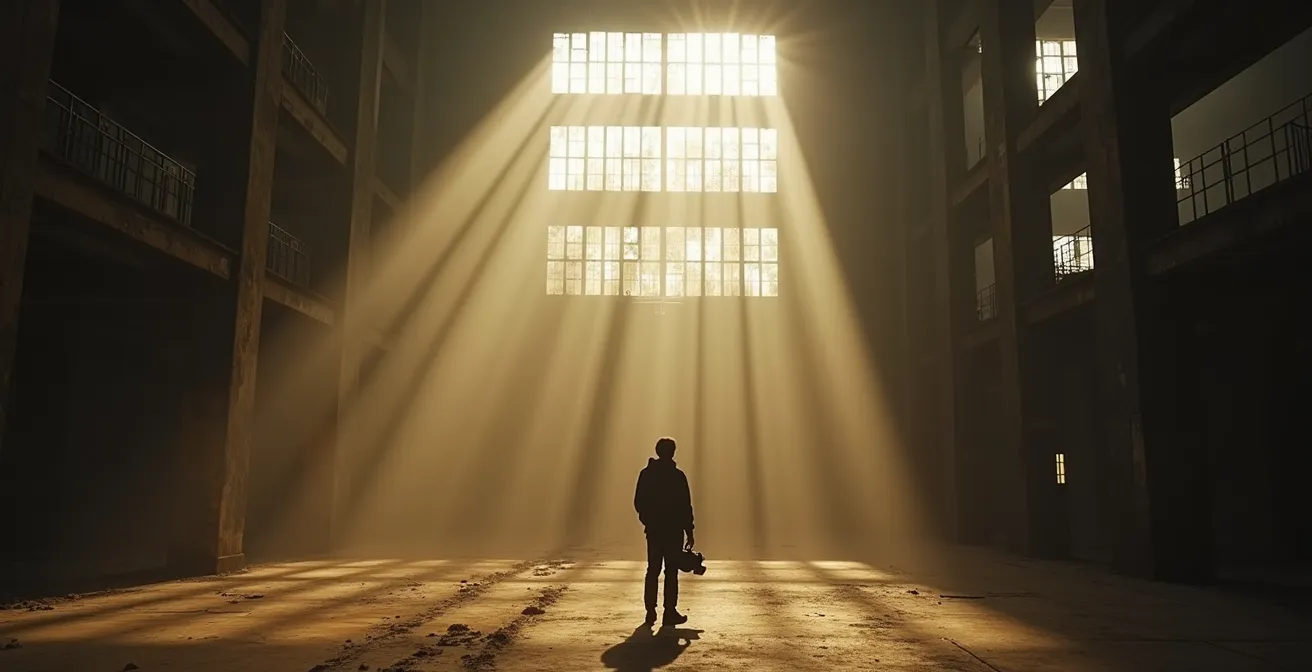
Contrary to popular belief, successful urban exploration isn’t about recklessly breaking in; it’s a calculated art of risk management and ethical documentation.
- Physical safety relies on a trained eye for structural hazards, not just luck.
- Legal survival depends on de-escalation and framing your presence as historical interest, not trespassing.
Recommendation: Before your first exploration, master the frameworks for safety assessment and respectful interaction. Your camera is your best tool and your best alibi.
There’s a magnetic pull to places left behind—a silent ballroom reclaimed by ivy, a factory frozen in time, a schoolhouse where chalk dust still hangs in the air. This fascination with decay and history has drawn millions into the world of urban exploration, or “urbex.” But for every adventurer captivated by these ruins, there’s a nagging fear: crumbling floors, unseen dangers, and the very real possibility of legal trouble. Most guides will offer the same tired advice: “be careful” and “don’t get caught.”
This approach is fundamentally flawed. It treats urbex as a game of chance rather than a discipline. The key to exploring abandoned places without breaking the law—or your leg—is not to be reckless, but to be methodical. It’s about shifting your mindset from a trespasser to a historian, from an intruder to a documentarian. This requires a sophisticated framework for managing risk, understanding the ethics of the community, and knowing precisely how to interact with the world outside the fence.
This guide moves beyond the clichés. We won’t just tell you what to do; we’ll explain the principles behind a safe, respectful, and legally defensible exploration. We will deconstruct the beauty that draws us in, build a practical system for identifying hazards, and provide a clear script for navigating the most feared encounters. The goal is to transform your curiosity into a calculated art form.
For those who prefer a visual deep dive, the following video offers an atmospheric look into the kind of hidden histories that await a respectful explorer, perfectly complementing the principles laid out in this guide.
To help you master this discipline, we’ve structured this article to build your skills progressively. You will learn not only how to see these places but how to navigate them with intelligence and respect, from the psychological allure to the photographic art form.
Summary: A Guide to the Art of Urban Exploration
- Why Do We Find Beauty In Ruined Buildings And Overgrown Nature?
- How To Spot A Rotting Floorboard Before You Step On It
- Chernobyl Tour Vs Local Factory: Which Offers A More Authentic History Lesson?
- The Geotagging Error: Why Sharing Locations Destroys Abandoned Sites
- What To Say: Handling Security Guards And Police If You Get Caught
- How To Curate A Photo Series That Tells A Complete Story
- Why A Satellite Communicator Is Non-Negotiable For Solo Treks?
- Mindful Photography: How To See The World Differently Through A Lens?
Why Do We Find Beauty In Ruined Buildings And Overgrown Nature?
The appeal of urban exploration runs deeper than a simple thrill. It taps into a profound human appreciation for the sublime—the experience of awe mixed with a touch of fear. We are drawn to ruins not because they are broken, but because they tell a story of time, resilience, and the quiet, relentless power of nature. This aesthetic, sometimes called “ruin lust,” is about finding beauty in imperfection and impermanence, a concept central to the Japanese philosophy of wabi-sabi.
An abandoned place is a moment frozen in amber. A desk scattered with papers, a doll left on a bed, a calendar still turned to a long-past date—these are artifacts that offer a direct, unfiltered connection to history. There is no curator, no velvet rope, no interpretive plaque. You become the archaeologist, piecing together the narrative from the evidence left behind. This raw, unmediated experience is a powerful antidote to our overly sanitized and curated modern world.
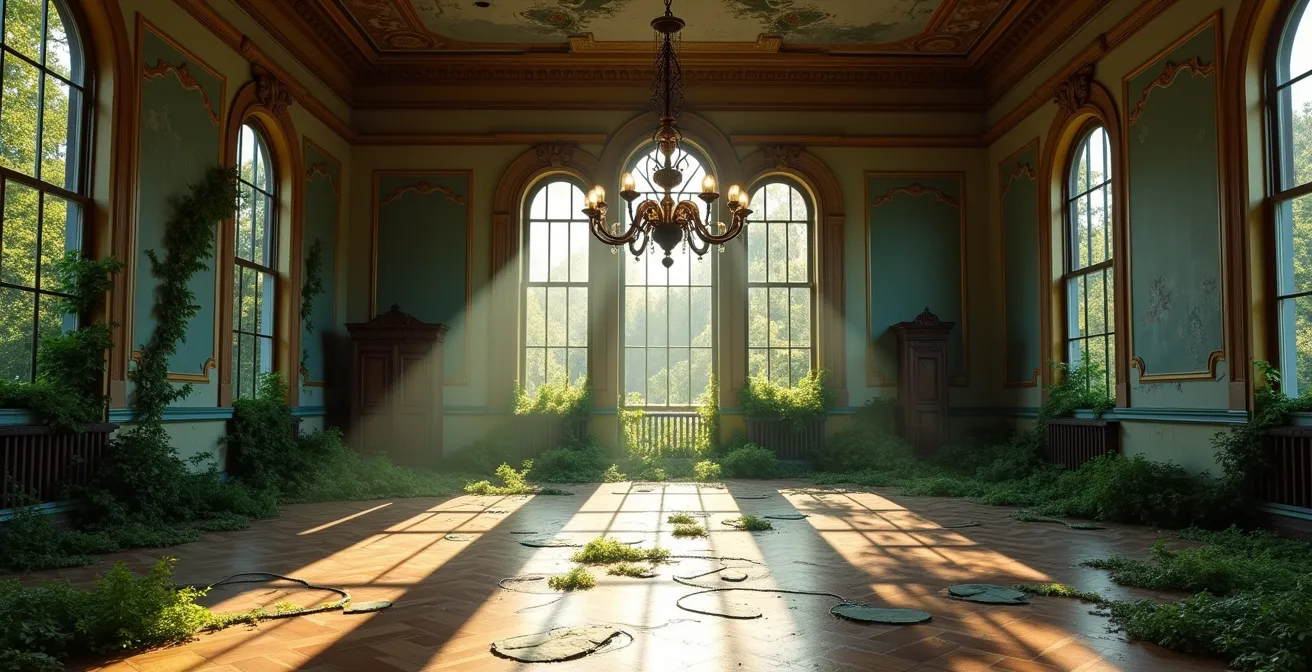
As the visual above illustrates, the sight of nature reclaiming man-made structures—vines scaling walls, trees growing through floors—creates a powerful visual metaphor. It speaks to the cycle of creation and decay, reminding us of our own place within that cycle. For many explorers, this is more than a hobby; it’s a form of meditation. As one anonymous explorer noted in the SHELLZINE Urbex Guide, this feeling is unique:
The sense of adventure inherent in endeavors like these is unparalleled; I cannot compare it to anything else.
– Anonymous Urban Explorer, SHELLZINE Urbex Guide
This quest for unparalleled adventure and quiet contemplation is the true engine of urbex. It is this appreciation for history and atmosphere that separates an explorer from a mere vandal and forms the ethical foundation of the entire practice.
How To Spot A Rotting Floorboard Before You Step On It
The romantic beauty of decay masks a very real and present danger: structural instability. An explorer’s most critical skill is not courage, but a highly developed sense of observation. Before you even think about your camera, you must become an expert in reading the language of decay. Floors, ceilings, and walls are constantly communicating their weaknesses; you just need to know the signs. The consequences of misreading them can be catastrophic, a fact tragically highlighted by experienced explorers.
In 2017, Eric Janssen, a seasoned urban explorer, fell to his death while photographing from a Chicago hotel rooftop. This incident, reported by the Chicago Tribune, underscores a stark reality: experience is not immunity. The only thing that protects you is a rigorous and repeatable risk assessment process. This is the core of the risk mitigation framework: treat every surface as hostile until proven otherwise.
A rotting floorboard rarely fails without warning. Water damage, the primary culprit, leaves a trail of evidence. Your first priority upon entering any new room is to perform a systematic visual sweep, looking for discoloration, sagging, or other indicators of compromise before you place your full weight anywhere.
Your Structural Hazard Checklist: A 5-Point Inspection
- Scan for Discoloration: Look for dark, map-like stains on floors, ceilings, and walls. These are the primary indicators of water damage, which leads to wood rot and compromised plaster.
- Identify Sagging or Bowing: Stand back and look at the floor and ceiling from a low angle. Any visible dip, bow, or unevenness suggests the structural supports are failing. Never walk on a sagging floor.
- Spot Hazardous Materials: Be wary of 9×9 inch floor tiles, as they often contain asbestos. Their presence requires you to move slowly to avoid disturbing fibers and to wear appropriate respiratory protection.
- Read the Cracks: Look for diagonal “step cracks” in brick or plaster walls. These cracks often indicate that the foundation has shifted, putting immense stress on the floors connected to that wall.
- Probe Before You Proceed: Never trust a surface with your full weight immediately. Use a sturdy stick or a trekking pole to tap and probe the floor ahead of you. Listen for hollow sounds and feel for soft, spongy spots.
Chernobyl Tour Vs Local Factory: Which Offers A More Authentic History Lesson?
As urban exploration grows in popularity, a fascinating debate has emerged around authenticity. On one hand, you have commercially organized tours to infamous sites like Chernobyl. They are legal, relatively safe, and provide a wealth of historical context. On the other, you have the personal discovery of a local, abandoned factory—an experience that is raw, unpredictable, and legally gray. This raises a central question for every explorer: what constitutes a more “authentic” connection to the past?
The curated experience of a Chernobyl tour offers a pre-packaged narrative. Guides lead you along safe paths, monitor radiation, and explain the history of the disaster. While undeniably powerful, the experience is controlled. You are a visitor in a museum, albeit a very large and dangerous one. The history is presented to you. In contrast, exploring a local abandoned site is an act of discovery. The narrative is not given; it must be pieced together from the objects and decay left behind. You find the story yourself.
This practice of exploring ruins, known as haikyo (廃墟) in Japan, is defined by this personal discovery. According to Wikipedia’s entry on the topic, the term itself is synonymous with the act of urban exploration, emphasizing the unmediated encounter with the site. The choice between these two approaches depends entirely on what the explorer seeks, as each offers a distinct set of trade-offs.
The following table breaks down the fundamental differences between a guided, curated exploration and a self-directed, personal one. Understanding these distinctions is key to defining your own goals as an explorer.
| Aspect | Chernobyl Tours | Local Factory Exploration |
|---|---|---|
| Legal Status | Fully legal with permits | Often requires permission or risks trespassing |
| Safety | Professional guides, radiation monitoring | Self-assessed risks, personal responsibility |
| Narrative | Pre-packaged historical context | Self-discovered through artifacts |
| Authenticity | Preserved but curated experience | Raw, unfiltered decay |
| Cost | $100-500 per tour | Free but potential legal costs |
| Documentation | Allowed with restrictions | Full creative freedom |
Ultimately, there is no “correct” answer. Some explorers may start with curated tours to build confidence before moving on to personal explorations. Others may find the raw, unfiltered danger of a local site to be the only true form of connection. The important thing is to understand the authenticity paradox and choose the path that aligns with your personal ethics and goals.
The Geotagging Error: Why Sharing Locations Destroys Abandoned Sites
There is one cardinal rule in the urbex community that transcends all others: you do not share locations. This isn’t about elitism or gatekeeping; it’s a desperate measure of preservation. An abandoned site is a fragile ecosystem. Once its location becomes public knowledge, it is almost inevitably vandalized, looted, or destroyed. The very act of sharing, intended to celebrate a place’s beauty, becomes the catalyst for its ruin. This is the great ethical paradox of modern urban exploration.
The problem has been massively amplified by social media. As social media platforms have transformed urbex visibility, what was once a niche hobby has exploded into a mainstream trend. Popular YouTube channels now boast millions of subscribers, and Instagram hashtags are filled with stunning images of decay. While this has brought appreciation to the art form, it has also put thousands of fragile locations on a countdown to destruction as newcomers, unaware of the ethics, hunt for coordinates.
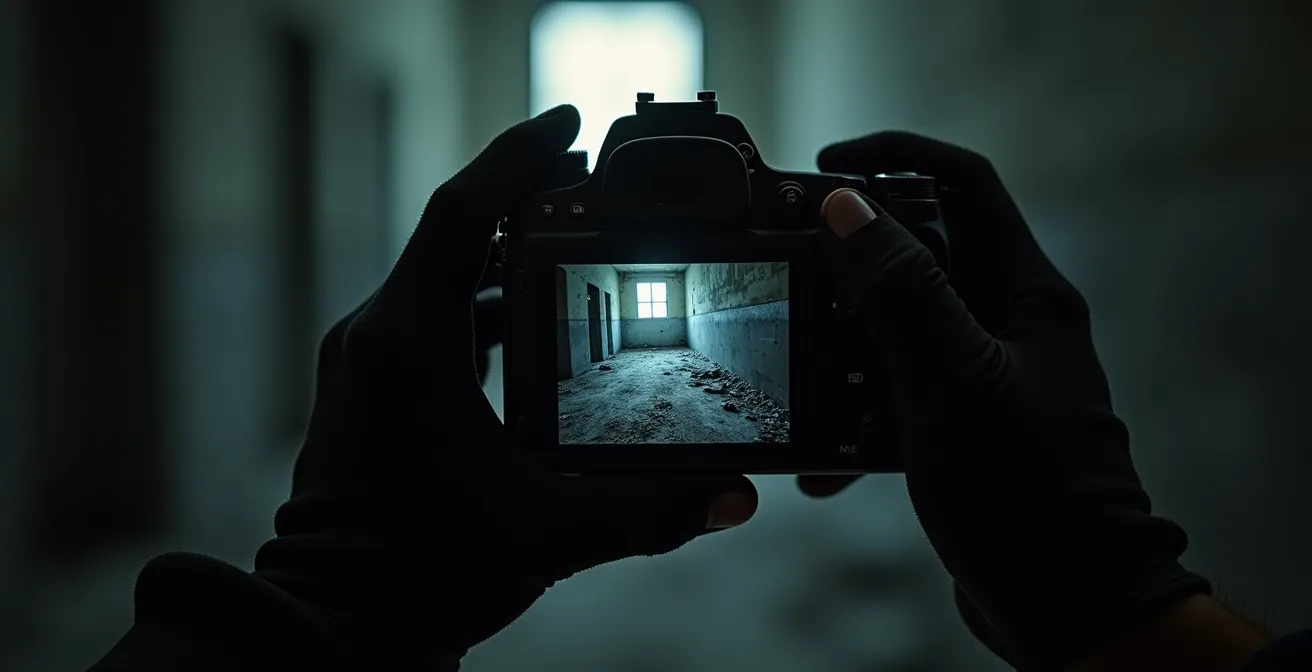
Protecting a location requires more than just not posting the address. It requires a meticulous process of scrubbing your digital footprint. Your camera, phone, and social media posts can all betray a location’s whereabouts through hidden data and visual clues. Ethical documentation means being as careful with your data as you are with your footsteps. This involves removing EXIF data from photos, which can contain GPS coordinates, and carefully examining your images for any identifying features.
To practice responsible sharing, you must treat your photos like a crime scene investigator, looking for any clue that could lead others to the site. Here are the key steps to follow:
- Remove all EXIF data from photos before uploading them online. Tools are available for this on both desktop and mobile.
- Blur or crop out any unique architectural features, murals, or graffiti tags that could be used to identify the building.
- Avoid photographing street signs, house numbers, or any distinctive landmarks visible from the property.
- Check for reflections in windows, mirrors, or puddles that might reveal identifying information about you or the surroundings.
- Never mention the name of the city, nearby businesses, or street names in your photo descriptions or comments. Use vague tags like “An abandoned hospital somewhere in the north.”
- Consider waiting months or even years before posting photos from a particularly sensitive or well-preserved location.
What To Say: Handling Security Guards And Police If You Get Caught
No matter how careful you are, the day may come when you are confronted by a security guard, property owner, or police officer. This is the moment where your entire exploration hinges on your ability to remain calm and communicate effectively. Panic, arguing, or running are the worst possible reactions. Your goal is not to win a legal debate but to de-escalate the situation and leave peacefully. The legal risks are very real; an article from Map-Urbex highlights that in France, penalties for trespassing can include up to a year in prison and fines reaching €15,000.
The key to de-escalation is to instantly reframe your identity. You are not a criminal, a vandal, or a thrill-seeker. This crucial piece of advice from the experts at Abandoned Explorers sets the correct tone:
You are a photographer, a researcher, a historian or a journalist. Don’t call yourself an urban explorer.
– Abandoned Explorers, How to URBEX Guide
The term “urban explorer” can sound reckless or antagonistic to someone unfamiliar with the subculture. “Photographer” or “historian,” however, sounds harmless and even respectable. Your camera is your greatest asset in this situation—it’s visible proof of your stated intent. The moment you are approached, your posture should be non-threatening, your hands visible, and your voice calm and respectful.
Follow this communication framework to maximize your chances of a peaceful resolution:
- Stay Calm and Polite: Do not make any sudden movements. Keep your hands where they can be seen. Speak in a calm, even tone.
- Acknowledge Immediately: The first words out of your mouth should be an acknowledgment that you understand you are in the wrong. “You’re right, I apologize, I understand I shouldn’t be here.” This immediately removes any sense of confrontation.
- State Your Identity and Intent: Clearly and concisely state, “I’m a photographer documenting the architecture of old buildings. I’m fascinated by the history.” Show them your camera.
- Offer to Leave Immediately: Make it clear you are not there to cause trouble. “I’ll pack up my gear and leave right away.”
- Never Argue: Do not try to argue about the law, property lines, or whether a door was “really” locked. You will not win. Your goal is to leave, not to be right.
- Comply Peacefully: If they ask for your ID, it is generally best to comply. Arguing this point will only escalate the situation.
- Be Respectful on Your Way Out: As you leave, thank them for their understanding. A little respect can go a long way in ensuring they don’t pursue charges.
How To Curate A Photo Series That Tells A Complete Story
Ethical documentation is not just about taking pictures; it’s about telling the story of a place. A single, beautiful shot of a decaying hall is powerful, but a curated series of photos can transport a viewer into the space and allow them to experience it with you. This is the art of narrative curation. Instead of a random collection of images, you should think like a film director, planning your shots to create a complete story with a beginning, middle, and end.
A successful photo series guides the viewer’s eye and emotions. It starts by establishing the scene, then draws the viewer in closer to discover the intimate details that reveal the human history of the location, builds to a visual climax, and finally offers a moment of reflection. Each shot has a specific purpose within this narrative structure. A wide-angle lens can capture the grand scale of a space, while a macro lens can reveal the poignant story told by a single forgotten object.
Thinking in terms of a story not only improves your photography but also deepens your exploration. It forces you to look at a location more intentionally, seeking out the elements that build the narrative. The following framework, adapted from principles of narrative photography, provides a structure for building a compelling urbex photo story.
This table outlines a five-shot structure that can form the narrative backbone of any exploration. As demonstrated in this guide to narrative photography, a deliberate approach transforms simple documentation into powerful storytelling.
| Shot Type | Purpose | Technical Approach |
|---|---|---|
| Establishing Shot | Context and scale | Wide angle (24-35mm), f/8-11 for depth |
| Character Details | Human story through objects | Macro lens (100mm), shallow DOF |
| Atmosphere Shots | Mood and feeling | Slow shutter for light trails, dust capture |
| The Climax | Most striking space | Dramatic angle, golden hour light |
| Resolution | Looking out/reflection | Frame within frame, symbolic exit |
By planning your shots around a narrative arc, you elevate your work from simple snapshots to a curated photo essay. Your images become a respectful tribute to the location’s history, preserving its story long after the physical structure has turned to dust.
Why A Satellite Communicator Is Non-Negotiable For Solo Treks?
The first rule of urbex is to never go alone. However, some explorers, for various reasons, choose to undertake solo missions. If you ever find yourself in this high-stakes situation, your risk mitigation framework must become exponentially more robust. When you are alone, there is no one to help if you fall, get trapped, or are injured. In these scenarios, where cell service is almost always non-existent, a satellite communicator becomes an indispensable lifeline.
It is not an exaggeration to say this device can be the difference between life and death. The hazards in abandoned places are unpredictable and can incapacitate you in an instant. Explorer Mike Kinsch, describing his exploration of the abandoned Edgewater Medical Center in a report by the Chicago Tribune, noted the air was thick with two decades of decay and that discarded prescription drugs littered the floors. Imagine having a severe allergic reaction or injury in an environment like that with no way to call for help.
A satellite communicator (like a Garmin inReach or a ZOLEO) works where your phone does not. It allows you to send and receive text messages, track your location, and, most importantly, trigger an SOS signal that alerts emergency services to your exact GPS coordinates. For a solo explorer, this is not a luxury; it’s as essential as a good pair of boots. It is the ultimate backstop in your safety plan.
Relying on telling a friend where you’re going is a passive safety measure. It only helps if you don’t return on time. A satellite communicator is an active safety tool that allows you to request help the moment you need it. The cost of the device and subscription is insignificant when weighed against the potential cost of being trapped and injured with no way to contact the outside world. If you choose to explore alone, you are accepting 100% of the risk; a satellite communicator is the one tool that allows you to offload a small but critical portion of that risk.
Key Takeaways
- Safety Is an Active Skill: Your survival depends on a rigorous risk mitigation framework, not luck. Actively read and test your environment before you trust it.
- Ethics Are Preservation: The cardinal rule is to protect locations. Never share coordinates and scrub all identifying data from your photos before posting.
- Your Camera Is Your Alibi: In any confrontation, you are a photographer or historian, not a trespasser. Your camera proves your intent is documentation, not destruction.
Mindful Photography: How To See The World Differently Through A Lens?
Beyond documentation and storytelling, the camera in urban exploration can serve a deeper purpose: it can be a tool for mindfulness. The act of mindful photography is about slowing down and seeing the world with intense, focused attention. In the quiet, forgotten corners of an abandoned building, this practice can transform a simple exploration into a profound meditative experience. It’s about seeing beyond the obvious decay and discovering the abstract art hidden within it.
This means shifting your focus from the grand “establishing shots” to the minute details. Instead of just photographing a room, you photograph the way light falls across a peeling wall, the intricate fractal patterns of rust on a metal beam, or the gradient of colors in layers of old paint. You’re no longer just documenting a place; you are capturing the texture of time itself. This requires you to engage with the environment on a micro level, noticing details that most people would walk right past.

To cultivate this way of seeing, it can be helpful to impose creative constraints. Using a single prime lens (like a 35mm or 50mm) forces you to physically move through the space to frame your shot, connecting you more intimately with your surroundings. Relying only on natural light maintains the authentic atmosphere and challenges you to work with shadows and contrast. The following techniques can help you practice mindful photography:
- Embrace a single prime lens to force a more physical and deliberate exploration of the space.
- Use long exposures on a tripod to capture the subtle movement of dust particles in a sunbeam, revealing the “breath” of the building.
- Focus intensely on textures and patterns: the gradient in a patch of rust, the geometry of peeling paint, the organic lines of encroaching nature.
- Shoot only with natural light to preserve the authentic mood and challenge your skills in low-light composition.
- Visit during the “golden hour” (early morning or late afternoon) to take advantage of long, dramatic shadows that reveal texture.
- Frame your shots as abstract art, focusing on color, shape, and line rather than the literal identity of the object.
Your journey into the past begins not with a crowbar, but with a camera and a conscience. It’s a discipline that demands respect, intelligence, and a deep appreciation for the stories that linger in the silence. Start exploring the world’s hidden histories the right way, armed with this framework of safety and ethical documentation.