
Contrary to the belief that video games detract from reading, they actually function as a parallel literary system, training core comprehension skills through active participation.
- Complex narrative games require advanced cognitive skills like inference, narrative analysis, and empathetic projection.
- Active problem-solving in games fosters greater cognitive engagement and metacognition than passive screen time like watching TV.
Recommendation: Focus on story-rich, choice-driven games to leverage them as powerful tools for literary and emotional development.
For many parents and educators, the term “screen time” conjures images of passive consumption and wasted hours. The notion that video games, particularly sprawling role-playing games (RPGs), could rival a bookshelf in educational value is often met with deep skepticism. The common advice revolves around limiting game time, promoting traditional reading, and viewing gaming as a leisure activity at best, a cognitive detriment at worst. We’re told to focus on flashcards and phonics, not fantasy worlds and boss fights.
But this perspective overlooks a fundamental shift in how narratives are being consumed and processed. It fails to recognize the complex cognitive demands that modern video games place on a player. While it’s true that not all games are created equal, a significant genre operates on principles remarkably similar to those of classic literature. These interactive experiences are not merely distracting from reading; they are teaching the very skills required to be a better reader.
What if the true key to fostering literary skills in the 21st century isn’t about fighting a war *against* video games, but about understanding them as a **parallel literary system**? This article reframes the debate, moving beyond the simplistic “good vs. bad” dichotomy. We will explore the research-backed mechanisms through which narrative games build essential competencies like spatial reasoning, empathy, and critical analysis. This is not an argument to replace books, but to recognize that the skills of a good reader are now being forged in the crucible of interactive, digital worlds.
This guide will dissect the cognitive benefits of gaming, compare its impact to traditional media, and provide practical advice for selecting games that enrich rather than detract. We will also address the valid concerns, from addictive mechanics to physical health, offering a balanced and evidence-based view for skeptical parents and educators.
Summary: Video Games As Literature: How Playing RPGs Enhances Reading Comprehension?
- Why Does Playing ‘Zelda’ Improve Spatial Reasoning Skills?
- How To Choose Narrative Games That Teach Empathy To Teenagers
- Gaming Vs TV: Which Screen Time Is Better For A Child’s Brain?
- The Loot Box Danger: How To Spot Gambling Mechanics In Kids’ Games
- How To Sit While Gaming To Prevent Carpal Tunnel And Back Pain
- How To Gamify A Museum Tour To Keep Teenagers Off Their Phones?
- The Brain Training Fallacy: Why Apps Won’t Raise Your IQ
- Beyond the Screen: How the Gaming Ecosystem Cultivates Real-World Reading
Why Does Playing ‘Zelda’ Improve Spatial Reasoning Skills?
The sprawling world of Hyrule in ‘The Legend of Zelda’ is more than just a digital playground; it’s a complex spatial puzzle. To succeed, players must build a mental map of a vast, three-dimensional world, remembering landmarks, navigating intricate dungeons, and understanding how different areas connect. This process is a rigorous workout for spatial reasoning skills—the ability to think about and manipulate objects in 3D space. This is not a trivial skill; it’s foundational to fields like engineering, architecture, and surgery, and it also plays a surprising role in reading comprehension.
When we read a novel, we are similarly constructing a “world” in our minds. We track characters’ movements, visualize the layout of a castle, or understand the geography of a fictional kingdom. The ability to navigate the 3D environments of a game like ‘Zelda’ directly builds the cognitive muscles needed for this kind of textual world-building. Research has shown that playing video games is a literate practice that enhances learning through complex navigation and problem-solving. It’s a form of **active comprehension** where understanding the space is essential to progressing the narrative.
Furthermore, the benefits extend beyond just spatial skills. Action games, which demand constant attention and rapid decision-making, have been shown to have a powerful effect on cognitive functions crucial for reading. A study in *Nature Human Behaviour* demonstrated that children who played action games showed significant improvements in attention control and reading accuracy, with these benefits persisting even six months after the training ended. By forcing the brain to process a high volume of visual and spatial information quickly, these games fine-tune the attentional networks that are also essential for decoding text and maintaining focus while reading a dense page.
How To Choose Narrative Games That Teach Empathy To Teenagers
While action games build foundational cognitive skills, story-rich narrative games offer something more profound: a training ground for empathy. Unlike a film or a book where one is a passive observer, games like ‘Life is Strange’ or ‘The Walking Dead’ place the player in the protagonist’s shoes, forcing them to make difficult moral choices and live with the consequences. This active participation creates a powerful mechanism for **empathetic projection**, where players must consider others’ perspectives to navigate complex social and ethical dilemmas. This is a core objective of literature, achieved here through interaction.
As Paul Darvasi, an English and media studies teacher, notes, this connection is not superficial. He explains how interactive narratives can be analyzed using the same literary lens as traditional texts:
Story-rich games like ‘Gone Home’ and ‘What Remains of Edith Finch’ can be analyzed for many of the same narrative characteristics found in traditional texts, such as setting, plot, character development, mood and tone.
– Paul Darvasi, English and media studies teacher, Toronto
Choosing the right game is crucial. The key is to look for titles that prioritize story, character, and choice over pure mechanics. Games with silent protagonists, for example, often compel players to project their own emotions onto the character, intensifying the empathetic bond. Environmental storytelling—where the narrative is revealed through letters, journals, or the state of the world itself—encourages inference and close “reading” of the game’s environment, skills directly transferable to analyzing a dense novel.

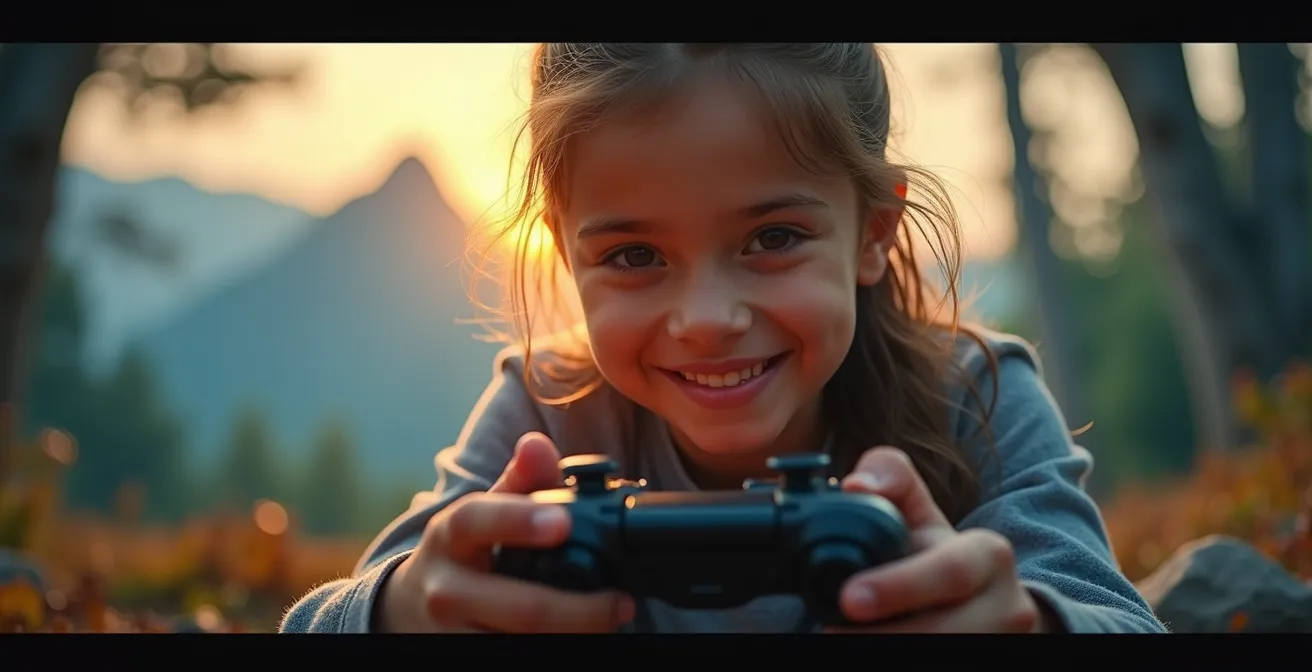
This image captures the essence of deep engagement with a narrative game. The player is not just reacting; they are contemplating, feeling, and experiencing the story’s emotional weight. To help parents and educators identify these valuable experiences, here is a practical guide for selecting games that foster empathy.
Action Plan: Choosing Games That Cultivate Empathy
- Seek Moral Complexity: Look for story-rich games with moral choices like ‘Life is Strange’ that force players to grapple with the consequences of their actions.
- Favor Player Projection: Choose games with silent protagonists (e.g., ‘Undertale’) that compel players to project their own emotions and motivations onto the character.
- Value Environmental Storytelling: Prioritize games that tell stories through optional side-quests, letters, and journals which depict everyday struggles and build a richer world.
- Identify Textual Elements: Select narrative games that deliberately include embedded documents, such as letters or diaries, to bridge the gap between gameplay and traditional reading.
- Ensure Meaningful Agency: Ensure the game allows players to make meaningful choices that genuinely affect the story’s outcomes, making their decisions feel impactful.
Gaming Vs TV: Which Screen Time Is Better For A Child’s Brain?
Not all screen time is created equal. A common mistake is to lump active video gaming and passive television watching into the same category. The fundamental difference lies in cognitive engagement. Watching television, even a high-quality drama, is primarily an act of **passive consumption**. The narrative unfolds without any input from the viewer. Video gaming, by contrast, is an act of **active problem-solving**. To advance, a player must constantly think, strategize, make decisions, and interact with the game’s systems. This distinction has profound implications for brain development.
One of the most significant benefits of gaming is the development of metacognition, or “thinking about thinking.” Games often have mandatory pauses—in loading screens, inventory management, or skill-tree allocation—where players must reflect on their strategy, assess their failures, and plan their next move. This cycle of action, failure, reflection, and adaptation is a powerful learning loop that is largely absent from passive media. It’s a key reason why, in a fourth-grade study, 75 percent of students chose narrative-based digital games as their favorite read-aloud format; they feel a sense of agency and involvement.
Even the act of reading itself is more integrated into gaming. In many RPGs, reading quest logs, character dialogues, and in-game lore is not optional—it’s essential for success. This contrasts sharply with television, where reading is limited to optional subtitles. The following table breaks down the cognitive impact of these two popular forms of screen time.
| Aspect | Video Gaming | Television Watching |
|---|---|---|
| Cognitive Engagement | Active problem-solving, higher cognitive load | Passive consumption, narrative transportation |
| Metacognition Development | Mandatory pauses for strategic thinking | Continuous flow, less reflection time |
| Social Skills | Active communication in collaborative games | Passive shared experience in co-viewing |
| Reading Practice | Required for gameplay, quest understanding | Optional (subtitles), not essential |
| Decision Making | Constant choices affecting outcomes | No viewer agency in narrative |
The Loot Box Danger: How To Spot Gambling Mechanics In Kids’ Games
While advocating for the benefits of gaming, it is irresponsible to ignore its darker side. To build trust with a skeptical audience, one must acknowledge and address the valid concerns about predatory monetization schemes. The most prominent of these is the **loot box**, a digital container that players can purchase for a chance to receive randomized in-game items. These mechanics are often designed with the same psychological hooks used in gambling, creating a significant risk for children.
These systems exploit cognitive biases to encourage repeat spending. “Near-miss” animations that show you *almost* getting a rare item, flashy sounds and visuals during the “unboxing,” and limited-time offers that create a false sense of urgency are all hallmarks of behavioral manipulation. For a child’s developing brain, which has a less developed prefrontal cortex for impulse control, these mechanics can be particularly insidious and lead to addictive patterns. Acknowledging this danger is the first step in responsible digital parenting. It also highlights the importance of choosing games based on their narrative quality rather than their monetization model. Interestingly, even with these risks, games remain a powerful entry point to stories. In fact, National Literacy Trust research reveals that 73% of young people who don’t enjoy reading said playing games helps them feel more part of a story than a book.
Empowering parents to identify these predatory systems is crucial. Instead of a blanket ban on gaming, a more effective approach is to teach media literacy. Here are the key warning signs that a game may contain gambling-like mechanics:
- Randomized Rewards for Pay: The core of the problem. If a game asks for real or virtual currency in exchange for an item of unknown value, it’s a loot box.
- “Near-Miss” Psychology: Watch for animations that suggest you were very close to winning a rare prize, designed to make you want to try “just one more time.”
- Sensory Overload: Flashing lights, triumphant sounds, and celebratory visuals during box openings mimic the sensory experience of a slot machine.
- Artificial Urgency: Limited-time offers and “daily deals” on loot boxes create a fear of missing out (FOMO) that pressures players to buy now.
- Obscured Currency: Games often use multiple, complex virtual currencies (gems, coins, crystals) to intentionally obscure how much real money is being spent.
- Addictive Language: Monitor if your child starts talking about needing “just one more box” or expressing frustration at their “bad luck,” as this is language associated with gambling.
How To Sit While Gaming To Prevent Carpal Tunnel And Back Pain
Beyond the cognitive and ethical considerations of gaming, there are practical, physical concerns that every parent rightfully worries about. The stereotypical image of a gamer hunched over a screen for hours is not without merit, and poor posture can lead to chronic issues like **carpal tunnel syndrome, back pain, and neck strain**. Addressing these ergonomic concerns is a tangible way to ensure gaming remains a healthy and sustainable hobby.
The key is to move from static, unhealthy postures to a dynamic and supported setup. The concept of an “ergonomic triangle”—the spatial relationship between your eyes, hands, and seat—is central. The monitor should be at arm’s length, with the top of the screen at or just below eye level to prevent neck strain. Wrists should remain in a neutral position, not bent up or down, whether using a controller or a keyboard and mouse. This simple adjustment can drastically reduce the risk of repetitive strain injuries like carpal tunnel.

Furthermore, the idea of “dynamic sitting” is crucial. The body isn’t designed to stay in one position for long periods. Encouraging gamers to change positions every 20-30 minutes, and to take micro-breaks for stretching, is as important as the initial setup. A chair with good lumbar support, or even a simple cushion, can help maintain the natural curve of the spine and prevent lower back pain. Creating a healthy physical environment for gaming demonstrates a holistic approach that builds credibility with concerned parents.
Your Ergonomic Audit: Key Points for a Healthy Gaming Setup
- Monitor Positioning: Position the top of the monitor at or slightly below eye level and maintain an arm’s length distance from the screen.
- Wrist Neutrality: Ensure wrists are straight and not bent up, down, or to the side when using a keyboard, mouse, or controller.
- Lumbar Support: Use a chair with built-in lumbar support or add a small cushion to maintain the natural inward curve of your lower back.
- Dynamic Movement: Practice dynamic sitting by changing your position every 20-30 minutes and take micro-breaks every hour for targeted wrist and neck stretches.
- The 90-Degree Rule: Keep your elbows, hips, and knees at or near a 90-degree angle, with your feet flat on the floor or on a footrest.
How To Gamify A Museum Tour To Keep Teenagers Off Their Phones?
The principles that make video games so engaging—quests, rewards, discovery, and narrative progression—are not confined to a digital screen. This concept, known as **gamification**, can be applied to real-world learning environments to transform passive experiences into active adventures. A museum tour, often a point of contention for teenagers, is a perfect candidate for this approach. Instead of fighting against their phones, we can leverage the “game-like” thinking they’ve developed to deepen their engagement with the exhibits.
The key is to reframe the tour as a quest. Instead of a linear path, provide a “quest log” with challenges: “Find the artifact that tells a story of betrayal,” “Photograph three symbols of power from different cultures,” or “Uncover the name of the artist who was a rival to…” This transforms teenagers from passive observers into active detectives. They are no longer just looking; they are searching, interpreting, and making connections. As noted by Karen Schrier, a leading expert in the field:
Games support literacy skills in part because they enable students to play and learn in authentic worlds they care about, where they need to read to be able to solve missions or interpret clues.
– Karen Schrier, Associate Professor and Director of Games, Marist College
This same principle applies in a museum. The “clues” are the information plaques, the “missions” are the challenges, and the “world” is the curated collection. The successful implementation of ‘Sydney’s World’, a narrative RPG used in a classroom setting, showed that this methodology can significantly improve reading fluency and comprehension. The game’s **narrative scaffolding**—its system of quests and interactive storytelling—provided a structure for learning that felt authentic and motivating to students. A gamified museum tour simply applies this proven pedagogical strategy to a physical space, using the teenager’s phone not as a distraction, but as the tool for their quest.
The Brain Training Fallacy: Why Apps Won’t Raise Your IQ
In the quest for cognitive enhancement, a market has emerged for “brain training” apps that promise to boost IQ, memory, and focus through simple, repetitive mini-games. For parents eager to ensure screen time is “productive,” these apps can seem like a perfect solution. However, the scientific consensus is clear: the benefits of these apps rarely transfer beyond the specific task being practiced. Getting good at a memory game makes you good at that memory game, not necessarily better at remembering your grocery list. This is the **brain training fallacy**.
True cognitive growth comes from tackling complex, multi-faceted problems, not from isolated drills. This is where complex video games, especially RPGs, show their true value. A game like ‘Chrono Trigger’ or ‘Baldur’s Gate 3’ is not a single puzzle but an integrated system of challenges. It requires players to manage inventory, analyze statistical systems, navigate social dialogues, read and interpret lore, and strategize in combat—often all at once. This experience enhances **critical thinking and cognitive engagement** in a way that no simple app can. It’s the difference between practicing scales and composing a symphony.
The evidence supporting complex games over simple apps is compelling. While “brain training” shows limited real-world transfer, research on action games demonstrates far-reaching benefits. One landmark Italian-Swiss research published in Nature shows that children who played action games improved not only in attention and reading but also showed significant gains in their school grades for mathematics and their native language up to 18 months later. This long-term, cross-disciplinary improvement suggests that complex games don’t just teach isolated skills; they fundamentally enhance the brain’s executive functions and its capacity to learn.
Key takeaways
- Video games are not a monolith; their cognitive impact depends entirely on their design, with complex RPGs offering the most literary benefits.
- The active engagement required by gaming (problem-solving, decision-making) is cognitively superior to passive screen time like watching television.
- To be a credible advocate for gaming’s benefits, one must also acknowledge and mitigate its risks, such as predatory loot boxes and poor ergonomics.
Beyond the Screen: How the Gaming Ecosystem Cultivates Real-World Reading
Perhaps the most powerful and overlooked argument for video games as a literary tool is that the engagement doesn’t stop when the screen turns off. Complex games create an entire ecosystem of literacy around them. When a player gets stuck on a difficult puzzle, wants to optimize their character build, or wishes to understand the deep lore of the game world, where do they turn? They turn to text. They read wikis, forums, strategy guides, and character backstories. They write their own theories and engage in detailed, text-based debates with other players.
This is not trivial reading. It is highly motivated, self-directed research. The player is not reading because a teacher assigned it; they are reading because they have a genuine, pressing need to know. This intrinsic motivation is the holy grail of education. Astonishingly, research has found that the average tenth-grade student spends over an hour every day happily reading *about* video games. For many young people, particularly those who may be reluctant readers in a traditional academic context, the gaming ecosystem is their primary arena for developing advanced literacy skills.
This reframes the entire debate. The fear that video games are pulling children away from reading is based on a false premise. For millions, video games are the very thing that is *leading* them to read, write, and think critically about complex texts. They are learning to synthesize information from multiple sources, evaluate the credibility of arguments in a forum, and articulate their own ideas in writing. These are the skills of a 21st-century literate citizen, cultivated not in spite of their hobby, but because of it. The game is the gateway to a universe of text.
Start evaluating games not just as entertainment, but as complex literary systems to unlock your child’s full potential. By choosing the right experiences and engaging with the surrounding ecosystem, you can transform a hobby into a powerful engine for intellectual and emotional growth.