
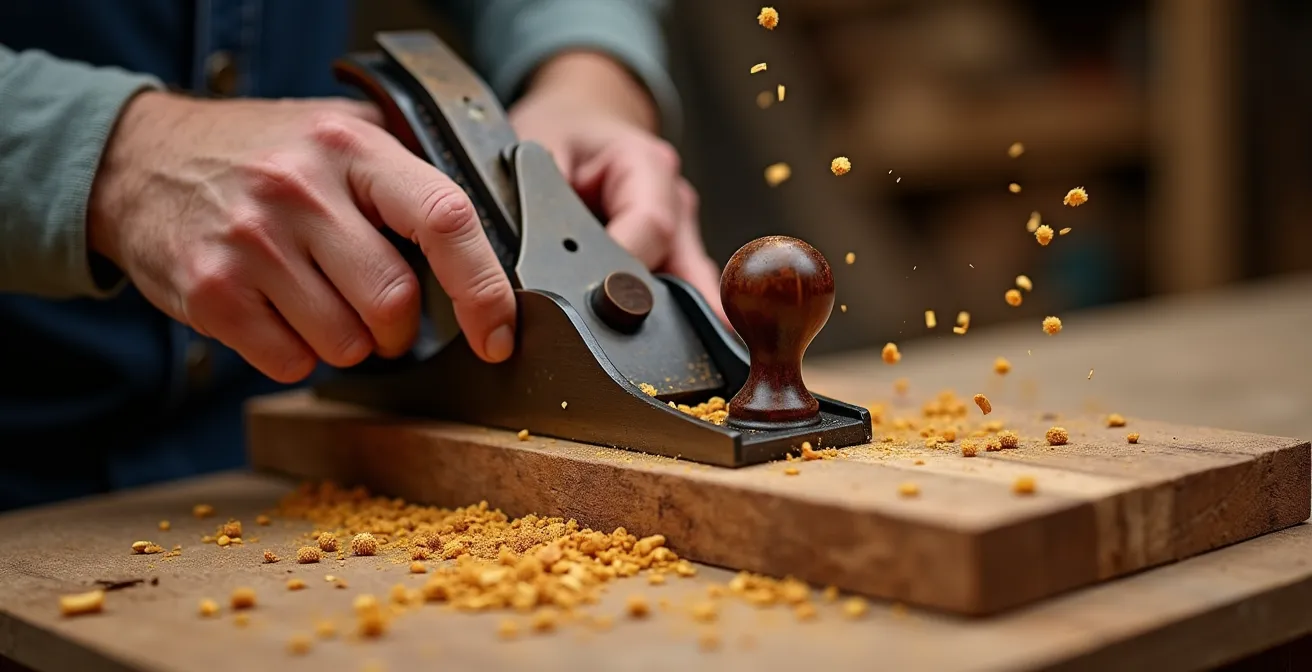
Contrary to the belief that more rest is the cure for burnout, the most effective antidote is not passive vacationing but the deep engagement of a ‘serious’ hobby.
- Passive consumption, like watching TV, often fails to disengage the brain’s anxiety-prone “Default Mode Network,” leaving you restless.
- Tactile, skill-based hobbies actively force the brain into a restorative “flow state,” recalibrating neural pathways for deeper focus and resilience.
Recommendation: Stop searching for a passive escape and start building an active practice. This ‘unproductive’ time will become the most strategic investment in your professional performance.
For the driven workaholic, the cycle is painfully familiar. You grind until exhaustion, book a vacation as a prescribed cure, and return feeling just as depleted, if not more anxious about the work that piled up. The promise of “disconnecting” on a beach often fails because the mind, trained for constant problem-solving, doesn’t have an off-switch. It continues to ruminate, plan, and worry, even thousands of miles away from the office. This leads to a profound sense of guilt: guilt for not working, and guilt that the expensive, time-consuming “rest” isn’t even working.
The conventional wisdom to “find a hobby” often feels just as hollow. It’s perceived as frivolous, a waste of precious time that could be spent getting ahead. We are told to find a work-life balance, but for a mind that equates activity with value, inactivity feels like a failure. This creates a paradox where the very solutions meant to heal burnout—vacations and leisure—become new sources of stress.
But what if this entire framework is flawed? What if the true antidote to burnout isn’t passive rest, but a specific kind of active, structured engagement? This article argues that a “serious hobby”—a skill-based, tactile pursuit—is not an escape from productivity but a direct method for enhancing it. We will explore the neurological mechanics that explain why activities like woodworking or pottery quiet the mind more effectively than passive entertainment, and how to embrace this practice without it becoming another stressful job. This isn’t about finding more time to relax; it’s about strategically using that time to recalibrate the very cognitive tools you rely on every day.
To understand how to implement this counter-intuitive strategy, this article breaks down the core principles, from the science of mental quiet to the practical steps for protecting your newfound practice. Explore the sections below to build your defense against burnout.
Summary: Why a Serious Hobby Is Your Ultimate Professional Tool
- Why Does Building Furniture Quiet The Mind More Than Watching Netflix?
- How To Progress In A Hobby Without Turning It Into A Second Job
- Scrolling Vs Hiking: Which Activity Actually Recharges Your Dopamine?
- The Side Hustle Trap: Why Selling Your Art Can Kill Your Joy
- How To Block Out 3 Hours A Week For Golf Without Upsetting Your Spouse
- Why Does Working With Clay Quiet The Default Mode Network Of The Brain?
- Dancing Vs Sudoku: Which Activity Is Superior For Preventing Dementia?
- Pottery Vs Coding: Why Tactile Hobbies Are Essential For Tech Workers?
Why Does Building Furniture Quiet The Mind More Than Watching Netflix?
The feeling of restlessness after a night of binge-watching a series is a common experience. You’ve been “relaxing” for hours, yet your mind feels scattered, not restored. This happens because passive consumption, like watching Netflix, doesn’t fully disengage the brain’s Default Mode Network (DMN). The DMN is the “idle” brain, responsible for self-referential thought, rumination about the past, and anxiety about the future—the very thought patterns that fuel a workaholic’s stress. Watching a show provides just enough stimulus to be distracting, but not enough engagement to truly silence the internal chatter.
In contrast, a tactile and complex activity like building furniture demands your full cognitive presence. You can’t be worrying about a deadline while measuring a cut to the millimeter or feeling the grain of a piece of wood. This intense focus on a single, tangible task forces the brain into a “flow state.” It’s a form of productive stillness where the DMN goes quiet because other neural circuits—those responsible for motor control, spatial reasoning, and sensory feedback—are fully activated. This isn’t just a distraction; it’s a complete neurological recalibration.
Case Study: A Professional’s Use of Woodworking for Mindfulness
An insightful professional on LinkedIn detailed how the practice of woodworking serves as a powerful tool for mental training. The tactile engagement with the material—feeling knots, sensing grain patterns, and maintaining intense concentration during precision cuts—forces the brain into a state of flow. This state directly competes with and overrides abstract worry patterns. According to the case, this whole-brain activity strengthens the mind-muscle connection and, as a direct result, improves the ability to focus on single tasks for extended periods, a skill that translates directly back to professional work.
The result is a mind that is not just rested, but actively retrained for focus. This is why such hobbies are so effective at improving professional output. In fact, research consistently shows a direct link between this type of engagement and work performance, with a 2024 study finding that 60% of respondents agree that stress-relieving hobbies improve their productivity and confidence at work. The quiet mind you gain from a workshop session is a direct asset in the boardroom.
This image of a calm, organized workshop perfectly captures the essence of “productive stillness.” It’s not an empty space of idleness, but a structured environment for deep, restorative focus, where the chaos of the outside world gives way to the clarity of a single, meaningful task.
How To Progress In A Hobby Without Turning It Into A Second Job
For a workaholic, the most dangerous moment in adopting a hobby is the point of proficiency. The instinct to optimize, measure, and perform kicks in, threatening to transform a source of joy into another source of pressure. Suddenly, your weekend pottery class has KPIs, and your golf game is analyzed with the same ruthless efficiency as a quarterly report. This is the fast track to “hobby burnout,” and it negates the entire purpose of the activity. With an astonishing 82% of employees at risk of burnout in 2025, it is critical that our sanctuaries of rest do not become another battleground for achievement.
The key to avoiding this trap is to consciously shift the goal from outcome to process. The value of the hobby is not the perfect ceramic bowl or the sub-par golf score; it’s the 90 minutes of uninterrupted focus you experienced while creating it. Progress should be measured not in the quality of the final product, but in the quality of your mental engagement during the activity. Are you more present this week than last? Did you manage to go a full hour without thinking about work? That is the real metric of success.
Resisting the urge to professionalize your joy requires setting firm, deliberate boundaries. This means protecting the hobby from the very metrics that define your professional life. It’s about cultivating an activity where the only expectation is to be present. This is not laziness; it’s a strategic defense of your mental recovery space. By focusing on the intrinsic rewards of the process—the feel of the clay, the sound of the golf ball, the focus of the dance—you can continue to grow in your skill without falling into the trap of turning relaxation into another job.
Your Action Plan: Keeping Your Hobby a Sanctuary
- Set Clear Boundaries: Deliberately limit your hobby time. Designate specific, non-negotiable slots in your week and do not let it bleed into other areas of your life or become an obligation.
- Practice Mindful Engagement: When you are engaged in your hobby, focus entirely on the process. Pay attention to the sensory details—the texture, the sounds, the movements—rather than rushing toward a final product.
- Resist Perfectionism: Give yourself permission to be an amateur. The goal is not a flawless masterpiece but a restorative experience. Accept and even celebrate the imperfections as signs of a human process.
- Avoid Over-Scheduling: Do not pack your hobby time with rigid goals or deadlines. A hobby is an escape from the calendar, not another entry on it. Allow for spontaneity and freedom within your practice.
- Take Regular Breaks: If you feel fatigue or frustration, step away. Forcing yourself to continue when the joy is gone is a hallmark of work, not leisure. The enthusiasm must be protected.
Scrolling Vs Hiking: Which Activity Actually Recharges Your Dopamine?
Many of us turn to our phones for a “quick break,” assuming a few minutes of social media scrolling will help us relax. In reality, we often feel more drained and anxious afterward. This is because of the way these platforms manipulate our brain’s dopamine system. Dopamine is a neurotransmitter associated with motivation and reward, and social media apps are designed to provide a constant, unpredictable stream of small “hits”—a new like, a funny video, an interesting headline. This creates a “seeking loop” where the brain is constantly anticipating the next reward, but the rewards are too shallow and fleeting to provide genuine satisfaction.
This erratic cycle of micro-rewards and constant anticipation depletes our dopamine regulation. It’s like eating candy for energy; you get a quick spike followed by a crash, leaving you less motivated and focused than before. Your brain’s reward system becomes conditioned to expect novelty at a frantic pace, making it harder to engage in deep, sustained focus on meaningful tasks. Scrolling doesn’t recharge your mind; it exhausts its capacity for concentration.
In stark contrast, an activity like hiking recharges the dopamine system in a healthy, sustainable way. The reward is not delivered in unpredictable, bite-sized chunks. Instead, it is built through consistent effort toward a clear goal—reaching the summit, completing the trail. The physical exertion, the exposure to nature, and the sense of accomplishment all contribute to a much more profound and lasting release of dopamine and other positive neurochemicals like endorphins and serotonin. This type of reward is earned and integrated, not just passively consumed. It restores the brain’s baseline for what feels rewarding, recalibrating it away from the need for constant, shallow stimulation and toward the satisfaction of meaningful achievement.
The Side Hustle Trap: Why Selling Your Art Can Kill Your Joy
In a culture obsessed with optimization and productivity, the idea of turning a passion into a “side hustle” is incredibly seductive. You enjoy painting, people compliment your work, and the thought arises: “I could be making money from this.” While it seems like a win-win scenario, this transition from a hobby to a commercial enterprise is often the very thing that extinguishes the initial joy. It marks the shift from intrinsic to extrinsic motivation, and this change has profound psychological consequences.
Intrinsic motivation is the drive to do something because it is inherently satisfying. You paint because you love the process of mixing colors and creating an image. The reward is the activity itself. This is the source of the “flow state,” where you lose track of time in deep, effortless engagement. However, the moment you decide to sell your art, extrinsic motivators—money, customer approval, sales targets, deadlines—enter the picture. The focus subtly shifts from “Do I enjoy this?” to “Will someone buy this?”.
This introduces performance pressure and the fear of judgment. Suddenly, a blank canvas is no longer an opportunity for free expression but a risk of producing something unsellable. The restorative practice becomes a job, complete with its own set of stresses and obligations. You start catering to market trends instead of your own creative impulses. The very thing that served as an escape from the pressures of your primary career now mirrors them. This is the side hustle trap: in the pursuit of monetizing your joy, you can inadvertently strip it of its therapeutic power, leaving you with two jobs and no sanctuary.
How To Block Out 3 Hours A Week For Golf Without Upsetting Your Spouse
For a workaholic, one of the biggest hurdles to maintaining a serious hobby isn’t just personal guilt, but external expectations. Taking three hours for a round of golf or a long hike can feel like a selfish act, especially when partners, family, or social commitments also demand your time. The key to navigating this is not to frame the hobby as “leisure time” or a “break,” but to communicate its true function: essential cognitive maintenance.
When you present your hobby time to your spouse or family, avoid language that positions it as an optional indulgence. Instead of saying, “I need to relax,” try framing it with a more strategic, functional purpose. For example: “I need to block out this time on Saturday morning to fully reset my brain. When I do this, I’m a much more present and effective partner/parent for the rest of the weekend.” This reframes the activity from a personal escape to a shared investment in the well-being of the family unit. It’s not time taken *from* the family; it’s time invested *for* the family.
This requires a two-part strategy: scheduling and reciprocation. First, treat your hobby time with the same seriousness as a work meeting. Block it out in the shared calendar and make it a non-negotiable appointment. This signals its importance and removes the friction of last-minute negotiations. Second, be proactive in ensuring your partner also has protected time for their own restorative activities. This demonstrates that the principle of “cognitive maintenance” applies to everyone and fosters a culture of mutual support rather than resentment. By treating your hobby as a critical component of your mental health infrastructure, you can protect the time you need without creating conflict.
Why Does Working With Clay Quiet The Default Mode Network Of The Brain?
The profound sense of calm that comes from working with a material like clay is not just a feeling; it’s a neurological event. As previously mentioned, our brains have a “Default Mode Network” (DMN), which is active when we are not focused on an external task. It’s the source of our mind-wandering, our daydreams, and, for many high-achievers, our relentless cycle of anxious rumination about work. The DMN is what keeps you mentally “at the office” even when you are physically at home. To achieve true rest, you must actively disengage this network.
This is where a tactile, immersive hobby like pottery excels. Working with clay is a full-sensory, high-feedback activity. Your brain is simultaneously processing a flood of information: the coolness and texture of the clay, the pressure required from your fingers, the visual feedback of the shape you are forming, and the motor control needed to keep the wheel centered. There is simply no leftover cognitive bandwidth for the DMN to spin its wheels on abstract anxieties. The external, physical task becomes so demanding and engaging that it effectively crowds out the internal, self-referential chatter.
This process is a form of forced mindfulness. Unlike meditation, where you must consciously work to quiet the mind, an activity like pottery hijacks your attention system and does the work for you. The immediate, tangible nature of the task—the clay either centers or it collapses—grounds you firmly in the present moment. You are not thinking about the past or the future; you are entirely focused on the “now.” By consistently engaging in an activity that provides a powerful, external focus point, you are effectively training your brain to switch off its anxiety-producing DMN on command.
Dancing Vs Sudoku: Which Activity Is Superior For Preventing Dementia?
When considering hobbies for long-term brain health, both purely cognitive puzzles like Sudoku and physical-cognitive activities like dancing are often recommended. While both are beneficial, they are not equal in their protective effects against cognitive decline and dementia. They work on different systems, and one offers a far more comprehensive form of “brain training.” Sudoku is an excellent exercise for a specific type of cognitive function: working memory and logic. It strengthens existing neural pathways related to problem-solving within a fixed set of rules.
However, an activity like dancing is neurologically superior because it engages multiple brain systems simultaneously in a dynamic and unpredictable environment. It is a trifecta of cognitive benefits:
- Physical Engagement: The cardiovascular aspect of dancing increases blood flow to the brain, which is crucial for neurogenesis (the creation of new neurons) and overall brain health.
- Cognitive Engagement: Learning new steps and sequences constantly challenges your memory and learning centers. You have to recall patterns while planning your next move, which is a complex executive function task.
- Proprioceptive and Spatial Engagement: Dancing forces your brain to constantly track your body’s position in space (proprioception) relative to a partner and the environment. This rapid, real-time spatial calculation is an incredibly complex task that builds cognitive resilience.
This multi-modal engagement is what makes dancing a powerhouse for preventing dementia. It doesn’t just strengthen one part of the brain; it builds a more robust, interconnected, and adaptable neural network. While Sudoku is like doing bicep curls for your brain, dancing is a full-body workout that includes cardio, strength training, and flexibility. For building a truly resilient mind, the choice is clear.
Key Takeaways
- Burnout is a failure of restoration, not a failure of effort. Passive rest like watching TV is often insufficient.
- “Serious hobbies” involving tactile skills (woodworking, pottery) are a form of neurological training that quiets the brain’s anxiety circuits.
- The goal of a hobby should be process, not outcome. Monetizing your joy (the “side hustle trap”) often destroys its restorative power by reintroducing performance pressure.
Pottery Vs Coding: Why Tactile Hobbies Are Essential For Tech Workers?
For knowledge workers, and particularly those in tech, life is lived in the abstract. Days are spent manipulating symbols on a screen—lines of code, cells in a spreadsheet, words in a document. The work is disembodied, and success is often intangible and delayed. This constant immersion in the digital realm can lead to a sense of detachment and a specific type of cognitive fatigue. The brain is overworked in its abstract-reasoning centers but under-stimulated in its sensory and motor pathways. This creates a profound imbalance that contributes heavily to burnout.
This is why tactile hobbies like pottery, gardening, or baking are not just a nice-to-have, but an essential counterbalance for the modern worker. These activities are the polar opposite of coding. They are concrete, immediate, and deeply physical. There is no ambiguity in holding a lump of clay; its weight, texture, and temperature are real and present. The feedback loop is instantaneous—if you apply too much pressure, the pot collapses. This grounds you in physical reality in a way that debugging a line of code never can.
Engaging in these hobbies restores a fundamental part of our human experience: using our hands to create and manipulate tangible objects. It closes the loop between mind and body that is so often severed in knowledge work. It provides a different, more primal form of problem-solving and a more immediate sense of accomplishment. According to experts at UC Davis Health, this kind of personal engagement is a powerful protective factor. They note that people who spend at least 20% of their time on personal projects are significantly protected from higher rates of burnout. For the tech worker, that project should ideally be something you can hold in your hands.
The first step toward implementing this strategy is to stop viewing your free time as empty space to be filled and start seeing it as a critical workshop for your mind. Identify one activity—not for its potential to become a side hustle, but for its ability to absorb your full attention and engage your hands—and schedule your first session today.