
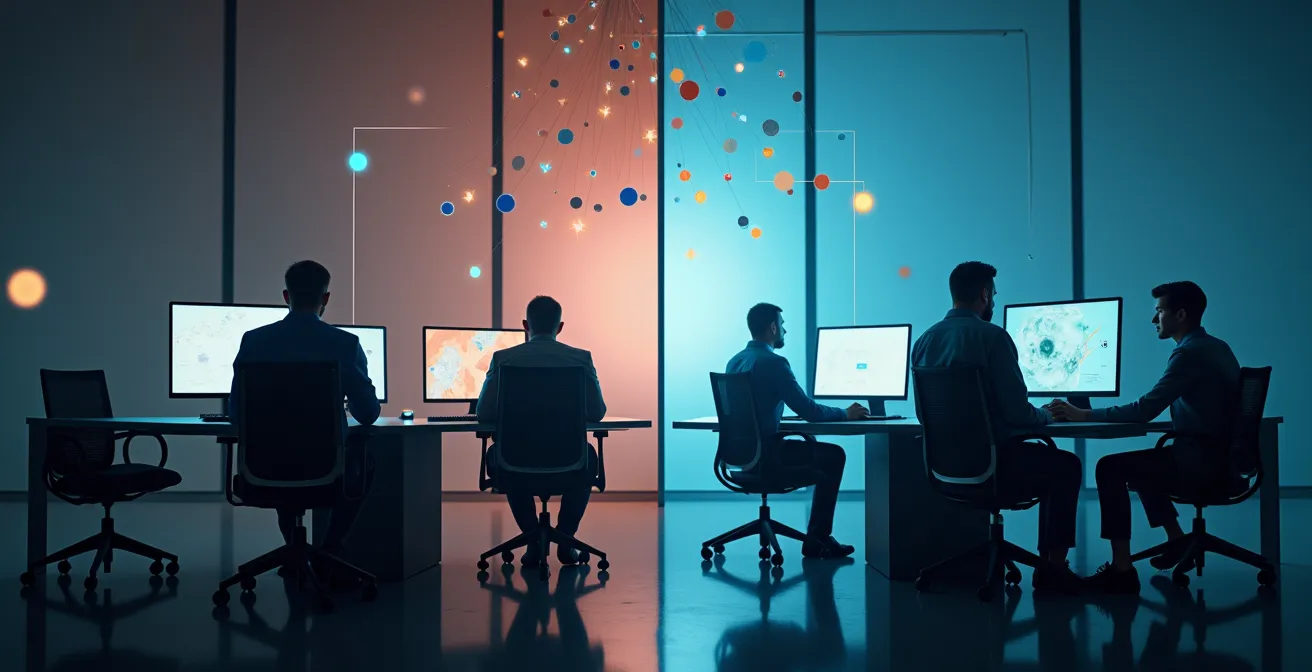
Contrary to the belief that gaming is an unproductive escape, it functions as a high-fidelity simulator for developing critical executive functions.
- Game mechanics, from raid encounters to resource management, directly train crisis communication, long-term planning, and systemic thinking.
- The cognitive demands of gaming environments build transferable skills in problem-solving, teamwork, and adaptive leadership that are increasingly scarce in the corporate world.
Recommendation: Re-evaluate your own ‘play’ history not as a liability, but as a portfolio of demonstrable cognitive and strategic competencies.
For many professionals, the time spent in digital worlds is a source of quiet guilt—a frivolous indulgence in a life demanding constant productivity. It’s the digital elephant in the room, often dismissed with vague justifications about “improving problem-solving skills” or “relaxing.” This perspective, however, fundamentally misunderstands the nature of modern interactive entertainment. The hours invested in guiding a guild through a complex raid or building a virtual empire from scratch are not wasted; they are, in fact, a rigorous form of cognitive and strategic training with direct, transferable applications in management.
The prevailing discourse often fails to move beyond surface-level observations. This analysis will not simply repeat that games are beneficial. Instead, it will deconstruct the specific cognitive architectures and socio-dynamic systems at play within Role-Playing Games (RPGs) and other strategic genres. We will demonstrate how these game mechanics function as high-fidelity simulators for developing the very executive functions—planning, adaptation, crisis management, and empathetic leadership—that define elite management in the 21st century. The argument is simple: the virtual grind is a crucible for real-world strategic acumen.
For those who prefer a visual summary, the following video from Jane McGonigal explores the powerful, world-changing potential inherent in gaming, complementing the deep-dive analysis of this article.
To fully grasp how these digital environments cultivate managerial prowess, we will dissect the specific skills forged in different gaming contexts. This exploration will move from high-pressure team dynamics to individual cognitive enhancement, revealing the powerful learning systems hidden within the code.
Summary: Why Playing RPGs Improves Strategic Thinking in Management?
- How Raiding in MMORPGs Teaches Better Crisis Communication Than an MBA?
- Portal vs The Witness: Which Game Boosts Spatial Reasoning More?
- The “One More Turn” Syndrome: How Strategy Games Hijack Your Dopamine?
- VR Headsets vs Ultra-Wide Monitors: Which Offers Better Flow State?
- Story-Driven vs Sandbox: Which Genre Develops Empathy?
- How to Facilitate a Virtual Whiteboard Session Without Losing Engagement?
- The “Collective Effervescence” Phenomenon in Live Audiences
- How to Brainstorm Effectively with Remote Teams Across 3 Time Zones?
How Raiding in MMORPGs Teaches Better Crisis Communication Than an MBA?
A Master of Business Administration program teaches crisis communication through sterilized case studies and theoretical frameworks. A 25-person raid in a Massively Multiplayer Online RPG (MMORPG) forces you to live it. These encounters are complex, multi-phase ballets of coordinated action where a single miscommunication can lead to catastrophic failure. The raid leader is not just a manager; they are a real-time incident commander, processing immense volumes of information, identifying critical threats, and issuing clear, concise commands under extreme temporal pressure.
This environment is a crucible for what is known as a socio-dynamic system, where individual performance is inextricably linked to group cohesion and communication flow. Players must learn to filter noise, report vital information succinctly, and trust the calls of their leader without hesitation. This dynamic is far more than simple teamwork; it’s a practical, high-stakes lesson in distributed cognition and resilient communication protocols. As the MMORPG Info Editorial Team states in their raid guide, “Communication is vital—raid leaders should call out mechanics, while players respond quickly to avoid avoidable deaths. Coordinated groups not only survive longer but also clear encounters faster.” This mirrors the need for clarity and rapid response in any corporate crisis.
The skills honed here are not theoretical. Indeed, psychological studies confirm that gamers demonstrate superior leadership traits, with research showing that nearly 89% of gamers exhibit an ability to manage groups effectively. This is a direct result of participating in systems that demand and reward decisive, clear communication under fire, a skill set that many corporate training programs can only hope to simulate.
Portal vs The Witness: Which Game Boosts Spatial Reasoning More?
Moving from the social to the individual, puzzle games offer a direct workout for the brain’s cognitive architecture. Spatial reasoning—the ability to mentally manipulate objects in two and three dimensions—is a cornerstone of strategic thinking, vital for engineers, architects, surgeons, and even managers visualizing complex organizational charts or process flows. Games like Portal and The Witness are often lauded for their ability to enhance this skill, but they do so in fundamentally different ways.
Portal develops spatial reasoning through a constrained, physics-based ruleset. The player learns to think “with portals,” mastering a single, powerful tool to navigate and manipulate a 3D environment. The challenge is executional and predictive: you must visualize a sequence of actions and their physical consequences. The Witness, conversely, focuses on abstract pattern recognition. Its puzzles are embedded in the environment, requiring the player to identify underlying rules and logical systems from visual cues alone. It trains the brain to find order in chaos and to deconstruct complex problems into their core principles.

So, which is “better”? It depends on the desired outcome. Portal is superior for training applied, goal-oriented spatial problem-solving, akin to logistical planning. The Witness excels at developing the abstract, systemic thinking needed for strategic analysis and identifying hidden patterns in data. Both build the mental agility and processing speed that are hallmarks of experienced gamers. This environment of constant problem-solving directly enhances the core cognitive machinery required for effective decision-making in any professional field.
The “One More Turn” Syndrome: How Strategy Games Hijack Your Dopamine?
The feeling is familiar to any fan of strategy games like Civilization or StarCraft: it’s 2 a.m., and the promise of “just one more turn” is too powerful to resist. This phenomenon is not a sign of weak willpower but a masterclass in behavioral psychology. These games are built around a powerful compulsion loop: a cycle of activity, reward, and the anticipation of the next reward that triggers the release of dopamine in the brain. This very mechanism, often viewed negatively as “addictive,” is also the engine of profound strategic learning.
Each “turn” involves a cascade of managerial decisions: resource allocation, technological research, diplomatic negotiation, and long-term infrastructure planning. The player receives constant feedback—a new building is completed, a rival is outmaneuvered—which provides a small dopamine hit and reinforces the desire to continue. This loop effectively hijacks the brain’s reward system to encourage thousands of iterations of strategic planning. The player is not just playing; they are running a complex simulation, internalizing the intricate cause-and-effect relationships that govern a system’s growth or decline. This provides an invaluable, intuitive understanding of systemic thinking.
This training is critically needed. With 87% of companies worldwide expecting to face skills gaps, harnessing these learning systems is no longer a trivial matter. The compulsion loop is not a bug; it’s a feature that transforms entertainment into an incredibly efficient training tool for the executive functions required to run a business.
Action Plan: Harnessing Game Compulsion Loops for Team Productivity
- Project Scoping: Define clear “quests” by structuring large projects into smaller, distinct mini-milestones that mimic game achievements.
- Progress Visualization: Create a visible “tech tree” or progress map that shows the team’s development path and what skills or milestones unlock next.
- Reward System Design: Implement a non-monetary reward system, such as digital badges or public recognition, for completing key tasks or “quests.”
- Rhythm and Pacing: Cycle work between high-intensity “sprints” (boss fights) and lower-intensity planning and recovery phases (town visits).
- Feedback Integration: Establish rapid feedback loops where progress is immediately visible on a shared dashboard or “leaderboard” to foster engagement and healthy competition.
VR Headsets vs Ultra-Wide Monitors: Which Offers Better Flow State?
The concept of “flow state,” a state of complete immersion and focused concentration, is the holy grail of productivity. The technology we use to interface with our work dramatically impacts our ability to achieve it. In gaming, the debate between immersive Virtual Reality (VR) and expansive ultra-wide monitors offers critical insights for designing the optimal managerial cockpit. The choice is not merely about screen real estate; it’s about managing cognitive load and facilitating different types of thinking.
VR headsets offer unparalleled immersion by eliminating external distractions. This fosters a powerful sense of embodied cognition, where physical interaction with virtual objects (e.g., manipulating a 3D model of a product) can lead to deeper insights. However, this total immersion comes at a cost: high “transition cost.” Entering and leaving the virtual world creates cognitive friction, making VR ideal for deep, focused bursts of creative or analytical work but poorly suited for multitasking. Ultra-wide monitors, in contrast, excel at displaying high-density information. They allow a manager to keep a dashboard of KPIs, a communication channel, and a primary work document in view simultaneously, facilitating rapid context-switching and peripheral awareness.
The following table, based on an analysis of different work interfaces, breaks down the core trade-offs for achieving a productive flow state.
| Feature | VR Headsets | Ultra-Wide Monitors |
|---|---|---|
| Embodied Cognition | Enhanced through physical interaction | Limited to visual processing |
| Information Density | Lower – focused immersion | Higher – multiple data streams |
| Best Use Case | 3D visualization, creative brainstorming | KPI monitoring, project management |
| Transition Cost | High – cognitive friction when switching | Low – seamless context switching |
| Flow Duration | Shorter bursts (30-45 min) | Extended sessions (2-3 hours) |
The optimal choice depends on the task. For a manager needing to brainstorm a new factory layout, the embodied experience of VR is superior. For a project manager tracking multiple fast-moving dependencies, the information density of an ultra-wide monitor is more effective. Understanding this trade-off allows a leader to intentionally design their own and their team’s digital workspaces to match cognitive demands.
Story-Driven vs Sandbox: Which Genre Develops Empathy?
Empathy, the ability to understand and share the feelings of another, is increasingly recognized as a critical leadership competency. Video games, often mischaracterized as isolating, can be powerful engines for its development, but the mechanism varies significantly by genre. The distinction between linear, story-driven games and open-ended sandbox games provides a useful framework for understanding two different forms of empathy: directed and emergent.
Story-driven games like The Last of Us or Mass Effect cultivate directed empathy. They place the player in the role of a specific character with a defined history and motivations, forcing the player to see the world through their eyes and make decisions based on their predicament. This is a guided exercise in perspective-taking. Sandbox simulators, however, foster what can be termed emergent empathy. These games provide a set of rules and systems but no prescribed narrative. As Melika Shirmohammadi’s research notes, gaming produces outcomes across “affective, behavioral, and cognitive” domains, and sandbox games heavily engage the affective.
Case Study: RimWorld’s Systemic Empathy Development
In a game like RimWorld, the player manages a colony of survivors, each with unique traits and needs. Empathy is not for a single protagonist but for the system as a whole. The player learns through unscripted interaction that a seemingly small decision—prioritizing a new workshop over expanding the freezer—can lead to a food shortage, causing a beloved colonist to have a mental break, which in turn leads to a social fight that injures a key doctor right before a raid. This creates a deep, systemic understanding of cascading consequences, directly analogous to organizational leadership where small policy changes can have unforeseen systemic impacts on employee morale and productivity.
This long-term engagement with complex systems yields significant benefits. For instance, University of Houston research reveals that MMO gamers with over 20 years of experience showed enhanced teamwork and leadership skills. This is empathy at scale—not just feeling for an individual, but understanding the interconnected web of a community.
How to Facilitate a Virtual Whiteboard Session Without Losing Engagement?
The virtual whiteboard session has become a staple of remote work, but it frequently suffers from low energy and disengagement. The principles of game design offer a proven blueprint for transforming these sessions from passive viewing experiences into active, collaborative “quests.” The core problem with most virtual meetings is their lack of structure, clear objectives, and feedback loops—all elements that games have perfected.
Instead of a blank canvas and a vague prompt like “let’s brainstorm,” a game-inspired approach involves setting clear, time-boxed objectives (e.g., “Quest: Generate 15 solutions for X in 10 minutes”). This creates urgency and focus. Participants can be given a limited number of “action points” (voting dots) to allocate to their preferred ideas, forcing prioritization and strategic investment. Designating specific areas of the board for each “player” encourages ownership and parallel processing, preventing the common issue where only one or two people dominate the conversation. This structure leverages the same psychological drivers that make games compelling.
This approach is not just a novelty; it is a strategic adaptation to the nature of the modern workforce. With Cloudwards research indicating that 77% of Millennials and 81% of Gen Z identify as gamers, using a language and structure they intuitively understand is a powerful management tool. By applying techniques borrowed from raid leadership—active guidance, real-time synthesis of ideas, and clear phase transitions—a facilitator can maintain momentum and ensure every participant remains an engaged player, not a passive spectator.
The “Collective Effervescence” Phenomenon in Live Audiences
Émile Durkheim, a founder of sociology, coined the term “collective effervescence” to describe the sense of energy and harmony a group feels when they participate in a shared action. It’s the magic that happens at a concert, a sports match, or a religious ritual. In an era of remote work, generating this sense of unity and shared purpose among a distributed team is one of management’s greatest challenges. Gaming communities, particularly in MMORPGs and live streaming, offer a powerful model for creating it digitally.
These communities build effervescence through three key elements: shared rituals (e.g., weekly raid nights, server-wide events), common symbols (guild logos, unique in-game items, community-specific emotes), and a collective purpose (defeating a difficult boss, achieving a “world first”). This creates a “safe” environment for collaboration and even leadership. As consultant Lauren Spear notes, “MMORPGs have a ‘talent’ for putting people in leadership positions who might normally be too reserved to step forward.” This digital space allows for the development of confidence and shared identity.

Case Study: Twitch Communities and Remote Team Unity
The success of Twitch streaming communities provides a replicable blueprint for managers. Streamers act as community leaders, creating a narrative, celebrating member contributions (subscriptions, comments), and facilitating constant, low-stakes interaction through chat. They build a shared identity around common goals and inside jokes. Corporate leaders who adopt streamer-like techniques in their virtual meetings—such as constant interaction, celebrating small wins, and weaving a compelling narrative around a project’s goals—report significantly higher engagement and a stronger sense of team cohesion, effectively generating a form of corporate collective effervescence.
By consciously designing shared rituals, adopting team symbols, and articulating a clear, compelling collective purpose for projects, managers can replicate this powerful unifying force and transform a collection of isolated remote workers into a cohesive, energized team.
Key Takeaways
- Gaming is not idle time; it is a training ground for high-demand cognitive skills like crisis communication, strategic planning, and systemic thinking.
- Specific game genres target distinct executive functions: MMORPGs for team coordination, puzzle games for spatial reasoning, and strategy games for long-term planning.
- Game design principles, such as compulsion loops and quest-based objectives, can be directly applied to corporate settings to boost productivity and engagement in remote teams.
How to Brainstorm Effectively with Remote Teams Across 3 Time Zones?
The ultimate challenge for a modern manager is orchestrating effective collaboration across vast geographical and temporal divides. Brainstorming, an activity that thrives on spontaneous energy, seems almost impossible in an asynchronous environment. Yet, gaming communities solved this problem decades ago through the structure of game forums and persistent world servers, providing a blueprint for 24/7 innovation.
The key is to abandon the idea of a single, synchronous meeting and embrace a hybrid model. This involves creating a persistent digital space—a “Single Source of Truth” like a dedicated Slack channel, a Miro board, or a wiki—that acts as the team’s forum. Here, ideas can be posted, debated, and built upon around the clock. This asynchronous foundation is then punctuated by short, overlapping synchronous sessions, or “Time-Zoned Raids.” A European lead might run a 90-minute session with their team, then “pass the baton” to an East Coast US lead who overlaps for the final 30 minutes to ensure continuity before starting their session. This maintains momentum without requiring anyone to work at 3 a.m.
This model leverages the strengths of both asynchronous depth and synchronous energy. It allows for considered, thoughtful contributions from introverts or those in different time zones, while the short, focused “raids” provide bursts of high-energy collaboration and decision-making. This game-based learning model is proven to work, as it directly develops the competencies needed for modern collaborative work. This approach transforms time zones from a logistical nightmare into a strategic advantage, creating a truly continuous, 24-hour cycle of innovation.
The next logical step is to reframe your perspective. Begin to consciously analyze the games you play, identifying the specific managerial skills being honed—be it resource management, crisis communication, or systemic thinking—and learn to articulate this experience as a legitimate component of your professional development.
Frequently Asked Questions on How to Brainstorm Effectively with Remote Teams Across 3 Time Zones?
How can asynchronous brainstorming work effectively?
Create a persistent channel like gaming forums where team members post and build upon ideas 24/7. Use voting systems and threaded discussions to maintain momentum across time zones.
What’s the best way to handle time zone overlaps?
Schedule ‘Time-Zoned Raids’ – short overlapping sessions (e.g., EU/US East, then US East/US West) with leaders passing the baton to ensure continuity between sessions.
How do we maintain consistency across async work?
Establish a ‘Single Source of Truth’ wiki-style document that centralizes all ideas, decisions, and action items, allowing any team member to get up to speed instantly regardless of login time.