
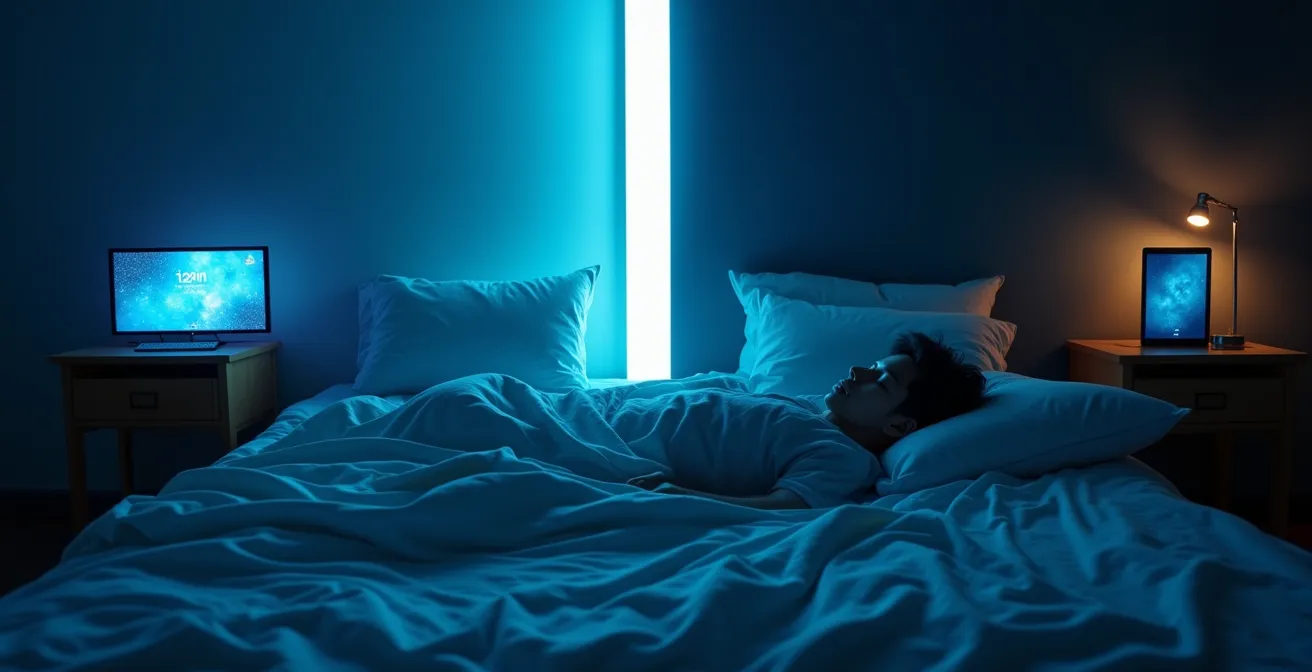
Sleeping for eight hours is irrelevant if your body’s internal clock is misaligned; true energy comes from precisely timing environmental signals to synchronize your biology.
- Light exposure at the wrong time (especially blue light at night) actively suppresses your sleep hormone, melatonin.
- Consistency in your wake-up time is more powerful for setting your 24-hour rhythm than your bedtime or total sleep duration.
Recommendation: Focus on two key actions: get 10 minutes of direct sunlight as soon as you wake up, and block all blue light for two hours before you go to bed.
The deepest frustration in modern life might be the experience of waking up exhausted after a full eight hours of sleep. You followed the rules, allocated the time, yet the promised rejuvenation never arrived. You blame your mattress, your diet, or stress, but the conventional advice—simply “sleep more”—misses the fundamental point. This feeling of persistent fatigue, even with adequate sleep duration, is a classic symptom of a desynchronized circadian rhythm. Your body isn’t just a simple battery that needs charging; it’s a complex orchestra of hormones and genes that rely on a conductor to keep time.
This internal conductor, a master clock in your brain called the suprachiasmatic nucleus (SCN), dictates nearly every biological process, from your energy levels and mood to your metabolism and immune response. When its signals are clear and consistent, you feel alert during the day and sleepy at night. But when modern life introduces conflicting cues—late-night screens, inconsistent meal times, and weekend sleep-ins—the orchestra falls out of sync. The result is not just tiredness, but a cascade of hormonal chaos that no amount of extra sleep can fix on its own.
The solution is not to chase more hours in bed, but to actively manage the signals that calibrate this internal clock. This isn’t about generic “sleep hygiene”; it’s about understanding the specific, non-negotiable environmental and biochemical inputs that your body uses to tell time. It’s about shifting your focus from the quantity of sleep to the quality of your circadian signaling. By learning to control these signals, you can move from feeling perpetually jet-lagged to mastering your own biology.
This guide will deconstruct the core mechanisms of your circadian rhythm and provide science-backed protocols to resynchronize it. We will explore how specific wavelengths of light sabotage your sleep, why timing your supplements matters more than the dose, and how a simple morning routine can set the stage for all-day energy. Get ready to stop counting sheep and start synchronizing your clock.
For those who prefer a visual format, the following video provides a brilliant overview of how a single morning activity can dramatically improve your energy levels and sleep quality, perfectly complementing the detailed protocols in this guide.
To navigate this deep dive into your biology, the article is structured to address the most critical factors influencing your internal clock. Below is a summary of the key areas we will cover, from the science of light exposure to actionable daily routines.
Summary: A Scientific Guide to Resynchronizing Your Internal Clock
- Why Does Blue Light After 9 PM Halt Melatonin Production For 3 Hours?
- How to Use Amber Glasses to Protect Your Sleep Hormones While Watching TV
- Melatonin vs. Magnesium: Which Supplement Actually Fixes Deep Sleep Architecture?
- The ‘Nightcap’ Trap: How One Glass of Wine Destroys REM Sleep
- When to Wake Up: Why Consistency Matters More Than Duration for Energy
- Why Drinking 500ml of Water Before Coffee Jumpstarts Your Brain?
- When to Take Meds: How Your Circadian Genes Affect Drug Efficacy
- The 20-Minute Morning Routine That Boosts CEO Productivity by 40%
Why Does Blue Light After 9 PM Halt Melatonin Production For 3 Hours?
The single most powerful signal for your brain’s master clock is light. For millennia, the bright, blue-rich light of the sun dictated our wakefulness, while its absence at sunset signaled the time for rest. Your biology is hardwired to this cycle. Specifically, specialized cells in your retina, called intrinsically photosensitive retinal ganglion cells (ipRGCs), are highly sensitive to blue light. When they detect it, they send a direct signal to the suprachiasmatic nucleus (SCN) to shut down the production of melatonin, the hormone of darkness.
In the modern world, we are surrounded by devices—phones, tablets, laptops, and LED lights—that emit high concentrations of blue light, particularly around the 460-nanometer (nm) wavelength. This specific wavelength is a potent biological trigger. When you’re exposed to it after dusk, you are effectively telling your brain it’s the middle of the day. The result is a direct and immediate halt in melatonin secretion. Research confirms the dramatic impact of this exposure.
A pivotal study found that just two hours of evening exposure to 460 nm blue light significantly suppressed melatonin from 12.0 pg/mL to 8.8 pg/mL, delaying the onset of sleepiness and disrupting the body’s preparation for rest. This isn’t a minor inconvenience; it’s a powerful form of biochemical signaling that throws your entire 24-hour hormonal cascade off-schedule. Even if you manage to fall asleep later, the quality of that sleep is compromised because your body entered it from a state of forced alertness rather than natural, progressive drowsiness.
This delay creates a mismatch between your desired sleep time and your biological readiness, forming the very foundation of circadian desynchronization. Protecting yourself from this signal is the first and most critical step in reclaiming your night.
How to Use Amber Glasses to Protect Your Sleep Hormones While Watching TV
Given that eliminating all screens after 9 PM is impractical for most people, the most effective strategy is to filter the problematic wavelengths of light at the source. This is where blue-light-blocking glasses become an essential tool, not a wellness trend. However, not all blue-blocking glasses are created equal. The clear or light-yellow lenses marketed for daytime computer use are insufficient for nighttime protection, as they only filter a small fraction of blue light.
To protect melatonin production, you need to create a state of “biological darkness,” which means blocking nearly all light in the blue and even green spectrum. This is achieved with amber or red-tinted lenses, which are specifically designed to filter out the wavelengths that your ipRGCs are most sensitive to. Wearing these glasses for 90 minutes to two hours before your intended bedtime allows melatonin to rise naturally, as if you were sitting by a campfire instead of in front of a television.

As you can see, the right lenses transform the harsh, stimulating light from modern environments into a warm, non-disruptive glow. This simple intervention sends a clear “dusk” signal to your brain, preserving your natural sleep-wake cycle. Choosing the right pair depends on your evening activities and desired level of protection.
- Clear Lenses (30-40% filtering): These are best for daytime computer use. Their primary function is to reduce digital eye strain and glare without significantly altering color perception, but they offer minimal circadian protection.
- Amber Lenses (~98% blocking): This is the optimal choice for general evening use, such as watching TV or reading on a tablet. They block almost all melatonin-suppressing blue light while maintaining enough visibility for most tasks.
- Red Lenses (99.9%+ blocking): For the most rigorous protection, red lenses create near-complete biological darkness. They are ideal for the 60-90 minutes immediately before bed when you want to maximize melatonin synthesis.
Combining these glasses with other light-management strategies, like dimming screens and using warm-toned bias lighting behind your TV, creates a comprehensive shield against circadian disruption.
Melatonin vs. Magnesium: Which Supplement Actually Fixes Deep Sleep Architecture?
When sleep feels broken, the first impulse for many is to reach for a supplement, with melatonin being the most common choice. However, using melatonin as a generic sleep aid is a fundamental misunderstanding of its biological role. It’s not a sedative that knocks you out; it’s a chronobiotic—a hormone that signals time. Taking melatonin can be effective for shifting your clock, such as when dealing with jet lag, but it does little to improve the intrinsic quality or structure of your sleep if your timing is already correct.
If your issue isn’t falling asleep but rather waking up frequently or feeling unrefreshed, your problem likely lies within your sleep architecture—specifically, a lack of slow-wave sleep (SWS), or deep sleep. This is where a different supplement, magnesium, plays a more effective role. Magnesium acts as a soporific, or sleep-inducing agent, by relaxing the nervous system. It functions as a GABA agonist, binding to and activating GABA receptors in the brain. GABA is the primary inhibitory neurotransmitter, responsible for calming neuronal activity and reducing anxiety, which are often culprits behind fragmented sleep.
Understanding the distinct mechanisms of these two supplements is crucial for choosing the right tool for the job. A detailed comparison of their effects on sleep highlights their different, complementary functions.
| Aspect | Melatonin | Magnesium |
|---|---|---|
| Primary Function | Chronobiotic – timing signal for SCN | Soporific – nervous system relaxant |
| Main Effect | Corrects sleep onset (latency) | Increases Slow-Wave Sleep (Deep Sleep) |
| Best For | Circadian desynchronization, jet lag | Nocturnal awakenings, anxiety-related sleep issues |
| Sleep Stage Impact | Primarily affects sleep timing | Enhances deep sleep quality |
| Mechanism | Signals darkness to brain | Acts on GABA receptors |
Therefore, while melatonin is a powerful hormone for telling your body *when* to sleep, magnesium is often the more effective nutrient for helping your body *stay* asleep and achieve the restorative deep sleep necessary for physical repair and memory consolidation.
The ‘Nightcap’ Trap: How One Glass of Wine Destroys REM Sleep
The “nightcap” is one of the most enduring and destructive myths in sleep hygiene. While a glass of wine or a cocktail can indeed make you feel drowsy and help you fall asleep faster, this initial sedative effect masks a severe disruption that occurs in the second half of the night. Alcohol is particularly damaging to REM sleep, the stage critical for emotional regulation, memory processing, and creativity.
Initially, alcohol enhances the activity of the inhibitory neurotransmitter GABA, which is why you feel relaxed and sleepy. However, as your body metabolizes the alcohol, a phenomenon known as the “glutamate rebound” occurs. Glutamate is the brain’s primary excitatory neurotransmitter, and its surge during the night leads to a state of heightened arousal. This rebound effect is what causes the fragmented, poor-quality sleep characteristic of a night of drinking. Your sleep becomes lighter, you wake up more frequently, and your heart rate elevates—all signs that your nervous system is in a state of stress, not rest.

The consequence of this rebound is a dramatic alteration in sleep architecture. While you might get more deep sleep in the first half of the night, your REM sleep is significantly suppressed. Then, as the alcohol wears off, the brain tries to compensate, leading to a 30-40% increase in REM density in the early morning hours. This REM sleep is often fitful and accompanied by vivid, stressful dreams, which is why you can wake up feeling mentally exhausted and emotionally frayed, even after a full night in bed.
Studies have directly correlated this withdrawal period with heightened glutamate activity, fragmented sleep, and increased autonomic arousal. One glass is enough to initiate this disruptive cascade. The initial feeling of relaxation is a trap, trading a few minutes of faster sleep onset for hours of compromised neurological restoration.
If true rest is the goal, alcohol has no place in your evening routine. It is fundamentally a sleep antagonist, not a sleep aid, and is one of the most potent ways to desynchronize your internal rhythms.
When to Wake Up: Why Consistency Matters More Than Duration for Energy
Of all the signals that entrain your circadian rhythm, the most powerful and controllable is your wake-up time. While most people focus on getting to bed on time, it is the consistency of the morning anchor that truly sets the 24-hour clock. Waking up at the same time every day—including weekends—establishes a precise, predictable starting point for your entire hormonal cascade, beginning with the Cortisol Awakening Response (CAR).
The CAR is a natural surge in the hormone cortisol that occurs approximately 30-45 minutes after you wake up. This is not the chronic, stress-induced cortisol to be feared; it’s a vital, energizing signal that promotes alertness, suppresses leftover melatonin, and kickstarts your metabolism for the day. A robust and consistent CAR is a hallmark of a well-synchronized circadian rhythm. When your wake-up time is erratic, this signal becomes blunted and delayed, leaving you feeling groggy and “slow to start” for hours.
The discrepancy between your weekday and weekend sleep schedules has a name: “social jetlag.” Even a seemingly harmless one or two-hour shift is enough to desynchronize your internal clock. This misalignment is not a trivial matter; it’s associated with measurable negative health outcomes, including increased inflammation markers, insulin resistance, and a higher risk for metabolic syndrome. You are, in effect, giving your body a mild case of jet lag every single weekend, and spending the first half of the week struggling to recover.
If you’ve accumulated a sleep debt, it’s far better to repay it with a short, 20-30 minute afternoon nap or a Non-Sleep Deep Rest (NSDR) protocol than it is to sleep in. Sleeping in may feel good in the moment, but it pushes your clock later, making it harder to fall asleep the following night and perpetuating a cycle of desynchronization.
Why Drinking 500ml of Water Before Coffee Jumpstarts Your Brain?
The first thing many people reach for upon waking is a cup of coffee. While the caffeine is effective, its timing is often suboptimal. A more powerful sequence for kickstarting your brain involves two key steps before coffee ever touches your lips: immediate hydration and a strategic delay in caffeine intake. Drinking approximately 500ml (16oz) of water right after you wake up is crucial for supporting the Cortisol Awakening Response (CAR).
Overnight, your body loses a significant amount of water through respiration. Even mild dehydration can impair cognitive function and blunt the morning cortisol surge that is so essential for alertness. Rehydrating immediately supports optimal adrenal function and ensures this energizing hormone is released effectively. This simple act primes your system for wakefulness. The second step is to wait 60-90 minutes after waking before consuming caffeine. This allows your body to naturally clear out the adenosine that has built up overnight.
Adenosine is a neurotransmitter that promotes sleep pressure; the longer you are awake, the more it accumulates. Caffeine works by blocking adenosine receptors. If you drink coffee immediately upon waking when your cortisol is already rising and adenosine is clearing, you are essentially getting less “bang for your buck” and are more likely to experience an afternoon crash. By waiting, you allow cortisol to peak naturally and then use caffeine to block the remaining adenosine, providing a more sustained and effective boost in alertness. This morning protocol optimizes your internal chemistry:
- Upon waking: Immediately drink 500ml of room temperature water.
- During the next 60-90 minutes: Expose yourself to bright, natural sunlight. Research shows that 30-40 minutes of bright light in the morning is crucial for setting your circadian clock.
- After 60-90 minutes: Consume your coffee.
This strategic timing ensures your CAR is robust, your hydration is restored, and your caffeine intake is maximally effective, preventing the dreaded mid-afternoon energy slump.
When to Take Meds: How Your Circadian Genes Affect Drug Efficacy
The influence of your circadian rhythm extends far beyond sleep and wakefulness, impacting everything down to the cellular level—including how your body processes medication. The emerging field of chronopharmacology studies how the effectiveness and side effects of drugs vary depending on the time of day they are administered. This is because the enzymes responsible for metabolizing drugs, particularly the Cytochrome P450 family in the liver, are not produced at a constant rate; their expression is governed by circadian clock genes.
This means that a dose of medication taken in the morning can have a profoundly different effect than the exact same dose taken in the evening. The drug might be more potent, clear from your system faster, or produce more side effects based on the rhythmic activity of your metabolic machinery. Ignoring this biological timing can lead to suboptimal treatment outcomes or unnecessary adverse effects. For a person with a desynchronized circadian rhythm, this variability can be even more pronounced and unpredictable.
The practical applications of chronopharmacology are already influencing medical recommendations. For instance, research demonstrates that certain medications have clear optimal timings. Statins, used to lower cholesterol, are often more effective when taken at night because the enzyme responsible for cholesterol synthesis in the liver is most active while we sleep. Similarly, some blood pressure medications show greater benefit with evening dosing, particularly for patients whose blood pressure doesn’t naturally dip during sleep (“non-dippers”).
As our understanding of circadian biology grows, synchronizing medication schedules with individual biological rhythms will become a standard of care. For now, it serves as a powerful reminder that our bodies are not static machines but dynamic, rhythmic systems, and that aligning our interventions with these natural cycles is key to maximizing health.
Key Takeaways
- Your internal clock (circadian rhythm) is the master regulator of your energy; its synchronization is more important than sleep duration.
- Light is the most powerful signal: get bright light in the morning to anchor your day and avoid blue light at night to protect melatonin.
- Consistency is king: a stable wake-up time, even on weekends, is the most effective way to maintain a robust and predictable rhythm.
The 20-Minute Morning Routine That Boosts CEO Productivity by 40%
Synthesizing the principles of circadian biology into a simple, actionable framework is the key to reclaiming your energy. Instead of a long, complicated morning ritual, a highly effective “circadian priming” protocol can be completed in just 20 minutes. This sequence is not about adding more tasks to your morning; it’s about performing a few high-leverage actions in the correct order to send a powerful, unambiguous “wake-up” signal to every cell in your body.
This routine is designed to optimize your hormonal environment by triggering a robust cortisol awakening response, suppressing residual melatonin, and front-loading dopamine from natural sources rather than your phone. By doing so, you are not only boosting immediate alertness but also setting the 24-hour timer for your next wave of melatonin release 14-16 hours later, ensuring you will feel naturally sleepy at your desired bedtime. This creates a virtuous cycle of synchronization that builds on itself day after day.
To implement this effectively, it’s useful to first audit your current habits to identify the points of greatest misalignment. The following plan provides a structured way to assess and correct your daily circadian signals.
Your 5-Step Circadian Rhythm Audit and Action Plan
- Identify Signal Inputs: For one day, list all major sources of light, the timing of your meals, and periods of physical activity. Note when you look at screens versus when you get natural sunlight.
- Inventory Current Habits: For three consecutive days (including a weekend day), log your precise wake-up time, your first caffeine intake, and your bedtime. Note the difference between weekday and weekend schedules.
- Analyze for Misalignment: Compare your log against key circadian principles. Is your wake-up time consistent? Are you getting sunlight within 30 minutes of waking? Are you avoiding blue light for at least 90 minutes before bed?
- Score Your Anchor Points: Rate the consistency of your two most critical anchors—your wake-up time and your first light exposure—on a scale of 1 (erratic and weak) to 5 (rock-solid and consistent). This reveals your weakest link.
- Create an Integration Plan: Based on your audit, identify the single biggest point of misalignment. Commit to fixing only that one habit for the next seven days, then re-audit. This focused approach prevents overwhelm and builds momentum.
Start by implementing just the first step of the protocol tomorrow morning. The simple act of getting sunlight upon waking is the highest-leverage action you can take to begin the process of resynchronizing your internal clock and unlocking your natural energy potential.
Frequently Asked Questions About Why Sleeping 8 Hours Isn’t Enough If Your Circadian Rhythm Is Desynchronized?
What is Social Jetlag and how does it affect health?
Social jetlag occurs when there’s a discrepancy between weekday and weekend wake times. Even 1-2 hours difference is linked to increased inflammation markers, insulin resistance, and higher metabolic syndrome risk.
How can I manage sleep debt without breaking consistency?
Maintain the same wake-up time and use 20-30 minute Non-Sleep Deep Rest (NSDR) protocols or short early afternoon naps to repay sleep debt without shifting your master clock.
Why is wake time more important than bedtime for circadian rhythm?
A consistent wake time sets a precise anchor for the cortisol awakening response (CAR), which dictates the entire 24-hour hormonal cascade and determines when you’ll naturally feel sleepy.