
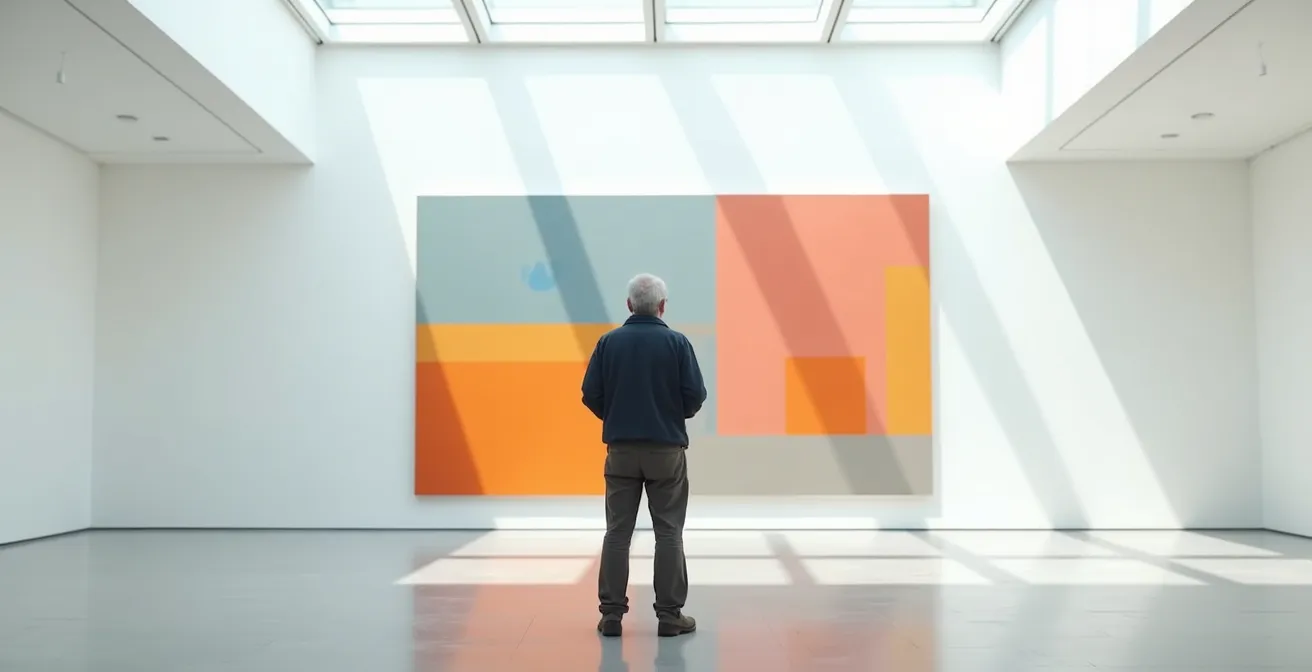
Contrary to the belief that museum visits are merely a pleasant pastime, they are a powerful, multi-modal cognitive training regimen. This article reveals the specific neurological mechanisms at play, from how abstract art remodels neural pathways to how the physical presence of others triggers deeper empathic responses. It’s not about passive viewing; it’s an active process of brain-building that has been shown to significantly reduce the long-term risk of dementia.
For many, a trip to the museum is a quiet, contemplative activity—a chance to absorb culture and beauty. The prevailing wisdom suggests that this mental stimulation is broadly “good for the brain,” a vague notion that places it in the same category as a crossword puzzle or learning a new language. We are told that staying mentally active is a key to healthy aging, and a gallery visit certainly feels more enriching than another afternoon of television.
But what if this common understanding dramatically underestimates the power of the museum experience? What if the act of walking through a gallery, standing before a canvas, or listening to a guide is not just a gentle mental jog but a full-blown cognitive workout, targeting specific neural circuits with scientific precision? This perspective shifts the museum from a place of passive consumption to a gymnasium for the mind, where specific “exercises” produce measurable neurological benefits.
The true key to unlocking these benefits lies not in simply showing up, but in understanding the specific cognitive demands the museum environment places on us. This article moves beyond platitudes to explore the scientific evidence. We will dissect the experience, examining how analyzing art, managing physical posture, and engaging in social interaction each contribute to building a more resilient and plastic brain, ultimately providing a robust defense against age-related cognitive decline.
This guide unpacks the science behind the museum’s effect on brain longevity. We will explore the specific neurological processes engaged during a visit and provide a clear framework for maximizing the cognitive benefits of your next cultural outing.
Summary: The Cognitive Science of Museum Visits
- How Analyzing Abstract Art Forces Your Brain to Build New Connections?
- The 10-Minute Painting Rule: Why Rushing Through Galleries Is Useless?
- Docent Tours vs Audio Guides: Which Format Boosts Memory Retention?
- The Physical Reason Your Back Hurts After 90 Minutes of Standing
- When to Visit: The “Tuesday Morning” Secret for Quiet Contemplation
- The Grey Matter Increase in the Prefrontal Cortex After 8 Weeks
- Why You Don’t Check Your Phone in a Theater (But Do at the Cinema)?
- Live Theater vs Netflix: Why the Brain Reacts Differently to Real Presence?
How Analyzing Abstract Art Forces Your Brain to Build New Connections?
When faced with a figurative painting—a portrait or a landscape—the brain’s task is relatively straightforward: recognition. It matches the visual input to existing mental models. Abstract art, however, denies the brain this easy path. It presents ambiguity, forcing the mind to move beyond recognition into a more demanding state of interpretation and pattern-seeking. This cognitive effort is not trivial; it’s a powerful neurological exercise.
This process heavily engages the brain’s Default Mode Network (DMN), a system of interconnected brain regions active during internal thought, self-reflection, and future planning. Instead of processing external certainties, the brain must look inward. As Nobel laureate Eric Kandel and his colleagues noted, “Abstract paintings may allow people to draw on unique internal representations.” This is where the magic happens: your brain is actively building new connections based on your unique memories, emotions, and ideas. A PNAS study found that engaging with abstract art prompts nearly 40% greater variability in brain activity within the DMN compared to representational art. This variability is a sign of a more complex, individualized, and creative cognitive process.
Abstract paintings may allow people to draw on unique internal representations, rather than differences in visual processing related to different incoming visual information.
– Eric Kandel et al., PNAS – The Beholder’s Share study
In essence, abstract art forces your brain out of its comfort zone. It cannot rely on pre-existing labels and must instead forge new, personal pathways of meaning. This act of “filling in the blanks” is a fundamental form of neuroplasticity, strengthening the brain’s ability to adapt and create.
The 10-Minute Painting Rule: Why Rushing Through Galleries Is Useless?
Many museum-goers treat a gallery like a checklist, moving quickly from one famous piece to the next in a blur of cultural consumption. This approach, however, offers minimal cognitive benefit. Research from Museum Management and Curatorship shows that, on average, museum visitors spend a mere 27-30 seconds viewing an artwork. This is barely enough time for basic recognition, let alone the deep cognitive engagement required for neuroplastic change.
The antidote to this superficial grazing is a practice known as “slow looking.” This involves dedicating a significant amount of time—five, ten, or even fifteen minutes—to a single work of art. Instead of a quick glance, you allow your brain to move through layers of observation: from initial impressions of color and form to the discovery of subtle details, the analysis of composition, and finally, the formation of personal connections and interpretations.
A 2025 study on slow looking provides compelling evidence for this approach. Participants who spent 5-10 minutes with each piece reported a much richer experience. They were able to forge individual connections based on their own interests and memories, leading to the creation of strong episodic memories—memories tied to personal experience, which are particularly resilient to cognitive decline. This extended viewing time gives the brain the space it needs to move past simple perception and engage in the more complex functions of analysis, reflection, and memory encoding. The “10-Minute Rule” isn’t about an arbitrary number; it’s a principle of prioritizing depth over breadth to truly exercise the mind.
Docent Tours vs Audio Guides: Which Format Boosts Memory Retention?
In the quest for information, many visitors plug in an audio guide, receiving a pre-recorded, one-way stream of facts. While informative, this format can be cognitively passive. A docent-led tour, by contrast, introduces a powerful and often overlooked variable: real-time social interaction. This dynamic element transforms the experience from a solitary lesson into a collaborative exploration, with profound implications for memory.
A human guide does more than just recite information. They ask questions, respond to the group’s curiosity, and facilitate discussion. This interactive environment requires your brain to do more than just listen; you must process information, formulate your own thoughts, listen to others’ perspectives, and potentially articulate a question or comment. This active, multi-faceted engagement is a far more potent cognitive stimulus.
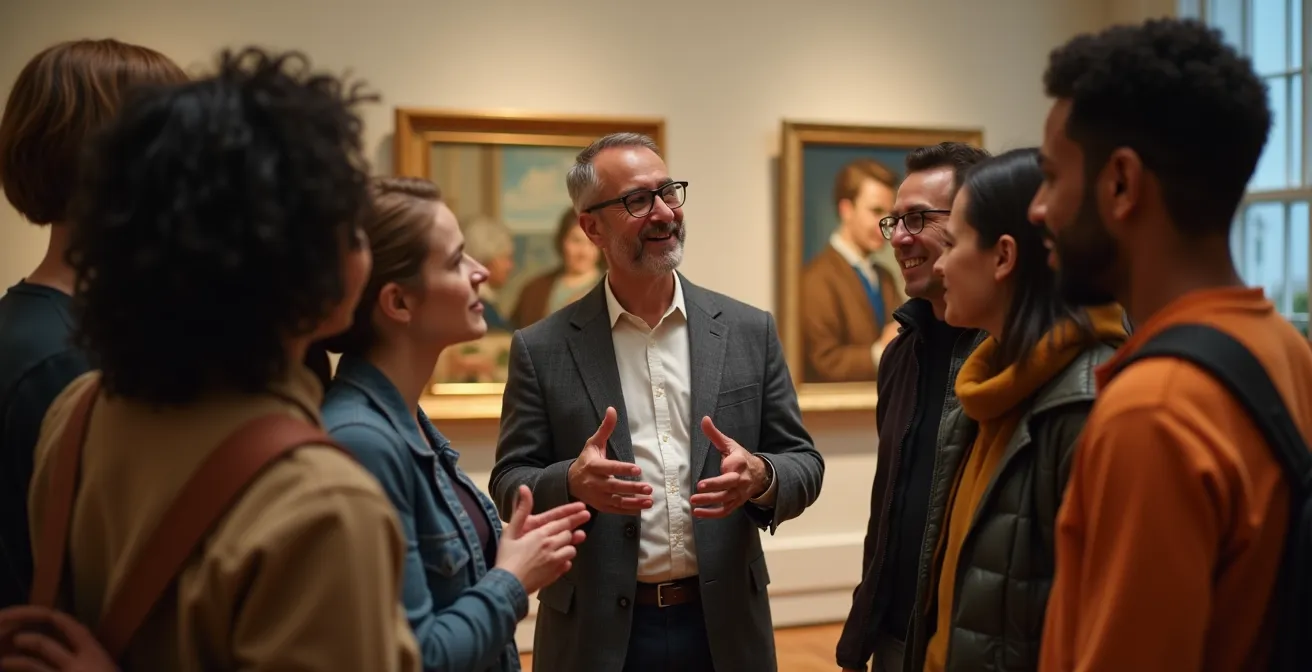
The benefits of this social engagement are backed by science. University of Michigan research demonstrated that just 10 minutes of social interaction improved memory performance and executive function as much as spending the same amount of time on traditional brain games. When you participate in a docent-led tour, you are not just learning about art; you are engaging in a complex social-cognitive task that strengthens neural pathways related to memory, attention, and executive control. The audio guide gives you facts; the docent tour helps your brain build the framework to retain them.
The Physical Reason Your Back Hurts After 90 Minutes of Standing
It’s a common experience: after an hour or so of wandering through a museum, a dull ache begins to set in, usually in the lower back or feet. We often dismiss this as simple physical fatigue. However, the cause is more complex and has direct implications for our cognitive capacity. The discomfort stems from the significant, yet hidden, mental work your brain is doing simply to keep you upright.
This process is governed by proprioception, the body’s ability to sense its own position in space. When you stand still on a hard gallery floor, your brain is in a constant feedback loop. It receives millions of signals from nerve endings in your joints, muscles, and tendons, and it must continuously process this data to make micro-adjustments in your posture to maintain balance. This is not an automatic, cost-free process.
Standing still forces the brain to constantly process feedback from joints and muscles to maintain balance. This is a significant, low-level cognitive load that drains mental energy needed for art appreciation.
– Research on Proprioceptive Fatigue, Museum Ergonomics Studies
This continuous “proprioceptive load” consumes mental resources. As your brain diverts energy to the task of maintaining stability, less is available for the higher-level cognitive functions required for art appreciation, like analysis, reflection, and memory formation. Your back hurts because your muscles are fatigued, but your mind feels foggy because your cognitive resources are being drained by this hidden task. Recognizing this connection is the first step toward managing museum fatigue and preserving mental energy for what truly matters.
Your Action Plan for Combating Museum Fatigue
- Plan your visit: Schedule your visit during less crowded times, like a weekday morning, to minimize sensory overload and allow for easier movement.
- Take strategic breaks: Make a conscious effort to sit down and rest for 5-10 minutes every 30-45 minutes, even if you don’t feel tired yet. This offloads the proprioceptive system.
- Focus your attention: Choose one wing or a few specific artworks to see in depth, rather than trying to cover the entire museum. Quality over quantity prevents cognitive burnout.
- Use available seating: Identify benches or seating areas as you enter a gallery and use them strategically, especially when engaging in “slow looking” at a particular piece.
- Engage interactively: When possible, participate in tours or interactive exhibits. The shift from passive standing to active engagement can alleviate static muscle fatigue.
When to Visit: The “Tuesday Morning” Secret for Quiet Contemplation
The environment in which you experience art is as important as the art itself. A crowded, noisy gallery filled with jostling visitors and crying children creates a state of high sensory input and cognitive distraction. In this state of mild overstimulation, the brain defaults to a protective mode, filtering out stimuli rather than deeply processing them. Your capacity for “slow looking” and thoughtful reflection plummets, and the potential cognitive benefits are lost in the noise.
The ideal environment for cognitive engagement is one of quiet contemplation. This is why the timing of your visit is a critical strategic decision. Mid-day on a weekend is often the worst choice, as crowds and noise levels peak. Conversely, weekday mornings, particularly on a Tuesday or Wednesday after the weekend rush has subsided, typically offer the most serene atmosphere. This “Tuesday Morning” strategy is about creating an environment where your brain can operate optimally.
A 2024 study at the Montreal Museum of Fine Arts provides direct evidence for this. Researchers tracked the brain activity and well-being of older adults visiting the museum at different times. The results were clear: participants who visited in the morning showed enhanced engagement in the prefrontal cortex—the brain’s hub for executive function and complex thought. They also reported significantly greater improvements in well-being scores compared to those who visited during busier afternoon hours. This aligns not only with the benefits of a quieter environment but also with natural circadian rhythms, as cognitive function often peaks in the late morning. Choosing when to visit is not just a matter of convenience; it’s a way to scientifically optimize your brain for learning and growth.
The Grey Matter Increase in the Prefrontal Cortex After 8 Weeks
The cognitive exercises prompted by museum visits—from deciphering abstract art to engaging in social tours—are not just fleeting mental states. They trigger tangible, structural changes within the brain. Consistent engagement in these activities can lead to a measurable increase in grey matter density, particularly in the prefrontal cortex, the region responsible for personality, decision-making, and complex thought.
This phenomenon is a direct result of neuroplasticity, the brain’s lifelong ability to reorganize itself by forming new neural connections. Research from Massachusetts General Hospital, for example, showed that just 8 weeks of mindfulness practice—an activity that shares deep similarities with the “slow looking” and focused attention of a museum visit—measurably increased grey matter density in key brain areas.
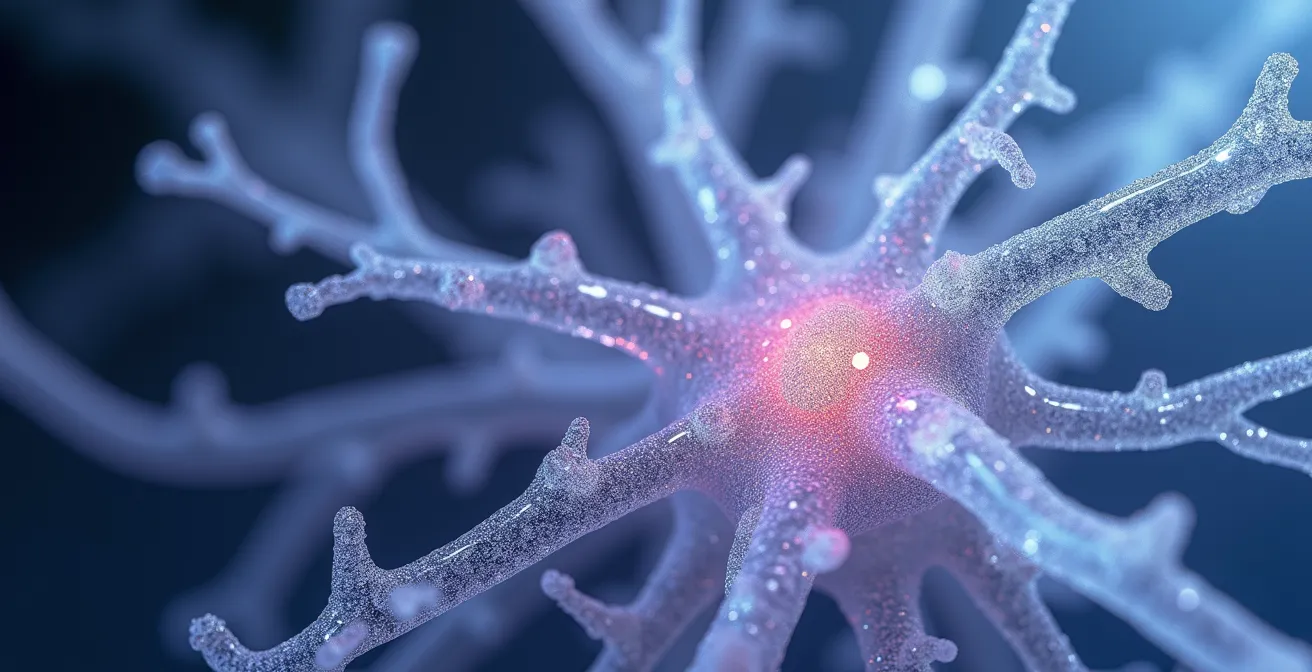
At a molecular level, this growth is fueled by proteins like Brain-Derived Neurotrophic Factor (BDNF). When the brain is challenged and engaged, the production of BDNF increases. This vital protein acts as a kind of fertilizer for neurons, promoting their growth, survival, and the formation of new synapses (the connections between neurons). As explained by researchers in *Frontiers in Molecular Neuroscience*, BDNF is particularly active in the cortex and hippocampus, areas vital for learning, memory, and higher thinking. Therefore, a monthly museum visit can be seen as a regular dose of this essential “brain fertilizer,” contributing directly to the physical maintenance and growth of your neural architecture.
Why You Don’t Check Your Phone in a Theater (But Do at the Cinema)?
Consider the social etiquette of two different venues: a live theater and a movie cinema. In a cinema, it’s common (though often frowned upon) to see the glow of a phone screen. In a live theater, such an act is a far greater transgression. This difference in social pressure is not arbitrary; it points to a profound neurological distinction in how we experience live versus recorded performances.
The key lies in the concept of shared presence. During a live performance, the audience and the performers are breathing the same air, sharing the same physical space. This co-presence creates a powerful, unspoken social contract. Research has revealed a fascinating phenomenon known as intersubjective synchrony, where audience members’ physiological responses—such as heart rates, breathing patterns, and even brain waves—begin to align with one another and with the performers. You become part of a temporary collective, a unified entity sharing a singular emotional and physiological experience.
This shared state creates a powerful feedback loop. The audience’s focused attention energizes the performers, whose heightened performance in turn captivates the audience more deeply. Breaking this loop by checking your phone is not just a personal distraction; it’s a violation of the collective experience. In a cinema, you are a collection of individuals watching a screen. In a theater, you are a component of a live, interconnected event. This neurological and physiological synchrony is impossible to replicate with recorded media and explains why the social rules of engagement are so much stricter in the presence of live human beings.
Key Takeaways
- Regular cultural engagement isn’t just stimulating; it actively remodels the brain by forcing it to build new connections and pathways.
- The effectiveness of a museum visit depends on the method: “slow looking” and social interaction are far more beneficial than passive, rushed viewing.
- The experience is holistic, involving a cognitive load from physical posture (proprioception) and a deep neurological response to the real-world presence of others (synchrony, mirror neurons).
Live Theater vs Netflix: Why the Brain Reacts Differently to Real Presence?
The powerful sense of connection felt during a live performance, whether at a museum tour or in a theater, goes deeper than social etiquette. It is hardwired into our neurology. Our brains are exquisitely tuned to respond to the presence of other real, three-dimensional human beings. This is largely due to the mirror neuron system, a network of brain cells that fire both when we perform an action and when we observe someone else performing that same action. It’s the basis of empathy and our ability to understand others’ intentions and emotions.
As researcher Paul Camic notes, this system responds with far greater intensity to observing real people in a shared space than it does to a flat, two-dimensional image on a screen. Watching an actor cry on Netflix might elicit a mild empathic response, but witnessing a performer express that same raw emotion a few feet away triggers a much deeper and more complex neurological event. Your mirror neurons are firing in high gear, simulating that emotion within your own brain, leading to a richer, more visceral empathic experience. This is a level of neural engagement that digitally mediated content cannot replicate.
The mirror neuron system responds far more intensely to seeing real, three-dimensional human bodies expressing emotion in shared space than to a 2D representation, leading to a neurologically deeper empathic experience.
– Paul Camic, Research on Museum-based Interventions for Dementia
This deep engagement has profound long-term consequences for cognitive health. It contributes to what neuroscientists call cognitive reserve—the brain’s ability to withstand neurological damage. By regularly engaging in complex, real-world social and emotional processing, you are building a more resilient and flexible brain. This is powerfully supported by The English Longitudinal Study of Ageing, which found that regular cultural engagement was associated with a 49% lower dementia incidence over a 10-year period. The data confirms what our brains already know: real presence matters.
The evidence is clear: a monthly museum visit is not a passive hobby but a deliberate, powerful investment in your long-term cognitive vitality. The next logical step is to integrate these findings into your own life by scheduling your next visit, armed with the knowledge to make it a truly brain-building experience.