
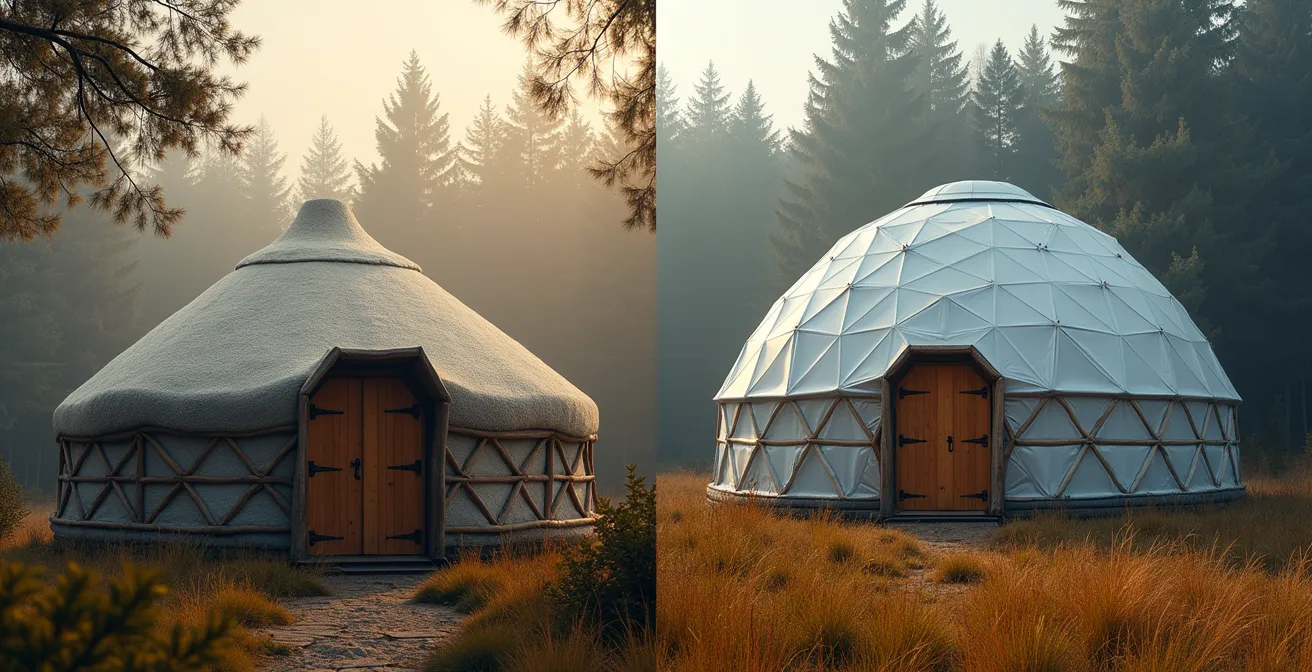
The debate over yurt vs. dome insulation misses the point; true glamping comfort comes from mastering the entire ‘building envelope,’ not just the structure’s shape.
- A structure’s R-value is only one part of thermal performance; air-tightness and moisture management are equally critical to prevent drafts and condensation.
- The best choice depends on the climate and how the site operator manages these interconnected systems, from floor insulation to ventilation.
Recommendation: Instead of asking “yurt or dome?”, ask potential hosts “how do you manage your building envelope to ensure four-season comfort?”
The promise of glamping is seductive: immersion in nature without sacrificing the comforts of a boutique hotel. Yet, for many would-be adventurers, a single fear looms large: being cold. This anxiety often funnels into a seemingly crucial question: which is warmer, a yurt or a geodesic dome? The internet offers simple answers, pitting the dome’s geometric efficiency against the yurt’s traditional, layered insulation. You’ll hear that domes have less surface area for heat loss and that yurts “breathe” better.
But from an architectural perspective, this debate is a red herring. It’s like asking whether a wool coat or a rain jacket is “better” without considering if you’re in a dry desert or a humid rainforest. True thermal comfort is not a feature of a shape, but the result of a holistically designed system. The key isn’t the structure itself, but the integrity of its building envelope—the complete barrier between the cozy interior and the wild exterior. This includes not just the walls and roof, but the floor, windows, and the seams that join them.
If the real secret to a comfortable stay lies in mastering the interplay of insulation, airtightness, and moisture control, then our focus must expand. A truly exceptional glamping experience depends on getting all the details right, from the fundamental systems we don’t see, like eco-plumbing, to the very quality of our sleep. This guide will move beyond the superficial yurt-versus-dome question to explore the critical elements that truly define comfort and luxury in the wild.
To help you plan an experience that delivers on its promise of comfort and connection, we will explore the often-overlooked logistical and experiential details that make or break a glamping holiday. This table of contents outlines the key questions every discerning traveler should ask.
Contents : An Architect’s Field Guide to Glamping Logistics and Comfort
- Composting Toilets: How to Deal with “Eco-Plumbing” Without Horror Stories?
- Treehouse vs. Underwater Hotel: Which Experience Is Worth the $500/Night?
- The “Hotel but Outside” Packing List: What Amenities Are Usually Missing?
- Locks and Canvas: How Secure Are You in a Bubble Tent?
- When to Book: Why Treehouses Sell Out 9 Months in Advance?
- Air Mattress vs. Cot: Which Setup Prevents Back Pain for Parents?
- Wellness Retreat or City Break: Which Solo Trip Suits Your Personality?
- How to Plan Your First Solo Trip to Reconnect With Yourself?
Composting Toilets: How to Deal with “Eco-Plumbing” Without Horror Stories?
The term “eco-plumbing” can conjure images of unpleasant odors and complicated rules, but a well-managed composting toilet is a marvel of sustainable design. The horror stories almost always stem from one of two failures: improper use or a breakdown of the biological process. The key is maintaining the right conditions for aerobic bacteria to do their work, which primarily means managing moisture and temperature. A common misconception is that they are simply passive bins; in reality, they are active biological systems.
The process works by separating liquids from solids and providing carbon-rich material (like sawdust or coconut coir) to balance the nitrogen in the waste, eliminating odors and facilitating decomposition. The challenge in many glamping scenarios is climate. The composting process slows dramatically in the cold; a study confirms that composting toilets require temperatures to remain above 32°F (0°C) to be effective. This is a critical question to ask a host if you’re booking a winter stay.
For a glamping site to offer a seamless experience, they must have a robust cold-weather protocol. This isn’t just about insulation; it’s about active management. Key strategies include:
- Creating a warm enclosure around the active composting chamber, often using insulated walls or even straw bales.
- Diligently sealing all gaps to prevent cold drafts, which are more detrimental than poor insulation.
- Using a small, low-wattage electric heating pad to maintain a stable core temperature within the compost pile.
- Emptying the liquid waste bottle frequently before freezing conditions arrive to prevent it from cracking.
When a host understands these principles, the composting toilet becomes an invisible, odorless part of the sustainable luxury experience rather than a memorable part of a horror story.
Treehouse vs. Underwater Hotel: Which Experience Is Worth the $500/Night?
At the highest end of unique accommodations, the choice is less about comfort—which is a given—and more about the nature of the experience itself. A $500/night price tag is a gateway to two fundamentally different worlds: the ethereal, elevated perspective of a treehouse versus the immersive, sub-aquatic mystery of an underwater room. Deciding which is “worth it” is a matter of personal aspiration: do you want to feel like you’re floating above the world or becoming a part of a hidden one?
The luxury treehouse experience is about architecture harmonizing with nature. It offers panoramic views, the sound of wind in the leaves, and a sense of serene detachment. The design focuses on bringing the outside in, with large windows, natural materials, and balconies that place you amidst the canopy. In contrast, the underwater hotel is about creating a portal to an alien environment. It’s an experience defined by wonder and the surreal feeling of observing marine life in its natural habitat from the safety of a climate-controlled cocoon.
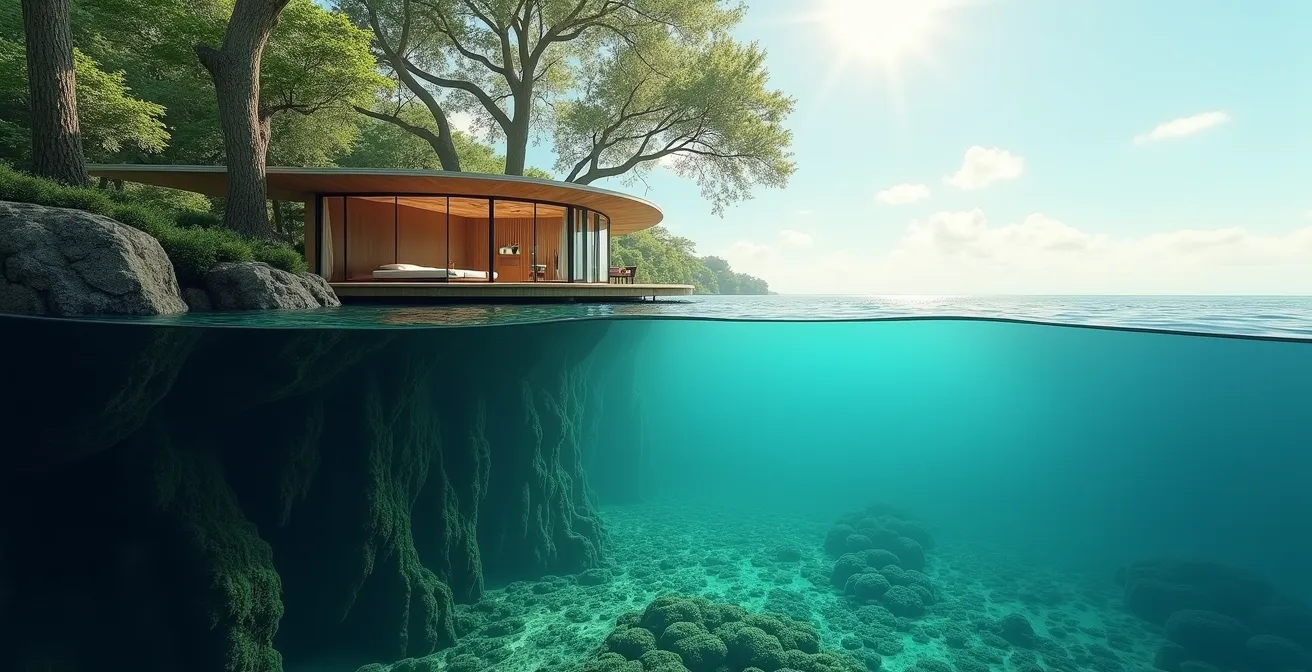
While a luxury treehouse might cost a few thousand dollars a night, true underwater rooms are in a different league entirely; for example, The Muraka suite at Conrad Maldives costs from $9,000 to over $50,000 per night. However, more accessible options exist that prioritize the experience over opulence.
Case Study: The Jules’ Undersea Lodge Experience
Jules’ Undersea Lodge in Florida offers a prime example of adventure over pure luxury. Housed in a former underwater laboratory 21 feet below the surface, guests must literally scuba dive to enter their quarters. The accommodations are functional—bunk beds and a communal area—but the experience is unparalleled. It’s less about thread count and more about the profound, educational thrill of living, even for a night, beneath the waves. It proves that a unique lodging experience’s value is not always measured in its luxuriousness but in its capacity to create a lifelong memory.
Choose the treehouse for quiet contemplation and a connection to the terrestrial world. Choose the underwater room for a mind-bending adventure and a story that few can tell.
The “Hotel but Outside” Packing List: What Amenities Are Usually Missing?
The phrase “glamping” promises a hotel-level experience in a natural setting, but the reality often exists in a gray area between a rustic campsite and a four-star resort. The most common source of discomfort isn’t a lack of big-ticket items like a comfy bed, but the absence of small, thoughtful amenities that mitigate the realities of living in a fabric structure. A successful glamping architect designs for these nuances, but a smart traveler packs for them, just in case.
Even the most well-designed yurt or dome has inherent vulnerabilities that a traditional building doesn’t. Canvas breathes, domes can echo, and floors are often elevated off the cold ground. These aren’t design flaws, but characteristics of the form. As the experts at Glamping Dome Store note, while domes are structurally superior in many ways, personal comfort still requires attention to detail.
Domes are very aerodynamic and can withstand hurricane winds without collapsing if properly anchored. Secondly, domes are much more energy efficient as the surface and energy losses are minimal.
– Glamping Dome Store, FAQ on dome structures vs yurts
Even in that energy-efficient dome, you might feel a draft from the door or be woken by rain noise. Your comfort kit should focus on tackling these three areas: thermal gaps, sound pollution, and light pollution. These are the small things that separate feeling like you’re in a “hotel outside” from just feeling like you’re… outside. A well-prepared glamper arrives with a small bag of tricks to perfect their environment:
- For Thermal Gaps: Pack draft stoppers for the bottom of doors and a pair of thick, insulated slippers for cold floors, a common issue in structures on platforms.
- For Humidity Control: In airtight domes, condensation can be an issue. A portable hygrometer and a small rechargeable dehumidifier can make a huge difference.
- For Sound & Light: A white noise machine or high-quality earplugs are essential to block the sound of wind and rain on canvas or PVC. A quality sleep mask is a must for domes with large skylights or yurts where morning light penetrates the crown.
Packing these items ensures that you can fine-tune your environment for a truly restful experience, regardless of any minor imperfections in the structure’s design.
Locks and Canvas: How Secure Are You in a Bubble Tent?
The idea of sleeping in a structure with soft walls can feel vulnerable. When we talk about security in glamping, it’s a two-part conversation: personal security (from intruders) and structural security (from the elements). Most glamping sites address personal security through location—they are often on private, managed land far from public access, making the risk of intrusion very low. While a fabric wall is not a deadbolt, the primary security feature is the remoteness and oversight of the site.
The more relevant and technical question is about structural security against weather. A flimsy tent in a storm is terrifying; a high-performance glamping structure is an engineering feat. This is where the architectural differences between yurts and domes become a critical safety feature. Geodesic domes are famously resilient due to their incredible strength-to-weight ratio and aerodynamic profile. Their ability to distribute stress across the entire structure makes them exceptionally stable in high winds and heavy snow loads.
Case Study: The Hurricane Andrew Dome Survivors
The legendary resilience of geodesic domes was proven after Hurricane Andrew in 1992. In a Florida neighborhood that was otherwise devastated, a cluster of residential geodomes survived the catastrophic winds with minimal damage. Their inherent structural integrity kept them intact while conventional homes around them were destroyed. This real-world event demonstrates that a well-built dome provides a level of storm security that far exceeds its lightweight appearance.
However, modern yurts are not to be underestimated. While traditional yurts rely on a tension system that can be vulnerable, engineered yurts built for four-season climates are robustly designed. Performance yurt companies use high-tech fabrics, aircraft-grade cables, and structural upgrades to handle extreme weather. For instance, specialized yurts are engineered so that WeatherPort Yurts can withstand up to 120 MPH winds and significant snow loads. The key is that the yurt must be specifically engineered for such conditions and anchored to a proper foundation.
Ultimately, whether in a dome or an engineered yurt, your security is a function of design and location. You are far safer from the elements in one of these structures than in any traditional tent, and the secluded nature of most sites is your best defense for personal security.
When to Book: Why Treehouses Sell Out 9 Months in Advance?
The most sought-after glamping experiences, especially unique structures like luxury treehouses, operate on a booking rhythm more akin to a Michelin-star restaurant than a typical hotel. It’s not uncommon for popular locations to be fully booked 9 to 12 months in advance, a reality that often surprises travelers. This high demand isn’t just hype; it’s a direct result of extreme scarcity and seasonal appeal. Unlike a hotel with hundreds of identical rooms, a signature treehouse is often a one-of-a-kind architectural creation.
This scarcity is compounded by powerful seasonal demand. The ideal time to experience a treehouse is during peak foliage in autumn or the lush greenery of summer, concentrating demand into a few key months. During this peak, operators can command premium prices. It’s common for rates to jump significantly, with some exclusive treehouse suites costing up to $1,500 per night or more. This price fluctuation is a core part of the business model, rewarding those who plan far ahead with access, if not always lower prices.

The financial logic becomes clear when looking at the seasonal pricing structure of a high-end property. The difference between booking a stay in the off-season versus peak summer is not trivial and reflects the immense pressure on inventory during those ideal months.
| Season | Standard Suite | Family Suite |
|---|---|---|
| Off-Season | $1,000/night | $3,500/night |
| Peak Summer | $1,500/night | $5,500/night |
To secure your stay in one of these architectural gems, you must adopt a long-range planning mindset. Set alerts, subscribe to property newsletters for opening announcements, and be prepared to book the moment your desired dates become available—even if it’s for next year.
Air Mattress vs. Cot: Which Setup Prevents Back Pain for Parents?
For parents on a glamping trip, a good night’s sleep is non-negotiable, and the choice between an air mattress and a cot can have a major impact on back health. An air mattress offers adjustable firmness and a larger, more uniform sleeping surface, which can feel more like a traditional bed. However, they are prone to losing air overnight, leading to a soft, unsupportive surface that can cause back pain. Cots, on the other hand, provide consistent, firm support and elevate you off the floor. But their taut fabric can create pressure points for side-sleepers.
From a functional design perspective, however, the “best” choice is incomplete without considering the thermal environment. Your body’s comfort is directly affected by the cold. A cot, while supportive, allows air to circulate underneath you. If the floor is cold, this creates a “convective loop” that constantly saps your body heat, leading to stiffness and discomfort that you might mistake for a bad mattress. This is where the structure’s building envelope, specifically the floor insulation, comes into play.
A well-designed glamping structure will have an insulated platform. The effectiveness of this insulation is measured by its R-value. A higher R-value means better thermal resistance. For example, some high-performance yurts can be equipped with flooring systems where Rainier Outdoor’s double-layer reflective insulation achieves an R-value of R10, creating a strong thermal break from the cold ground. On a floor this well-insulated, a cot is an excellent choice. On an uninsulated floor, an air mattress will be warmer, as the volume of air inside it acts as a buffer. The best solution of all is a cot with an insulated sleeping pad on top, giving you both structural support and a thermal barrier.
Therefore, before you decide, ask the host about the floor’s insulation. If it’s well-insulated, a cot will likely offer superior back support. If not, a high-quality, insulated air mattress is probably the warmer and more comfortable option.
Wellness Retreat or City Break: Which Solo Trip Suits Your Personality?
Choosing a solo trip is an exercise in self-knowledge. The decision between a stimulating city break and a restorative wellness retreat hinges on your goal: are you seeking external input or internal connection? A city break is about discovery—new foods, art, and the energy of the crowd. It’s perfect for the extroverted traveler or anyone feeling a deficit of novelty. A wellness retreat, particularly one set in nature, is about disconnection from that noise. It’s for the traveler seeking to lower their cortisol levels, quiet their mind, and reconnect with their own thoughts.
If you lean towards a wellness retreat, the quality of the environment is paramount. “Wellness” is not just an aesthetic of yoga mats and green juice; it’s the active removal of stressors. One of the most overlooked but crucial factors is acoustic privacy. The goal of a retreat is to hear yourself think, which is impossible if you can hear your neighbor’s conversation. This is where the material science of a glamping structure becomes a vital part of the wellness experience.
A single-layer PVC dome, for example, can be an echo chamber where rain sounds like a drum solo. A traditional felted yurt, by contrast, has excellent sound-dampening properties. A truly wellness-oriented glamping site will have invested in acoustic comfort. They will use multi-layer insulation systems, sound-dampening materials, and site planning that provides ample space between units. Before booking what looks like a peaceful escape, it’s essential to audit its potential for true quiet.
Your Acoustic Comfort Audit Checklist for a Wellness Retreat
- Insulation Value: Ask about the R-value of the insulation; better thermal insulation often correlates with better sound-dampening.
- Condensation Systems: Inquire about condensation management, as dripping water can be a source of noise and discomfort.
- Sound Dampening: Verify if structures use specific sound dampening materials, like thick felted layers in yurts versus single-layer domes.
- Unit Spacing: Request information about acoustic privacy between units—how far apart are they, and are there natural sound barriers like trees?
- Ventilation: Ask about natural ventilation features versus mechanical systems, as a loud HVAC unit can ruin a quiet evening.
By asking these questions, you move beyond the marketing photos and ensure your investment in a wellness retreat delivers its most important promise: a truly restorative and peaceful environment.
Key Takeaways
- True glamping comfort is a system: It’s not about choosing a yurt or a dome, but about how well the ‘building envelope’—insulation, airtightness, and ventilation—is managed as a whole.
- Experience is a design choice: High-end accommodations like treehouses and underwater hotels are not just places to sleep; they are curated experiences designed for either serene elevation or immersive wonder.
- Details define luxury: The difference between a good and a great glamping stay often lies in small, thoughtful details like acoustic privacy, light-blocking, and managing thermal gaps.
How to Plan Your First Solo Trip to Reconnect With Yourself?
Planning a first solo trip to reconnect with yourself is less about the destination and more about creating the right conditions for introspection. The goal is to strip away the daily demands and distractions—your job, social obligations, even the subtle negotiations of traveling with others—to create space for your own thoughts to surface. The most effective way to do this is by curating an environment of profound comfort and minimal friction.
This means your planning should prioritize the elimination of all physical and mental stressors. A beautiful view is meaningless if you’re shivering. The quiet of nature is lost if you’re worried about the security of your tent. This is why a well-chosen, high-quality glamping experience can be the perfect vessel for a solo journey. It provides the immersion in nature you crave, but with a foundational layer of comfort and security that allows your mind to truly relax. When vetting a location, think like an architect: focus on the quality of the building envelope.
Does the structure use modern insulation to ensure a stable temperature? High-tech reflective insulation can reflect 95-97% of radiant heat, keeping you warm at night and cool during the day, a crucial element for deep rest. Have they considered acoustics? Is the site plan designed for privacy? This holistic approach to comfort is the bedrock of a successful solo retreat. It’s about creating a space so seamless and supportive that the structure itself disappears, leaving only you and your thoughts.
This brings us back to the central theme: comfort is a result of thoughtful design, not a single material or shape. As a leading yurt engineer wisely states, focusing on one metric, like R-value, is missing the bigger picture.
A high R-value is important, but it is not the final word. That’s why the engineering and design of our yurts is just as important as the effectiveness of our insulation options.
– WeatherPort, Extreme Climate Yurt Guide
Your first solo trip is an investment in yourself. Ensure its success by choosing a sanctuary engineered for total comfort, allowing you the physical and mental space to fully reconnect.