

Splashing cold water on your face is more than a folk remedy; it’s a direct physiological command to your brain. This technique intentionally triggers the Mammalian Dive Reflex, a powerful, dormant evolutionary circuit. By activating the trigeminal and vagus nerves, it forces your body out of a ‘fight-or-flight’ state and into a ‘rest-and-digest’ mode within seconds. This article decodes the neurobiology behind this process, giving you a clinical tool to reclaim control from chronic stress and anxiety.
For many high-stress individuals, the feeling of being perpetually “on” is a clinical reality. Your heart races, your thoughts loop, and even in moments of quiet, your body remains braced for a threat that never fully materializes. You are told to “just relax” or “breathe deeply,” but these platitudes often feel insultingly simplistic when your entire physiology is locked in a state of high alert. This chronic activation of the sympathetic nervous system—your body’s ‘fight-or-flight’ response—is a difficult cycle to break through conscious thought alone.
But what if there was a way to bypass the anxious mind and communicate directly with the control center of your autonomic nervous system? The answer lies not in a new-age wellness trend, but in a deeply embedded evolutionary reflex that all mammals possess. The key is not simply about cooling down; it is about leveraging a precise neurobiological mechanism: the Mammalian Dive Reflex. This article will deconstruct the fascinating science behind vagus nerve stimulation, starting with its most potent trigger—cold water on the face. We will explore the physiological cascade that shifts your body from a state of panic to one of calm, examine complementary techniques that reinforce this reset, and provide a clinical protocol to turn this knowledge into an immediate, actionable tool against overwhelming stress.
For those who prefer a visual demonstration, the following video offers a practical overview of the core mechanism we are about to explore: the Mammalian Dive Reflex, a key skill in Dialectical Behavior Therapy (DBT) for anxiety reduction.
To navigate the complex yet fascinating landscape of your own nervous system, this guide is structured to build your understanding from the foundational problem of chronic stress to a suite of practical, science-backed interventions. Explore the sections below to master the art of physiological self-regulation.
Summary: A Clinical Guide to Nervous System Regulation
- Why Chronic Stress Keeps Your Body in “Survival Mode” Even While Sleeping?
- How Humming Low Frequencies Stimulates the Vagus Nerve Instantly?
- HRV Explained: What Your Heart Rate Variability Says About Your Burnout Risk?
- The Subtle Sign of Jaw Clenching That Predicts a Migraine
- When to Take a “Micro-Break”: The 90-Minute Focus Limit
- Why the “Box Breathing” Technique Lowers Heart Rate in 60 Seconds?
- Why a 30-Second Cold Shower Boosts Dopamine for Hours?
- How to Practice “Micro-Mindfulness” During High-Pressure Zoom Calls?
Why Chronic Stress Keeps Your Body in “Survival Mode” Even While Sleeping?
To understand why your body remains on high alert, we must first examine the two competing branches of your Autonomic Nervous System (ANS). The sympathetic nervous system (SNS) is your ‘gas pedal,’ initiating the “fight-or-flight” response. Conversely, the parasympathetic nervous system (PNS) is your ‘brake pedal,’ managing the “rest-and-digest” state. In a healthy system, these two work in a dynamic balance. However, chronic stress—from work deadlines, personal conflict, or persistent anxiety—causes the SNS to become chronically dominant. Your brain, through a subconscious process called neuroception, continually perceives threat even when none exists, flooding your system with stress hormones like cortisol and adrenaline.
This state of hypervigilance doesn’t simply turn off when you go to bed. A dominant SNS can lead to difficulty falling asleep, restless nights, and waking up feeling unrefreshed, as your body is not fully entering the deeply restorative parasympathetic state. The master controller of this parasympathetic response is the vagus nerve. As the longest cranial nerve, it acts as a superhighway of information between the brain and the body’s vital organs.
As neuroscientist Dr. Stephen Porges describes in his foundational work, the vagus nerve is a remarkable structure:
The longest in our body; wandering from the brain stem through various organs including the pharynx, larynx, esophagus, nerves of the heart, stomach, pancreas and liver
– Dr. Stephen Porges, The Polyvagal Theory
When your system is stuck in survival mode, it’s because the signal from the vagus nerve is too weak to override the SNS alarm. Therefore, resetting your nervous system is not about ‘thinking’ your way to calm; it’s about finding physiological ways to directly stimulate the vagus nerve and strengthen its signal, or “vagal tone.”
How Humming Low Frequencies Stimulates the Vagus Nerve Instantly?
One of the most accessible and immediate methods for vagal stimulation involves using your own voice. The vagus nerve heavily innervates the vocal cords and the muscles in the back of your throat. When you hum, chant, or even gargle, the resulting vibrations create a direct mechanical stimulation of these nerve endings. This sends a powerful signal up to the brainstem, indicating that you are safe and activating the parasympathetic “rest-and-digest” response. The effect is not merely psychological; it is a tangible physiological event.
Low-frequency sounds are particularly effective. Think of the deep, resonant “Om” chant in yoga or the simple act of humming a low note. These frequencies generate a more significant vibration, leading to a more robust activation of the vagal pathways. Research into this phenomenon has yielded impressive results, demonstrating that this simple practice can produce a substantial shift in autonomic function. For instance, some scientists found humming for just 15 minutes resulted in a remarkable 176% enhancement in measurements of vagus nerve function.
This makes humming a discreet and potent tool for managing acute stress. Unlike deep breathing, which can be noticeable, a quiet hum can be practiced almost anywhere—at your desk, in your car, or even in a bathroom stall before a stressful meeting. It acts as a quick “reboot,” interrupting the sympathetic stress loop and nudging your body back toward a state of equilibrium. The key is the physical vibration, which serves as a clear, non-negotiable signal to your brain to engage the body’s innate calming mechanisms.
HRV Explained: What Your Heart Rate Variability Says About Your Burnout Risk?
While your heart rate measures the number of beats per minute, Heart Rate Variability (HRV) measures the minuscule variations in time *between* each of those beats. Contrary to what you might think, a highly regular, metronomic heartbeat is a sign of a stressed system. A healthy, resilient nervous system is adaptable, and this adaptability is reflected in a high HRV. A high HRV indicates a strong “vagal tone,” meaning your parasympathetic nervous system is actively modulating your heart rate in response to your breath and environment, ready to apply the ‘brakes’ at any moment.
Conversely, a low HRV is a clinical marker of sympathetic dominance. It signals that your ‘fight-or-flight’ system is in control and your body has lost its ability to adapt and recover efficiently. Chronic stress, poor sleep, and overtraining progressively lower your HRV, making it a powerful leading indicator for burnout. Before you experience the full cognitive and emotional symptoms of burnout, your HRV will likely have been declining for weeks or months, serving as an early warning sign from your physiology.
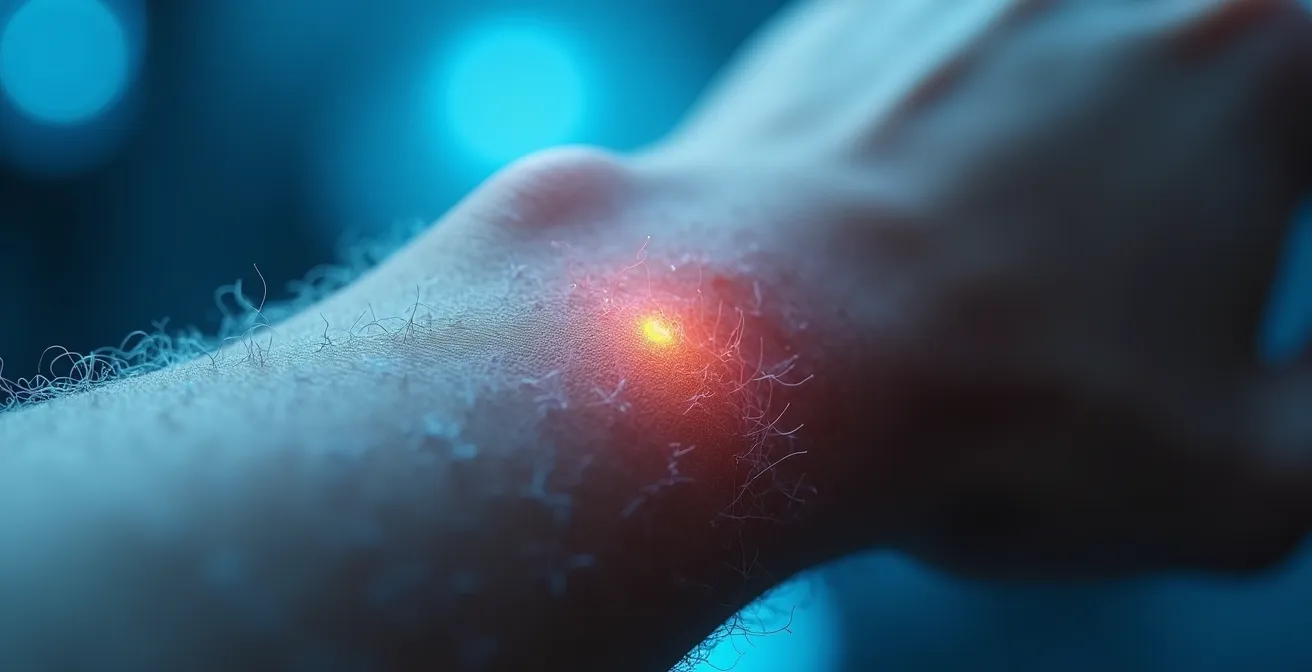
As the image illustrates, monitoring HRV provides a direct window into the functional state of your vagus nerve. Many modern wearables now track this metric, allowing you to see the real-time impact of your lifestyle choices. A stressful day, a poor night’s sleep, or an illness will cause a noticeable drop in HRV. Conversely, incorporating practices like meditation, quality sleep, and the vagal stimulation techniques discussed in this article will lead to a measurable increase in your HRV, reflecting enhanced resilience and a well-regulated nervous system.
The Subtle Sign of Jaw Clenching That Predicts a Migraine
One of the most common physical manifestations of chronic stress is bruxism, or the unconscious clenching and grinding of the jaw, particularly during sleep. This tension is not isolated to the jaw muscles; it is directly linked to the trigeminal nerve, the largest of the cranial nerves, responsible for sensation in the face. When this nerve is chronically irritated by muscular tension, it can become a key trigger for tension headaches and even migraines. This makes jaw clenching a subtle but significant predictive sign that your nervous system is overloaded.
However, the trigeminal nerve also holds the secret to one of the most powerful nervous system resets. While its irritation causes problems, its deliberate stimulation triggers a profound calming reflex. This is the core of the Mammalian Dive Reflex. When your face—specifically the areas around the nose, cheeks, and forehead, which are rich in trigeminal receptors—is exposed to cold water, it sends an urgent signal to the brainstem. This signal activates a cross-pathway to the vagus nerve, immediately initiating a parasympathetic response.
The primary effect is a rapid slowing of the heart rate, a phenomenon known as bradycardia. As a study on the trigeminal-vagal reflex highlights, this response is potent. Research comparing age groups found that immersing the face in cold water induced a more significant heart rate drop in middle-aged participants than in younger adults, demonstrating an enhanced trigeminal-vagal reflex activation with age. This isn’t just a minor fluctuation; it’s a hardwired evolutionary response designed to conserve oxygen during underwater submersion, and we can leverage it on dry land to stop a panic response in its tracks.
Holding your breath and putting cold water on your face, or just an ice pack, will trigger the diving reflex, which dramatically decreases your heart rate.
– John Campbell, University of Virginia Neurobiology Lab
When to Take a “Micro-Break”: The 90-Minute Focus Limit
Our brains operate on natural cycles of focus and rest known as ultradian rhythms, which typically last around 90 minutes. Pushing past this limit without a break leads to diminished cognitive function, increased stress, and a sharp decline in productivity. The key to sustained performance is not to eliminate stress, but to punctuate periods of high focus with deliberate periods of recovery. This is where the concept of a “micro-break” becomes a strategic necessity. However, not all breaks are created equal.
Many common break-time activities, such as scrolling through social media or checking email, are not true recovery. They are “passive recovery” at best and can often maintain or even increase sympathetic nervous system activation. In contrast, active recovery techniques are designed to intentionally engage the parasympathetic nervous system to accelerate physiological restoration. Cold water facial immersion is perhaps the most efficient form of active recovery, forcing a rapid down-regulation of the stress response.
The following table, based on an analysis of recovery techniques, starkly contrasts the impact of different micro-break strategies on your nervous system.
| Recovery Type | Technique | Duration | Effect on Nervous System |
|---|---|---|---|
| Active Recovery | Cold water face immersion | 10-30 seconds | Immediate vagus nerve activation |
| Active Recovery | Box breathing with cold compress | 2-4 minutes | Parasympathetic dominance |
| Passive Recovery | Social media scrolling | Variable | Continued sympathetic activation |
| Passive Recovery | Email checking | Variable | Maintains stress response |
By strategically scheduling a 90-second active recovery break every 90 minutes, you can reset your focus and prevent the cumulative buildup of stress hormones. The following protocol provides a step-by-step guide to performing this powerful micro-break.
Your 5-Step Protocol: Activating the Mammalian Dive Reflex
- Fill a bowl with cool to cold water (10-20°C is sufficient); ice is not necessary initially for the effect.
- Take a calm, deep inhale through your nose, then gently lower your face into the water, ensuring your eyes, nose, and cheeks are submerged.
- Hold for 10-30 seconds, or as long as is comfortable, without straining. Focus on the sensation of the cold.
- Lift your face from the water and exhale slowly and completely through your mouth, noticing the immediate slowing of your heart rate.
- Repeat this cycle 2-3 times if needed, with a short break in between, to deepen the calming effect and fully reset your state.
Why the “Box Breathing” Technique Lowers Heart Rate in 60 Seconds?
Box breathing, a technique utilized by elite performers from Navy SEALs to surgeons, is a powerful method for gaining conscious control over autonomic functions. Its effectiveness lies in its simple, rhythmic structure: inhale for four seconds, hold for four, exhale for four, and hold for four. This pattern directly manipulates the key players in your nervous system. The slow, controlled inhalation stimulates the sympathetic system slightly, while the extended exhalation robustly activates the parasympathetic vagus nerve, signaling the body to calm down.
The most critical component, however, is the breath-hold. Holding the breath at the top and bottom of the cycle allows for a temporary increase in carbon dioxide (CO2) levels in the bloodstream. Your brainstem is exquisitely sensitive to CO2; a slight rise is a primary signal to increase vagal tone and slow the heart rate to improve gas exchange efficiency. By intentionally manipulating CO2 levels in this controlled manner, you are essentially hijacking the body’s own feedback loops to command a state of calm. This is far more effective than simply being told to “take a deep breath,” which can sometimes lead to hyperventilation and increased anxiety if done incorrectly.

The structured nature of box breathing also provides a cognitive anchor. During a high-stress moment, focusing on the simple count of ‘four’ occupies the prefrontal cortex, interrupting the cycle of anxious thoughts and preventing your mind from spiraling. This combination of physiological and psychological intervention is what makes the technique so rapidly effective. Similarly, other forms of cold stimulation, like drinking cold water, can also activate these pathways; one study noted a 39% increase in vagus nerve activity in people who drank ice water.
Key Takeaways
- Cold facial immersion triggers the Mammalian Dive Reflex, a direct and potent neurobiological pathway to vagus nerve activation.
- Vagal tone, which is clinically measurable by Heart Rate Variability (HRV), is the most accurate indicator of your nervous system’s resilience to stress.
- Techniques like humming, box breathing, and cold exposure are not just ‘relaxing’; they are precise physiological interventions that shift your autonomic state from sympathetic (stress) to parasympathetic (calm).
Why a 30-Second Cold Shower Boosts Dopamine for Hours?
While a cold shower might seem like a purely physical shock, its most profound effects are neurochemical. The sudden, intense cold exposure is a form of hormetic stress—a beneficial, low-dose stressor that stimulates the body to become more resilient. When the cold receptors in your skin are activated en masse, it sends a massive electrical impulse to the brain, triggering a significant release of norepinephrine. This neurotransmitter is crucial for focus, vigilance, and mood. It effectively “wakes up” your brain, shaking off the fog of fatigue or anxiety.
More remarkably, this cold-induced norepinephrine flood is followed by a prolonged release of dopamine, the neurotransmitter associated with motivation, reward, and pleasure. Unlike the fleeting highs from other dopamine triggers, the effect from cold exposure is sustained, leading to an elevated mood and increased motivation that can last for hours. This is not just a feeling; it’s a measurable neurochemical shift that counteracts the depletion caused by chronic stress. Studies on more intensive cold exposure, such as cold water baths, have found they can deliver up to a 280% boost in vagus nerve activity, showcasing the dose-dependent power of cold therapy.
This powerful biological response has shown significant promise in clinical settings, particularly for conditions rooted in nervous system dysregulation, like PTSD. The experience of individuals who have used this therapy provides compelling evidence of its transformative potential.
I’d throw myself into the chilly morning waters and splash around until I figured out how to control my breathing. I started to notice how much better I felt on the days that I swam. My brain felt alive and in the moment. I felt calmer, a feeling that would last from my 9 am swim until finishing work late at night. My memory started getting better too, probably because it was so much easier to focus.
– Justin Faraday, PTSD UK
A short, 30-second blast of cold at the end of your regular shower is enough to initiate this beneficial cascade. It’s a challenging but highly effective practice for building both psychological and physiological resilience.
How to Practice “Micro-Mindfulness” During High-Pressure Zoom Calls?
The principles of nervous system regulation are not reserved for dedicated breaks; they can be integrated into the most stressful moments of your day. High-pressure situations like a critical Zoom call trigger a sympathetic response, but you can counteract this in real-time using subtle “micro-mindfulness” techniques. The goal is not to zone out, but to remain present and grounded while actively managing your physiology. These are covert interventions that no one else on the call will notice.
One of the most effective techniques is subtle vagal breathing. While maintaining a neutral facial expression, shift to a breathing pattern where your exhale is slightly longer than your inhale (e.g., inhale for 4 counts, exhale for 6). This gently stimulates the vagus nerve without the noticeable structure of box breathing. Another technique is to discreetly press your tongue against the roof of your mouth, which can help relax the jaw and reduce trigeminal nerve tension. You can also press your thumb firmly into the palm of your opposite hand, a simple acupressure technique that diverts sensory input and grounds you in the physical moment.
These micro-interventions act as anchors, preventing your nervous system from being fully hijacked by the stress of the situation. They are small, deliberate acts of parasympathetic activation that accumulate over time, increasing your overall resilience. The speed of these interventions is remarkable; studies using a cold compress on the neck (another discreet option) have shown a measurable reduction in heart rate in just 16 seconds. This toolbox of techniques allows you to move from being a passive victim of your stress response to an active regulator of your own physiological state, even under pressure.
Begin integrating these neurobiological tools today not just to manage stress, but to fundamentally retrain your nervous system’s response to it. By consciously practicing these techniques, you are building new neural pathways, increasing your baseline vagal tone, and reclaiming control over your physiological and psychological well-being.
Frequently Asked Questions About Cold Water Therapy
Is cold water face immersion safe for everyone?
People with heart conditions should consult their doctor first, as cold water can briefly slow heart rate. Those with Raynaud’s syndrome should avoid it as cold can trigger vascular spasms.
What temperature should the water be?
Water doesn’t need to be ice cold – just 10-20°C (50-68°F) is effective. Cool tap water is often sufficient for vagus nerve stimulation.
How long should I hold my face in the water?
Start with 10-30 seconds and build up gradually. Multiple shorter immersions can be as effective as one longer session.