
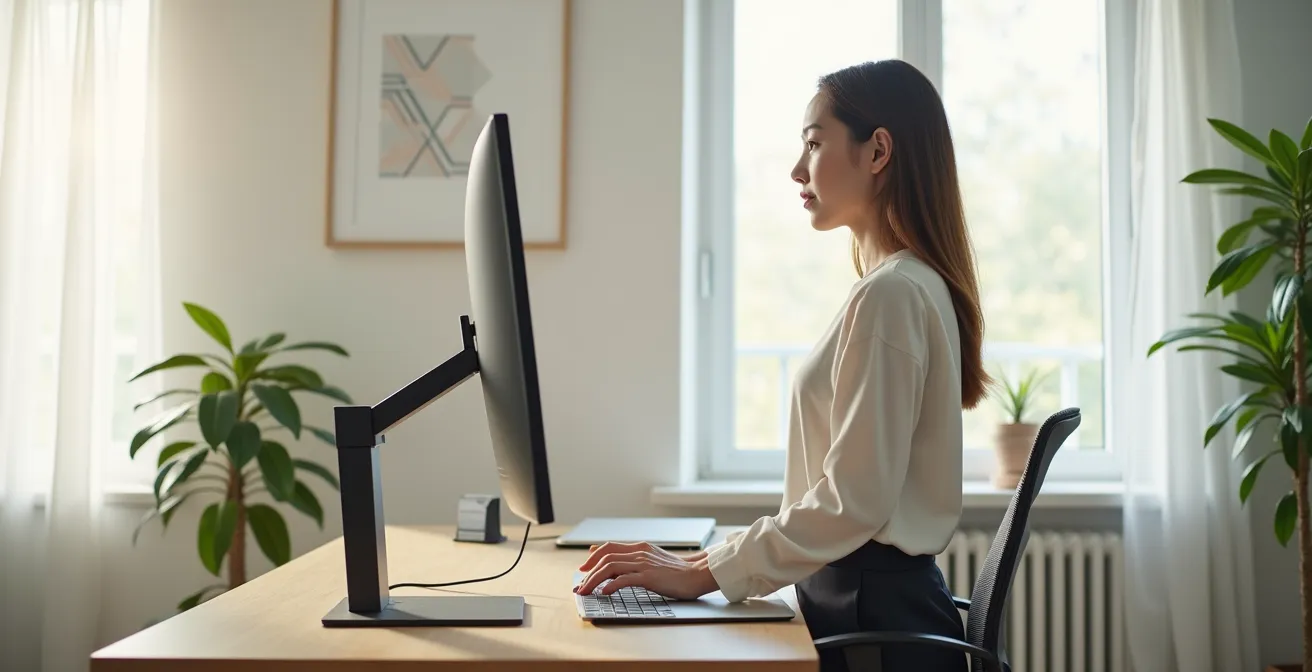
The chronic pain from “Tech Neck” is not just a muscle problem; it’s a systemic issue of accumulated ‘postural debt’ and neurological ‘sensory amnesia’ that cannot be solved by simple stretches alone.
- The key is not finding one “perfect” posture, but creating a ‘movement ecosystem’ that encourages frequent postural changes to prevent static load.
- Reversing the damage requires re-educating your body’s proprioceptive system through targeted micro-movements and reducing the friction for good habits.
Recommendation: Instead of focusing on “sitting up straight,” implement the 20-20-20 rule and choose one environmental trigger from this guide to begin resetting your body’s natural alignment today.
That persistent, nagging ache in your neck and shoulders after a long day at the desk is more than just a minor annoyance. It’s a physical signal that your body is accumulating a significant ‘postural debt.’ For many remote workers, the default advice—”just stretch more” or “buy an expensive chair”—provides only fleeting relief because it fails to address the root cause. These solutions are like patching a leaky roof without fixing the structural damage causing the leak. They treat the symptom, not the underlying dysfunction.
The truth, from a clinical perspective, is that “Tech Neck” is a complex biomechanical and neurological problem. Years of static, forward-head posture cause a kind of ‘sensory amnesia,’ where your brain and nervous system forget what a neutral, supported spine feels like. Your muscles, ligaments, and even your intervertebral discs adapt to this dysfunctional state. To achieve lasting relief without expensive interventions, we must move beyond simple stretches and fundamentally re-educate the body.
This guide offers a different approach. We won’t just give you a list of exercises. We will deconstruct the anatomical reasons behind your pain and provide a strategic plan to reverse it. By understanding the ‘why’—from the physics of head weight to the psychology of habit formation—you can re-engineer your workspace and your daily routines. This is about creating a holistic ‘movement ecosystem’ that works for your body, turning your desk from a source of pain into an environment that promotes health.
This article provides a structured, anatomical approach to understanding and resolving your pain. The following sections will guide you through the core principles, from the biomechanics of strain to practical, habit-forming strategies you can implement immediately.
Summary: How to Fix “Tech Neck” Pain Without Expensive Chiropractic Visits?
- Why Slouching Increases Feelings of Depression and Low Energy?
- How to Adjust Your Monitor Height to Prevent Chronic Cervical Strain?
- Standing Desk vs Ergonomic Chair: Which Is Better for lumbar Support?
- The Sitting Mistake That Compresses Your Discs After Age 40
- When to Stretch: The 20-20-20 Rule for Protecting Eyes and Spine
- The Physical Reason Your Back Hurts After 90 Minutes of Standing
- How Packing Your Gym Bag the Night Before Increases Attendance by 300%?
- How to Calculate Your Zone 2 Heart Rate Without a VO2 Max Test?
Why Slouching Increases Feelings of Depression and Low Energy?
The connection between your posture and your mood is not merely psychological; it’s deeply rooted in your anatomy and nervous system. When you slouch, with your head forward and shoulders rounded, you’re not just stressing your muscles. You’re sending a constant stream of negative feedback to your brain. This “postural feedback” can directly influence your emotional state and energy levels by affecting core physiological systems, including the vagus nerve, which plays a critical role in regulating heart rate, digestion, and mood.
A forward head posture can compress the thoracic region, inhibiting full, deep breaths. This shallow breathing pattern reduces oxygen intake and can trigger a low-grade stress response in the body, leading to feelings of anxiety and fatigue. The body and mind are a closed-loop system; a defeated posture signals defeat to the brain, which in turn reinforces feelings of lethargy and low motivation. As a clinical study highlights, the physical position itself can perpetuate a negative emotional cycle.
As the PMC Research Team noted in a study on the effects of forward head posture on brain function:
Subjects with slouched postures tended to be lethargic and had increased stress and depression.
– PMC Research Team, Effect of Forward Head Posture on Resting State Brain Function Study
Breaking this cycle requires a conscious effort to adopt more open, upright postures. This isn’t about vanity; it’s about resetting the communication between your body and brain. By improving your physical stance, you can directly influence your neurological and emotional baseline, leading to increased energy and a more positive outlook. This is the first step in paying off your accumulated postural debt.
How to Adjust Your Monitor Height to Prevent Chronic Cervical Strain?
The single most significant factor in “Tech Neck” is the position of your monitor. A screen that is too low forces you into a state of chronic cervical flexion, or forward head posture. From a biomechanical standpoint, this is a disaster for your spine. In a neutral position, the average adult head weighs about 10-12 pounds. However, the laws of physics dictate that this effective weight multiplies as your head moves forward and away from its center of gravity over the shoulders.
This isn’t a small increase; the biomechanics are unforgiving. It’s been shown that the effective weight on your spine increases by approximately 10 pounds for every inch your head moves forward. A mere two inches of forward posture—a common position for laptop users—means your neck muscles are struggling to support 40 pounds instead of 10. Over eight hours, this relentless strain leads to muscle fatigue, trigger points, and eventually, chronic pain and degenerative changes in the cervical discs.
To prevent this, the ergonomic rule is simple: the top of your monitor should be at or slightly below eye level. This encourages a neutral neck position where your ears are aligned with your shoulders. For laptop users, this is non-negotiable and requires an external keyboard and mouse, along with a laptop stand or a stack of books to elevate the screen. The goal is to bring the screen to you, not to collapse your posture down to the screen.
The table below, based on established biomechanical data, starkly illustrates how quickly the load on your cervical spine escalates. This is a clear visualization of the postural debt you accumulate with every inch of forward lean.
| Head Position | Angle | Effective Weight | Impact |
|---|---|---|---|
| Neutral | 0° | 10-12 lbs | Normal load |
| 1 inch forward | 15° | 27 lbs | 2.5x increase |
| 2 inches forward | 30° | 40 lbs | 4x increase |
| 3 inches forward | 45° | 49 lbs | 5x increase |
| 4 inches forward | 60° | 60 lbs | 6x increase |
Standing Desk vs Ergonomic Chair: Which Is Better for lumbar Support?
The debate between a standing desk and an ergonomic chair misses the fundamental point about spinal health. The question is not which single position is “best,” because the human body was not designed to remain static for long periods. The real enemy is stationariness. The most effective solution for lumbar support and overall spinal health is to create a movement ecosystem—an environment that encourages and facilitates frequent changes in posture throughout the day.
An ergonomic chair can provide excellent lumbar support, promoting the natural curve of the lower back. A standing desk can offload the pressure on the intervertebral discs and engage different muscle groups. However, staying in either position for too long leads to its own set of problems: static sitting compresses the spine, while static standing can lead to muscle fatigue and circulatory issues in the lower limbs. The key is alternation. The ideal setup allows you to seamlessly transition between sitting, standing, and even ‘perching’ (using a stool or saddle chair) every 30-60 minutes.
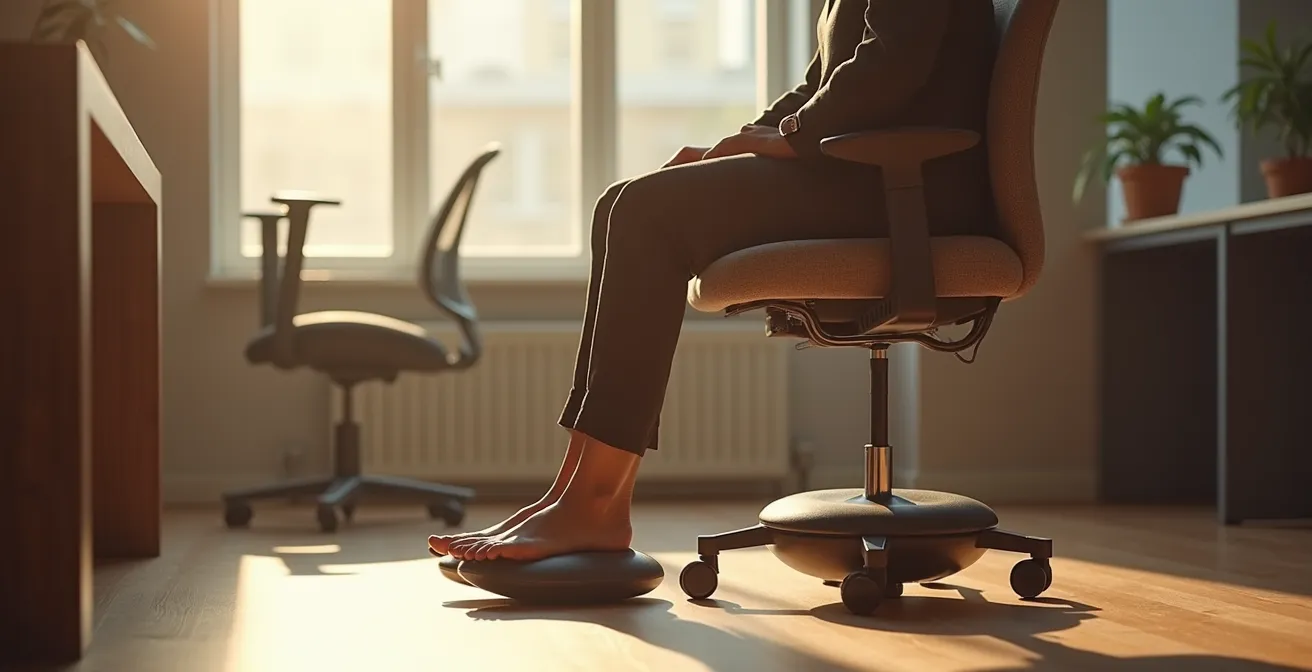
This concept of a dynamic work environment is supported by clinical findings. When workers are given the tools and encouragement to vary their posture, the benefits are significant. This approach moves beyond a single “correct” posture and embraces the body’s need for continuous, subtle adjustments, which is crucial for preventing the onset of sensory amnesia where the body forgets how to properly support itself.
Case Study: The Movement Ecosystem
To demonstrate this principle, OrthoCarolina conducted a study where office workers adopted a ‘Movement Ecosystem’ approach, alternating between sitting, standing, and perching every 30 minutes. After 12 weeks, this dynamic group reported remarkable outcomes compared to those who only sat or only stood. The results included a 65% reduction in lower back pain and a 40% improvement in self-reported energy levels, proving that variety, not a single perfect posture, is the key.
The Sitting Mistake That Compresses Your Discs After Age 40
One of the most pervasive—and damaging—myths of office ergonomics is the idea that you must sit perfectly upright at a 90-degree angle at all times. While well-intentioned, this rigid posture is difficult to maintain and can actually increase the compressive load on your lumbar intervertebral discs. As we age, our discs naturally lose some of their hydration and resilience, making them more susceptible to the cumulative stress of prolonged, static compression. The mistake is not sitting, but sitting statically and vertically.
From an anatomical perspective, a slightly reclined posture is far superior for offloading the spine. When you lean back slightly against a supportive backrest, you transfer a portion of your upper body weight from your spinal column to the chair. This simple act can dramatically reduce intradiscal pressure. Spine health research indicates that a 25 to 30-degree recline can reduce lumbar disc pressure by up to 50% compared to sitting bolt upright. This doesn’t mean slouching; it means using your chair as it was intended—as a supportive tool. Your feet should remain flat on the floor, and the lumbar support should fit snugly into the curve of your lower back.
In addition to optimizing your seated posture, it’s crucial to counteract the effects of compression with regular movement. The concept of spinal flossing or promoting disc hydration involves gentle, cyclical movements that act like a pump, encouraging the exchange of fluid and nutrients within the discs. This helps maintain their health and pliability. The following checklist provides a simple yet powerful routine to integrate into your daily schedule.
Action Plan: Spinal Flossing Technique for Disc Health
- Start in a tabletop position (on your hands and knees) with your spine in a neutral, straight line.
- Slowly arch your spine upward toward the ceiling (like a cat), tucking your chin to your chest. Hold for 5 seconds to feel a gentle stretch.
- Transition to the ‘cow’ pose by slowly dropping your belly toward the floor and gently lifting your head and tailbone. Hold for 5 seconds.
- Perform 10-15 repetitions of this cat-cow cycle, focusing on smooth, controlled movement. This should be done in the morning and evening.
- Follow up with seated pelvic rocks (gently tilting your pelvis forward and backward while sitting) to mobilize the sacroiliac joints.
When to Stretch: The 20-20-20 Rule for Protecting Eyes and Spine
The question of “when to stretch” is more important than “how to stretch.” Sporadic, intense stretching sessions cannot undo the damage of eight hours of continuous static posture. The key to protecting both your eyes and spine is frequency. Your body needs regular, small interruptions to reset its posture and relieve muscular and visual strain. This is where the 20-20-20 rule becomes an invaluable clinical tool.
The rule is simple and effective. As a leading spine health resource explains, it’s a powerful preventative habit. As NeuroSpine Center of Wisconsin’s Dr. David DeWitt advises in a recommendation for preventing text neck, “Every 20 minutes, take a 20-second break to look at something 20 feet away.” This simple action does two things simultaneously. First, it forces your eyes to change focus, reducing the risk of digital eye strain. Second, it serves as a non-negotiable trigger to break your static posture, even for a moment. It’s the perfect opportunity to stand up, roll your shoulders, or perform a gentle neck stretch.

Think of these short breaks not as interruptions, but as “movement snacks.” They are small, nourishing doses of movement that combat the sensory amnesia caused by sitting. A 20-second or even a 2-minute break is not about burning calories; it’s about waking up your proprioceptive system—the network of nerves that tells your brain where your body is in space. Performing a simple thoracic spine rotation, as shown above, can help decompress the spine and re-engage dormant postural muscles.
These micro-breaks are far more effective at preventing postural debt than one long break at the end of the day. Set a timer on your computer or phone to remind you. Consistency is the goal; making this a non-negotiable part of your workflow will yield significant long-term benefits for your entire musculoskeletal system.
The Physical Reason Your Back Hurts After 90 Minutes of Standing
While standing is a crucial part of a healthy movement ecosystem, prolonged static standing presents its own set of biomechanical challenges. After about 90 minutes of standing still, many people begin to experience a deep ache in their lower back. This pain is a direct result of two factors: muscle fatigue and a failure of your proprioceptive system.
When you stand still, your stabilizing muscles (like the transverse abdominis, glutes, and spinal erectors) are under constant isometric load. Over time, they fatigue. As they tire, they can no longer effectively support your pelvis and spine, often leading to an anterior pelvic tilt, where your lower back over-arches. This position increases the compressive forces on the facet joints of your lumbar spine, causing pain. Furthermore, static standing reduces blood flow to these working muscles, leading to an accumulation of metabolic waste products and further fatigue.
The solution is not to stop standing, but to introduce micro-movements. This is why anti-fatigue mats are so effective; their cushioned surface encourages your feet and legs to make constant, subconscious adjustments, shifting your weight and keeping muscles active. A 2024 workplace study found that users of anti-fatigue mats experienced 70% less lower back pain after 90 minutes, with pressure mapping showing 300% more weight shifting. To achieve this without a special mat, you can perform periodic “proprioceptive wake-up” drills. These are simple movements designed to re-engage your stabilizing muscles and remind your nervous system how to support your body efficiently.
Performing a quick sequence of single-leg balances, toe spreads, or gentle weight shifts can “reboot” your stabilizers, improve circulation, and prevent the onset of fatigue-related pain. The goal is to keep your neuromuscular system active and engaged, even while you are “standing still.”
How Packing Your Gym Bag the Night Before Increases Attendance by 300%?
The principle behind packing your gym bag the night before has little to do with the bag itself and everything to do with a powerful psychological concept: friction reduction. The title’s statistic, while perhaps specific to one context, illustrates a universal truth: the easier we make it to perform a desired action, the more likely we are to do it. This concept is directly applicable to correcting poor posture and fixing “Tech Neck.” Your goal is not to rely on willpower to “remember to sit straight,” but to engineer your environment so that good posture becomes the path of least resistance.
Instead of trying to force a new habit, you can “stack” it onto an existing one. This is a technique where you link a new, desired behavior to a routine you already perform without thinking. The key is to create an obvious environmental trigger. For example, as the Hinge Health Physical Therapy Team suggests for building a spinal health habit: “After I brush my teeth, I will do 3 wall angels.” Brushing your teeth is the trigger; the wall angels are the new habit. The connection becomes automatic over time.
You can apply this friction-reduction model throughout your workspace. Place your water bottle just out of comfortable reach, forcing you to rotate your torso to grab it. Set a standing desk preset that automatically raises your desk every hour. Place a small, brightly colored “stretch trigger” object on your phone stand, reminding you to do a neck stretch every time you pick up your device. These are not about discipline; they are about clever environmental design that makes the right choice the easy choice.
The following table contrasts the traditional, willpower-based approach with a friction-reduced, trigger-based system. The success rates highlight how engineering your environment is vastly more effective than relying on memory alone.
| Traditional Approach | Friction-Reduced Version | Success Rate |
|---|---|---|
| Remember to stretch | Phone stand triggers stretch when grabbing device | 85% compliance |
| Maintain good posture | Water bottle placement requires rotation | 73% improvement |
| Take regular breaks | Standing desk preset with timer | 91% adherence |
| Do neck exercises | Toothbrush holder with exercise card | 79% consistency |
Key takeaways
- “Tech Neck” is a systemic problem of ‘postural debt’ and ‘sensory amnesia’, not just a simple muscle ache.
- The solution is a dynamic ‘movement ecosystem’ that prioritizes frequent postural changes over finding a single “perfect” posture.
– Lasting change comes from building a system of micro-habits and environmental triggers that reduce the friction for good posture.
How to Calculate Your Zone 2 Heart Rate Without a VO2 Max Test?
While it may seem unrelated to neck pain, incorporating Zone 2 cardiovascular exercise is a powerful systemic strategy for improving your body’s resilience to static postures. Zone 2 training, performed at a low to moderate intensity, is exceptionally effective at improving mitochondrial function and increasing capillary density in muscle tissue. This means your muscles—including the postural muscles of your neck and back—get better at using oxygen and clearing out metabolic waste, dramatically improving their endurance and delaying the fatigue that leads to slouching.
You don’t need a lab or expensive equipment to find your Zone 2. The most practical and reliable method is the “Talk Test.” It’s a simple protocol that uses your breathing as a gauge for exercise intensity. The goal is to find a level of exertion where you are working hard enough to stimulate physiological adaptations but not so hard that you produce performance-inhibiting lactate.
This type of exercise complements the specific stretches and ergonomic adjustments discussed previously. While targeted exercises address the local issue, Zone 2 cardio improves the health of the entire system. Think of it as upgrading the engine that powers your postural muscles. Exercise physiology research confirms that just 20-30 minutes of Zone 2 cardio, performed 3-4 times per week, can yield significant improvements in tissue health and endurance.
Your Guide: The Talk Test Protocol for Zone 2 Training
- Begin walking, jogging, or cycling at a very comfortable, easy pace to warm up.
- After 5-10 minutes, increase your pace slightly and try to recite the alphabet or count to 20 out loud.
- If you can speak in full, comfortable sentences with only slight breathlessness at the end, you are likely in Zone 2. This is your target.
- A key indicator is being able to maintain nasal breathing only. If you find yourself needing to open your mouth to breathe, you have likely crossed into a higher intensity zone and should slow down.
- Once you find this pace, make a note of your heart rate (if you have a monitor) or the speed/resistance on the machine. This is your personal Zone 2 baseline for future sessions.
To begin reversing your postural debt and reclaiming your body from the strains of digital life, the most effective next step is to choose one strategy from this guide—whether it’s a movement snack, an environmental trigger, or a new habit stack—and implement it today. Consistency with one small change is more powerful than the intention to do everything at once.