
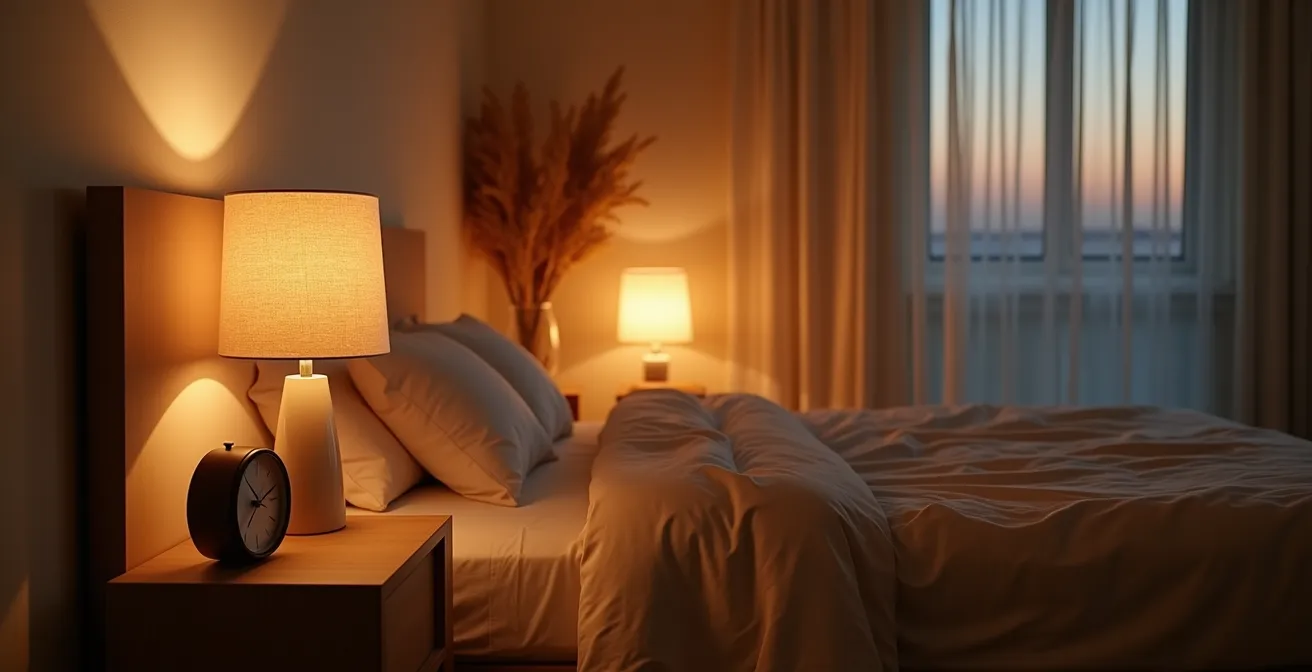
Engineering your bedroom for sleep isn’t about buying special bulbs; it’s about executing a “Circadian Shutdown Sequence” that systematically controls light intensity, color, and timing.
- Blue light suppression from screens is only half the problem; light intensity and cognitive arousal are equally disruptive.
- Room temperature and physical pressure from aids like weighted blankets are critical co-factors in signaling your body it’s time for rest.
Recommendation: Begin your shutdown sequence 90 minutes before your desired bedtime by systematically dimming all light sources to 50% or less.
You’ve followed the advice. You switched your phone to “night shift,” bought warm-colored bulbs, and drew the curtains, yet you’re still lying in bed, mind racing, sleep stubbornly out of reach. For those with a sensitive or disrupted circadian rhythm, this struggle is a nightly reality. The common knowledge about avoiding blue light is a valid starting point, but it’s often tragically insufficient because it overlooks the two most critical factors: light intensity and environmental sequencing.
True sleep readiness isn’t a switch you flip; it’s a gradual, physiological process. It requires more than just changing a light’s color; it demands a deliberate architectural approach to your entire sleep environment. Thinking like a Sleep Architect means moving beyond simple tips and creating a “sensory cocoon” that actively signals to your brain that the day is over and it’s safe to power down. The secret lies not in a single gadget, but in a carefully orchestrated “Circadian Shutdown Sequence.”
This guide provides the blueprint for that sequence. We will deconstruct the myths around screen time, explore the precise environmental triggers your body needs, and build a powerful routine that starts long before your head hits the pillow. We will cover the critical roles of temperature, pressure, and sound, and, most importantly, show you how to anchor your internal clock with a morning light routine that makes your evening shutdown almost automatic.
Summary: Your Blueprint for Engineering a Melatonin-Rich Sleep Environment
- Weighted Blanket vs Cooling Sheets: Which Aid Stops Nighttime Restlessness?
- The “Night Shift” Mode Myth: Why Phone Screens Still Keep You Awake?
- Deep Sleep vs REM: Which Stage Repairs Physical Exhaustion?
- Why 18°C (65°F) Is the Scientifically Perfect Temperature for Hibernation?
- White Noise vs Pink Noise: Which Sound Frequency Masks Traffic Better?
- Why Doomscrolling at Night Destroys Your Deep Sleep Quality?
- The “Phone in Bathroom” Trick That Forces You Out of Bed Immediately
- How to Build a Morning Routine That Survives a chaotic Household?
Weighted Blanket vs Cooling Sheets: Which Aid Stops Nighttime Restlessness?
Before we even address lighting, it’s crucial to architect the physical sensations of your bed. Your skin is your largest organ, and the signals it sends to your brain—pressure and temperature—are powerful hormonal triggers. While many focus on cooling sheets to combat overheating, a weighted blanket addresses a different, more profound need: the regulation of your nervous system. This is achieved through Deep Pressure Stimulation (DPS), a gentle, constant pressure that has a calming effect similar to a hug.
This isn’t just a feeling of comfort; it has a direct biochemical impact. A fascinating 2022 study found a 32% higher melatonin increase in participants using a weighted blanket compared to a light one. This suggests that DPS helps switch the body from a “fight or flight” sympathetic state to a “rest and digest” parasympathetic state, creating the ideal hormonal environment for sleep. A blanket weighing roughly 10-12% of your body weight is typically recommended to achieve this effect without causing discomfort or restricting movement.
The choice isn’t necessarily “either/or.” The optimal solution is often a combination. Using moisture-wicking cooling sheets made from bamboo or Tencel under a weighted blanket creates a perfect sensory paradox: the calming, secure pressure you need, without the thermal stress that can disrupt sleep. This pairing addresses both nervous system arousal and temperature regulation, tackling two major sources of nighttime restlessness simultaneously.
The “Night Shift” Mode Myth: Why Phone Screens Still Keep You Awake?
One of the most persistent myths in modern sleep hygiene is that activating your phone’s “night shift” or “warm light” mode makes it safe for evening use. While reducing blue light is marginally better than not doing so, it ignores a more potent sleep disruptor: light intensity. Your brain’s melatonin-producing pineal gland is incredibly sensitive not just to the color (wavelength) of light, but to its sheer brightness (luminance). A phone screen, held close to your face, is an intensely bright light source in a dark room, regardless of its color temperature.
This phenomenon is governed by the inverse-square law of light. The intensity of light is inversely proportional to the square of the distance from the source. This means a phone held one foot from your face is exponentially brighter and more disruptive than a dim lamp across the room. Research from sleep scientist Dr. Matthew Walker has shown that just two hours of iPad use before bed, even with reduced blue light, can result in a significant 20% reduction in melatonin levels. This is what we call light contamination—a concentrated dose of light that directly sabotages your body’s preparation for sleep.
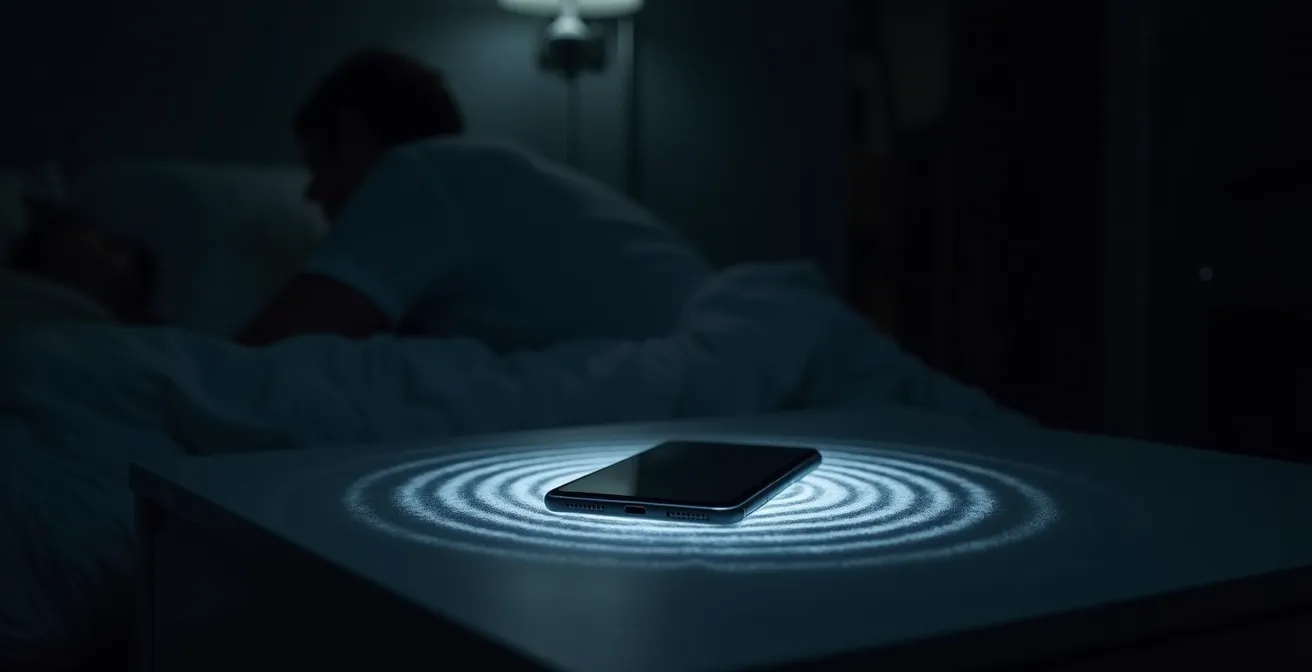
As the illustration demonstrates, even indirect light from a screen placed face-down can pollute a dark environment. The glow from notifications or charging indicators creates a subtle but constant signal to your brain that it is not yet time to sleep. Architecting your sleep environment means eliminating these sources entirely. The only “safe” way to use a screen at night is to not use it at all in the 90 minutes leading up to bedtime.
Deep Sleep vs REM: Which Stage Repairs Physical Exhaustion?
To understand why protecting your evenings from light is so critical, we need to look at what’s at stake: the very architecture of your sleep. Sleep is not a monolithic state; it’s a dynamic cycle through different stages, each with a unique restorative purpose. Light exposure at night doesn’t just make it harder to fall asleep; it actively degrades the quality of the most crucial stages. As the Sleep Foundation notes, this interference can be profound.
Light exposure at night can hinder transitions between sleep cycles, reducing the quality of sleep. Too much light can cause repeated awakenings, interrupting the sleep cycle and reducing time spent in deeper, more restorative sleep stages.
– Sleep Foundation, Light & Sleep: Effects on Sleep Quality
The two most vital stages for recovery are NREM Stage 3 (Deep Sleep) and REM Sleep. Deep Sleep is the phase of physical restoration. During this time, your body releases growth hormone, repairs tissues, and consolidates declarative memories (facts and knowledge). This is the stage that alleviates physical exhaustion. In contrast, REM sleep is for mental and emotional restoration, where the brain processes emotions and consolidates procedural memories (skills). Both are essential, but they are uniquely vulnerable to light contamination.
Evening light exposure, particularly from screens, has been shown to be most damaging to Deep Sleep, reducing its duration and delaying its onset. This directly impairs your body’s ability to physically repair itself from the day’s wear and tear. The following table breaks down this impact.
| Sleep Stage | Primary Function | Light Exposure Impact |
|---|---|---|
| NREM Stage 3 (Deep Sleep) | Physical repair, growth hormone release | Most vulnerable to evening light, reduced duration |
| REM Sleep | Memory consolidation, emotional processing | Delayed onset, fragmented episodes |
Why 18°C (65°F) Is the Scientifically Perfect Temperature for Hibernation?
Just as darkness signals your brain to produce melatonin, a drop in core body temperature is another primary trigger for initiating sleep. To fall asleep and stay asleep, your body needs to lower its core temperature by about 1-2 degrees Celsius (2-3 degrees Fahrenheit). Setting your bedroom thermostat to the right temperature range doesn’t just create a comfortable environment; it facilitates this crucial physiological process. For this reason, sleep researchers recommend maintaining bedroom temperature between 60-67°F (15-19°C).
An ambient temperature of around 18°C (65°F) is considered the sweet spot. A room that is too hot forces your body to work harder to shed heat, leading to restlessness and fragmented sleep. A room that is too cold can also be disruptive. The goal is to create a cool environment that allows your body to effortlessly reach its ideal sleep temperature. This temperature drop is a cornerstone of the “Circadian Shutdown Sequence,” a deliberate, step-by-step process to prepare your body for deep rest.
This sequence integrates lighting, temperature, and behavior to create an unmistakable signal for sleep. It’s not about doing one thing right, but about orchestrating a series of environmental cues in the correct order. Below is a practical checklist to implement your own shutdown sequence, starting 90 minutes before your desired bedtime.
Your Action Plan: The Circadian Shutdown Sequence
- 90 minutes before bed: Begin your wind-down by dimming all ambient lights in your living space from standard brightness down to 50%.
- 60 minutes before bed: Switch off all overhead cool-toned lights and use only warm-colored bulbs (2700K or lower) from lamps below eye level.
- 45 minutes before bed: Lower your bedroom thermostat into the target range of 65-68°F (18-20°C) to initiate the pre-sleep temperature drop.
- 30 minutes before bed: Power down all screens (TV, phone, tablet) and switch to using only dim amber or red night lights for any necessary illumination.
- At bedtime: Ensure your bedroom is in complete darkness, using blackout curtains or an eye mask to eliminate any residual light contamination.
White Noise vs Pink Noise: Which Sound Frequency Masks Traffic Better?
Creating a true sensory cocoon involves managing not just light, but also sound. Unexpected noises—a passing truck, a neighbor’s door slamming—can easily pull you out of deeper sleep stages. Sound masking is the strategy of using a constant, ambient sound to cover up these jarring interruptions. The two most common options are white noise and pink noise, and the best choice depends on the type of sound you need to mask.
White noise contains all audible frequencies at equal intensity. Think of the static from an old television or a running fan. Because of its broad, high-frequency energy, it’s exceptionally good at masking sharp, high-pitched sounds like voices or alarms. However, some people find its hissing quality to be harsh or fatiguing over a full night.
Pink noise is a more balanced alternative. It also contains all frequencies, but the intensity decreases as the frequency increases. This results in a sound that is deeper and more natural, often compared to the sound of steady rain or rushing wind. Because it has more power in the lower frequencies, pink noise is particularly effective at masking low-rumble sounds like traffic or the hum of an air conditioner. For most urban and suburban environments, pink noise provides a more soothing and effective shield against common disturbances, wrapping the bedroom in a blanket of consistent, unobtrusive sound.
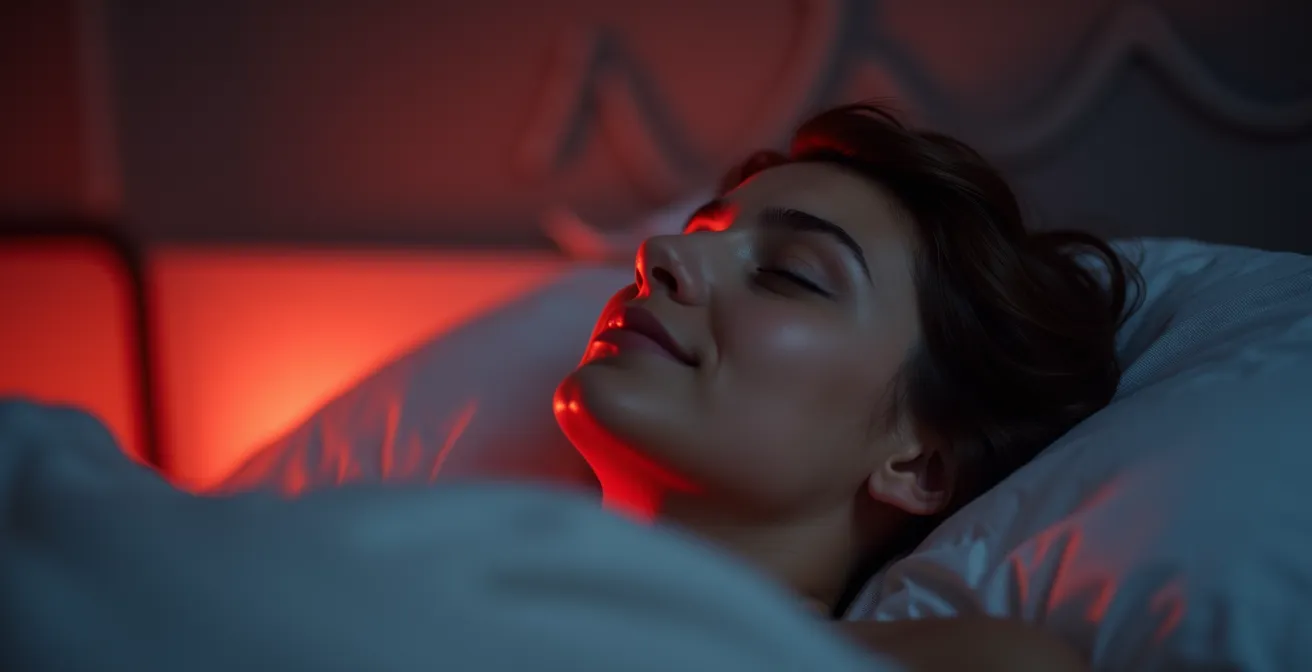
Combining the right sound frequency with the minimal red ambient lighting from your shutdown sequence completes the sensory cocoon. This environment sends a clear, consistent message to your brain: there are no threats, no interruptions, and it is safe to enter the deepest stages of restorative sleep.
Why Doomscrolling at Night Destroys Your Deep Sleep Quality?
The negative impact of using your phone at night goes far beyond the biological effects of blue light. The very act of “doomscrolling”—the compulsive consumption of negative news and anxiety-inducing content—creates what can be described as a hormonal vise on your brain. On one side, the light from the screen is actively suppressing your melatonin production. On the other, the stressful content is triggering the release of cortisol and adrenaline, your body’s primary stress hormones.
These two forces work in direct opposition. Melatonin is the “go to sleep” signal, while cortisol is the “wake up and handle a threat” signal. When both are active, your body is trapped in a state of wired-and-tired cognitive dissonance, making deep, restorative sleep physiologically impossible. The psychological toll is significant; a 2022 NIH study found adolescents who doomscroll over 4 hours daily show a 258% higher risk of stress disorders. This highlights that the content you consume is as disruptive as the light emitting it.
This is why simply switching to a “warmer” screen tone or reading an e-book can still be detrimental. Even if the content is neutral, the cognitive engagement required keeps your brain in an active, alert state. Architecting your sleep requires not just an environmental shutdown, but a cognitive shutdown as well. Replacing screen time with non-stimulating activities like reading a physical book under a dim red light, light stretching, or listening to calm music is essential to release the pressure from the hormonal vise and allow melatonin to do its job unimpeded.
Key takeaways
- Melatonin production depends on a “Circadian Shutdown Sequence” starting 90 mins before bed, controlling light intensity, color, and temperature.
- Screen “night modes” are insufficient; the intensity of light and cognitive stimulation from content are equally disruptive to sleep.
- Anchoring your circadian rhythm with bright light exposure within the first hour of waking is as crucial as managing darkness at night.
The “Phone in Bathroom” Trick That Forces You Out of Bed Immediately
The effectiveness of your evening shutdown sequence is directly tied to the strength of your morning wake-up signal. Your circadian rhythm is a 24-hour cycle; what you do in the first hour of your day sets the stage for the last. The single most powerful signal for anchoring your internal clock is exposure to bright light shortly after waking. This signal shuts off melatonin production for the day and starts the countdown timer for its release again approximately 14-16 hours later.
As experts at Harvard Health Publishing emphasize, this is a fundamental aspect of sleep health.
Expose yourself to lots of bright light during the day, which will boost your ability to sleep at night, as well as your mood and alertness during daylight.
– Harvard Health Publishing, Blue light has a dark side
The “phone in the bathroom” trick is a simple but powerful piece of behavioral architecture that leverages this principle. By charging your phone in the bathroom overnight instead of on your nightstand, you accomplish two things. First, you are physically forced to get out of bed to turn off your morning alarm, preventing the “snooze button” cycle that fragments your sleep-wake transition. Second, and more importantly, it places you in a room where you can immediately expose yourself to bright light. Flipping on bright bathroom lights while you brush your teeth sends that crucial “it’s morning” signal to your brain, kickstarting your day and solidifying your circadian rhythm.
To maximize this effect, you should aim for at least 30 minutes of light exposure within the first two hours of waking. This can be achieved by installing bright, daylight-replicating bulbs (5000K-6500K) in your bathroom, eating breakfast near a window, or taking a short morning walk outside. This deliberate act of “light anchoring” makes your entire system more receptive to the darkness cues you’ll provide in the evening.
How to Build a Morning Routine That Survives a chaotic Household?
The principle of morning light anchoring is clear, but implementing it in a chaotic household can feel impossible. The key is to integrate light exposure into activities you already do, rather than trying to add a new, time-consuming step. It’s about finding practical, portable, or passive solutions that fit your life. You don’t need to sit perfectly still in front of a window for 30 minutes; you need to weave light into the fabric of your morning rush.
For those with very little time, a stationary 10,000 lux SAD lamp placed on the breakfast table can deliver a powerful dose of light in just 10-15 minutes while you eat or drink your coffee. For individuals who need to be mobile—perhaps getting kids ready or moving around the house—light therapy glasses are a brilliant solution. While lower in intensity (typically 500-1500 lux), they provide a consistent signal directly to your eyes while you go about your morning tasks. They are a perfect example of adaptive sleep architecture.
However, no technology can fully replicate the full-spectrum benefits of natural sunlight. If at all possible, the most effective solution is a short 15-20 minute outdoor morning walk. This combines bright light exposure with light physical activity, both of which are powerful zeitgebers (external cues that align our internal clocks). Even on a cloudy day, the intensity of outdoor light is far greater than indoor lighting. If a walk isn’t feasible, simply positioning yourself near a window for key morning activities can make a substantial difference. By choosing the right tool for your specific circumstances, you can build a resilient morning routine that survives the chaos and provides the strong circadian anchor needed for a restful night.
Your journey to restorative sleep begins not when your head hits the pillow, but 90 minutes before. Start architecting your personal sensory cocoon tonight by implementing just one step from the Circadian Shutdown Sequence. By taking deliberate control of your environment, you signal to your body that rest is not just a hope, but an inevitability.
Frequently Asked Questions About Melatonin and Your Environment
What hormones does doomscrolling affect?
Doomscrolling increases cortisol and adrenaline (stress hormones) while suppressing melatonin production due to blue light exposure, creating a ‘hormonal vise’ that makes deep sleep physiologically impossible.
How long before bed should I stop scrolling?
The National Sleep Foundation recommends avoiding screens for at least 1 hour before bed, though some studies suggest 2-3 hours provides better melatonin recovery.
Can night mode really help?
Night mode only partially addresses the biological impact. The cognitive stimulation from anxiogenic content continues to elevate stress hormones regardless of screen color temperature.