
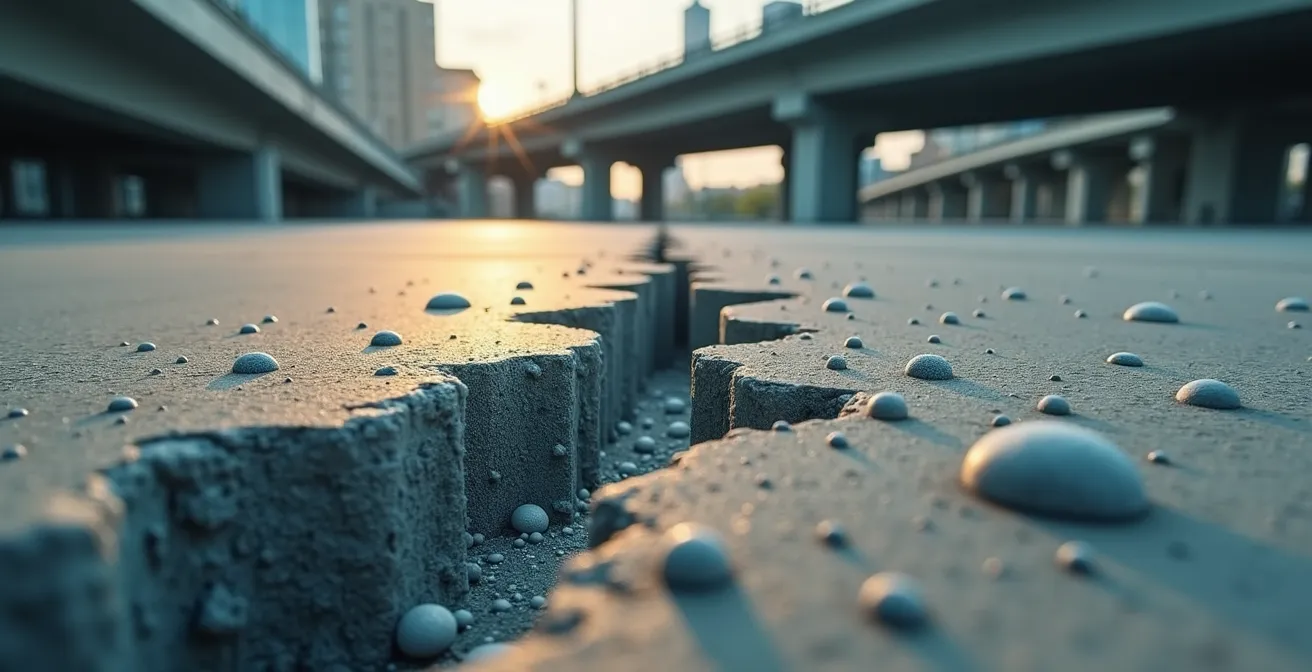
Self-healing concrete isn’t just about filling cracks; it’s a fundamental shift away from designing for strength towards designing for resilience.
- This technology embeds dormant bacteria within the concrete matrix that activate upon damage to produce limestone, effectively healing the structure from within.
- It promises massive reductions in both the lifecycle maintenance costs of infrastructure and the at least 8% of global CO2 emissions caused by the cement industry.
Recommendation: Evaluate new materials not just on initial performance, but on their entire lifecycle, including their “structural metabolism” and ability to self-repair.
The image is a familiar one: a crack spidering across a concrete bridge, a pothole forming on a busy highway. For centuries, our approach to infrastructure has been a battle against decay, a constant cycle of patching and replacing materials designed to be strong, but which are ultimately inert and brittle. We have engineered ever-stronger formulas, reinforced them with steel, and coated them with protective layers, all in an effort to delay the inevitable. This approach treats structures as static objects that begin to degrade the moment they are built.
But what if concrete could heal itself, much like a living organism repairs a wound? This is not science fiction; it represents a paradigm shift in materials science. We are moving away from an obsession with brute strength and towards the design of intelligent, resilient systems. This revolution is powered by biology, embedding microscopic life into our most foundational building material to grant it a form of structural metabolism. The goal is no longer to build things that are unbreakable, but to create infrastructure that is self-repairable, fundamentally changing our definitions of longevity, safety, and sustainability.
This article explores the principles and implications of this bio-integrated material. We will deconstruct the science behind self-healing concrete, compare its design philosophy to other advanced materials, and analyze the economic and environmental transformations it promises. By understanding this technology, we can glimpse a future where our infrastructure doesn’t just stand, but lives.
Summary: The Blueprint for Living Infrastructure
- Biomimicry: How Shark Skin Inspired Antibacterial Hospital Surfaces?
- Nano-Coatings: Can We Really Make Phones 100% Waterproof Without Seals?
- Graphene vs Carbon Fiber: Which Material Will Revolutionize Electric Cars?
- The Asbestos of the Future: Are Carbon Nanotubes Dangerous to Inhale?
- Lab to Market: Why Graphene Batteries Are Always “5 Years Away”?
- Why Polyester Garments degrade After 20 Washes Compared to Natural Fibers?
- The Toxic Waste Myth: What Happens to Panels After 25 Years?
- Solar Panels in 2024: How Long Until You Break Even on Installation Costs?
Biomimicry: How Shark Skin Inspired Antibacterial Hospital Surfaces?
For decades, materials science has looked to nature for inspiration, a practice known as biomimicry. The development of antibacterial surfaces modeled on the unique, microscopic pattern of shark skin is a prime example. This surface, called Sharklet, doesn’t kill bacteria with chemicals but prevents them from attaching and forming biofilms through its specific topology. This is a brilliant, passive design—copying a natural form to achieve a function. However, it represents only the first level of learning from biology: imitation.
Self-healing concrete takes this concept to a revolutionary new level: bio-integration. Instead of merely copying a static natural structure, it incorporates a dynamic, living system directly into the inorganic matrix. Early research focused on this very distinction. For instance, the University of Bath’s pioneering work utilized psychrotrophic bacteria—organisms that thrive in cold temperatures—isolated from limestone caves. These bacteria are not a passive surface pattern; they are living agents held in a state of engineered dormancy within the concrete. When a crack forms and water seeps in, the bacteria “awaken” and begin their metabolic process, consuming a calcium lactate food source and precipitating calcite (limestone) to seal the fissure.
This leap from passive imitation to active integration is the core of the self-healing revolution. We are no longer just building *like* nature; we are building *with* nature. It redefines a material from a fixed object to an adaptive system with the innate ability to maintain its own structural integrity. This is the foundational principle that separates living concrete from all materials that have come before it.
Nano-Coatings: Can We Really Make Phones 100% Waterproof Without Seals?
Another approach to extending a material’s life is to create an impermeable shield against environmental damage. The quest for waterproof electronics through hydrophobic nano-coatings perfectly illustrates this “protection” philosophy. These ultra-thin layers create a surface where water beads up and rolls off, preventing ingress without the need for bulky physical seals. This strategy is highly effective for preventing damage from external threats, acting as the first line of defense.
This protectionist model can be combined with the restorative model of self-healing concrete to create a “defense-in-depth” strategy for infrastructure. Imagine a structure where the outer surface is treated with a hydrophobic nano-coating to repel water, while the concrete matrix itself contains the bio-integrated healing system. The coating handles everyday weathering, while the bacteria stand ready to repair any deeper cracks that may form due to stress or impact. This layered approach dramatically enhances resilience and longevity, leading to significant economic benefits. In fact, it’s estimated that self-healing concrete could save up to 50% in lifetime maintenance costs for a structure.
This layered resilience model is a powerful concept for future construction, combining preventative and curative systems. The image below visualizes these distinct layers of protection and repair.
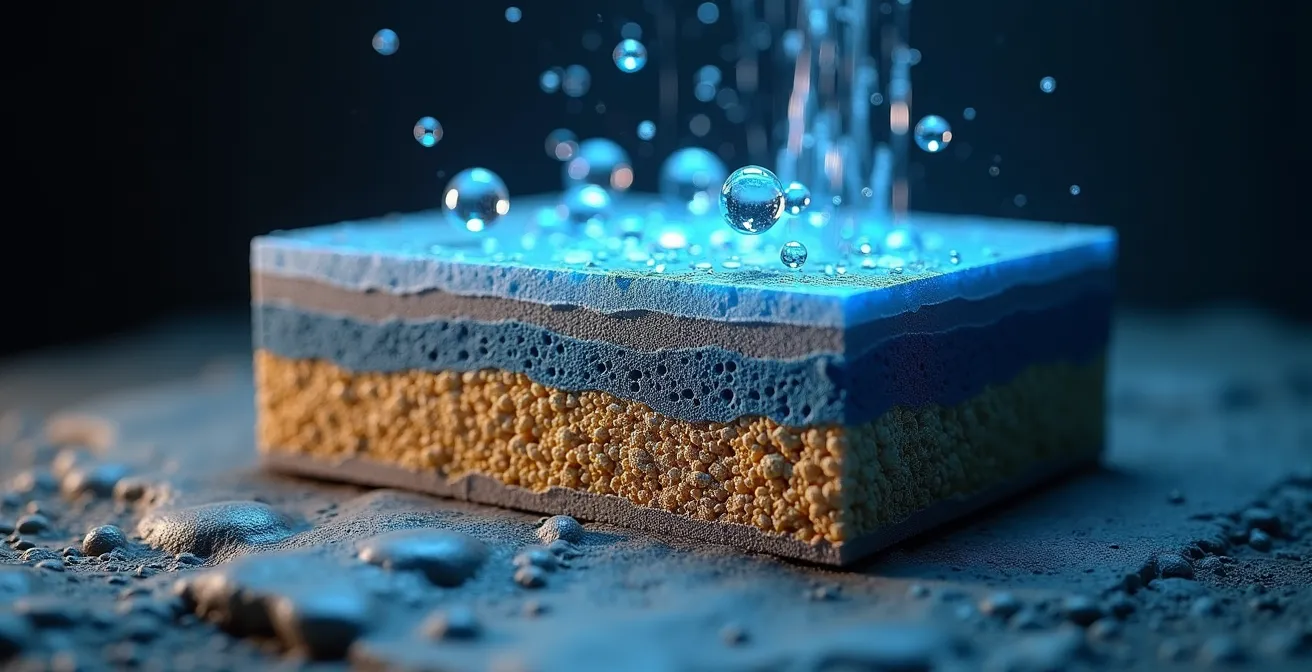
As this visualization shows, the outer coating acts as a barrier, but the true innovation lies in the active healing potential embedded within. This addresses a core limitation of traditional materials: damage is inevitable. Dr. Richard Barnes of The Concrete Society notes, “Concrete very rarely crumbles when it encounters water, wind or stress within its design capability.” The problem is that structures often face stresses *beyond* their initial design capability. A protection-only approach fails at this point; a self-healing system activates.
Graphene vs Carbon Fiber: Which Material Will Revolutionize Electric Cars?
The 20th-century paradigm of material science was dominated by the pursuit of ultimate performance metrics, primarily strength-to-weight ratio. Graphene and carbon fiber are the modern apotheosis of this philosophy. Carbon fiber composites revolutionized aerospace and high-performance vehicles by offering steel-like strength at a fraction of the weight. Graphene, a single-atom-thick sheet of carbon, promises to push this even further, with research showing dramatic increases in the strength of composite materials. These are “super materials” designed to resist failure through sheer force.
This “brute strength” approach, however, has a fundamental weakness: when these materials do fail, the failure is often catastrophic and irreparable. A hairline crack in a carbon fiber component can compromise its integrity entirely, requiring full replacement. Self-healing concrete offers a completely different, and arguably more mature, design philosophy. It accepts that damage is a natural part of a structure’s lifecycle and focuses on resilience over raw resistance.
Instead of preventing cracks at all costs, it manages them. The value is not in being unbreakable, but in being endlessly mendable. This shift is profound. It moves engineering from a static mindset (designing an object for peak performance at year zero) to a dynamic one (designing a system for optimal performance over a century). Graphene might make a car body lighter and stronger, but self-healing technology could allow a bridge to manage its own age-related wear and tear, extending its safe, usable life for decades.
The Asbestos of the Future: Are Carbon Nanotubes Dangerous to Inhale?
With every material innovation comes a necessary period of scrutiny regarding its long-term safety and environmental impact. The tragic legacy of asbestos, once hailed as a miracle material, serves as a stark reminder. Today, similar questions are rightly being asked about carbon nanotubes, whose needle-like shape raises concerns about potential respiratory damage if inhaled. This highlights a crucial challenge for materials scientists: innovation must be paired with rigorous lifecycle assessment.
The concept of embedding living bacteria in concrete naturally invites similar questions. Are the bacteria safe? What happens at the end of the structure’s life? The bacteria used, such as species of *Bacillus*, are non-pathogenic and commonly found in soil. Their viability is a more pressing technical challenge than a biological hazard. The bacteria are encapsulated and only activate in specific conditions (the presence of water and oxygen in a crack). A critical question is how long they can remain dormant. According to calculations from early studies, approximately 9-14% of the bacterial colonies were still alive after 30 days of concrete curing, demonstrating the challenge of ensuring long-term viability.
Visualizing the entire lifecycle is key to addressing these environmental concerns, from production to eventual demolition and recycling.
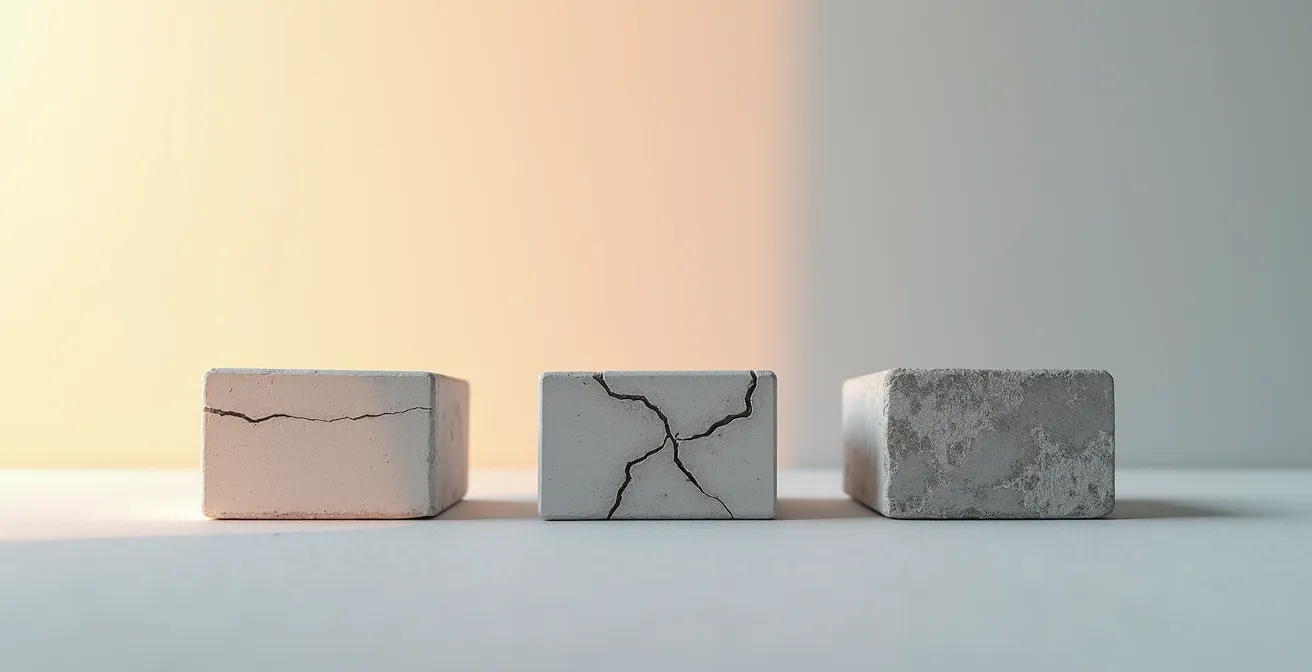
Unlike some synthetic nanomaterials that pose disposal challenges, the components of self-healing concrete—calcite, bacteria, and the concrete itself—are fundamentally earth-based. This opens up possibilities for a more circular economy, where the material is not just a waste product at the end of its life, but a resource for the future. The focus is on creating a system that is not just resilient in use, but also benign in its overall environmental footprint.
Lab to Market: Why Graphene Batteries Are Always “5 Years Away”?
The journey from a laboratory breakthrough to a commercially viable product is often called the “valley of death,” and few materials illustrate this better than graphene. For years, we’ve heard that graphene batteries, with their promise of ultra-fast charging and massive capacity, are just “five years away.” This recurring timeline highlights the immense hurdles of scaling production, reducing costs, and convincing established industries to adopt a new technology. Self-healing concrete faces a similar, though perhaps less steep, path.
The primary barrier is initial cost. Self-healing concrete is more expensive to produce than its traditional counterpart. However, its proponents argue this is a short-sighted view that ignores the total cost of ownership. The value proposition is not in the upfront price but in the drastic reduction of long-term maintenance, repair, and replacement costs. As one of the leaders at the Dutch startup Green Basilisk stated about their mission:
Despite the higher initial cost of self-healing concrete, Green Basilisk is working to convince the industry that the long-term savings in maintenance are well worth the expense.
– der Woerd, Green Basilisk
This educational effort is crucial for market adoption. While the technology proves itself in niche applications, market confidence is growing, reflected in significant economic forecasts. Projections indicate the global self-healing concrete market is predicted to reach approximately $1,376.31 billion by 2034. This suggests that, unlike some ” perpetually five years away” technologies, self-healing concrete is steadily crossing the valley from lab to market.
Why Polyester Garments degrade After 20 Washes Compared to Natural Fibers?
The way a material fails is just as important as how it performs. A polyester shirt that suddenly tears or loses its shape after a certain number of washes exhibits what engineers call “catastrophic degradation.” It functions perfectly up to a threshold, then fails rapidly. In contrast, a linen or wool garment undergoes “graceful degradation,” slowly wearing down while remaining functional. Traditional concrete also fails in a brittle, often sudden, manner.
Self-healing concrete introduces a third, revolutionary category: active regeneration. It doesn’t just degrade gracefully; it actively counteracts degradation. By repairing micro-cracks before they can propagate into larger structural failures, it fundamentally alters the material’s aging process. The embedded bacteria can theoretically remain viable for decades, with some estimates suggesting the concrete’s service life could be extended significantly. This moves beyond simply slowing down decay to creating a state of managed equilibrium, a true “structural metabolism.”
Understanding these different responses to stress is crucial for selecting the right material for any application. An audit of a material’s failure mode can reveal its true suitability and long-term resilience. The following checklist provides a framework for this analysis.
Action Plan: Auditing a Material’s Response to Stress
- Graceful Degradation: Identify materials that wear down predictably while maintaining core function (e.g., natural fibers, wood). Are there signs of gradual wear?
- Brittle Failure: Pinpoint materials that fail suddenly and completely under stress once a threshold is exceeded (e.g., traditional concrete, glass). What is the critical failure point?
- Catastrophic Degradation: Inventory materials that lose structural integrity rapidly after a period of stable performance (e.g., certain polymers like polyester). What triggers the rapid decline?
- Active Regeneration: Assess if the material has an inherent mechanism to repair damage and restore functionality (e.g., self-healing concrete). How is this mechanism activated and what are its limits?
- Lifecycle Integration: Based on the failure mode, devise a maintenance and end-of-life plan that anticipates how the material will age and degrade.
By designing with active regeneration in mind, we can create structures that are not only more durable but also vastly safer, as they can pre-emptively fix the small flaws that lead to catastrophic failures.
The Toxic Waste Myth: What Happens to Panels After 25 Years?
The success of any “green” technology is ultimately judged by its full lifecycle, including its end-of-life impact. For solar panels, a vibrant debate is underway about recycling the millions of panels that will be decommissioned in the coming decades. This focus on the circular economy is vital. For self-healing concrete, the end-of-life scenario presents not a problem, but an opportunity. The concrete industry is a massive contributor to global CO2 emissions, and any innovation must also address this legacy.
Self-healing concrete tackles this in two ways. First, by extending the lifespan of structures, it drastically reduces the need for demolition and new construction, thereby lowering future emissions. Second, and more radically, it opens the door to creating a new type of circular resource. At the end of a building’s life, the demolished bacterial concrete could potentially be processed and reused as a “bio-aggregate” for new construction, seeding the next generation of structures with healing potential.
Case Study: Aizawa Concrete’s Bio-Aggregate Vision
The Aizawa Concrete Corporation in Japan has successfully commercialized a form of self-healing concrete tailored to the country’s environment. Beyond immediate use, their vision aligns with a circular economy model. Their work is attracting attention as a method to reduce the construction industry’s carbon footprint, with one of the most exciting long-term prospects being the ability to recycle demolished self-healing concrete into a valuable bio-aggregate, creating a closed-loop system for building materials.
This vision of a circular, self-sustaining material lifecycle is a powerful counterpoint to the linear “take, make, dispose” model that has dominated manufacturing for centuries. It suggests that our buildings could become part of a continuously regenerating ecosystem, rather than future landfill.
Key Takeaways
- The core innovation of self-healing concrete is the shift from passive biomimicry (copying nature’s forms) to active bio-integration (embedding living systems).
- Its true value lies not in initial strength but in lifecycle cost reduction and enhanced resilience, a concept known as the “resilience dividend.”
- This technology is a cornerstone of a future circular economy for construction, with the potential to significantly reduce CO2 emissions and create recyclable “bio-aggregates.”
Solar Panels in 2024: How Long Until You Break Even on Installation Costs?
When evaluating a technology like solar panels, the primary question is often about the return on investment (ROI): how many years until the energy savings pay for the initial installation cost? This is a straightforward financial calculation. However, applying a simple break-even analysis to self-healing concrete misses its most profound value. Its ROI isn’t just financial; it’s structural.
The true benefit is the “resilience dividend”—the value of preventing a catastrophic failure that is difficult to quantify until it’s too late. While traditional concrete may be cheaper upfront, its failure can lead to astronomical costs in emergency repairs, economic disruption, and, in the worst cases, loss of life. Self-healing concrete is an insurance policy written into the very fabric of a structure. Its constant, low-level repair of micro-damage prevents the large-scale failures that ground transportation or compromise buildings.
A comparative model helps to illustrate these differing value propositions. While solar panels provide a return by generating a commodity (energy), self-healing concrete provides a return by preserving an asset and mitigating systemic risk.
| Investment Metric | Solar Panels | Self-Healing Concrete |
|---|---|---|
| Initial Cost Premium | 100-200% vs grid electricity | 25-30% vs traditional concrete |
| Break-even Point | 5-10 years | 20 years |
| Lifetime Savings | Energy generation revenue | 80% reduction in maintenance |
| Resilience Dividend | Energy independence | Catastrophic failure prevention |
This framework shows that while the simple financial break-even point for self-healing concrete may be longer, its total value, including the prevention of high-cost, low-probability disasters, is immense. It forces us to redefine ROI from a simple cost calculation to a holistic assessment of long-term resilience.
The next era of engineering begins not with stronger materials, but with smarter ones. It is time for engineers, architects, and policymakers to start designing infrastructure that doesn’t just stand, but lives, by evaluating materials based on their entire lifecycle and their innate ability to endure.